
Quick Take
- One blackbird species has outsmarted every other bird parent by never raising its own chicks, and it hides in plain sight at your backyard feeder. Meet the brood parasite →
- Red-winged blackbird flocks can reach a size that's almost impossible to picture, and once you hear the number, it will stop you cold. See the flock numbers →
- Not every bird in this article is actually all-black, and that contradiction is the whole point. Spot the non-black blackbird →
- One species on this list lives almost nowhere else on Earth, and its survival now depends on a habitat it never evolved to use. California's endangered specialist →
True “blackbirds” belong to the family Icteridae. They are often called New World blackbirds, as they are native to the Americas. There are over 100 blackbird species, with 23 living in North America. While these birds are blackbirds when it comes to taxonomy, they are not all black in color. In today’s article, we’re going to focus on true blackbirds that are also black birds. Read on to learn more about these beautiful songbirds with black plumage.
Red-Winged Blackbird (Agelaius phoeniceus)
The red-winged blackbird is mainly black, except for the adult male’s red shoulder patches and yellow wingbars. Females are blackish-brown with pale undersides. They measure 6.7-9.1 inches with a wingspan of 12.2-15.8 inches.
These blackbirds range throughout most of North America and Central America, breeding in Alaska, Florida, the Gulf of Mexico, Mexico, and Guatemala, with isolated populations in western El Salvador. You can find them in fresh and saltwater marshes, watercourses, dry meadows, and old fields. They most frequently inhabit rural and agricultural areas, where they roost in large flocks, occasionally numbering up to thousands (even millions) of individuals.
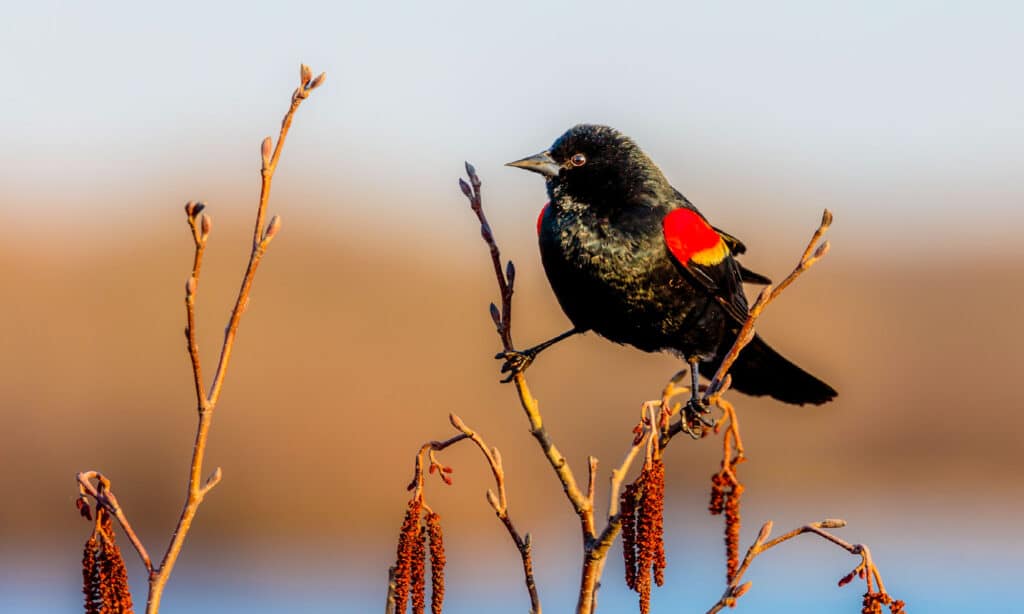
Red-winged blackbirds most frequently inhabit rural and agricultural areas, where they roost in large flocks.
©iStock.com/Michael-Tatman
Common Grackle (Quiscalus quiscula)
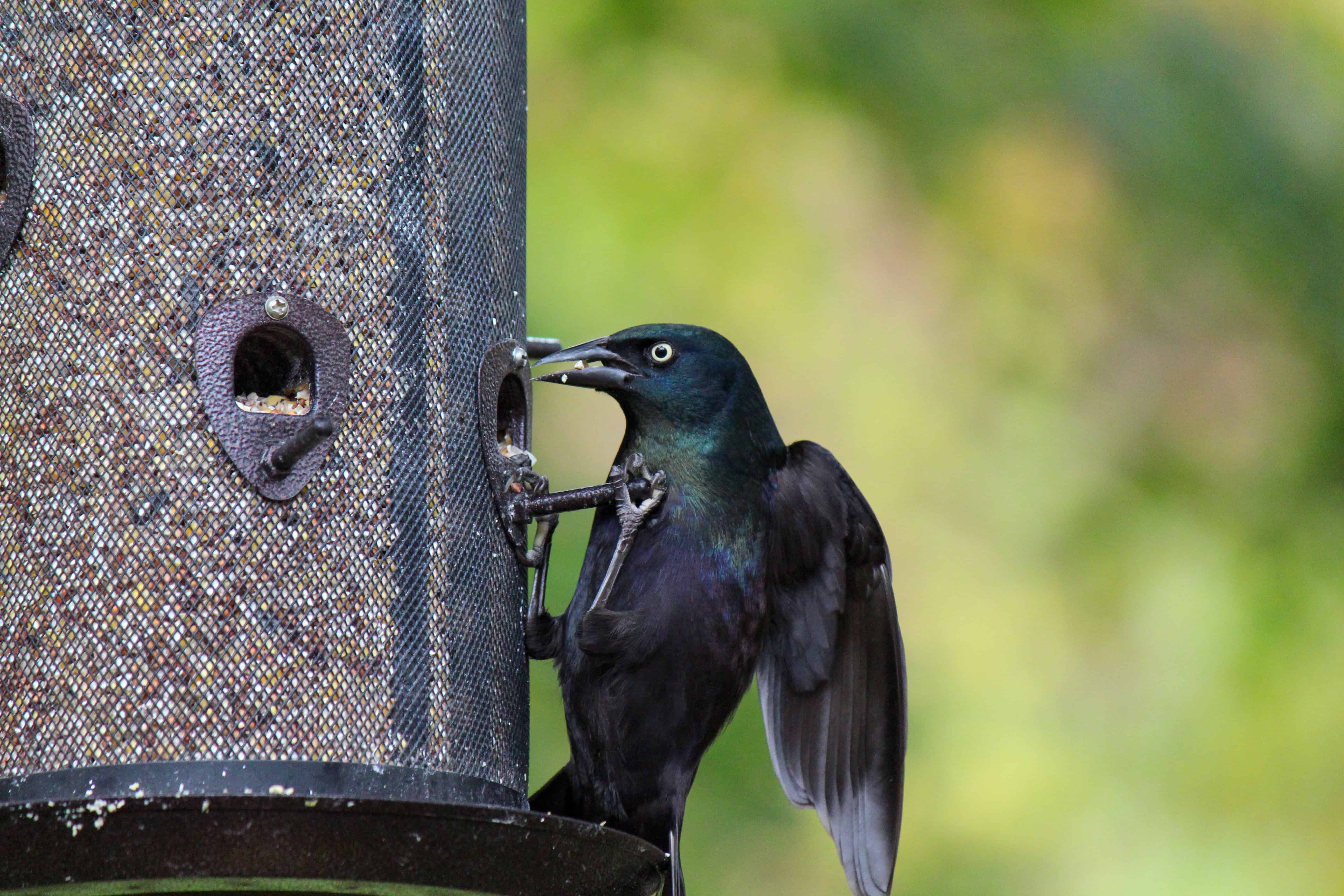
Common grackles have long, dark bills, long tails, and large wings. Their feathers are black with a bronze sheen on the body and blue, green, or purple iridescence on the head. They measure 11 to 13 inches and with a 14 to 18.1-inch wingspan.
They are somewhat sexually dimorphic, with females being smaller and having shorter tails and less iridescence in their plumage. The common grackle inhabits areas of North America east of the Rocky Mountains. Most of their populations are permanent residents in their habitats, but Canadian birds migrate to the southeastern United States. They live in large flocks and inhabit wet, open woodlands, marshes, parks, and agricultural fields.
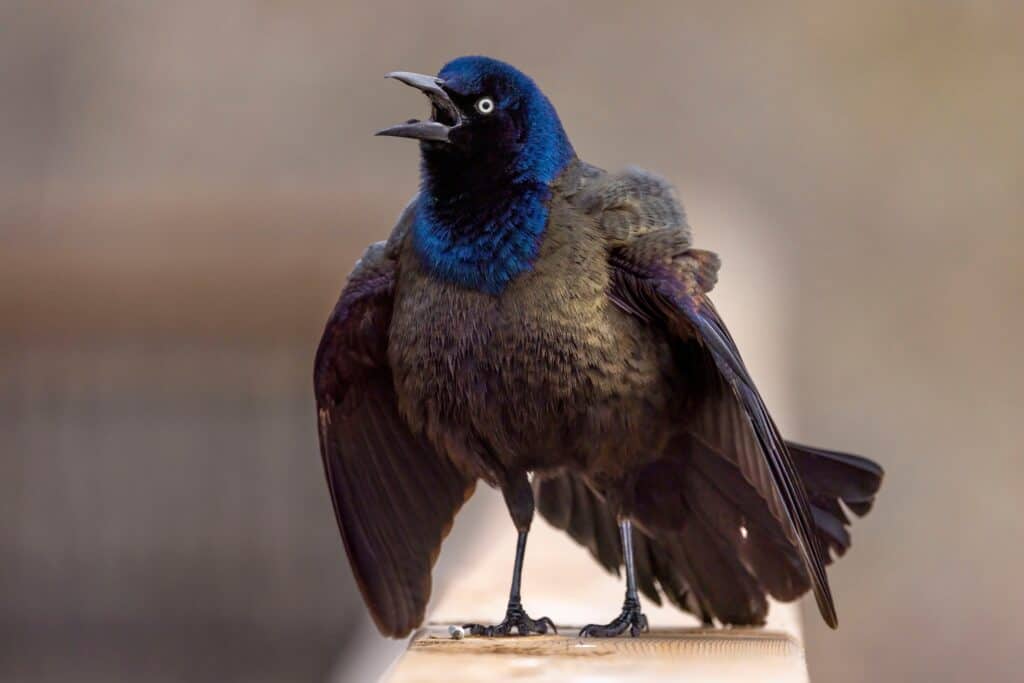
The common grackle has bronzy-black feathers with an iridescent head.
©Kendall Collett/Shutterstock.com
Brown-Headed Cowbird (Molothrus ater)
The brown-headed cowbird is notorious for its brood parasitism, meaning it relies on other bird species to raise its young. The cowbird is smaller than most blackbirds. Males reach up to 8.7 inches in length, while females reach up to 7.9 inches. They have a wingspan of up to 14.2 inches for makes and 15 inches for females.
These birds have finch-like heads and beaks. Adult males have black bodies and brown heads, while females are dull grey with pale throats and light streaking. Populations inhabiting the southern United States live there year-round, but populations that breed in Canada and the northwestern United States migrate to Mexico for the winter. You will often find them in fields, pastures, meadows, and suburban backyards.
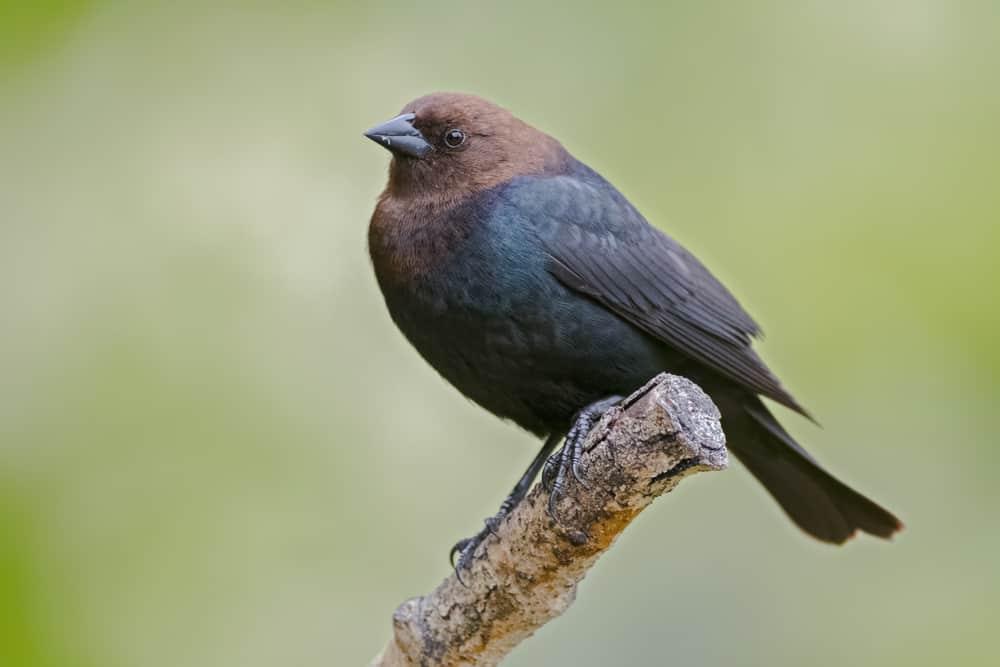
The cowbird is smaller than most blackbirds and has a finch-like head and beak.
©punkbirdr/Shutterstock.com
Brewer’s Blackbird (Euphagus cyanocephalus)
The Brewer’s blackbird is a medium-sized bird, with males measuring up to 9.8 inches and females measuring up to 8.7 inches. They have a wingspan of up to 14.6 inches. Adult males are entirely black with a purple iridescent sheen on their heads and bluish-green highlights on their bodies. Females have brownish-grey bodies with only a slight iridescence. Males have bright yellow irises, while females have dark brown.
They live across most of North America, inhabiting northwestern regions year-round. Populations that breed in Canada migrate to the southeastern United States and Mexico for the winter. These blackbirds live in open areas near water, like fields, prairies, farms, and parks.
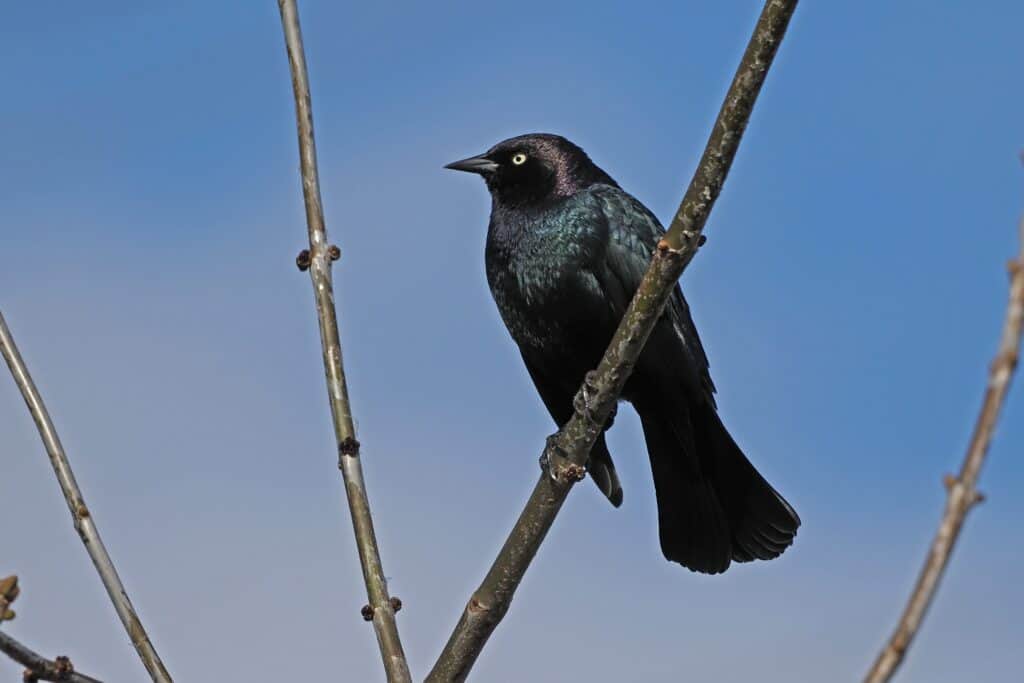
Brewer’s blackbirds live across most of North America, inhabiting northwestern regions year-round.
©John Rakestraw/Shutterstock.com
Great-Tailed Grackle (Quiscalus mexicanus)
Great-tailed grackles, also known as Mexican grackles, are slender, medium-sized birds measuring up to 18.1 inches with a wingspan of up to 22.8 inches. Adult males have glossy black plumage with a purple-blue sheen, and females feature brown feathers with darker wings and tails. This species has a long, pointed bill, long legs, and an extra-long, keel-shaped tail.
They are sedentary in their range, meaning they live in their environments year-round. You can find them in the tropical lowlands of Central and South America, ranging to the Midwest and West of the United States. They favor open habitats close to water and are often seen with other blackbirds foraging for food in agricultural fields, gardens, marsh edges, and parks.
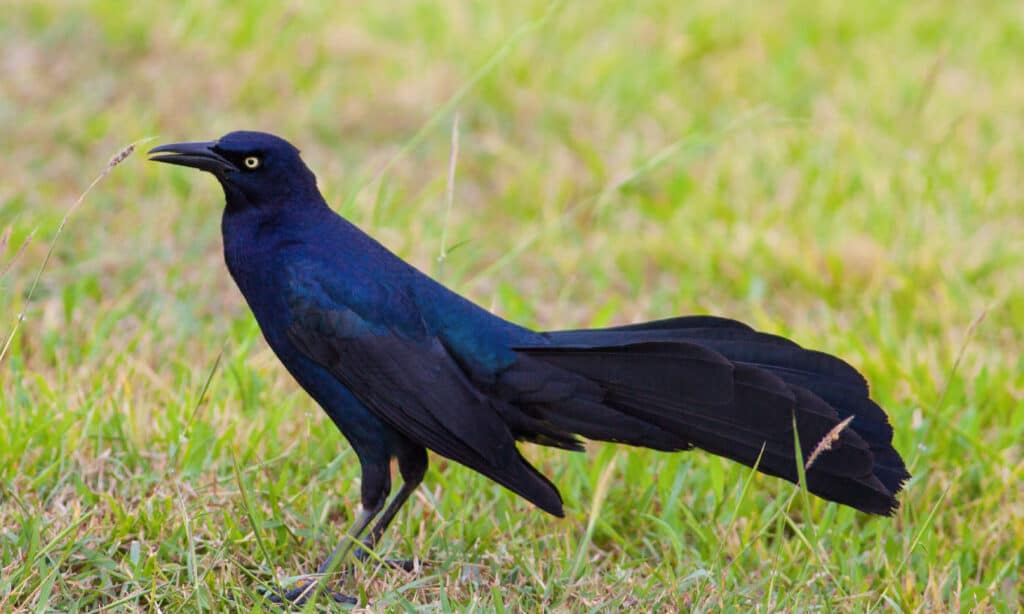
Great-tailed grackles are often seen foraging and roosting with other blackbirds.
©Melinda Fawver/Shutterstock.com
Yellow-Headed Blackbird (Xanthocephalus xanthocephalus)
Yellow-headed blackbirds are large, stocky birds with large heads and long, cone-shaped bills. They measure 8.3-10.2 inches with a wingspan of up to 17.3 inches. Males have yellow heads and chests with black bodies and white patches where their wings bend. Females are brown instead of black, their yellow heads are duller, and they do not have white where their wings bend.
These birds generally breed in freshwater wetlands and shallow areas of rivers, streams, marshes, and ponds in the western and central United States and Canada. They primarily eat insects during the summer, but they forage for seeds the rest of the year. During the winter, they gather in large flocks to forage in agricultural lands in Arizona, New Mexico, Texas, and most of Mexico.
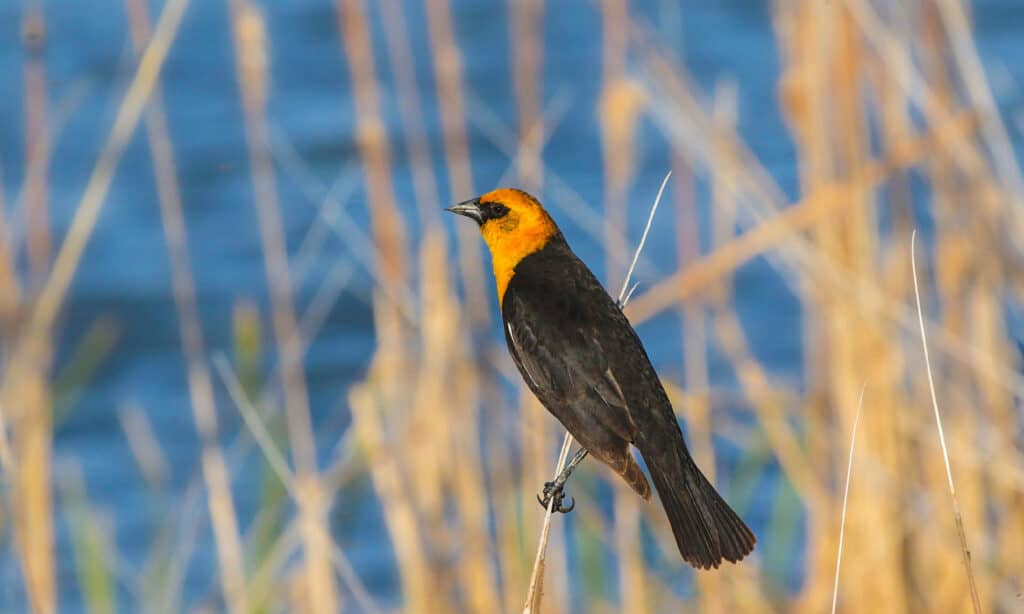
Yellow-headed blackbirds eat mainly insects during the summer and seeds the rest of the year.
©iStock.com/Nancy Strohm
Tri-Colored Blackbird (Agelaius tricolor)
Tricolored blackbirds are stout birds that have a hunchback when they are perched. They measure 7.1-9.4 inches with a wingspan of up to 13 inches. Males are black with a vivid red shoulder patch above a white band. Females are dark greyish-brown with streaks on their bellies and backs. They also have a pale patch over their eyes that looks like an eyebrow.
These birds live almost exclusively in California, primarily in the Central Valley and surrounding foothills. While some birds reside in this area year-round, others migrate from their original nesting area to a nesting area further north in the state. Tricolored blackbirds form large breeding colonies near a source of water, but as many of their previous nesting sites in the wetlands have been changed to agricultural lands, they have begun nesting in agricultural fields instead.
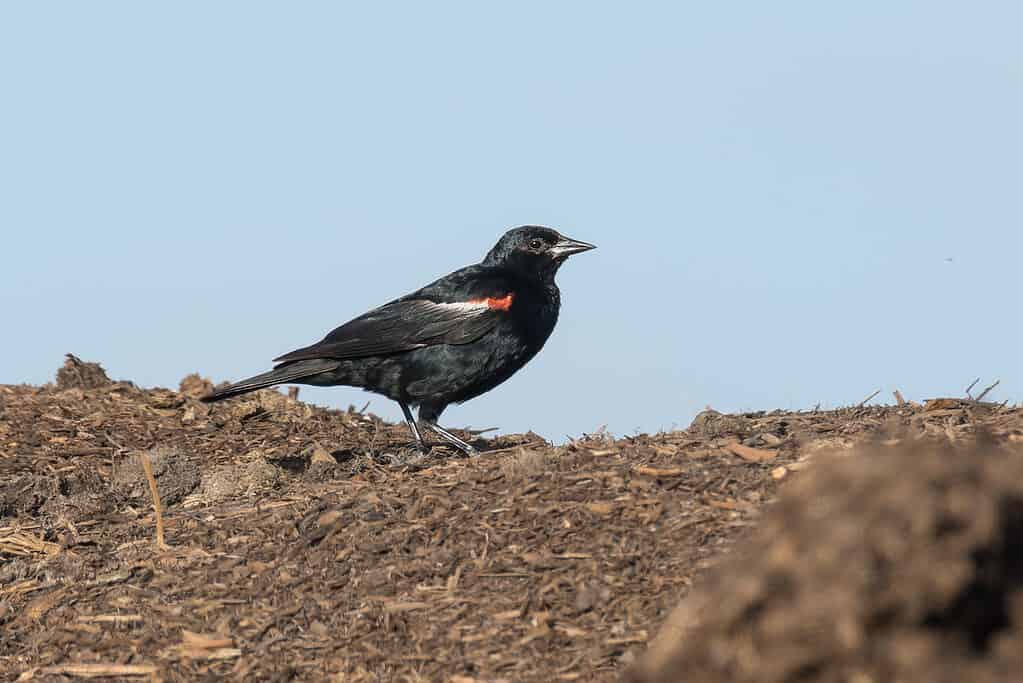
The endangered tricolored blackbird is found almost exclusively in California.
©iStock.com/Wichyanan Limparungpatthanakij
Shiny Cowbird (Molothrus bonariensis)
The shiny cowbird is a stocky bird with a short, pointed bill. They measure up to 7.1 inches long with a wingspan of 12-13 inches. Adult males have black plumage with a glossy purple sheen, while females are mostly brown with light throats and eyebrows.
They favor a wide range of open and semiopen habitats, including savannas, parks and gardens, orchards, agricultural fields, riparian woodland edges, and mangrove forests. Shiny cowbirds can be found throughout South America, the Caribbean, and as far north as Florida. They primarily breed in South America. These birds are non-migratory in tropical regions, but are short-term, seasonal migrants in more temperate regions.
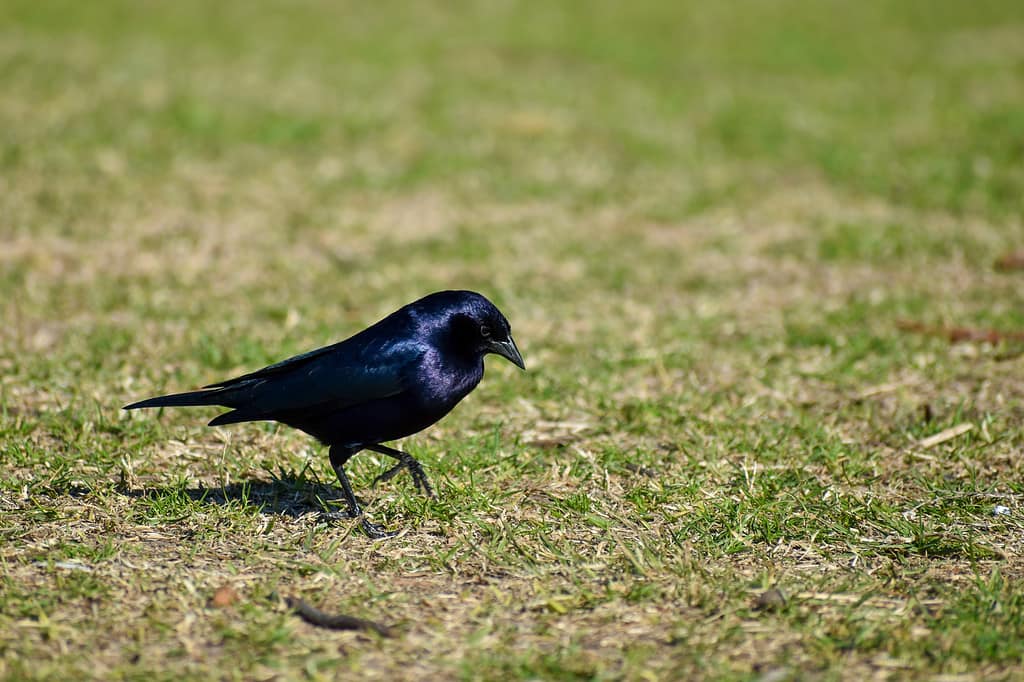
Shiny cowbirds have black plumage with a glossy purple sheen.
©Christian Peters/iStock via Getty Images
Rusty Blackbird (Euphagus carolinus)
Rusty blackbirds are medium-sized birds measuring 8.3-9.8 inches long with a wingspan of 14.6 inches. In the winter, nonbreeding males are a shiny black color with a green sheen. Nonbreeding males are dark brown with rust-colored feather edges and a pale eyebrow. Females are a greyish-brown with rust-colored feather edges, dark feathers around the eye, and a pale eyebrow.
Rusty blackbirds breed in wet woodlands in the boreal forests of the far north, particularly areas near water such as bogs and beaver ponds. They winter in the southeastern U.S., traveling in small flocks and inhabiting wet woodlands, swamps, marshes, and pond edges.
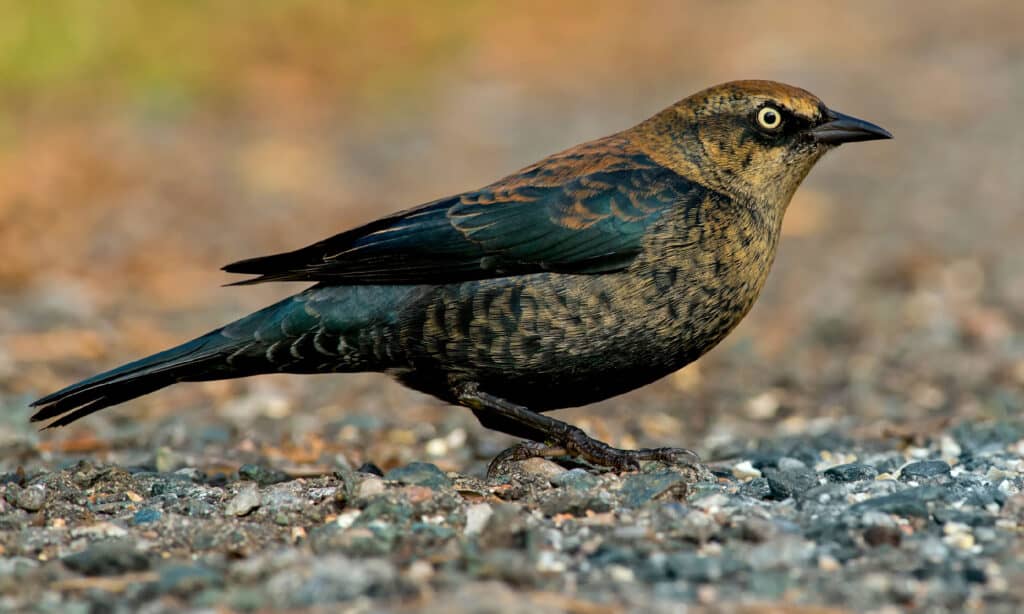
Female rusty blackbirds are a greyish-brown with rust-colored feather edges.
©iStock.com/PaulReevesPhotography
Bronzed Cowbird (Molothrus aeneus)
Bronzed cowbirds are stocky blackbirds with thick-based bills. Males have thick necks, black plumage with a bronze sheen, and bluish-purple wings. In the eastern part of their range, females and juveniles are also black, but in the western part, they are more of a brownish-grey color. Adult birds have red eyes, while juveniles have dark eyes. These birds measure up to 7.9 inches in length with a wingspan of up to 13 inches.
In the southern U.S., these birds favor open areas with few trees, such as agricultural lands, shrublands, and prairies. In the southwestern U.S., particularly Arizona and New Mexico, they also favor wooded canyons and riparian corridors. Their range also extends through Mexico and Central America, as far south as northern Colombia. U.S. populations are believed to be short-distance migrants, wintering in Mexico.
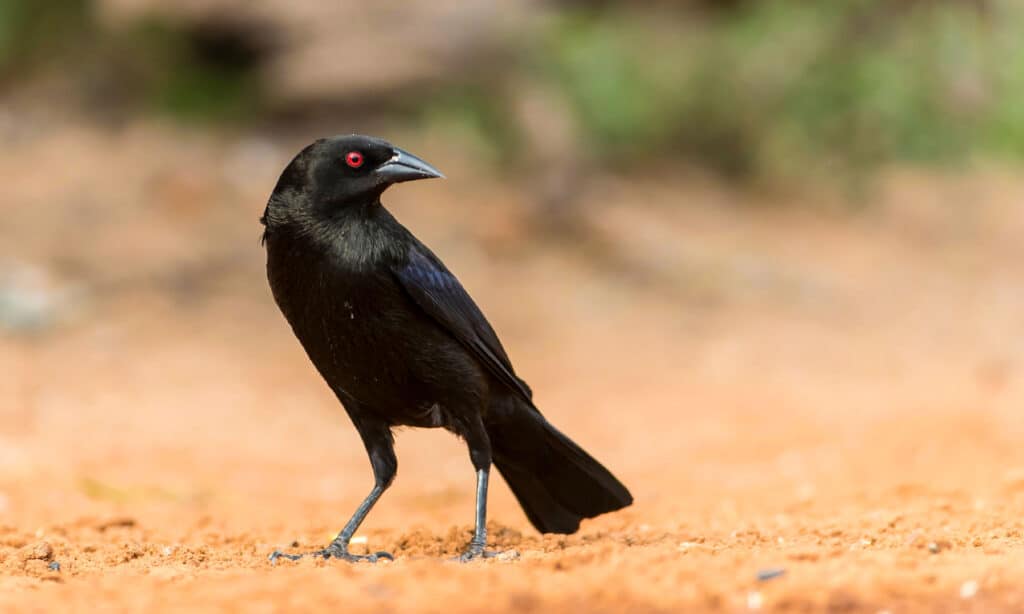
Bronzed cowbird adults all have red eyes, while juveniles have dark eyes.
©Dennis W Donohue/Shutterstock.com
Boat-Tailed Grackle (Quiscalus major)
Boat-tailed grackles are large birds with long legs and long bills. Males also have long tails, which measure nearly half of their body length. They are 10.2-14.6 inches in length with a wingspan of up to 19.7 inches. Males are glossy black all over with an iridescent purple, blue, and green sheen. Females have dark brown upperparts and warm reddish-brown underparts.
These birds are exclusive to the Atlantic and Gulf coasts. They are generally found near saltwater, with the exception of populations that live throughout the Florida peninsula. Boat-tailed grackles breed in salt and freshwater marshes along rivers, lakes, ponds, streams, and even impoundments. During the nonbreeding season, they inhabit similar environments.
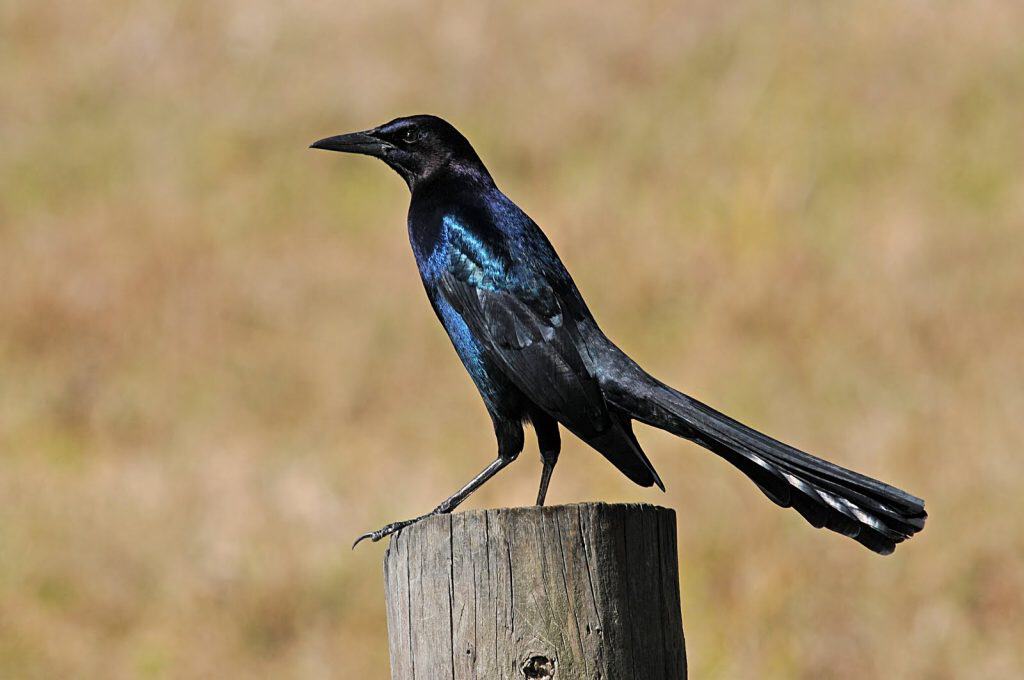
Male boat-tailed grackles have long tails that are almost half their body length.