
Unlike birds whose plumage is mostly blue, the green coloring of a green bird’s feathers is primarily a combination of pigment and structure, not just a trick of the light. These birds’ emerald green, lime green, chartreuse, or yellow-green plumage won’t disappear when viewed from different angles or in certain lighting. The following birds have predominantly green feathers, accentuated with other bright hues. These birds also remain green year-round, not just during their breeding season. Read on to learn about 10 different types of green birds.
1. Yellow-Naped Amazon Parrot
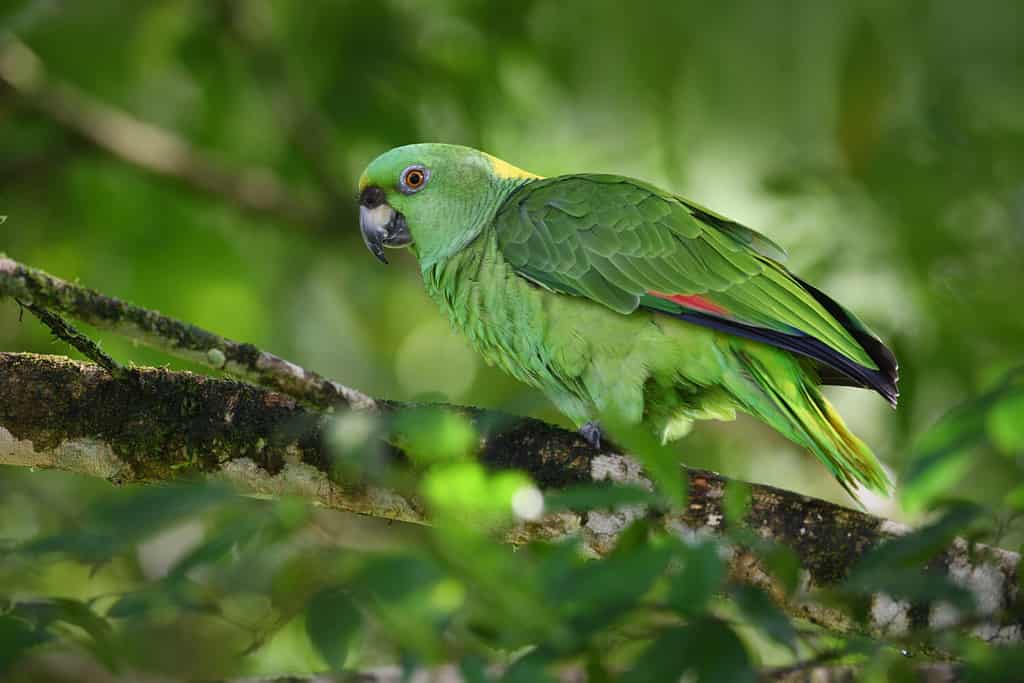
The yellow-naped Amazon parrot can be found in semi-open areas in Central America.
©petrdd/Shutterstock.com
Most species of Amazon parrots are green with brightly colored accents. The yellow-naped Amazon (Amazona auropalliata) is no exception. Both males and females have the same basic coloring. These parrots have dark gray beaks, yellow-orange eyes, and green heads with bright yellow feathers on the napes of their necks. Their bodies are predominantly green, but they have a red patch on their flight feathers. The yellow-naped Amazon inhabits semi-open forest areas in the tropical lowlands of Central America, but its populations have declined dramatically, and it is now classified as Critically Endangered by the IUCN.
2. Puerto Rican Tody
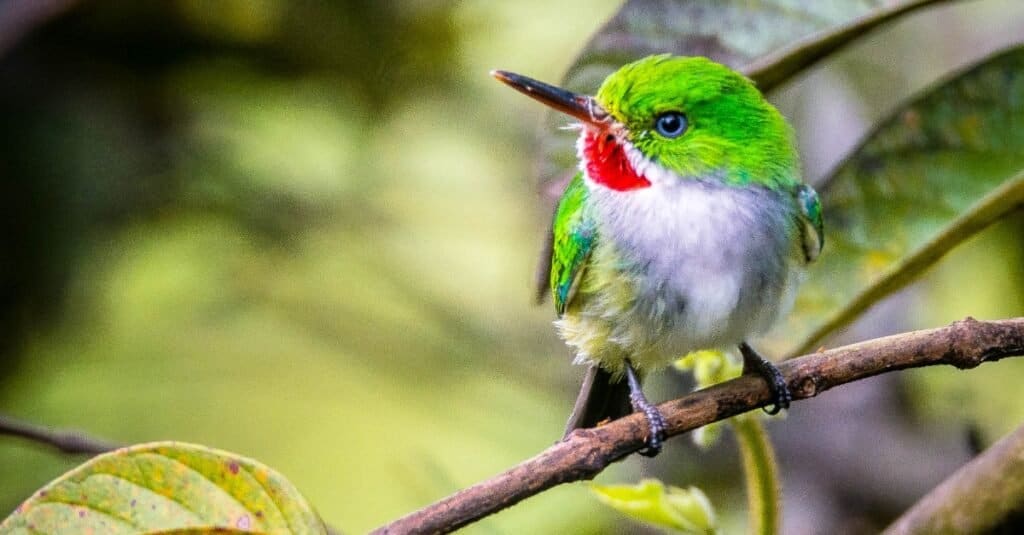
The Puerto Rican tody weighs less than an ounce.
©iStock.com/VicBruno
The Puerto Rican tody (Todus mexicanus) is a small, plump bird with emerald green upperparts. It has a white belly, yellow flanks, and a red throat. This bird has a long, narrow bill that it uses to snatch insects from the leaves. Males and females have similar coloring. The only difference is that males have gray eyes, while females have white eyes. They prefer lower to mid-level branches in wooded habitats across the island of Puerto Rico.
3. Green Broadbill
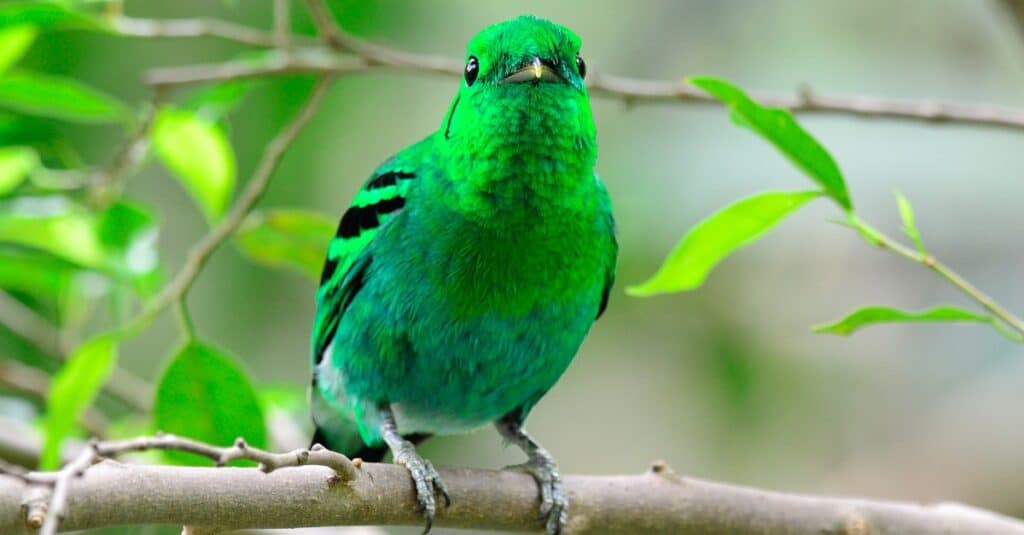
The plumage of the green broadbill allows it to easily camouflage itself in the lowland forest.
©iStock.com/PrinPrince
The green broadbill (Calyptomena viridis) is a rich, mossy emerald green, with contrasting black bands on its wings and a black patch over its ear. Its round eyes are shiny black. The bird has a stubby tail and a crest at the front of its face that nearly hides its tiny beak. Females are a duller green with no black markings. They inhabit lowland forests across the islands of Southeast Asia.
4. Green Honeycreeper
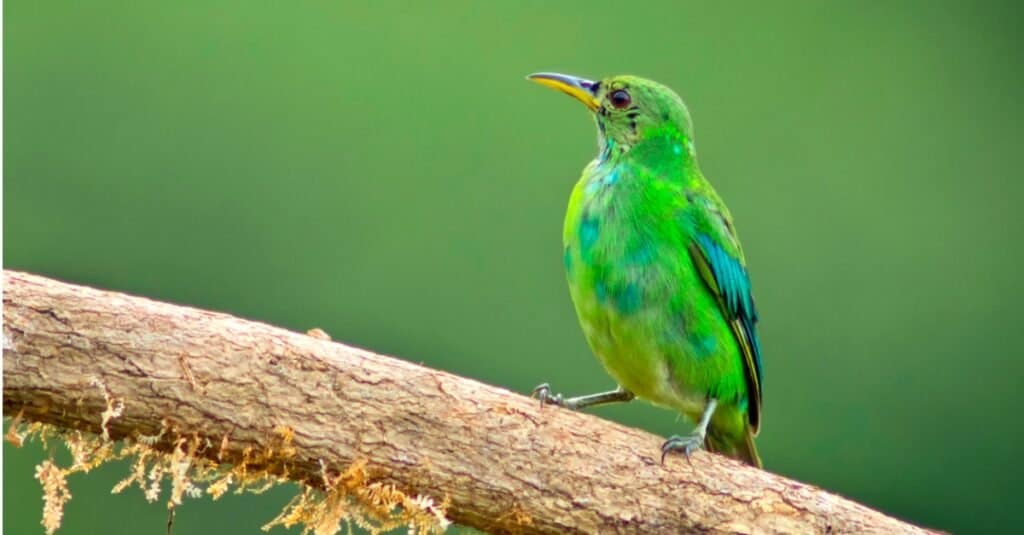
Juvenile males change from green to their turquoise adult plumage during their first molt.
©iStock.com/Alberto Carrera
Both male and female green honeycreepers (Chlorophanes spiza) are green, but they display different shades. The plumage of the adult male has an iridescent blue tinge, while the female is a lime or grass green, with paler green on the throat. Males also have partially black heads and yellow bills. Their bills are tapered with a slight curve, enabling them to easily access nectar inside flowers. These birds can be found from southern Mexico down to Brazil.
5. Hawaii Amakihi
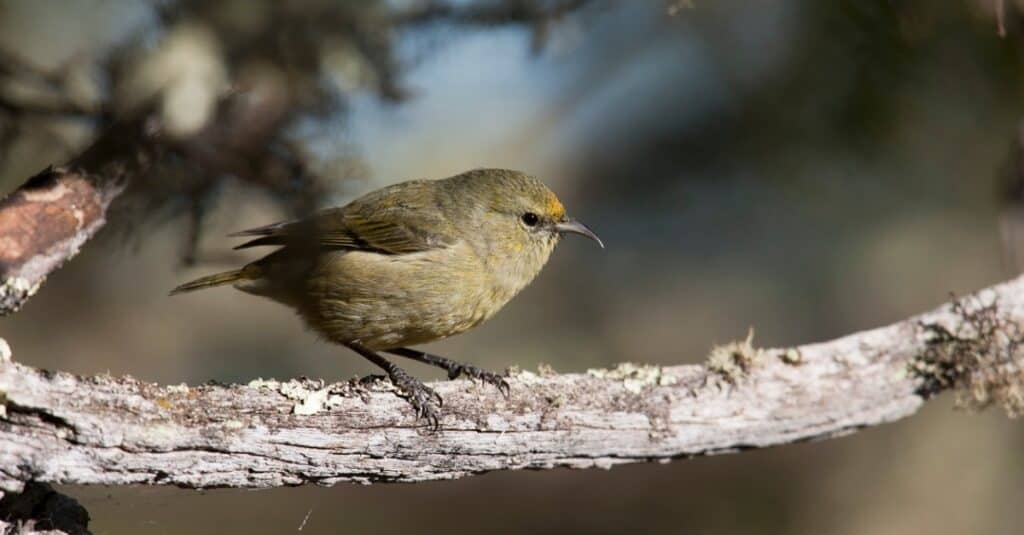
The plumage of the Hawaii amakihi can vary from yellow-green to olive green.
©Stubblefield Photography/Shutterstock.com
The green plumage of the small Hawaii amakihi (Chlorodrepanis virens) varies depending on the island, especially among females. Males range from a bright, yellow-green to an olive color, while females are generally duller. The birds on Hawaii are smaller and a brighter yellow-green, while birds that live on other islands tend toward olive-green plumage. They primarily inhabit the islands of Hawaii, Maui, and Molokai, where they prefer higher elevation forests.
6. Green Catbird
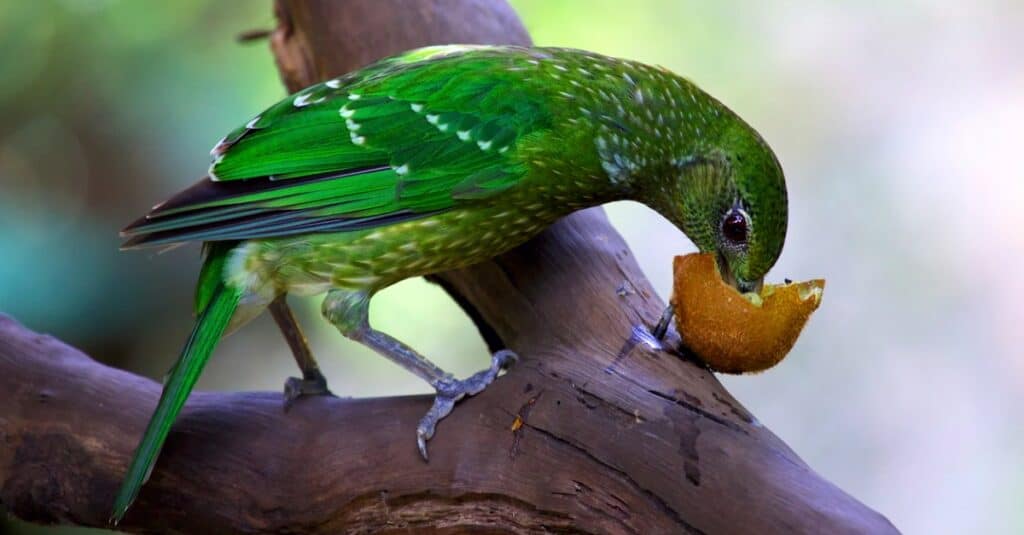
The green catbird is found along the eastern coasts of Australia.
©iStock.com/hypergurl
The upperparts of the green catbird (Ailuroedus crassirostris) are a lustrous emerald green, while its head is a mottled olive green. It has white streaks on its breast and wings, a heavy, curved bill, and red eyes. Males and females have similar coloring, making identification difficult. They are primarily found on the eastern coasts of Australia, where they prefer the mid-to-upper levels of the canopy.
7. Superb Fruit Dove
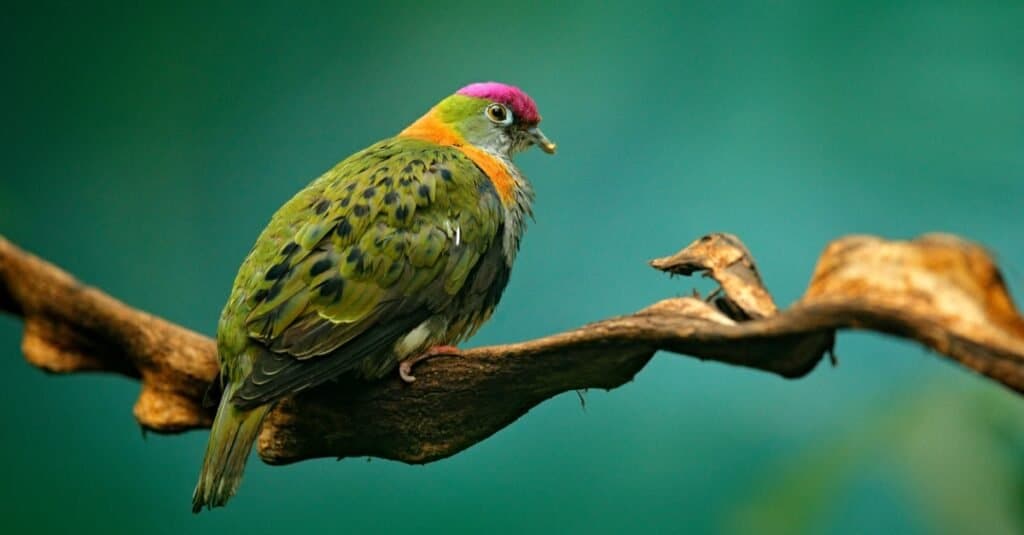
Male superb fruit doves have distinctive purple crowns.
©iStock.com/Ondrej Prosicky
Both male and female superb fruit doves (Ptilinopus superbus) are primarily green, but the males have more colorful accents. The wings, tail, thighs, and flanks of the males are green with black streaks. They have gray upper breasts and white underparts separated by a black band. The males also have orange feathers on their hind necks and purple crowns. Females are green with a gray breast, white underparts, and a small patch of purple on the crown. They can be found in the canopies of the rainforests and other closed forests of Indonesia, New Guinea, and the coast of eastern Australia.
8. Monk Parakeet
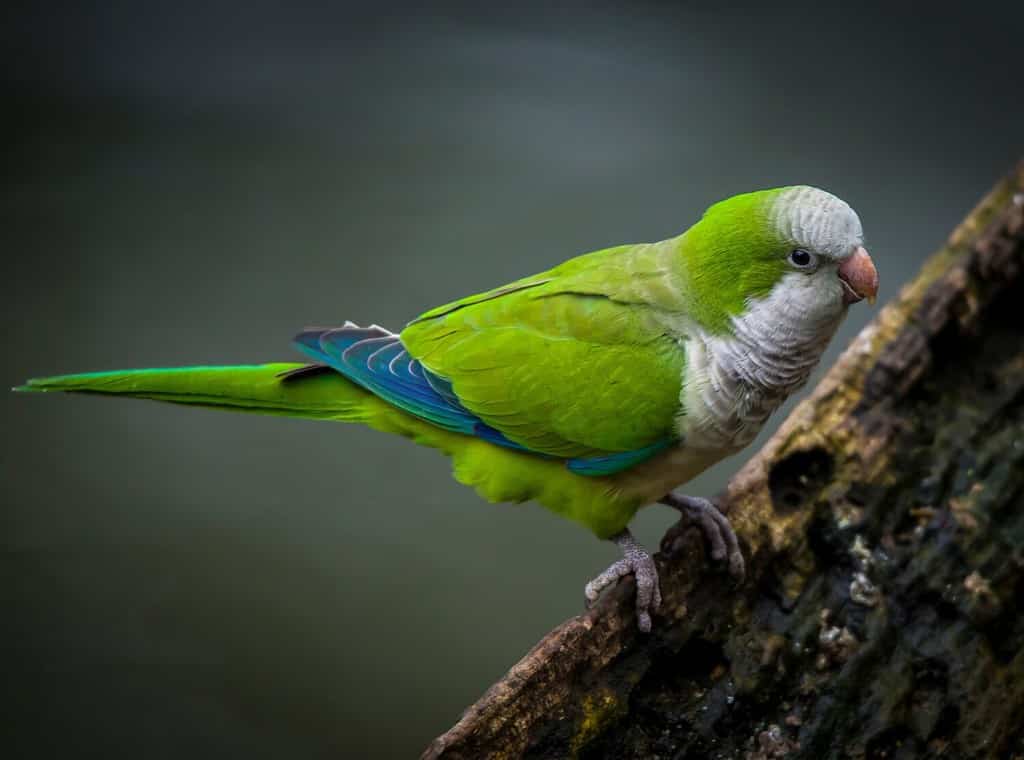
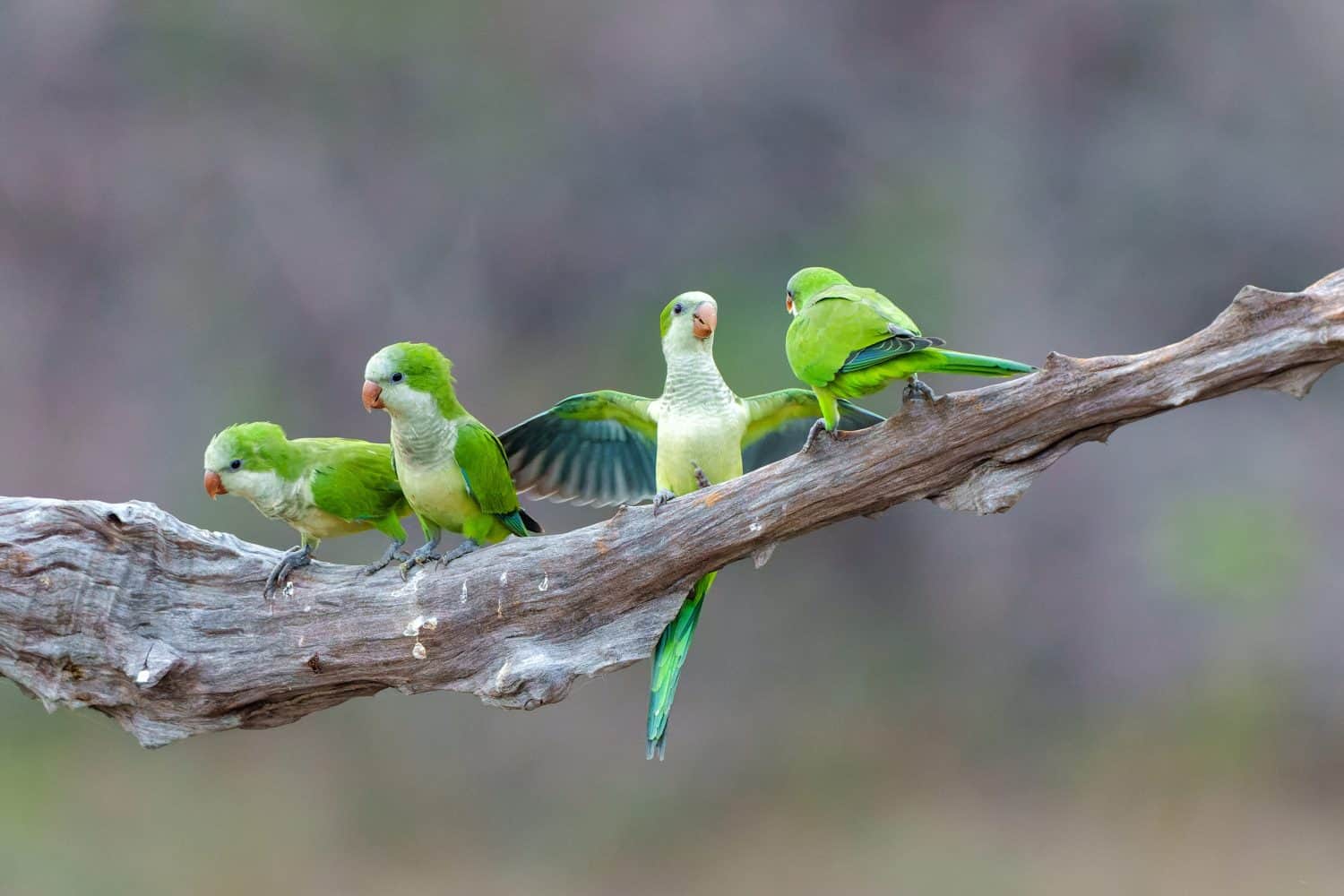
The monk parakeet is one of the few parrot species able to survive the colder winters of North America.
©Roel van Moorsel/Shutterstock.com
Monk parakeets (Myiopsitta monachus) have primarily green upperparts, with gray heads and breasts and blue primary and secondary flight wings. They have light pink hooked beaks and brown eyes. There are no significant differences in coloration between males and females. Although monk parakeets are native to the arid savannas and forests of South America, the pet trade has led to their presence in urban and suburban areas across the U.S.
9. Glistening Green Tanager
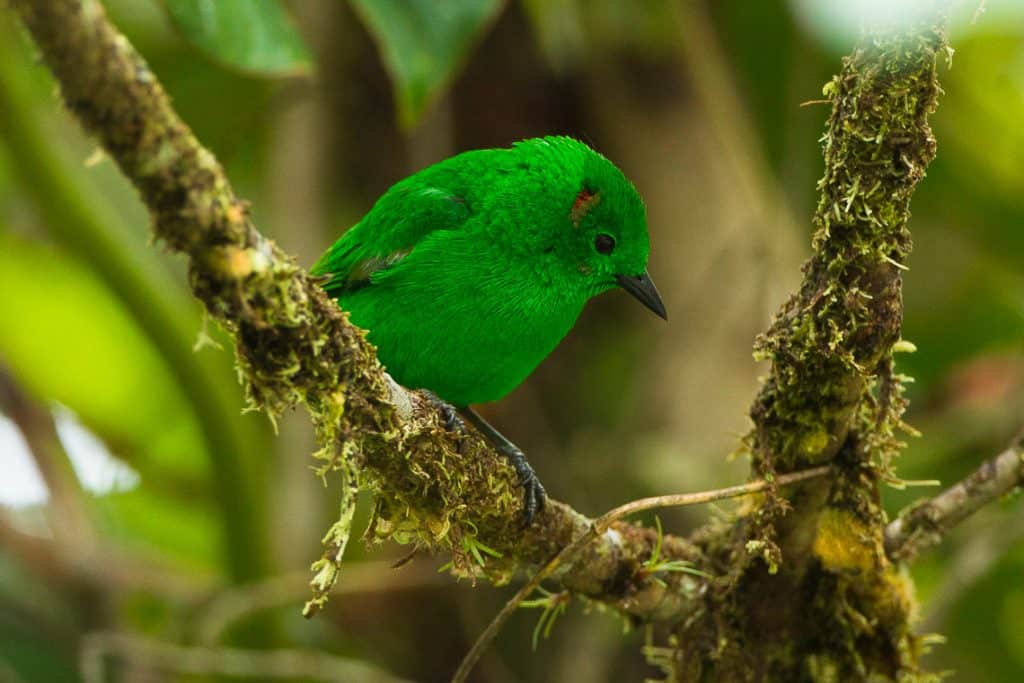
Glistening green tanagers are predominantly a bright, emerald green.
The glistening green tanager (Chlorochrysa phoenicotis) male has bright, emerald-green plumage with small red and white patches on the sides of its head. Females are generally not as bright, and they lack the colorful spots on their heads. These small birds can be found in the subtropical and tropical forests of Colombia and Ecuador, where they prefer the lower to middle levels.
10. Violet-Green Swallow
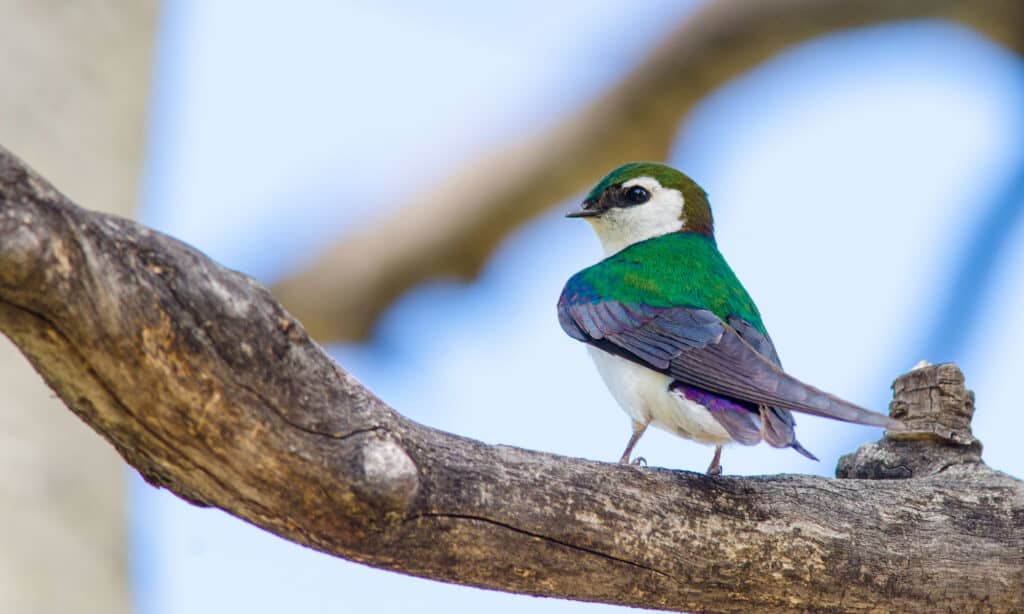
The violet-green swallow has long wings that extend past its tail.
©iStock.com/spates
Violet-green swallows (Tachycineta thalassina) have mossy green-colored heads and blue-green backs, with violet rumps and white cheeks and underparts. Females and juveniles are more drab, with brown heads and brownish-colored feathers on their cheeks. They have small, pointy bills and long wings that extend past their tails. During the breeding season, violet-green swallows inhabit cliffs and trees in open evergreen, deciduous, and mixed forests across the Western U.S. and Canada.