
Can’t you just picture camels traveling across the desert sand with their humps silhouetted against the glorious sunset? They always seem to know what they’re doing and where they’re going. Camels, both wild and domesticated, can be found throughout the arid and semi-arid regions of Asia and Africa. The story has been widely told that camels store water in their humps, but is this true? Why do camels really have humps? Keep reading to find out the answer.
Camel Facts
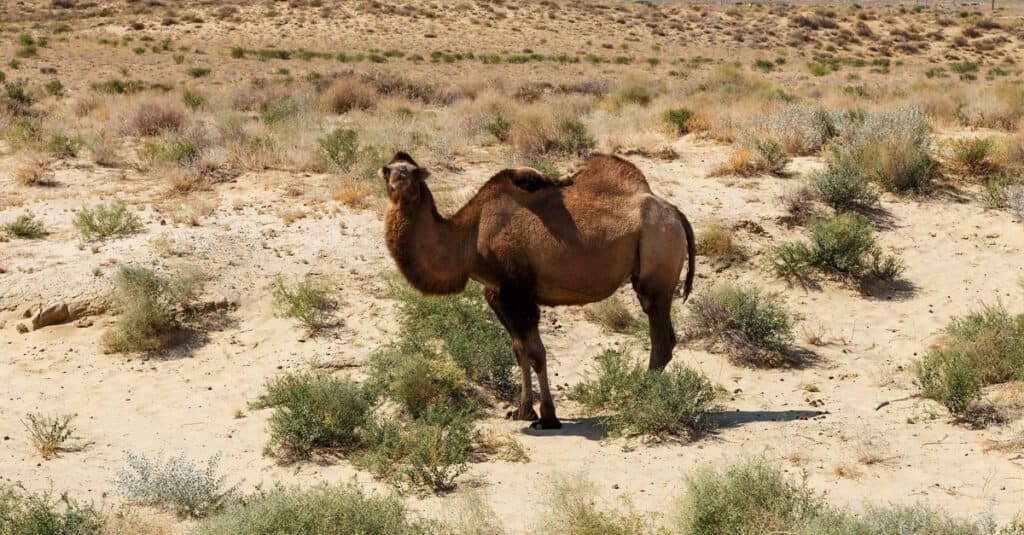
Bactrian camels have two humps and live in Asia.
©Mikhail Priakhin/Shutterstock.com
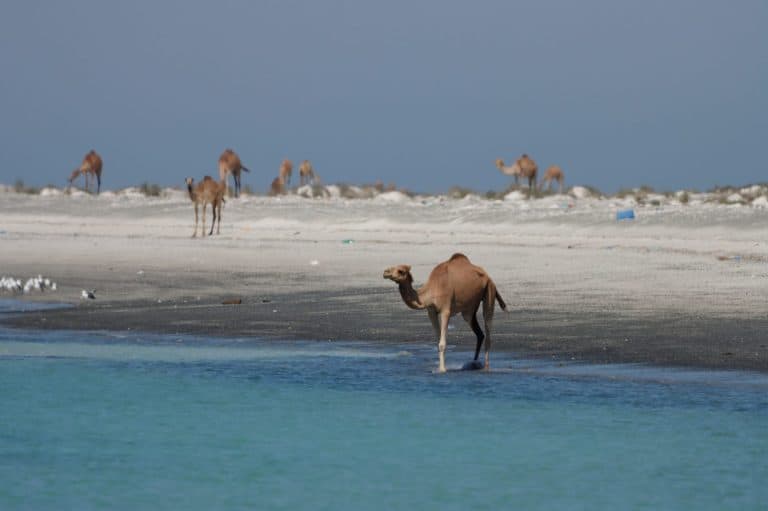
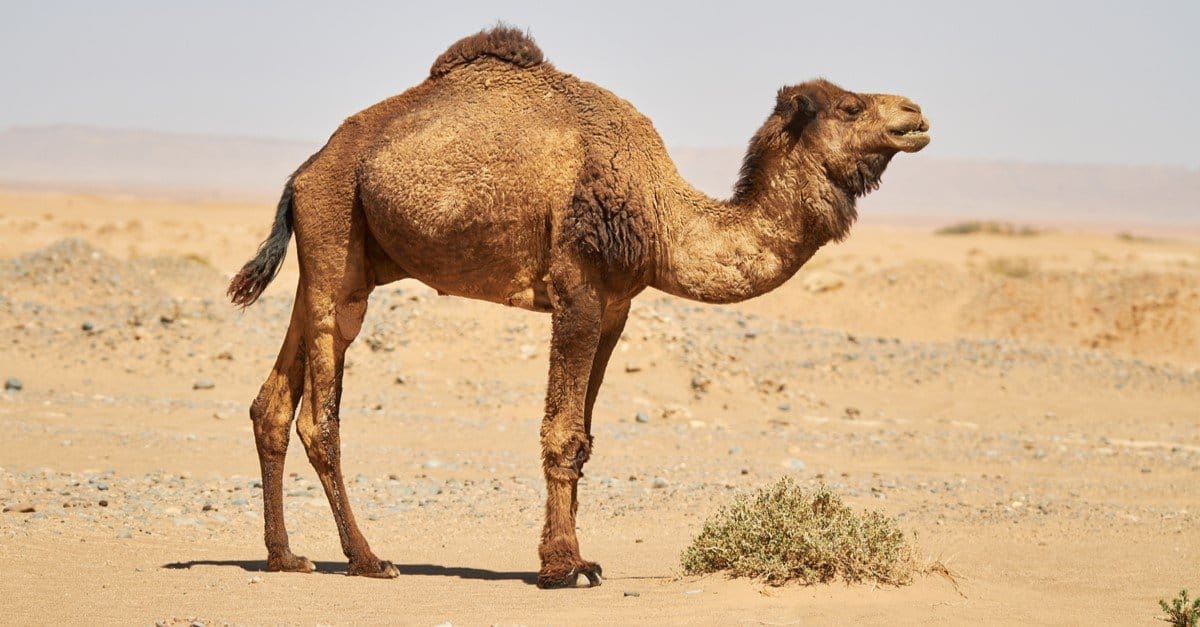
There are two types of camels: dromedary camels with one hump, and Bactrian camels with two humps. Around 90% of camels are dromedaries, and most of them are domesticated. Dromedary camels are primarily found in the desert regions of the Middle East and North Africa, including the Sahara Desert. Bactrian camels can be either domesticated or wild. They are endemic to the Gobi Desert in China and the steppes of Mongolia. People who live in these regions depend on camels for:
- Travel
- Meat
- Milk
- Labor
- Dung is used for fuel
- Textiles like felt made from camel hair
To protect them from desert sandstorms, camels have two rows of eyelashes and nostrils that can close completely. A thin, clear membrane that covers each eye also serves as protection. Their feet are calloused, padded, and wide, allowing them to walk on the hot desert sand or snow.
Camels are active during the day and spend their time eating when food is available. Their upper lips are split and move independently, making it easy for them to eat short grass. With the tough, leathery texture of their lips and tongues, they can also eat dry, bitter, thorny, and salty plants. They are mostly herbivores, but they will occasionally eat fish.
The Purpose of a Camel’s Hump
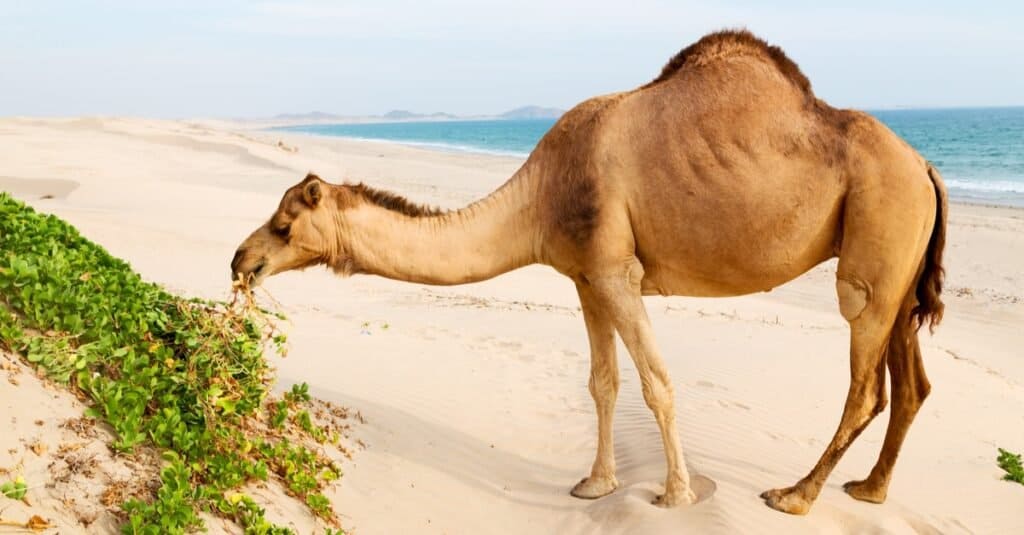
Camels are opportunistic foragers that can eat even thorny plants.
©lkpro/Shutterstock.com
Despite the stories, camels do not store water in their humps. Their humps hold stored fat to use as reserves during long journeys and food shortages. Their bodies convert the fat into energy, which is why they can go without food for several months.
Camels can store an incredible 80 pounds of fat in one of their humps. If those reserves are used, the humps begin to physically change shape, appearing to droop over the camel’s backbone. Storing fat in their humps also aids in thermoregulation, as it allows them to release heat from the rest of their bodies more easily.
How Can Camels Go Without Water for So Long?
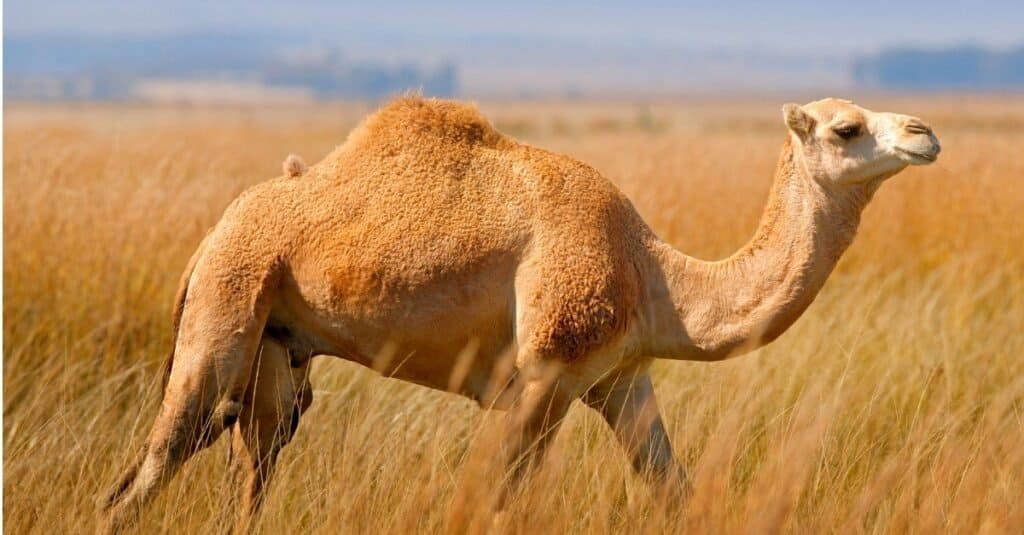
Camels can drink over 30 gallons of water at a time.
©Ondrej Prosicky/Shutterstock.com
The tale is true that camels can go at least a week without water. Camels have thin, flat, elliptical red blood cells, unlike the thick, round, concave red blood cells of most mammals. Camels gorge on water when they find it, drinking over 30 gallons in ten minutes. However, a camel’s red blood cells are able to tolerate rapid rehydration, expanding to twice their original size so the camel’s body can absorb the extra water without any ill effects.
Camels also produce thick, concentrated urine, and they do not sweat until their body temperatures reach over 107°F. Additionally, when they exhale, water vapor is trapped in their nostrils and reabsorbed into their bodies. All of these adaptations help camels conserve water. Wild Bactrian camels can even survive on saltwater. Eating green vegetation can also provide enough moisture to help them stay hydrated.