
Quick Take
- A camel's hump stores fat, not water, providing an energy reserve when food is scarce. See what's actually stored →
- Concentrating fat in the hump helps camels lose body heat more efficiently in hot desert conditions. Discover the heat survival edge →
- Specialized red blood cells allow camels to withstand dehydration and safely rehydrate after drinking large amounts of water.
- Unique nasal passages and other water-saving adaptations reduce moisture loss, helping camels survive long periods without drinking.
Growing up, one of the most common things that we learned about camels was that they store water inside their hump. Often, the assumption is that the hump literally contains a water supply that the camel uses as it crosses the hot, dry desert landscape. However, the idea is entirely incorrect. The contents of a camel’s hump are still vital for its survival, but the hump contains fat instead of water. Keep reading to learn how they use these reserves for their survival and how they manage to go for such long periods without having a drink.
What Is Really Inside a Camel’s Hump?
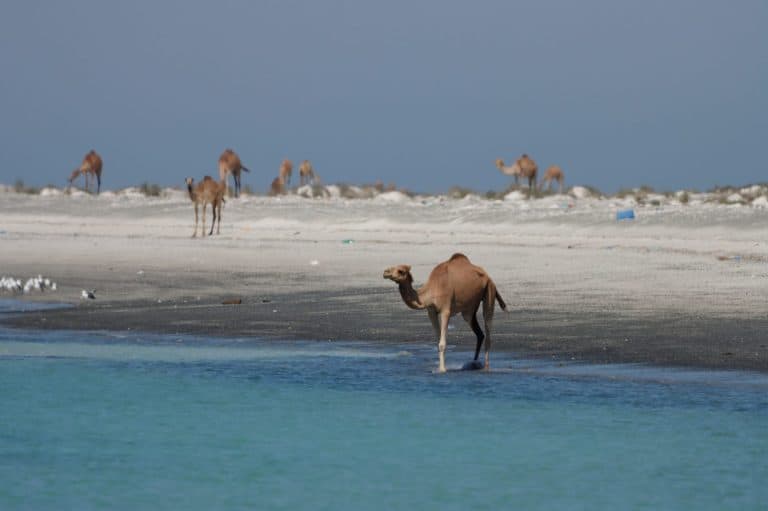
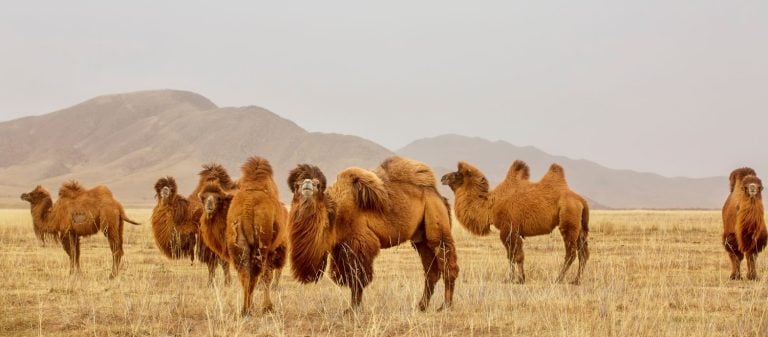
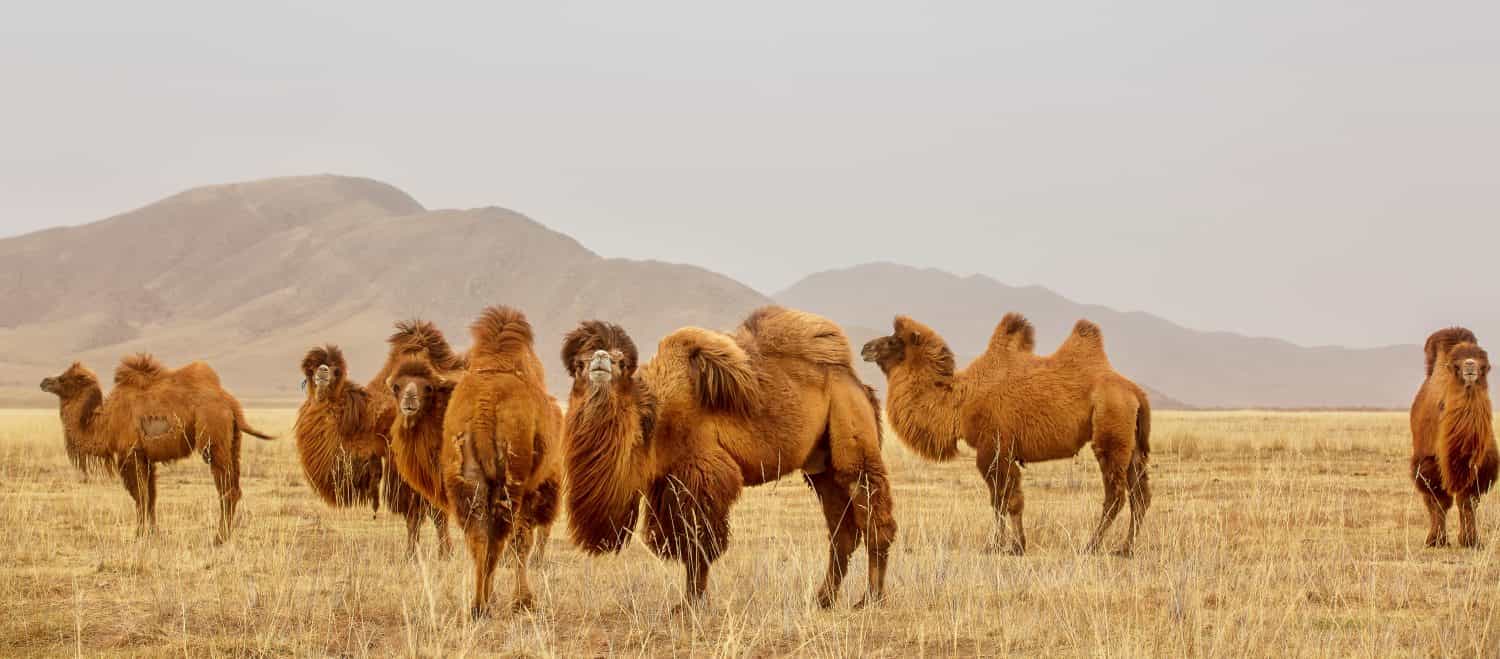
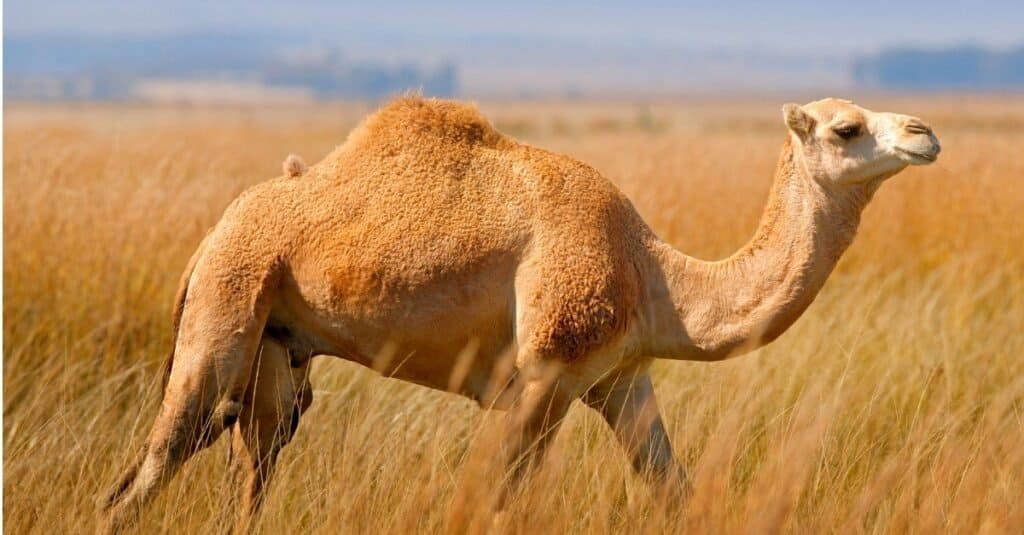
There are three species of camels – two that are domesticated and one that is wild – and their most recognizable feature is their hump. The dromedary has just one hump, but both the wild Bactrian and domesticated Bactrian species have two humps. Although it’s a common belief that camels store and carry water inside their hump, this is not the case. Instead, a camel’s hump consists entirely of dense, fatty tissue. This tissue can be used to help camels survive when there is little food or water available.
By storing fat in their hump, camels can use it as an energy reserve when food is scarce. When needed, they break down the fat stored in their hump. As the fat is metabolized, it produces a small amount of metabolic water, which the camel also uses for survival. However, this water is produced through metabolism, not stored directly in the hump.
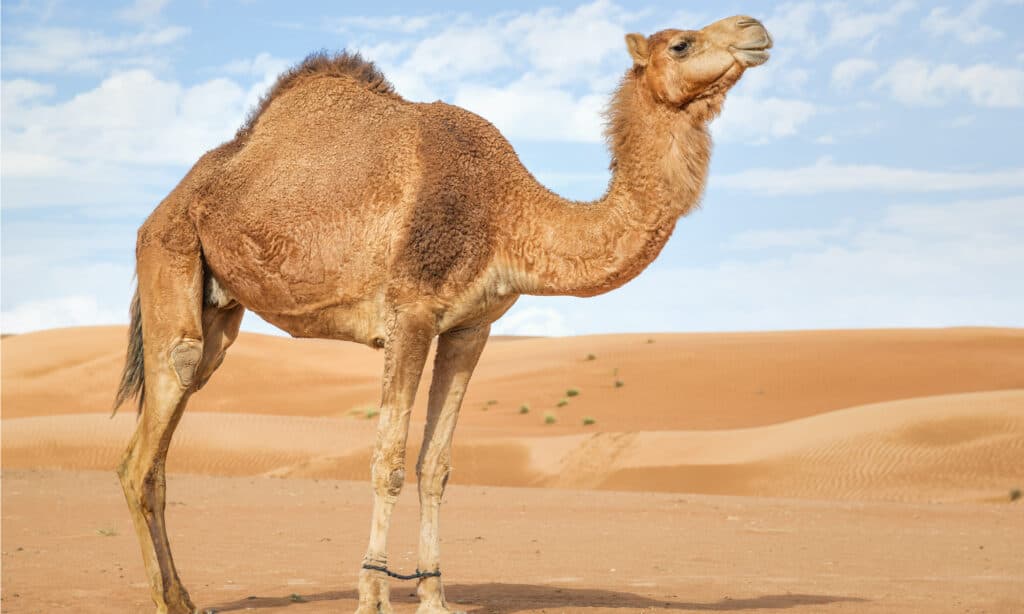
Camels’ humps contain fat that helps them to survive when food is scarce.
©Wolfgang Zwanzger/Shutterstock.com
Additionally, as their hump is used as a fat store, it actually reflects the overall condition of the camel. If the hump is firm and upright, then it suggests that the camel is well-fed and is not having to use its fat reserves to survive. In contrast, a camel with a small, soft hump or a hump that is drooping to one side indicates that the camel has used much of its fat reserve. The hump typically stays in this position until the camel has a chance to eat and build up its fat reserves again.
Why Storing Fat in One Place Helps in the Desert
Storing much of their fat in one place gives camels a major advantage for surviving in the heat. Fat typically acts as insulation when it is spread out across the body, which is an advantage in cold climates because it helps animals retain body heat. However, in hot climates, this insulation makes it much more difficult for animals to cool down, as heat becomes trapped in their bodies.
By storing their fat in their hump instead of spreading it across their entire body, camels allow the rest of their body to lose heat and cool down more easily. This is because it allows body heat to escape into the surrounding air instead of being trapped underneath a layer of insulating fat. This adaptation is vital for survival in desert environments, where daytime temperatures commonly exceed 100°F.
How Camels Actually Survive Without Much Water
Deserts are among the driest and harshest places in the world. Many desert regions receive very little rainfall, typically less than ten inches annually, making water particularly scarce. However, camels have adapted to survive in these inhospitable regions by being able to go long periods without drinking water. In some areas, camels have been known to go for a week or more without drinking.
Red Blood Cells
Camels have oval-shaped red blood cells that allow them to drink a lot of water in one go.
©Ondrej Prosicky/Shutterstock.com
There are several reasons camels are able to survive without much water. For example, they have specialized red blood cells that are oval rather than round. When camels become dehydrated, their blood becomes thicker. Oval red blood cells allow the blood to keep flowing even when it thickens, whereas regular round cells cannot cope with this change. Additionally, their red blood cells can expand to twice their usual size, allowing camels to drink large amounts of water when it is available without damaging the cells.
Reducing Water Loss
Reducing the amount of water they lose from their bodies is another reason camels can survive for long periods without drinking. Camels conserve water because they have specialized nasal passages that help them to recover moisture from the air.
When we exhale, we lose a lot of water as water vapor. The air camels inhale is cooler than their body temperature, but it warms as it moves through their nasal passages, which have cooled from previous breaths. When the camel exhales, the warm air passes through the now-cooler nasal passages, causing the air to cool and the nasal passages to warm up. As the air cools, condensation occurs, producing water that forms on the surface of the nasal passages instead of remaining as vapor. This water is then reabsorbed and used by the camel.
Camels also use the lining inside their nose to extract additional water from the air. Their nostrils are hygroscopic, meaning they attract and absorb water molecules from the air, allowing camels to remove more water vapor and absorb even more water with each breath.
Camels have another method of conserving water: they can regulate their body temperature according to the environment. Their temperature rises during the day and drops at night. Camels also do not begin to sweat until their body temperature exceeds 107°F, which helps reduce the amount of water they lose through sweating. These adaptations greatly reduce the amount of water camels lose, helping them survive in the desert.