
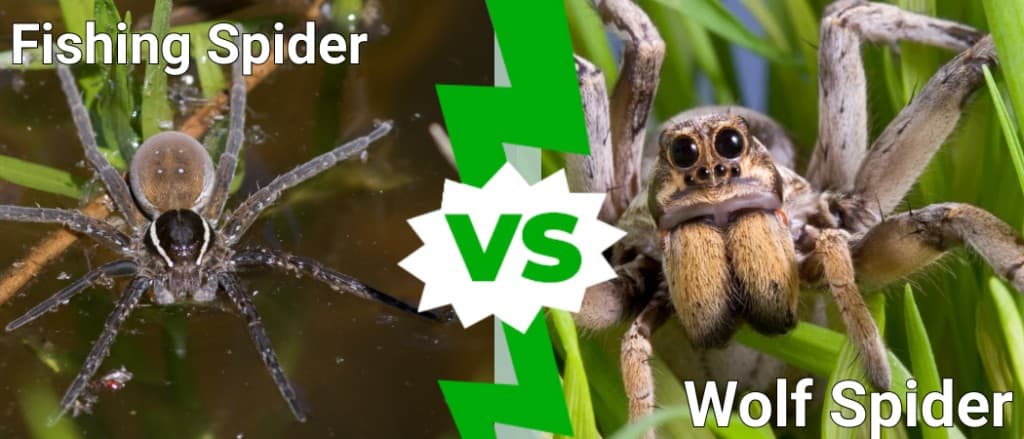
Fishing spiders and wolf spiders have a lot of similarities. Some people that see one may confuse it for the other. However, there are a number of differences that distinguish them. You’ll also learn how to tell these spiders apart with a glance. That way, you’ll know what kind of spider has welcomed itself into your home or garden. Read on to learn the significant differences between fishing spiders and wolf spiders.
Comparing a Fishing Spider and a Wolf Spider
| Fishing Spider | Wolf Spider | |
|---|---|---|
| Size | 0.35-1 inch in body length; leg span measures between 4 and 5 inches | 0.25-1.4 inches in body length; leg span measures up to 4 inches |
| Habitat | Found near bodies of water; may wander into homes and outbuildings | Located on the ground near sources of prey; in dark recesses of homes; may nest in tree hollows or burrows they have dug |
| Hunting Methods and Diet | Active hunter; chases prey over water or dives to catch it; envenomates prey; primarily consumes aquatic organisms | Active hunter; uses vision to locate prey and speed to chase it down; fangs envenomate prey; consumes insects, insect eggs, small vertebrates |
| Appearance | Varies by species; generally brown and gray; banded patterns on legs | Varies by species; light brown, dark brown, tan, or gray; sometimes have a stripe running down its back; may have patterns on its body and legs |
| Vision and Eye Arrangement | Has eight eyes in two horizontal rows; tapetum lucidum layer; good vision | Has eight eyes arranged in three horizontal rows; tapetum lucidum layer; excellent vision |
The 5 Key Differences Between Fishing Spiders and Wolf Spiders
There are over 100 species of fishing spiders in the genus Dolomedes and over 2,500 species of wolf spiders in the family Lycosidae worldwide. Fishing spiders and wolf spiders are often mistaken for one another because they are generally both large, brown spiders. However, these two spiders have differences in size, habitat, hunting methods and diet, appearance, and vision and eye arrangement. Take an in-depth look at each of these characteristics in the sections below.
Size
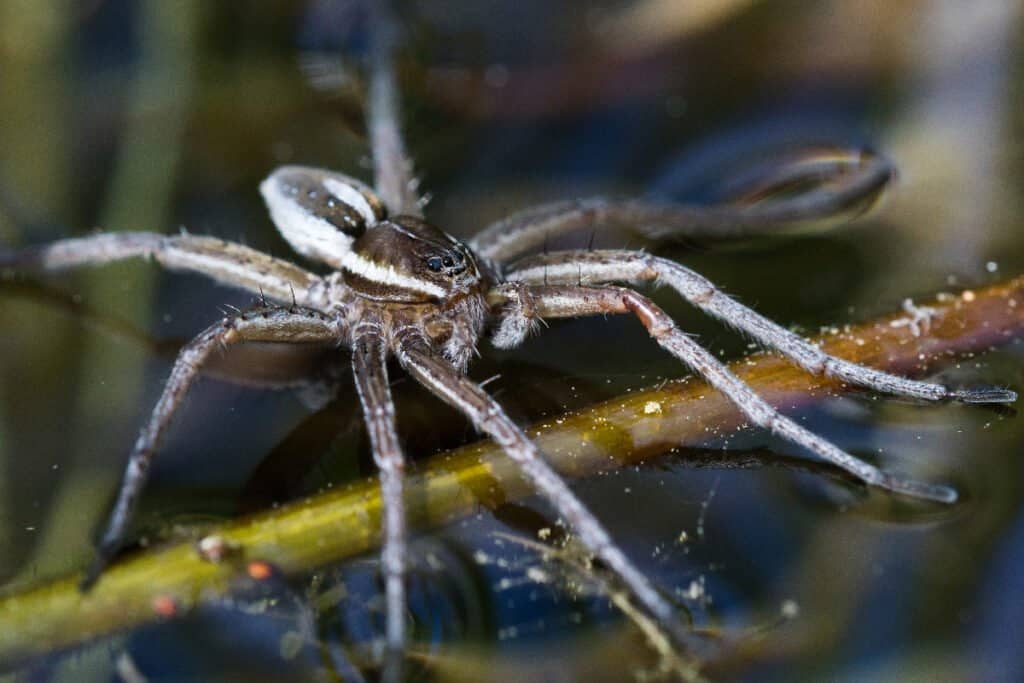
Fishing spiders may have smaller, flatter bodies but longer legs than wolf spiders.
©Jukka Jantunen/Shutterstock.com
A fishing spider and a wolf spider are often very close in size, but wolf spiders can have larger bodies, while fishing spiders can have longer leg spans. Fishing spiders average about 0.35 inches to 1 inch in body length. They have a leg span of between 4 and 5 inches. Males are typically smaller than females. For example, in the dark fishing spider (Dolomedes tenebrosus), males are half the size of females.
Wolf spiders generally measure between 0.25 and 1.4 inches in body length. They have a leg span of up to 4 inches in the largest species, the Carolina wolf spider (Hogna carolinensis). Male wolf spiders are smaller than females, with thinner bodies and shorter leg spans.
Habitat
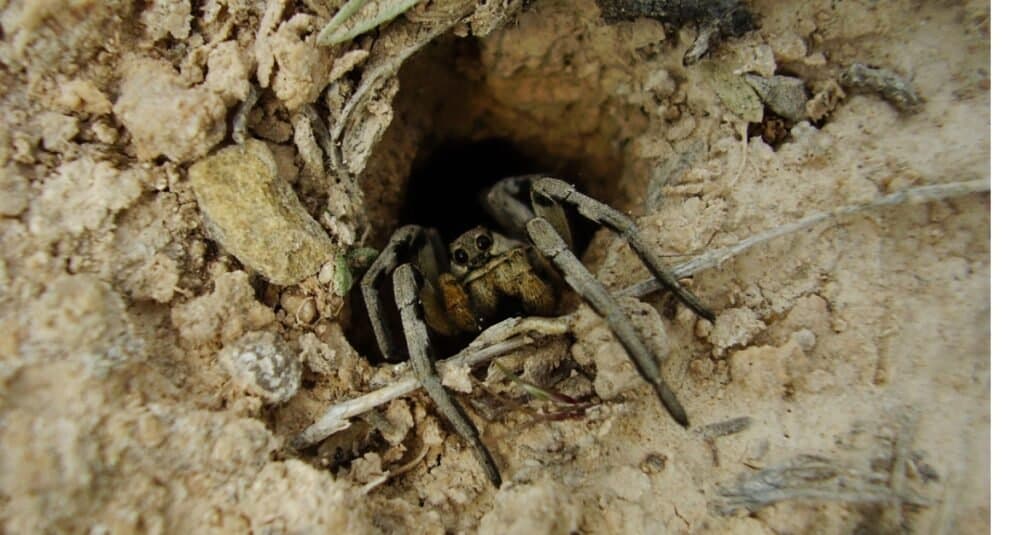
Wolf spiders often dig burrows in the ground.
©iStock.com/martinezcanovas
Fishing spiders are typically found near permanent water sources such as lakes, streams, and ponds. However, some species may also be found in drier, wooded areas or even gardens. Fishing spiders are usually found outdoors, but they occasionally make their way into homes and outbuildings.
Wolf spiders inhabit woodlands, grasslands, fields, meadows, and areas near freshwater sources such as marshes and ponds. They can be found under rocks and leaves, and in logs, tree hollows, or burrows they have dug in the ground.
Hunting Methods and Diet
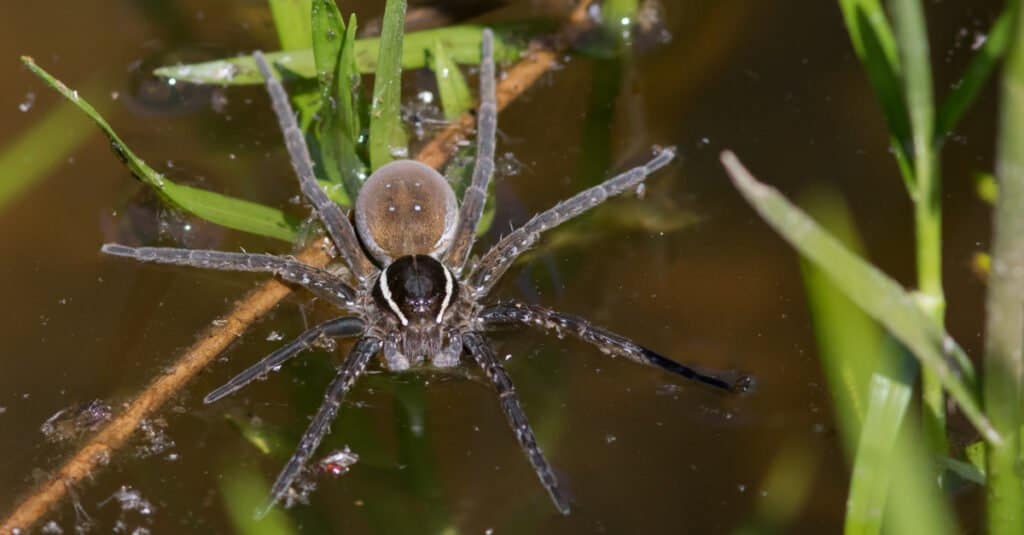
Fishing spiders live near aquatic areas and hunt prey around the water.
©Frode Jacobsen/Shutterstock.com
The fishing spider hunts by using the hairs on its legs to detect prey. Both spiders have trichobothria, the fine hairs on their legs that sense the world around them, but fishing spiders use them as their primary means of finding prey. Fishing spiders have a waxy coating on their legs that allows them to run across the surface of the water. They can also dive to chase down prey. Fishing spiders primarily consume small fish, tadpoles, aquatic insects, and other invertebrates.
Wolf spiders use their excellent vision to locate prey. They often hide in their burrows, ambushing prey that comes in range. Like fishing spiders, wolf spiders can also sense vibrations through the fine hairs on their body. Wolf spiders eat a diet of insects, insect eggs, and small vertebrates like lizards, small amphibians, and mice.
Physical Appearance
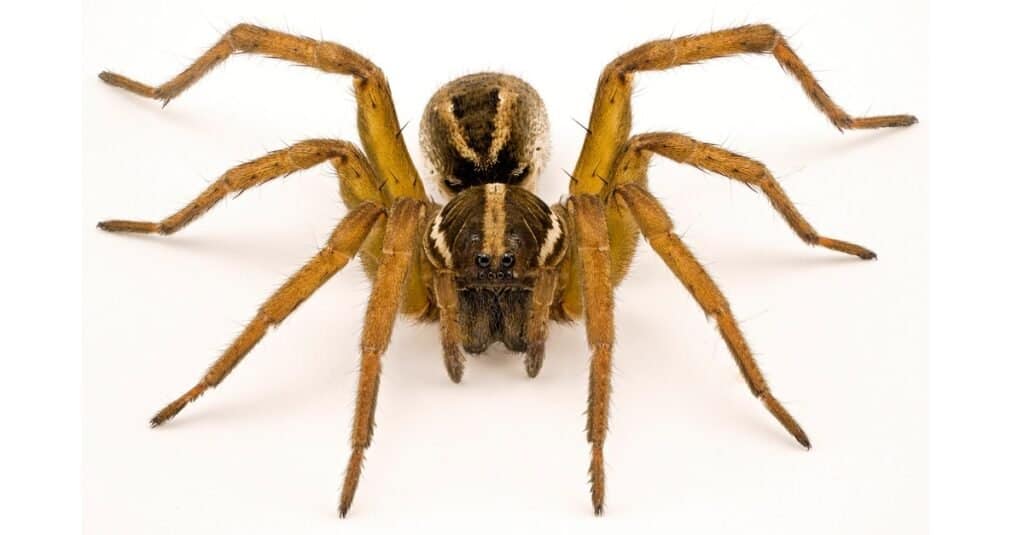
Wolf spiders hold their legs higher in a more bent position.
©iStock.com/Michele Jackson
The physical appearance of both of these spiders varies by species. However, fishing spiders are often brown and gray. They also frequently have banded patterns on their legs. Fishing spiders generally have more flattened bodies than wolf spiders. Fishing spiders also hold their legs out long and straight, almost in a radiating pattern. Their legs may be longer and more slender for skimming the surface of the water and diving.
Wolf spiders have robust bodies that are usually light brown, dark brown, gray, or tan. They frequently have longitudinal stripes running down their backs in either lighter or darker colors. Wolf spiders may also have additional markings on their bodies. Some wolf spiders have banded legs, but many do not. Wolf spiders tend to have slightly shorter but stockier legs for hunting on land. They also hold their legs up higher with a more bent posture.
Vision and Eye Arrangement
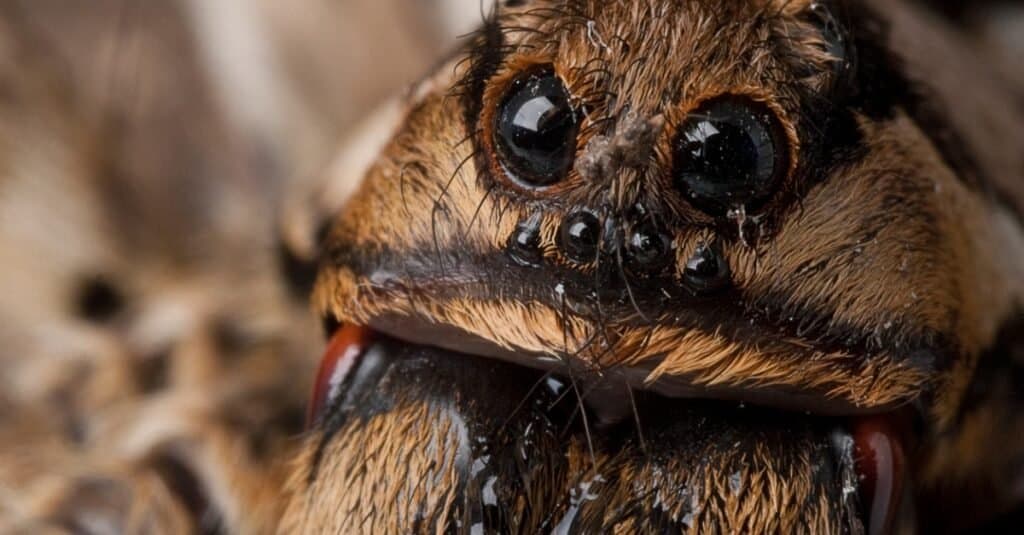
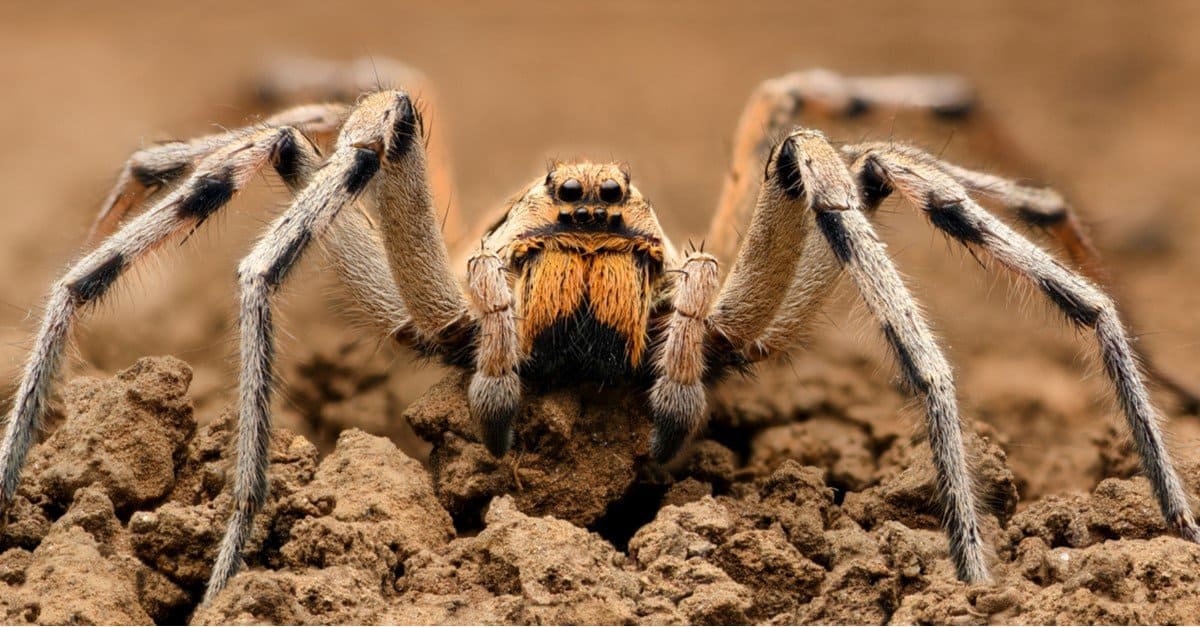
Wolf spiders’ eyes are arranged in three horizontal rows on the center of their heads.
©iStock.com/JAH
All fishing spiders and wolf spiders have a tapetum lucidum layer that reflects light and allows them to see more clearly in low light conditions. Both spiders also have eight eyes, but they are arranged differently. Fishing spiders have two rows of four eyes. Although they are considered to have good vision compared to other spiders, their vision cannot compete with the wolf spider’s vision.
Wolf spiders’ eyes are arranged in three horizontal rows and are centered on the head. They have a row of four small eyes at the bottom, two large eyes in the middle, then a row of two medium-sized eyes at the top. Wolf spiders have excellent vision, which is integral to their hunting strategy. Their two large primary eyes allow them to see in greater detail, and their secondary eyes give them a wide field of vision. Wolf spiders can even see ultraviolet light, which may help them navigate and locate prey, as well as aid in courtship rituals.