
Quick Take
- Neither of these animals is actually what its name suggests, a misidentification that hints at something genuinely strange about how they're built. See their true classifications →
- 160 feet of paralyzing tentacles sounds like the ultimate weapon, but that impression changes once you learn what the electric eel does when a target is too big to shock from the water. See the leaping attack →
- Electric eels don't always hunt alone, and their group strategy is far more coordinated than anyone expected. Explore group hunting tactics →
- One of these animals can't swim, can't chase, and can't flee. That single fact decides everything about which one wins. See why mobility decides it →
Both the Portuguese man o’ war and the electric eel are frequently mistaken for other animals. Despite their names and appearances, these two aquatic animals are neither jellyfish nor eels. Both of them paralyze their prey and can even injure humans, but which one is more dangerous, and which would win in a fight? Read on to find out.
Comparing a Man o’ War and Electric Eel
| Portuguese Man O’ War | Electric Eel | |
|---|---|---|
| Distribution | Found on the surface of tropical and subtropical oceans all over the world | Freshwaters of northern and central South America |
| Appearance | Blue, pink, or violet balloon-like float with long strands of tentacles and polyps | Long snake-like bodies with no scales; greenish-brown, dark grey, or black with yellowish-orange undersides |
| Size | Maximum 12-inch long bell, 30 to 160-foot tentacles | 6 to 9 feet long, depending on species |
| Attack method | Sting with highly toxic venom | Shock with up to 860-volt electrical charges; leaping attack |
| Hunting methods | They eat whatever their tentacles come into contact with | Sending out small shocks to locate prey; herding prey as a group |
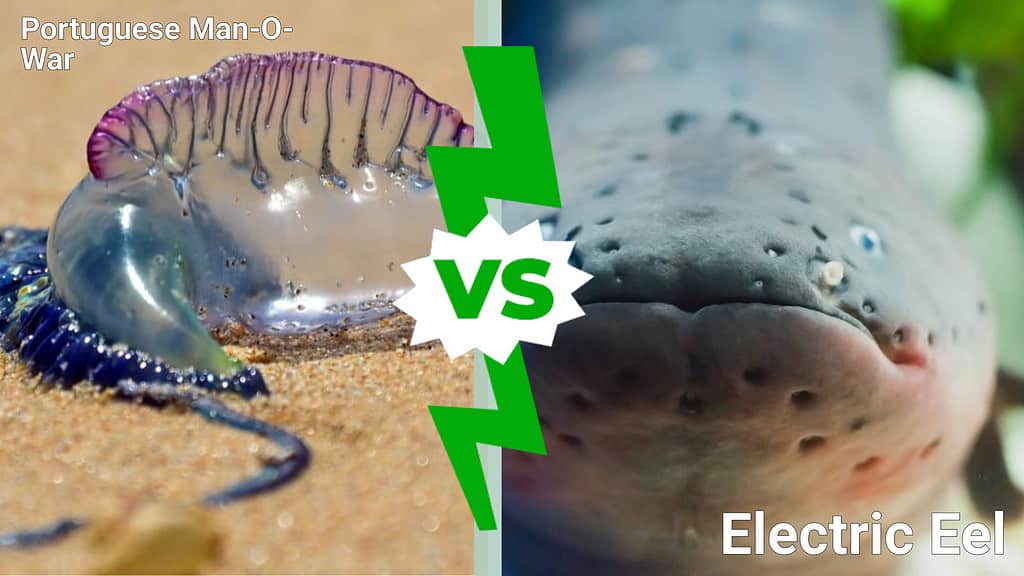
Key Differences Between a Man O’ War and an Electric Eel
There are four species of Portuguese man o’ war (Physalia species). These animals are related to jellyfish, but they are technically siphonophores. A siphonophore is a group of genetically identical individuals called zooids, or clones, with specialized structures and functions that work together as one unit. The electric eel (Electrophorus species) is not actually an eel, it is a knife fish in the family Gymnotidae. There are three electric eel species. While both the man o’ war and the electric eel can kill their prey with just a touch, they differ significantly in distribution, appearance, size, method of attack, and hunting methods.
Distribution
The Portuguese man o’ war is a marine animal found in the open waters of the Atlantic, Pacific, and Indian Oceans. They also occur in the Caribbean Sea and the Sargasso Sea in the North Atlantic. Portuguese men o’ war are most often found in tropical and subtropical waters. However, since they are dependent on the wind and ocean currents for movement, their exact habitat can change significantly. In the U.S. they are most commonly seen in the Florida Keys and around the Gulf.
Electric eels are native to large freshwater river basins in northern and central South America, with the specific habitat depending on the species. Electrophorus electricus is found in the Guiana Shield
region across northern Brazil, Guyana, Suriname, and French Guiana. The species with the highest voltage, Electrophorus voltai, inhabits the clear, high-altitude waters of the Brazilian Shield, which includes parts of Rondônia, Mato Grosso, Pará, and Amazonas states. Electrophorus varii is generally found in the deeper, murkier waters of the Amazon River Basin.
Appearance
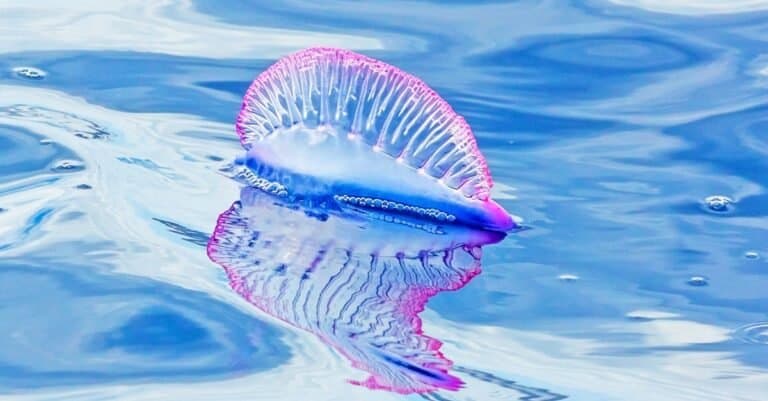
The Portuguese man o’ war looks similar to a jellyfish. It has a large, gas-filled float that looks like a balloon with a sail across the top. The float can be blue, pink, or violet, and it sits up to 6 inches above the waterline. It has long strands of tentacles stretching out below the float. Atlantic men o’ war (Physalia physalis) tend to have larger floats and longer tentacles, while those in the Pacific (Physalia utriculus) have shorter sails and a single, long fishing tentacle. Physalia megalista, found in the South Pacific, has a long, narrow float. Physalia minuta inhabiting the waters south of New Zealand, has a smaller, greenish-colored float with a shorter sail and shorter tentacles.
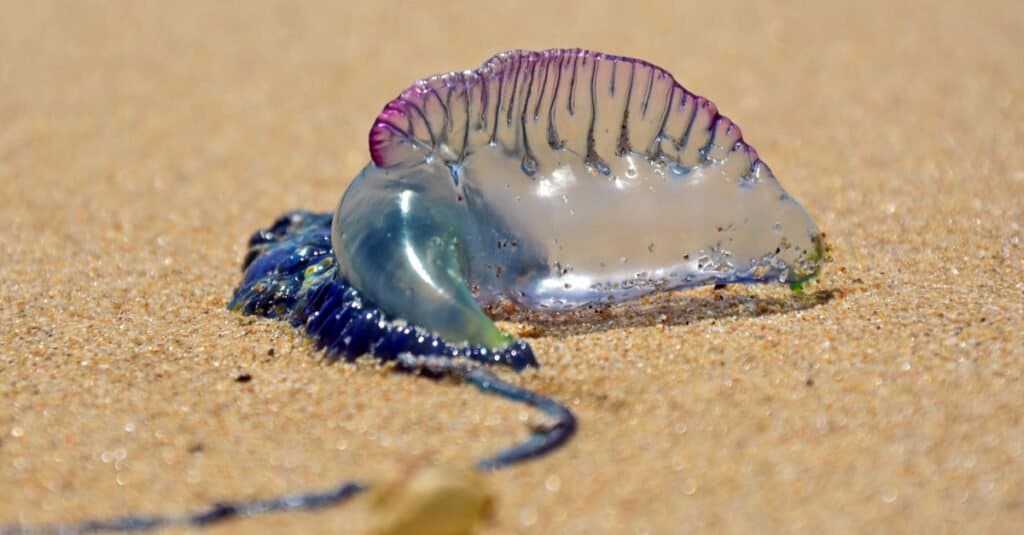
The Portugeuse man o’ war has a large, gas-filled float with a sail-shape across the top.
©KarenHBlack/Shutterstock.com
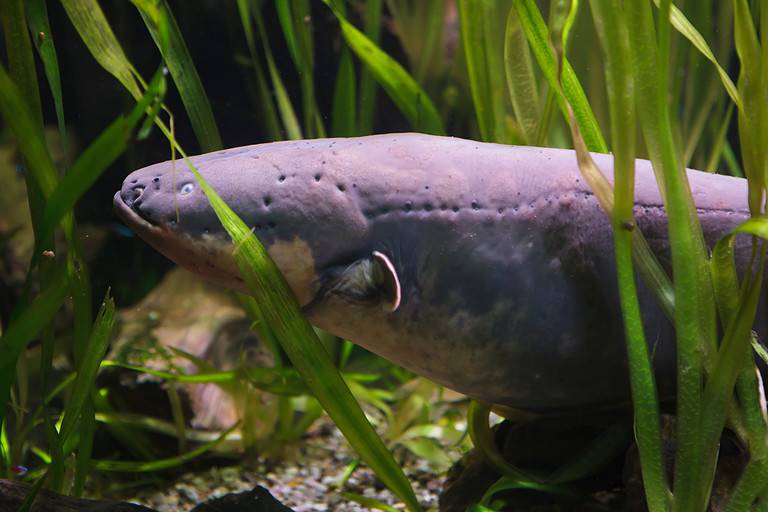
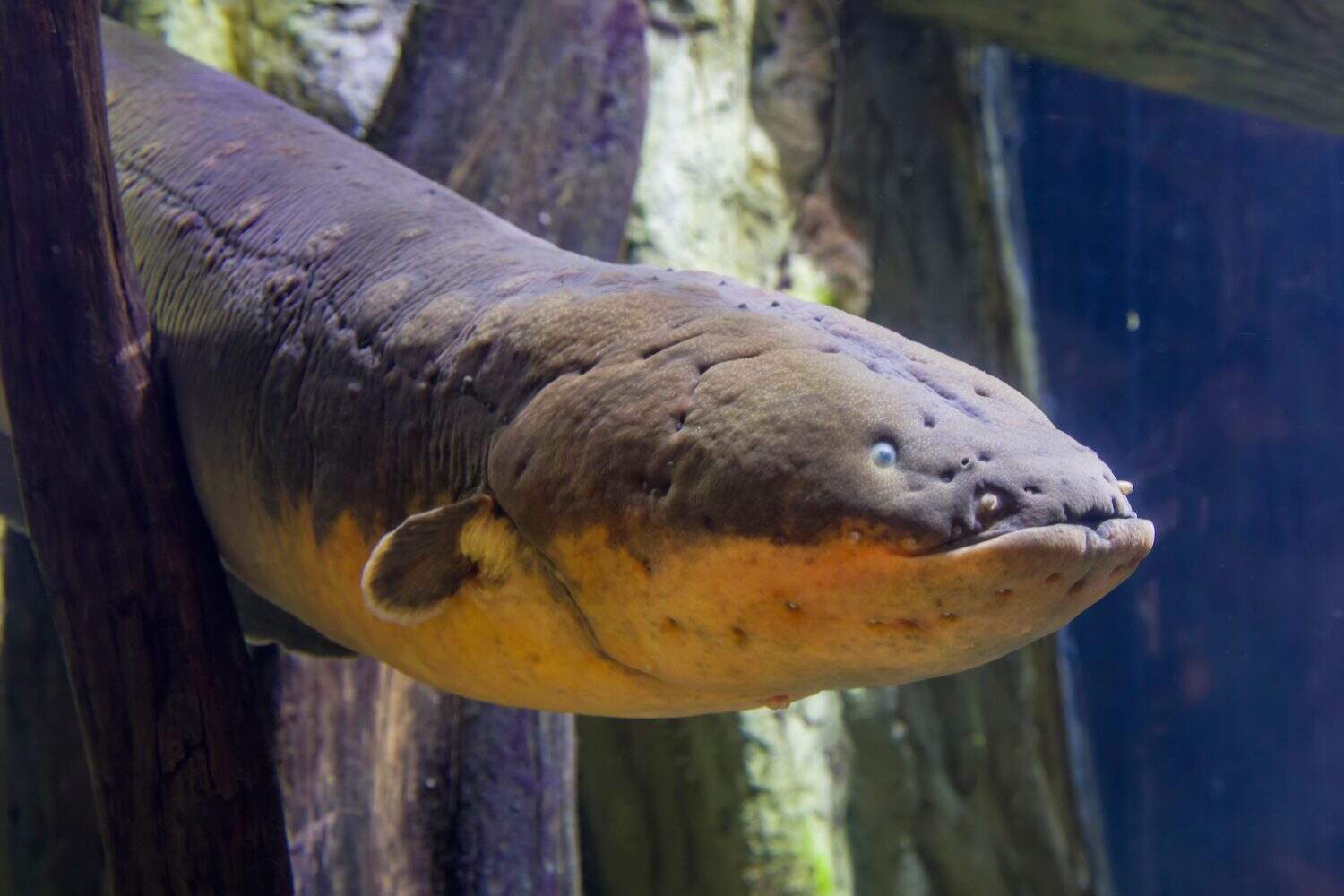
Regardless of species, electric eels have long, snake-like bodies and broad, flat heads. They lack dorsal and pelvic fins, but they have a long anal fin that runs the length of their bodies. Their smooth skin is greenish-brown, dark grey, or black with yellowish-orange undersides.
Size
when it comes to size and length, the man o’ war definitely wins. A Portuguese man o’ war has a tiny body but long tentacles. The float can measure up to 12 inches in length and around 5 inches wide. It floats approximately 6 inches off the surface of the ocean. However, a single long fishing tentacle stretches out from the bell an average of about 30 feet in length. Some men o’ war have had tentacles that measure over 160 feet in length. Portuguese men o’ war generally only weigh up to 1 pound.
The body of the electric eel generally reaches between 6 and 8 feet long. The largest of the three electric eel species, Electrophorus voltai, can grow up to 8 to 9 feet in length. However, electric eels are much heavier than Portuguese men o’ war. Electric eels generally weigh up to 44 pounds, although some individuals may grow larger.
Attack Methods
The Portuguese man o’ war contains a nasty venom in their tentacles, which they use to sting their prey. This is part of why people mistake them for jellyfish. They use a fishing tentacle to stretch out, find prey, and sting it with paralyzing venom. The massively long tentacles contain nematocysts, which are tiny capsules filled with harpoon-like barbs that inject venom. The tentacle on a man o’ war delivers a painful sting capable of killing fish and crustaceans. Its sting is also very painful to humans and typically causes red welts, but it is rarely fatal unless a person experiences anaphylaxis.
The electric eel uses three electrical organs to kill prey: the main organ, the Hunter’s organ, and the Sach’s organ. These organs contain cells called electrocytes that work similarly to batteries. The eel will identify its prey, then its nerves signal to the electrocytes to discharge up to 860 volts of electricity into the water. In the case of larger victims, or predators, the eel will leap out of the water and curl around the body of its partially submerged target. With the eel’s positive end, or head, touching the victim and its negative end, the tail, still in the water, it creates a closed electrical circuit. The shock is directed into the prey instead of being discharged into the water, temporarily paralyzing the victim. Shocks to humans are painful but are rarely deadly. The real danger for humans who have been shocked is drowning while incapacitated.
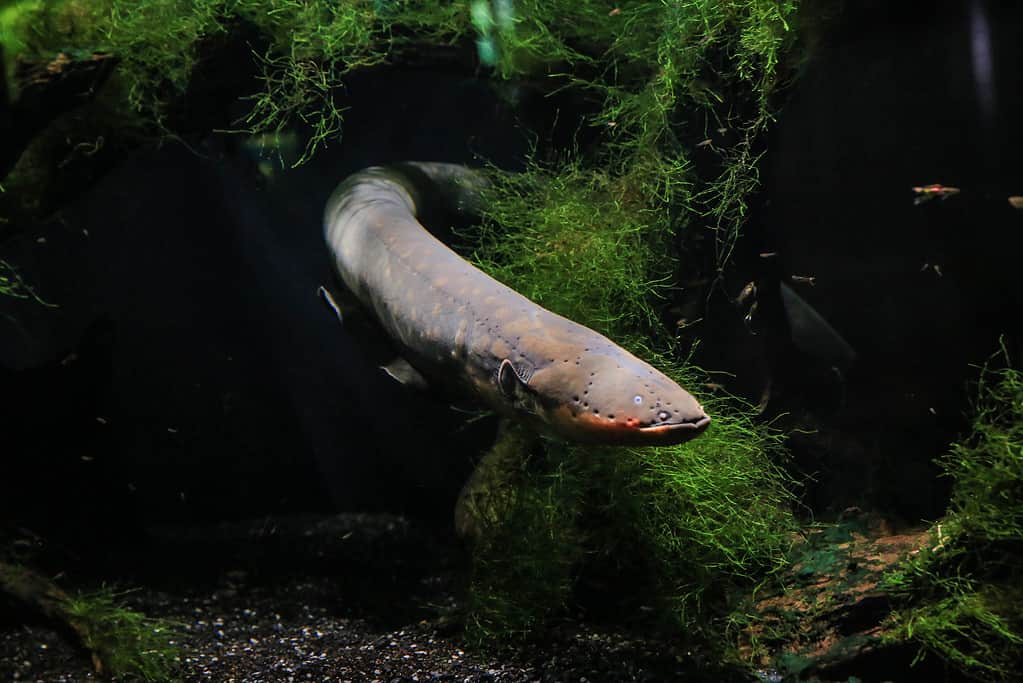
Some electric eels can deliver a jolt of electricity that is up to 860 volts.
©iStock.com/Kseniia Mnasina
Hunting Strategies
Portuguese man o’ war are opportunistic feeders because they cannot swim and do not chase prey. They locate prey by floating in the water and stretching out their tentacles to sting and kill small fish, larvae, plankton, and crustaceans that they come into contact with. They capture their prey by being in the right place at the right time, stretching out their fishing tentacles, and injecting prey with venom.
Electric eels, on the other hand, can be aggressive hunters. They generally hunt by sending out small shocks, forcing the prey’s muscles to twitch. Electric eels have motion-sensitive receptors on the sides of their bodies that detect water displacement when their prey twitches. Scientists have also found that electric eels herd prey as a group. They herd small fish into a ball and simultaneously send out electric shocks, stunning the fish and leaving them paralyzed so the group can feed on their motionless prey.
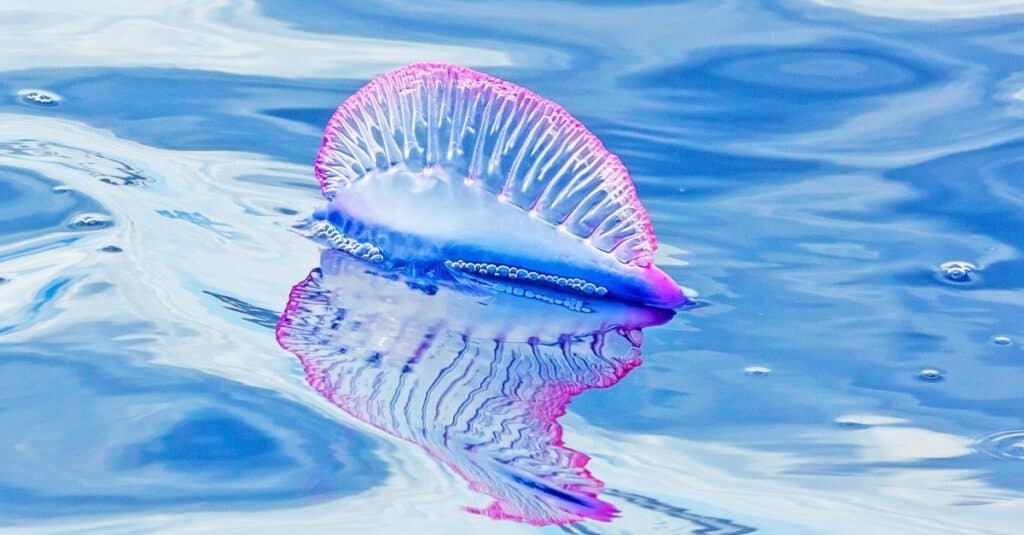
Portuguese Man-O-War drifts in the water, stretching out its fishing tentacle to find, shock, and reel in prey.
©iStock.com/aldorado10
Which Would Win in a Fight Between a Man O’ War and an Electric Eel?
Since a Portuguese man o’ war is a marine animal living in the oceans and electric eels are freshwater fish, their ranges do not overlap. So these animals would never come into conflict. However, electric eels are far more dangerous. A man o’ war may have long reach, but its venom only takes down small prey, not animals the size of electric eels. Men o’ war are also not as aggressive as electric eels, and since they can only drift, they could neither chase nor escape an electric eel. With a shock from 600 to 860 volts, an electric eel could shock a man o’ war into submission.