
Quick Take
- It looks like a jellyfish, but calling it one is a mistake that matters. The Portuguese man o' war is something far stranger. Discover what it really is →
- The most dangerous part of a man o' war is invisible, and it stays lethal long after the creature itself is dead. See the hidden danger →
- A specific combination of ocean and wind conditions turns Florida's Atlantic coastline into a man o' war magnet, and this phenomenon happens on a predictable schedule. Learn why Florida is a hotspot →
Florida’s beaches are famous for soft sand, endless sunshine, and warm ocean waves. But sometimes the ocean water surrounding the Sunshine State packs more of a punch than beachgoers expect.
There’s a silent lurker floating in Florida’s waters—one whose attractive appearance hides its dangerous and sometimes deadly nature. Meet the Portuguese Man o’ War.
What Is a Portuguese Man o’ War?
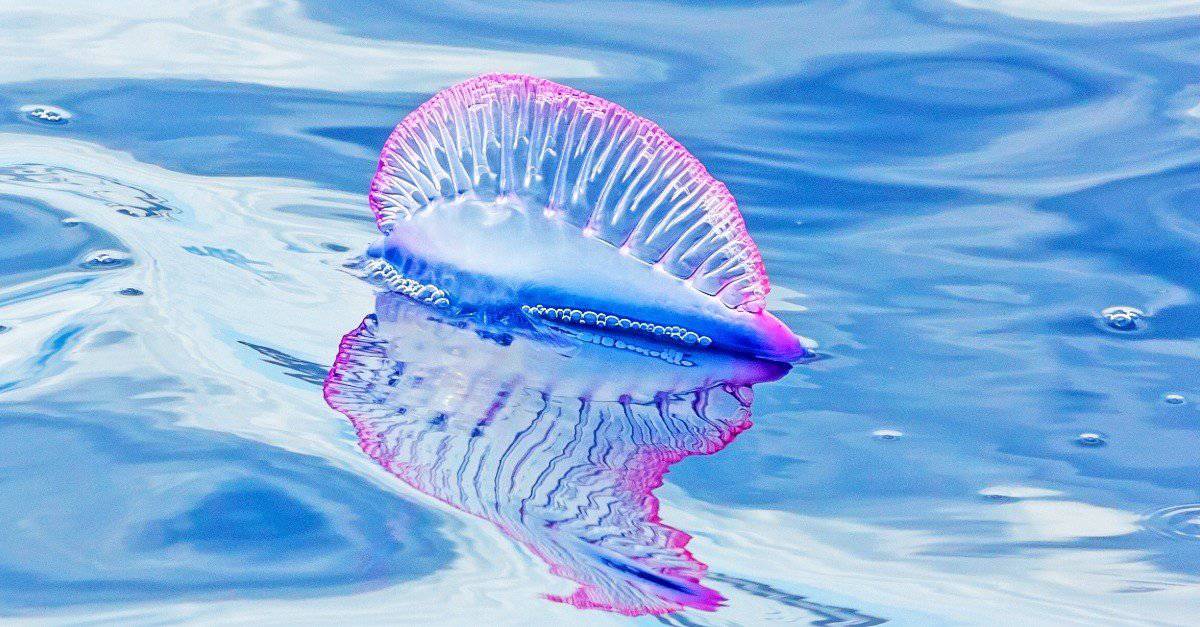
The Portuguese man o’ war, Physalia physalis, looks a lot like a jellyfish to the untrained eye, but it’s not. It’s actually a siphonophore, a collection of many tiny living beings – called zooids – that live together as a single unit. Each of the zooids has a unique role to play within the unit. Together, they keep the larger organism alive and thriving.
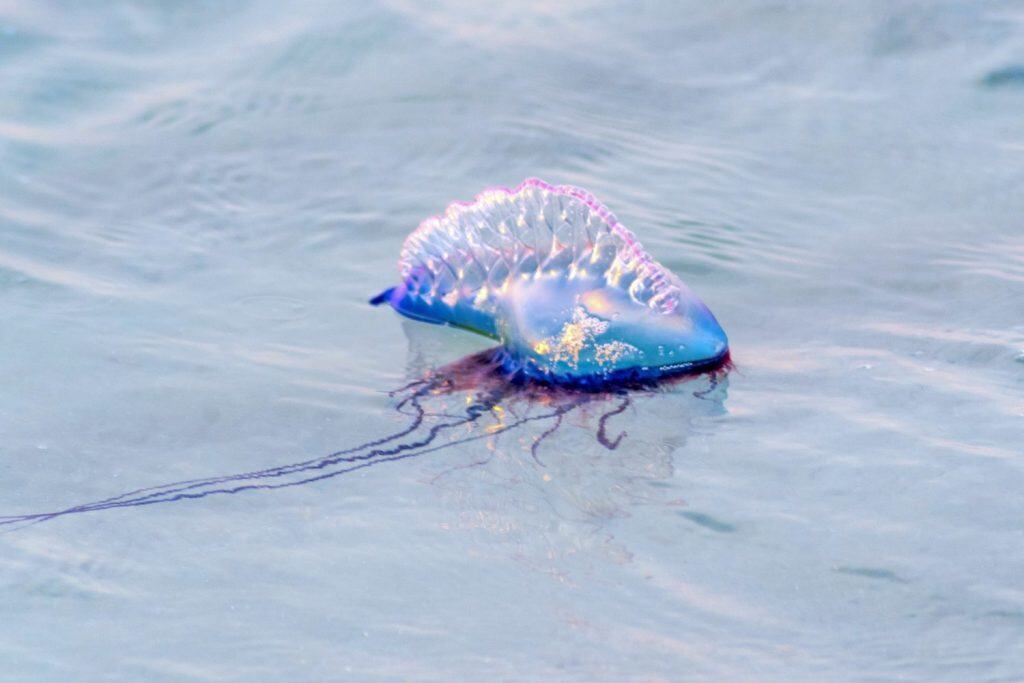
The Portuguese man o’ war has a large, gas-filled bladder that keeps the species afloat in the water.
©BSG_1974/Shutterstock.com
One of the most distinctive features of a Portuguese man o’ war is the part you see above the water. It is called the pneumatophore and is an eye-catching shade of purple and blue. It is a gas-filled bladder that acts like a sail to help the man o’ war move across the water. But the man o’ war can’t control its own direction. It just drifts along wherever the wind and current take it.
The Most Dangerous Part of a Portuguese Man o’ War
The gas-filled bladder is the pretty part of the man o’ war. The real dangers lurk below the waterline. That’s where the man o’ war’s tentacles exist. The number of tentacles an individual man o’ war has depends on several factors – its age, condition, and the size of its floating bladder. However, the number of tentacles doesn’t really matter.
It is their length, arrangement underwater, and the stinging cells on each tentacle that make the man o’ war so dangerous.
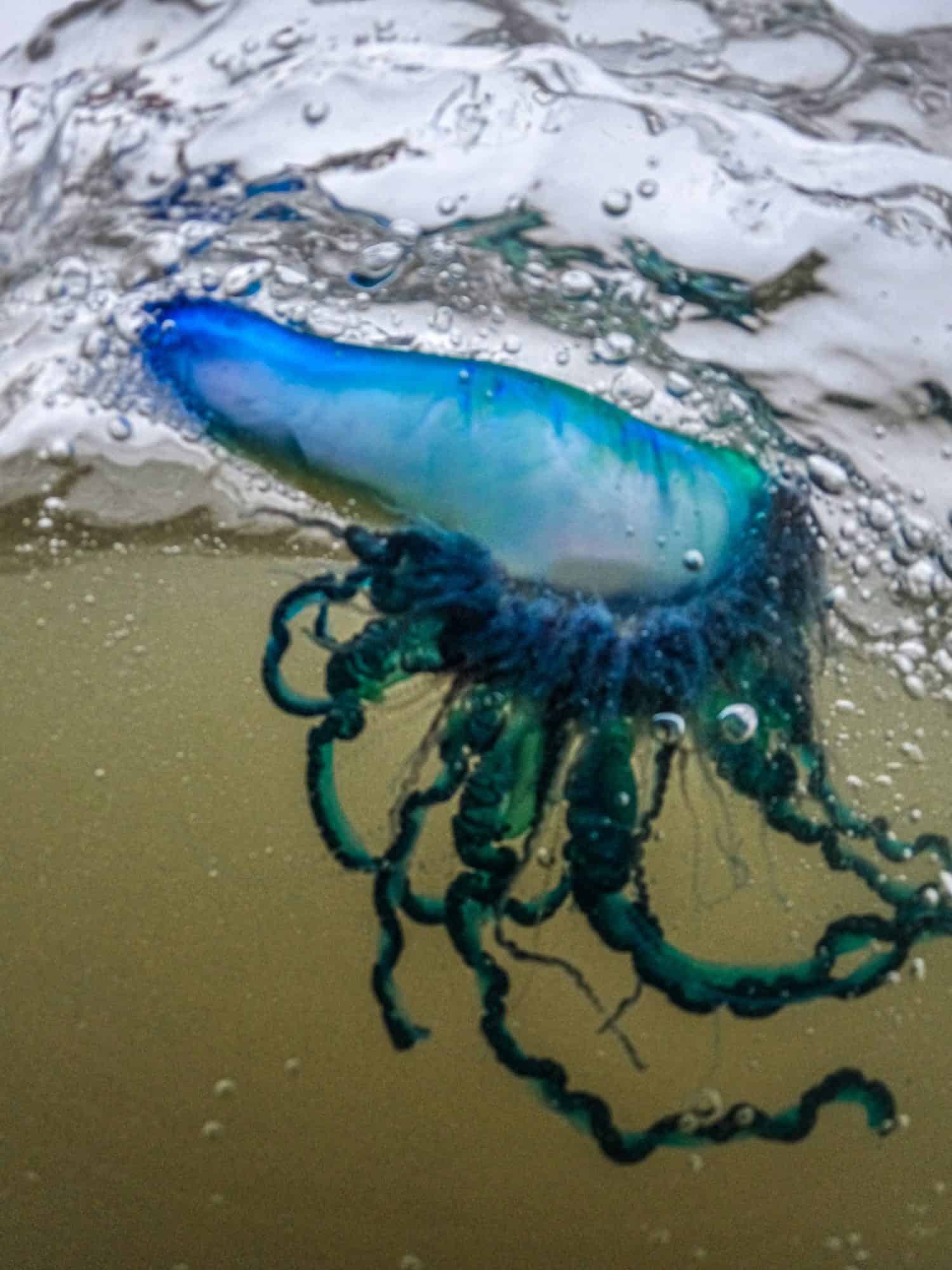
The man o’ war has tentacles that can reach up to 165 feet in length.
©H2osol/Shutterstock.com
Each man o’ war tentacle is covered with stinging cells called nematocysts and can reach up to 165 feet in length, intertwining into a tangled mass that extends downward from the gas-filled bladder. Each of these cells is filled with venom that causes welts and severe pain. In some cases, a sting from a man o’ war’s tentacles can cause anaphylactic shock or cardiac arrest, both of which can be fatal.
Another interesting and dangerous fact is that the tentacles remain venomous even after the man o’ war is dead. This means that even if you stay out of the water, you can still get stung if you encounter the nearly invisible tentacles on the beach.
Why Are There So Many Man o’ Wars in Florida’s Waters?
Florida’s east coast is a prime area for man o’ wars. This is due to a combination of the nearshore Gulf Stream and strong northerly winds that affect the area during the fall and winter months. Together, they act like a man o’ war superhighway, bringing the creatures to Florida beaches.
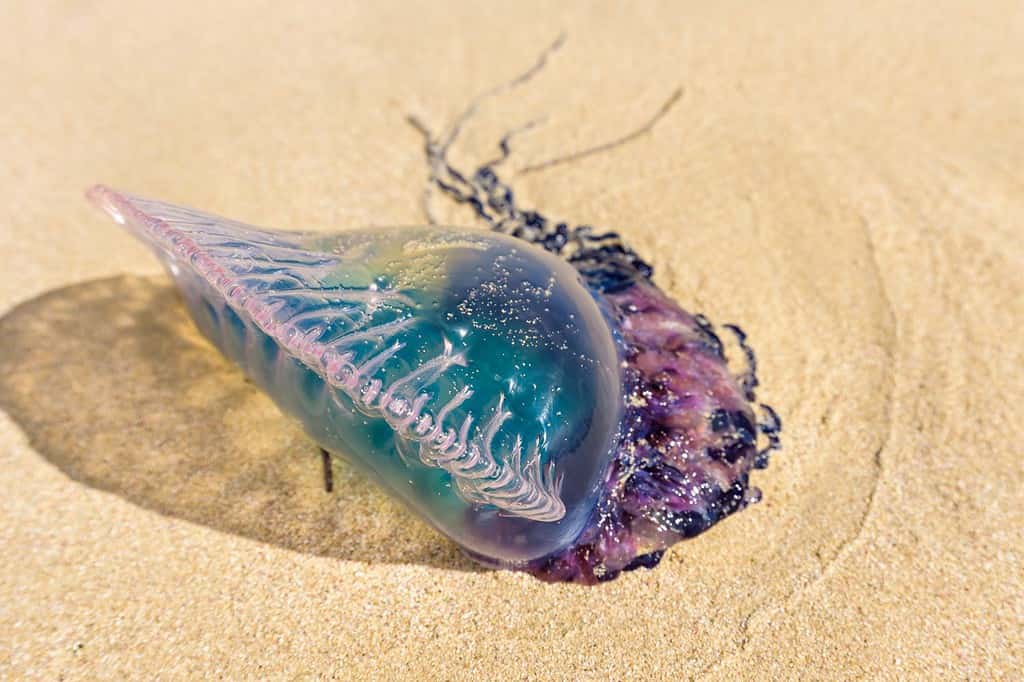
Even after they die and wash ashore, man o’ war tentacles can still sting.
©Roberto La Rosa/Shutterstock.com
Since man o’ wars are guided by wind and current, it is not uncommon to find masses of them grouped together in the water. This is why beach closures, especially along Florida’s Atlantic coast, are common when man o’ wars are present.
The Case of Mistaken Identity
Man o’ wars are often mistaken for other objects, leading to unfortunate interactions with humans. People sometimes mistake the man o’ war for a piece of plastic floating on the water and are shocked when they retrieve it. Once on shore, man o’ wars quickly deflate, losing their shape and color. Beachcombers often receive a painful surprise when picking up what they believe is a piece of beach glass.
What to Do If You Get Stung
Whether you are stung in the water by unseen tentacles or accidentally step on a man o’ war on the beach, the sting is unforgettable—and not in a good way.
Don’t Do This
If you are stung by a man o’ war, do not rely on common myths about treating the sting. Urine is not a proven remedy, so politely decline if someone suggests it, regardless of their intentions.
Also, avoid rubbing the sting with sand or a towel, as friction and pressure can trigger the nematocysts to release more venom. Sand can also embed tentacle fragments deeper into your skin.
Do This Instead
If you are stung by a man o’ war, follow these steps:
- Get out of the water immediately. The tentacles will likely still be attached, but getting away from the source is the first step.
- Try to remove the tentacles using something like a credit card, a stick, or a shell from the beach to flick them off.
Do not use your bare fingers, as you will be stung again. Also, do not rub the area. - Rinse the area with seawater. Do not use freshwater, as it will cause any remaining nematocysts to release more venom.
- Soak the affected area in hot (but not scalding) water. The heat helps break down the venom.
Take over-the-counter medications to reduce swelling and pain.
When to Seek Medical Help
In some situations, getting medical help is necessary. Any of the following signs or symptoms merit immediate medical care.
Seek immediate medical care if you experience signs of an allergic reaction, such as difficulty breathing or swelling beyond the sting site; chest pain, nausea, or dizziness; extensive stinging over large areas of the body; or if the victim is elderly or a young child.
In rare cases, Portuguese man o’ war stings can be fatal. Seek immediate medical attention if symptoms worsen.