
Quick Take
- One insect on this list goes beyond simply hiding from predators by using its disguise to lure them into a trap. See the trap in action →
- Some of these camouflaged insects fool human experts in the wild, yet one predator sees right through every disguise on this list. Meet the expert-fooling moth →
- The most jaw-dropping camouflage here goes beyond the visual. One species physically mimics a leaf's movement to complete the illusion. Watch the leaf illusion move →
- One butterfly looks completely different depending on whether its wings are open or closed. That split-second switch is its survival strategy. See the split-second switch →
The better an insect can camouflage itself, the higher its chances of survival. Because of this, adaptation and evolution have created some of some of the most remarkably camouflaged insects in the world. While some have evolved to look like sticks and leaves, others have evolved to look like plants and petals. Even for experts, it may be difficult to spot one in the wild. Continue reading to learn about intriguing insects that have evolved to look like leaves.
Giant Malaysian Leaf Insect
The Giant Malaysian Leaf Insect (Pulchriphyllium giganteum, formerly Phyllium giganteum) is one of the most iconic leaf mimics of all time. Its body appears to be a curling, browning leaf while its legs appear to be broken leaf segments. These insects are found throughout the tropics of Malaysia, in warm, humid areas.

The average lifespan of a giant Malaysian leaf insect is roughly one year.
©Bernard DUPONT from FRANCE / CC BY-SA 2.0 – Original / License
Birds enjoy snacking on the giant Malaysian leaf insect. When these insects sense one nearby, they become incredibly still in an attempt to blend in with their surroundings. Often, this strategy proves successful due to their remarkable likeness to leaf litter.
Katydid
When people think of insects that look like leaves, chances are they’re picturing the common true katydid (Pterophylla camellifolia). Also known as long-horned grasshoppers or bush crickets, true katydids mimic both the appearance and behavior of leaves. If one senses a predator nearby, it will gently flutter its body to mimic a leaf blowing in the wind, blending in even more effectively.

It is difficult for predators to spot a common true katydid.
©Bernard DUPONT from FRANCE / CC BY-SA 2.0 – Original / License
The common true katydid is distributed throughout the eastern United States, from Maine to Florida, and into southeastern Canada.
Moss-mimic Stick Insect
The moss mimic stick insect (Antongilia laciniata) bears an incredible resemblance to a stick covered in mossy vegetation and blends into any lush environment with ease. The insect’s entire body and legs are covered in tiny, green lobes and hair-like projections that accurately mimic the appearance of live moss growing on tree bark.

The moss-mimic stick insect is endemic to Madagascar.
©Frank Vassen from Brussels, Belgium / CC BY 2.0 – Original / License
Orange Oakleaf Butterfly
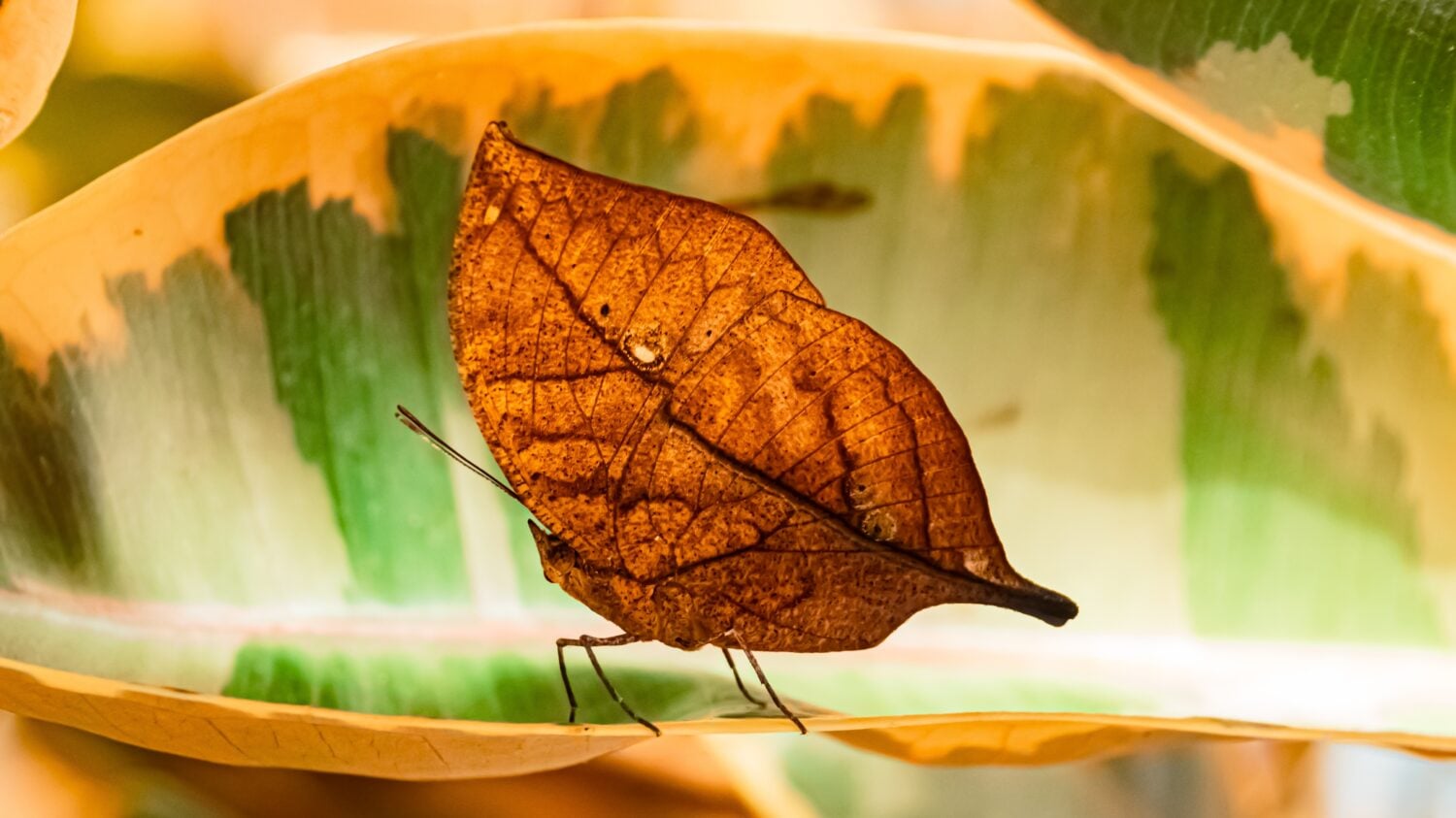
When the orange oakleaf butterfly (Kallima inachus) opens its wings, it is a beautiful blue and orange butterfly. However, when the orange oakleaf butterfly closes its wings, it appears to be a dead leaf.

The wingspan of an orange oakleaf butterfly can range from about three and a third to four and a third inches.
The orange oakleaf butterfly is found in Myanmar, China, India, Japan, Thailand, and other countries. It is preyed upon by birds, spiders, and other insects. However, this little butterfly has more than one line of defense. In addition to its camouflage, the orange oakleaf butterfly is an incredibly strong flier and capable of remarkably agile defensive maneuvers when threatened.
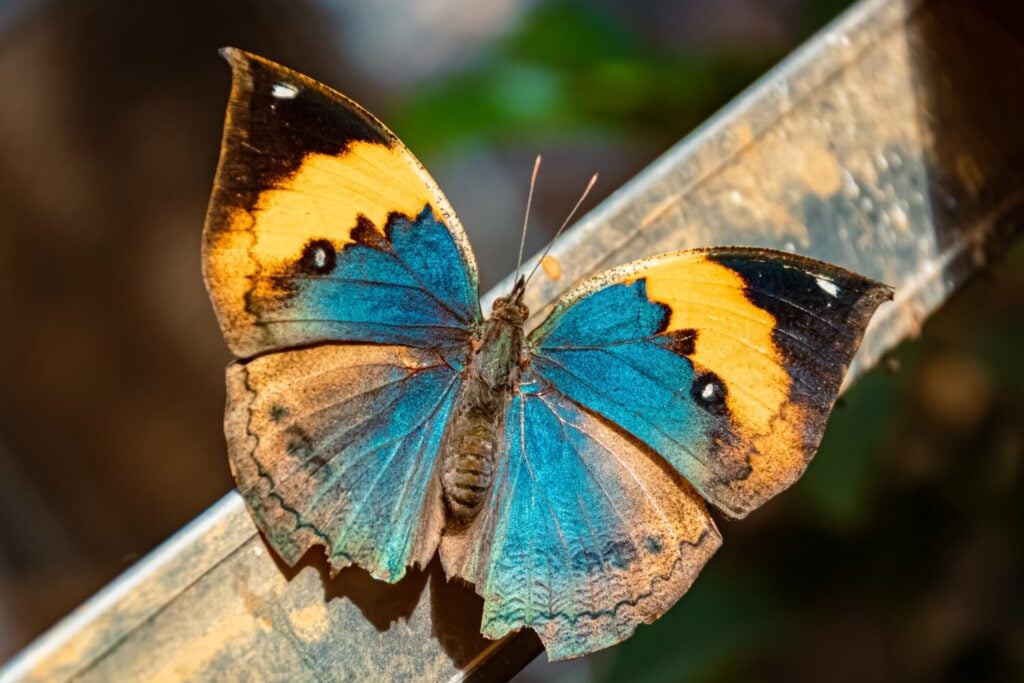
When its wings are open, the orange oakleaf butterfly looks very different than when its wings are closed.
©Martin Erdniss/Shutterstock.com
Leaf-mimicking Grasshopper
If the intricacy of camouflage were judged in a competition, the leaf-mimicking grasshopper (Chorotypus gallinaceus) would take home the grand prize. Though far simpler mimicry would likely be just as effective, the level of detail in the leaf-mimicking grasshopper’s appearance is astounding.

Dead leaf grasshoppers are entirely herbivorous.
©Pavel Kirillov from St.Petersburg, Russia / CC BY-SA 2.0 – Original / License
The sides of the leaf-mimicking grasshopper’s body resemble two curled-up dead leaves, complete with visible veins. If this insect were standing among a pile of leaf litter, distinguishing it would be nearly impossible even for a seasoned entomologist. The leaf-mimicking grasshopper is native to Southeast Asia, particularly Malaysia.
Giant Thorny Devil Stick Insect
The giant thorny devil stick (Eurycantha calcarata) is a combination of many forms of mimicry. The giant thorny devil stick may appear to be a piece of bark, a dead branch, thorns, or leaf litter. This gives it the ability to blend into many different environments and go undetected.
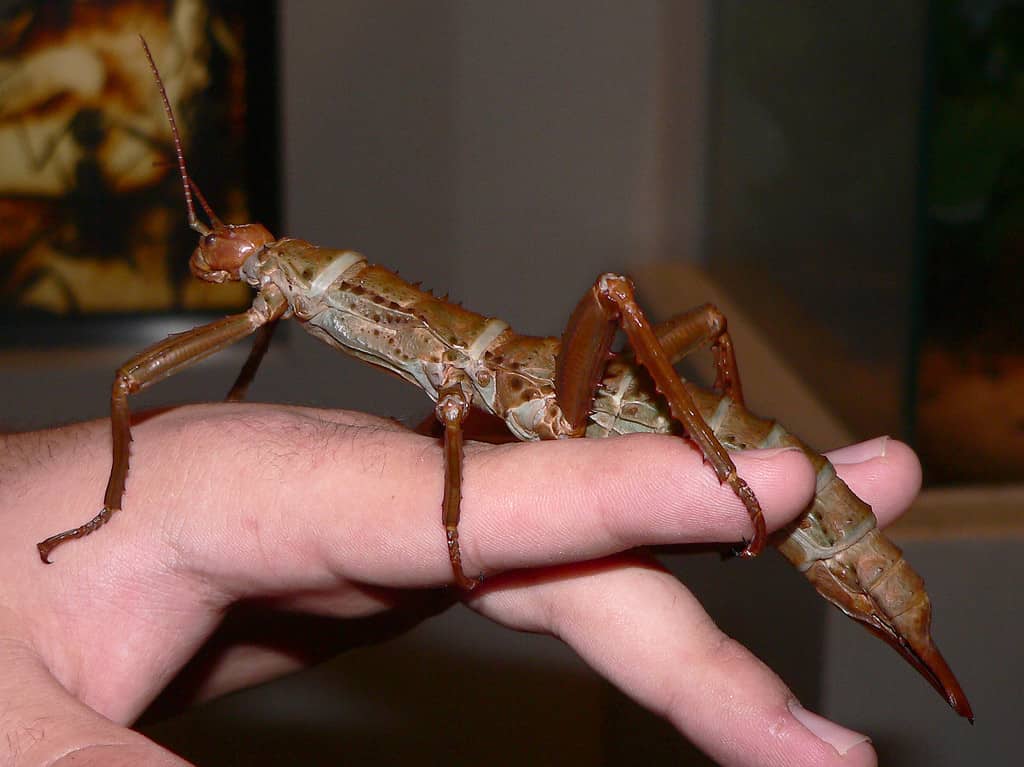
The thorny devil stick insect is found in Papua New Guinea, the Bismarck Archipelago, and the Solomon Islands.
Due to their unique camouflage and large size, one might think that not many animals would be willing to eat these insects. However, the thorny devil is preyed upon by bats. Bats rely on echolocation rather than sight, so they aren’t duped by the thorny devil’s impressive mimicry.
Dead-Leaf Moth
The dead leaf moth (Uropyia meticulodina) is one of one of the most stunning examples of evolutionary camouflage. While at rest, the closed wings of this moth appear to be a dead, curled-up leaf.

The dead leaf moth was first described in the 1800s.
This mimicry is so successful that professionals report difficulty finding these moths in their natural habitat. When these moths sense that danger is nearby, they become very still and silent. This is usually enough to fool their predators, who routinely pass over them. These moths are native to Taiwan, Japan, and China.
Giant Prickly Stick Insect
Commonly known as Macleay’s spectre, the giant prickly stick insect (Extatosoma tiaratum) is native to New Guinea and Australia. These stick insects sway back and forth when they feel threatened, attempting to appear as if they are a wind-swept leaf.

Giant prickly stick insects are also sometimes called Australian walking sticks.
The giant prickly stick insect has captured the hearts of many people, with some enthusiasts calling their appearance and mannerisms adorable. Whether you love them or find them unsettling, it is hard not to be impressed by them.
Orchid Mantis
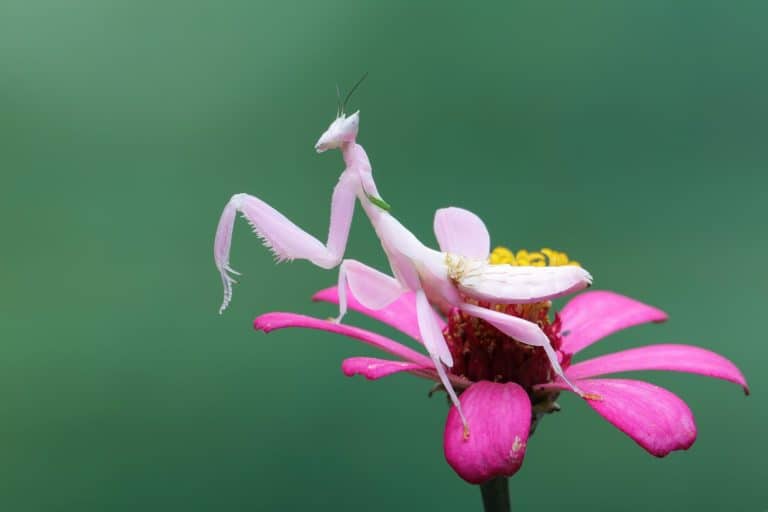
While orchid mantises (Hymenopus coronatus) may not look like leaves per se, they have adapted to look like flowers. As beautiful as they are, orchid mantises are also impressive hunters, and they are native to Southeast Asia.

Female orchid mantises are nearly twice as big as males.
Unlike other entries on this list, these insects use what is called aggressive mimicry. Aggressive mimicry differs from normal mimicry in that it is used not only as camouflage but also to attract prey. Orchid mantises sit among flowers, waiting for smaller insects to approach. Before the prey can tell that a mantis is hiding among the orchids, it is often too late.