
Quick Take
- Only a tiny fraction of the world's 4,500 cockroach species are actually pests, and one of them looks nothing like what you'd expect. Meet this unusual roach →
- The domino roach's polka-dot pattern is more than just striking. It turns out to be a calculated bluff against a far more dangerous insect. See the mimicry explained →
- Domino roach babies are completely unrecognizable from their parents, and the trigger behind their dramatic transformation is stranger than you'd think. Discover the nymph transformation →
- Some roach enthusiasts keep these as pets, but there's one unexpected challenge that catches most first-time owners off guard. Explore the pet challenges →
Roaches, despite their ability to survive practically anything, have a bad reputation. When people think of cockroaches, things like filth, squalor, and unhygienic living immediately spring to mind. While it’s true that many types of cockroaches infest living spaces, there are several roaches found across the world that aren’t likely to be pests. As seen in this Instagram reel, the Indian domino cockroach looks more like a die or domino piece than your typical reddish-brown German or American cockroach.
As the video shows, these roaches have an uncanny resemblance to gambling dice or dominoes. They move with a flurry of activity and coalesce around each other. They leapfrog on top of each other and huddle up. This grouping behavior gives the appearance of one much larger creature covered in spots. Is there a reason they gather together like this? Let’s explore this behavior, why these roaches have spots, and other fascinating details about these little creatures.
Domino Roach Background
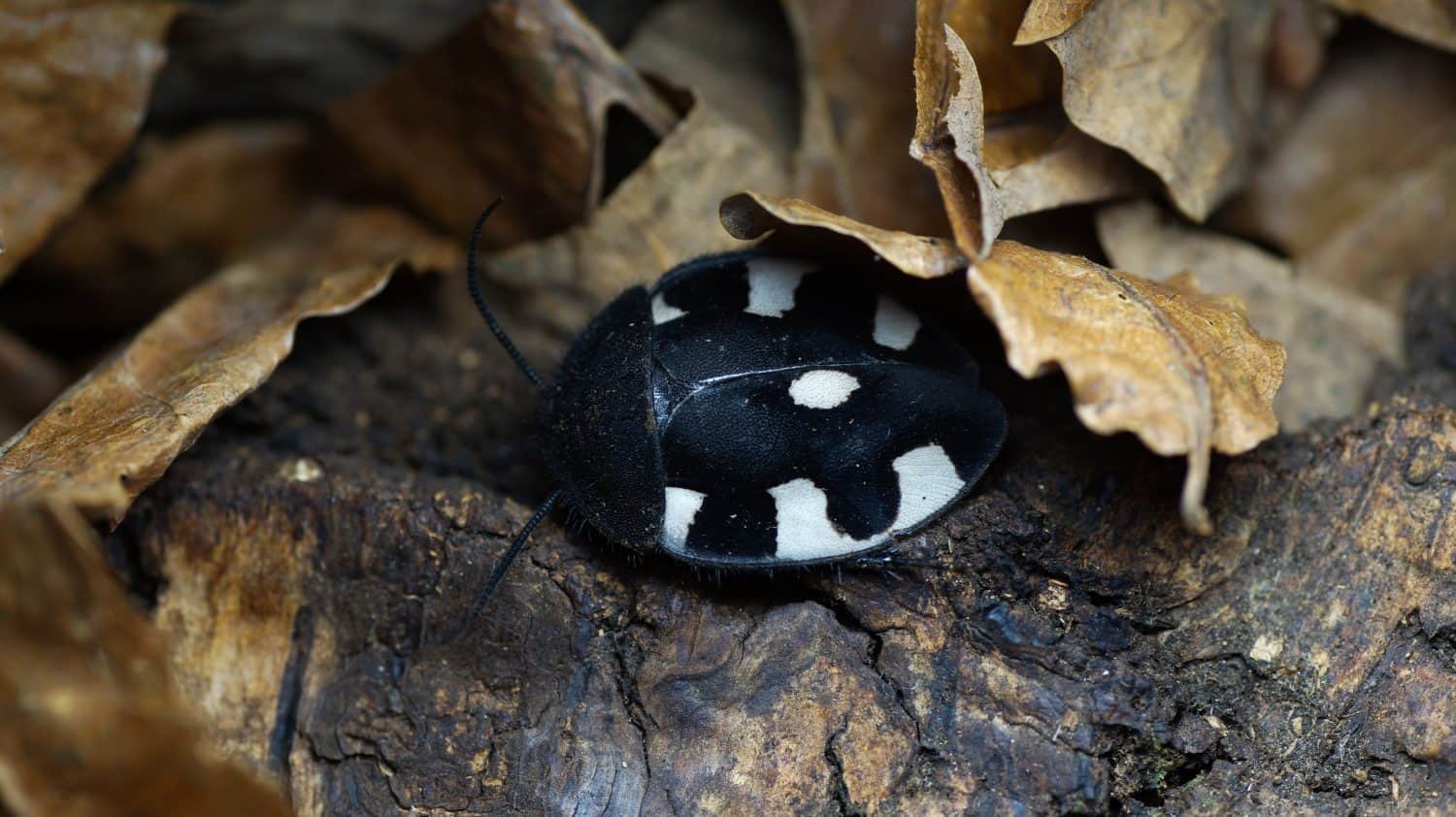
Unlike many cockroach species, Indian domino roaches have round frames with distinct polka dot-like marks on their glossy black bodies.
©morslasdert/Shutterstock.com
There are approximately 4,500 known species of cockroach found worldwide. Despite their horrible reputation, only 30-40 of those species are actual pests that can infest human settlements. The rest are a surprisingly diverse collection of fascinating creatures, ranging widely in size, color, shape, and temperament. One of the most visually striking cockroaches is the Indian domino cockroach. This species, Therea petiveriana, is also known as the desert cockroach and the seven-spotted cockroach.
While some roach species prefer wood as a substrate, these small, round roaches prefer leaf litter on the ground. Native to the scrub forests of southern India, domino roaches stand out due to their domino-like or playing-dice-like appearance. They feature round bodies with glossy black coloration accentuated by bright white or cream-colored spots.
In the forests, domino roaches can be hard to spot despite their striking appearance. They are crepuscular, fossorial creatures, meaning they only become active during dawn and dusk, spending most of their time beneath leaf litter or underground. In the context of India’s seasonal monsoons, this behavior keeps them safe from rapidly shifting, heavily wet weather conditions.
Falling Dominos
As seen in this Instagram reel, a collection of domino roaches huddle together to give the appearance of a much larger creature. It is hard to conclusively identify the behavior in this clip, but there is a good chance that it involves a mating pair and several other suitors. When a female domino roach copulates with a male, she kicks other males away with her hind legs.
Domino roaches are small creatures, no more than two to three and a half centimeters in length. Scientists believe that their striking polka-dot bodies are a form of defense mimicry. Another type of insect found in Southern Asia, the six-spot ground beetle (Anthia sexguttata) has a similar black and white spotted appearance. A little larger than the domino roach, this beetle has strong defense mechanisms, including the ability to spray predators with chemical irritants. It’s likely that the smaller-sized domino roach evolved its appearance to trick predators into thinking it is the much more ferocious six-spot ground beetle.
Interestingly, domino roach nymphs look unrecognizable compared to their parents. Before they mature, domino roach nymphs have the appearance of a small, brown, otherwise unremarkable insect. The nymphs are even harder to spot as they spend most of their time underground. It is not until they mature into adults and undergo a final molt that they take on the characteristic domino appearance. Like the six-spot ground beetle, domino roaches also release chemicals. Some of these are pheromones for intraspecies communication, but others are irritants known to induce alarm behavior in other creatures.
Pests or Pets?
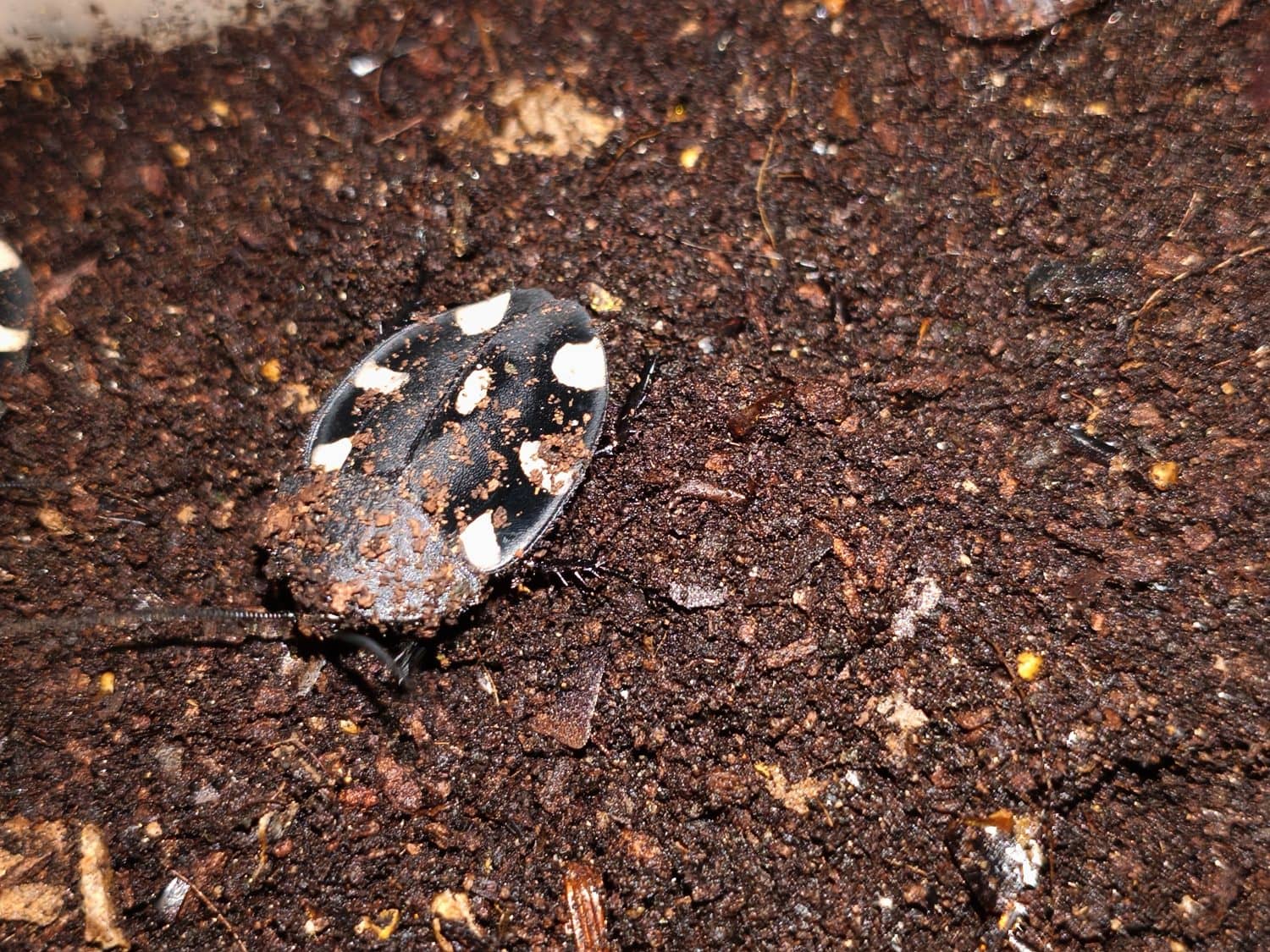
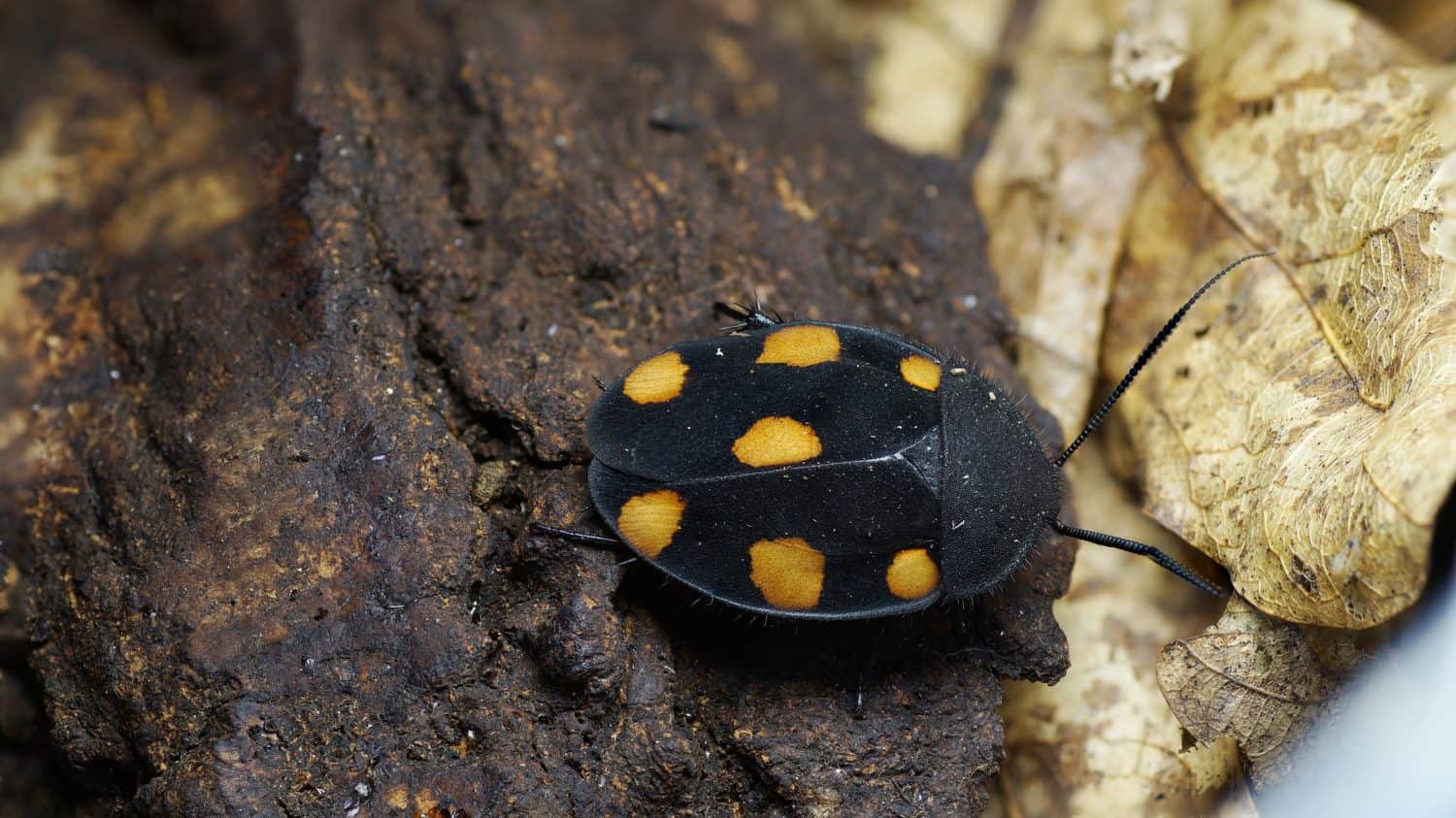
Domino roaches are commonly kept as pets, but they require a specialized substrate akin to leaf litter to thrive.
©Federico Cruz Calero/Shutterstock.com
Roaches may be pests to most people, but Indian domino roaches are commonly kept as pets. They are relatively docile compared to other roaches, and basically incapable of flying or biting. This makes them prized pets for a certain type of enthusiast. That said, there are challenges to keeping domino roaches as companion creatures. They require a specialized substrate equivalent to the leaf litter found in their native habitats. They typically eat dead leaves and other organic detritus, but they also benefit from small amounts of protein, such as fish flakes.
Another obstacle in keeping Indian domino roaches as pets is their inability to be contained, as they can climb smooth surfaces like glass. Keeping them contained requires escape-proof enclosures. To scientists and insect collectors alike, the Indian domino roach stands out thanks to its striking appearance and defensive evolutionary adaptations.