
Quick Take
- The largest specimen of Gauromydas heros on record is a female with a wingspan of 4.6 inches.
- Mydas flies do not have stingers, but they are Batesian mimics of large wasps, which means they resemble these stinging insects as protection from predators.
- Counter-intuitively, the world’s largest female flies maintain their massive size without consuming any food as adults.
- Flies are actually important pollinators, second only to bees.
Flies are among the most diverse groups of insects in the world. They are found in virtually every habitat and on every continent in the world apart from Antarctica. There are thousands of different species, and they come in a variety of shapes and sizes. While the world’s smallest fly, Euryplatea nanaknihali, only measures 0.015 inches long, others are shockingly large. So, just how big can flies really get? Join us as we discover the largest fly in the world.
About Flies
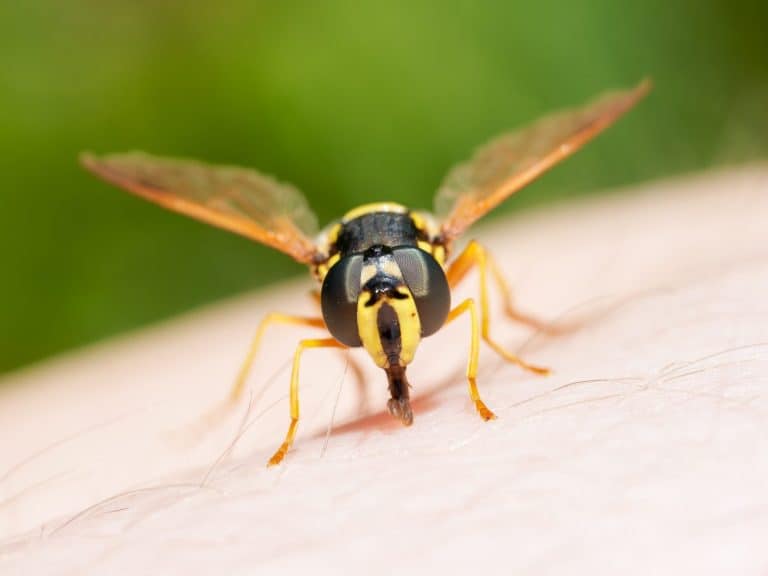
Flies are insects in the order Diptera, which contains over 150,000 different species, including horse flies, crane flies, midges, and mosquitoes. Insects in this order are characterized by a single pair of membranous wings. The term Diptera comes from the Greek words “di,” meaning two and “ptera,” meaning wings. These insects also have tiny, club-shaped, modified hind wings called halteres that help them maintain balance during flight. Other characteristics include a streamlined body, large eyes, mouthparts adapted for sucking, and hairy, sticky pads on their feet to help them cling to smooth surfaces.
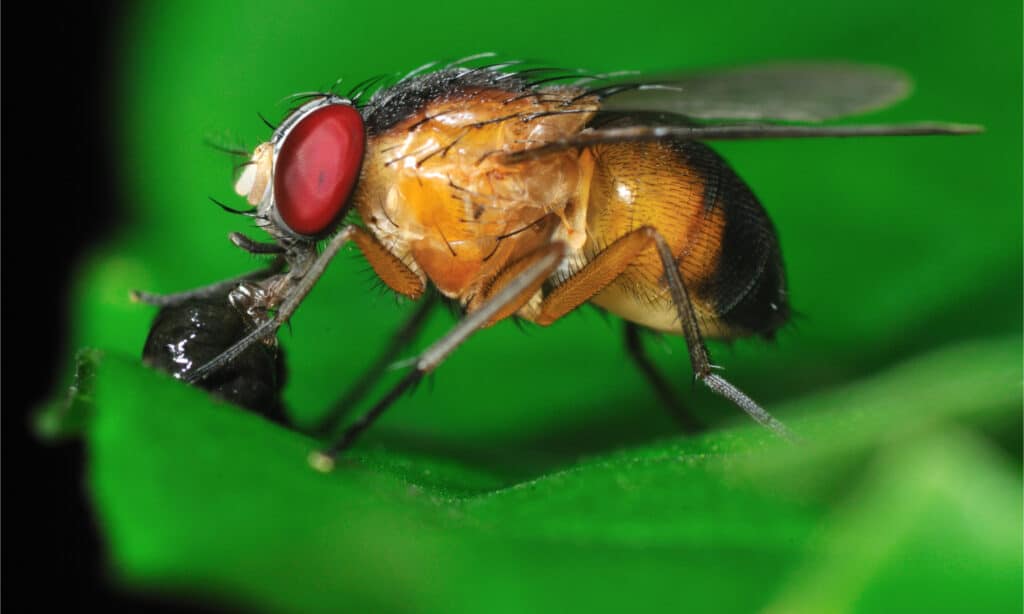
Flies have specialized mouthparts adapted for sucking.
©Jordan Lye/Shutterstock.com
Given how diverse they are, it’s not surprising that flies also have a varied diet. Depending on the species, they may eat plants, fruit, vegetables, carrion, blood, other insects, or even feces. Their mouthparts are adapted for piercing and sucking, like mosquitoes, or for sponging and lapping, like some house flies. Flies also have chemoreceptors to smell and taste their food.
Many flies have long larval stages and short adult lives, typically living only a few weeks. Most flies undergo complete metamorphosis and go through four stages: egg, larva, pupa, and adult. However, some species are ovoviviparous and deposit maggots rather than eggs. Incredibly, some flies can lay up to 500 eggs over a period of 5 to 6 days.
The Largest Fly in the World
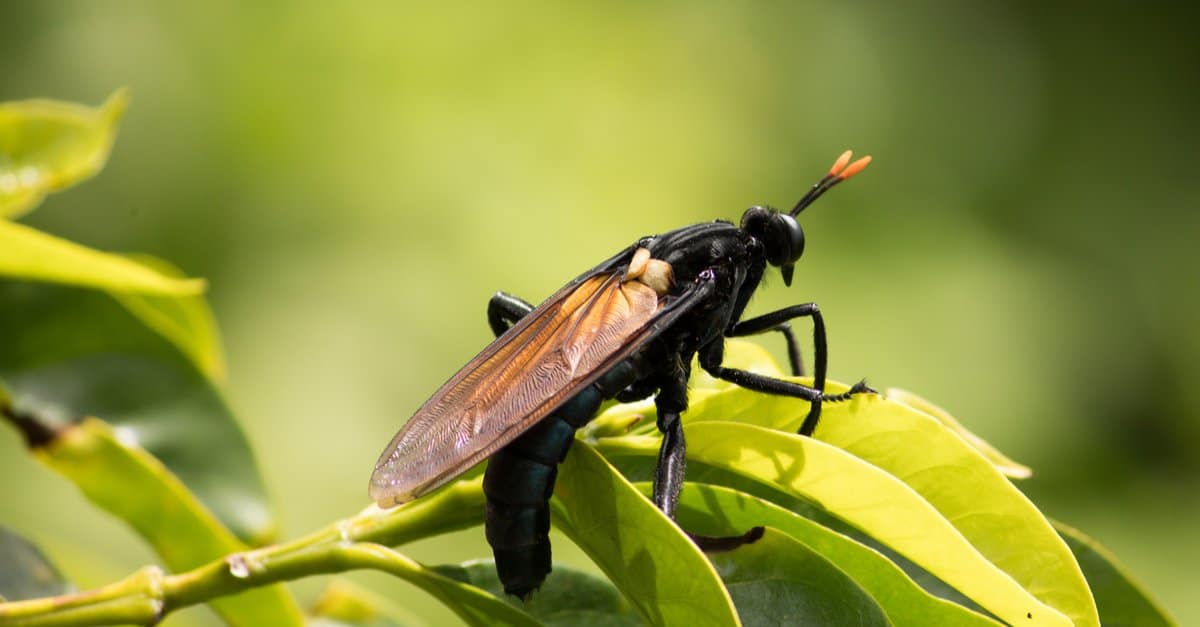
The largest fly in the world today is the little-known Gauromydas heros. These giant flies can reach incredible body lengths of up to 2.76 inches long, and the largest specimen on record has a wingspan of 4.6 inches. This is bigger than a monarch butterfly, which has a body length of up to 1.5 inches and a wingspan of up to 4 inches. Gauromydas heros are members of the Mydidae family group, known as Mydas flies. There are around 400 species of Mydas flies, and as a family, they are generally the largest of all flies. Gauromydas heros have cylindrical black bodies and long, narrow wings with white, brown, or orange membranes. Additionally, their hind legs are significantly longer and thicker than their other legs.
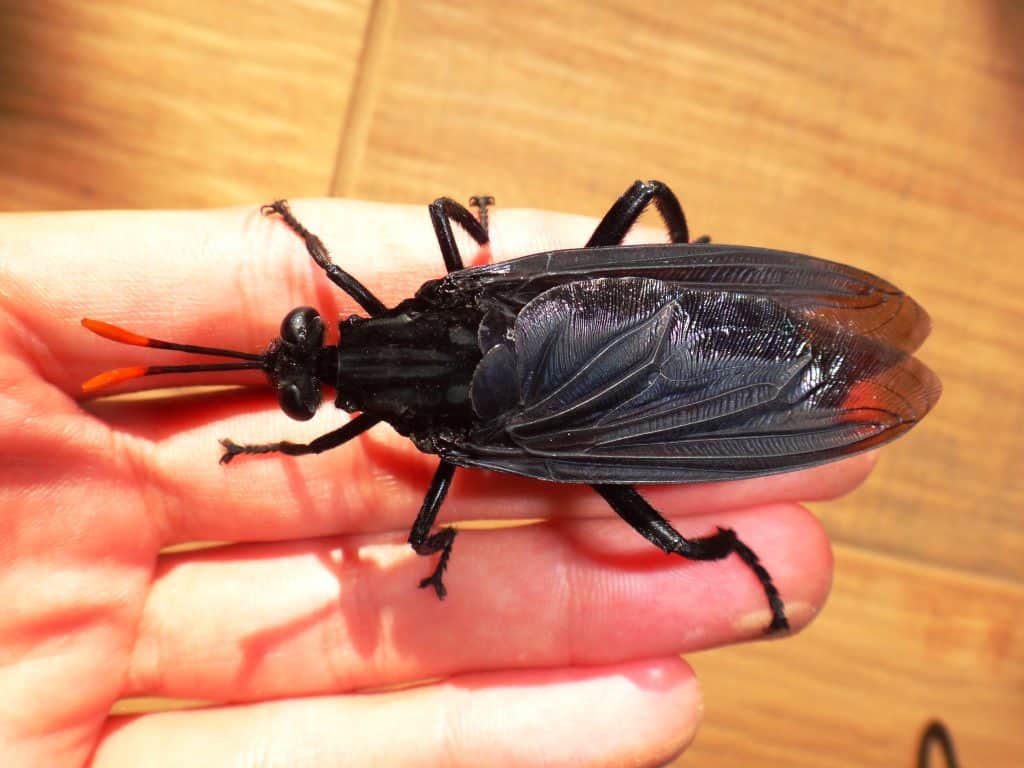
Gauromydas heros is almost 3 inches long and has a wingspan that can exceed 4 inches.
Mydas flies are Batesian mimics of large wasps, which means they resemble these stinging insects, but they do not have stingers. So, despite their large and intimidating size, Gauromydas heros are not dangerous. They mimic large, stinging insects to protect themselves from predators. This is because if they look like something that is dangerous, they are less likely to be attacked. This is similar to the way harmless milksnakes mimic the appearance of venomous coral snakes.
Gauromydas heros is native to Brazil, Bolivia, Paraguay, and possibly Colombia, where they typically live in arid and semiarid regions. Their larvae inhabit leafcutter ant nests, where they feed on beetle larvae scavenging in ant waste chambers. Adult males typically spend their time around different flowers where they drink the nectar. However, it is believed that adult females do not feed at all. Little else is known about them because they are only active for very short periods and are rarely seen or collected.
What About Giant Timber Flies?
Although Gauromydas heros is widely recognized as the largest fly in the world, there could be a few challengers for its title — giant timber flies. Timber flies are large, stocky flies that look like horse flies. There are 20-22 species of timber flies and they are all members of the family group Pantophthalmidae. The largest timber flies have a body length of up to 3.1 inches long, which is slightly longer than Gauromydas heros. However, their wingspans are not as large, reaching only 3.9 inches. Despite their impressive wingspans, they typically only fly when disturbed.
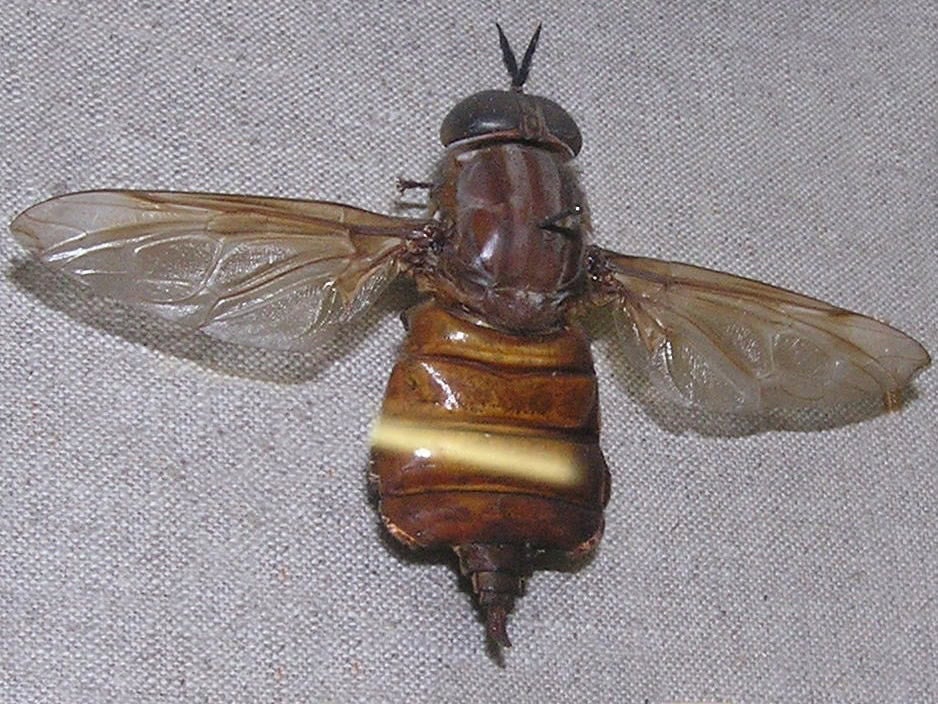
Giant timber flies can have a body length of over 3 inches.
Timber flies live in Central and South America. They get their name from their larvae, which live in trees and feed on the wood. Females lay their eggs in dead or dying trees, and when they hatch, the larvae begin to consume the wood, burrowing deeper inside the tree in the process. However, dead wood contains very few nutrients, so it takes the larvae a long time to develop into adults, usually several months. Although they eat wood in their larval stage, timber flies do not eat at all as adults and live for only a few weeks.
Are Flies Really Pests?
Despite being viewed as pests, flies play an important role in the ecosystem. Although it is true that many flies can transmit diseases, they can be useful, too. In fact, flies are highly important pollinators second only to bees.
Flies are also necessary for the disposal of dead plants and animals, as they help to break down decaying material. While they can be a problem to livestock, flies, or rather maggots, feed on dead flesh. They have even been used to clean wounds.
Not only that, but flies are the main food source of many birds, as well as other insects, fish, amphibians, and some mammals. Without flies as a source of food, many of these animals would struggle to survive. This, in turn, would impact other predators that rely on these animals for prey.