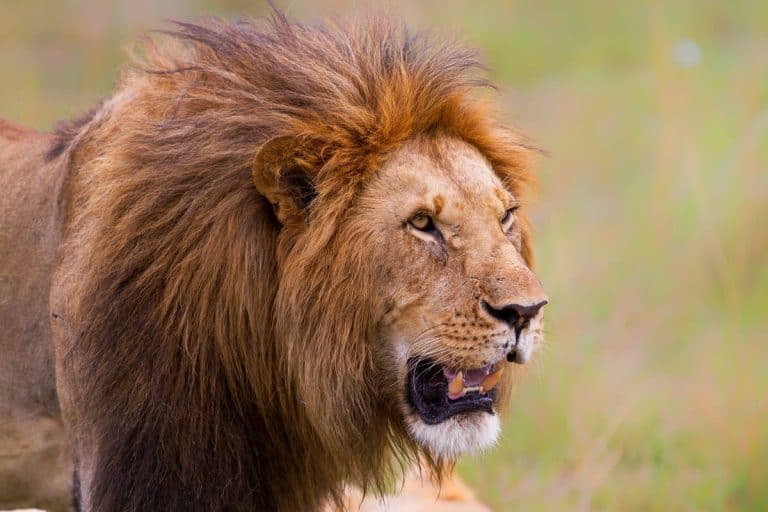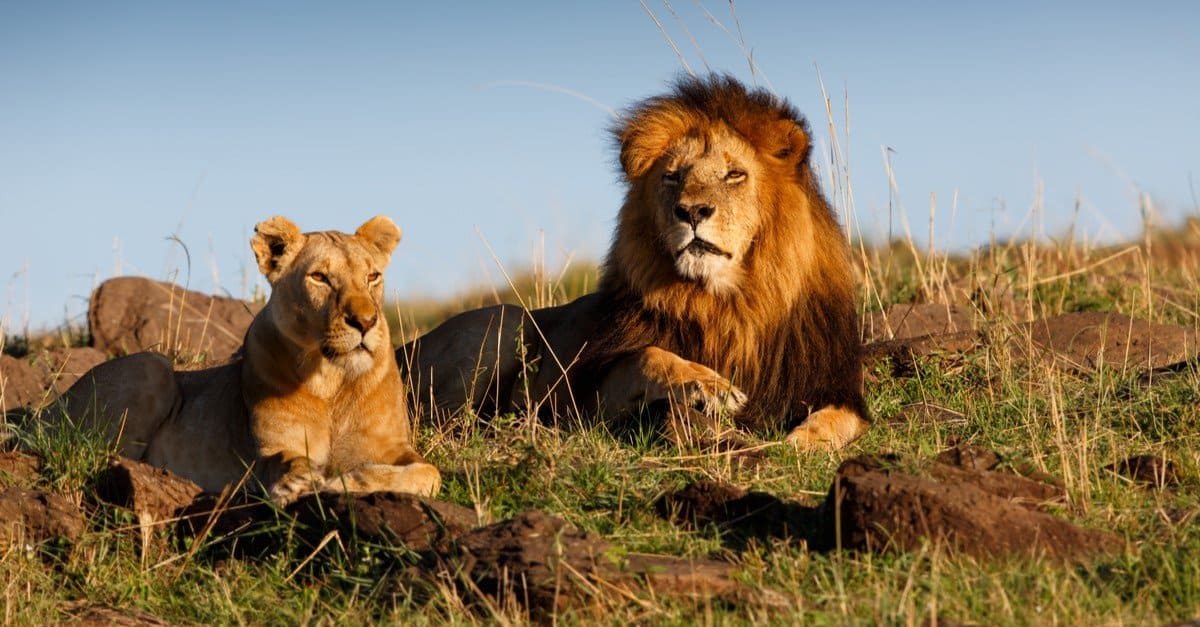

Lions (Panthera leo) have been studied extensively both in the wild and in captivity, particularly regarding their behavior, biology, and ecological role. Lions are unique and complex creatures that are considered keystone predators. Ecologically, a keystone species is essential for the survival of its ecosystem. If a keystone species goes extinct, the balance of its natural environment collapses. In addition to their significant ecological role, lions are the second-largest species of big cats, with tigers (Panthera tigris) being the largest. Continue reading to learn just how large these keystone predators can be.
Largest Extant Lion
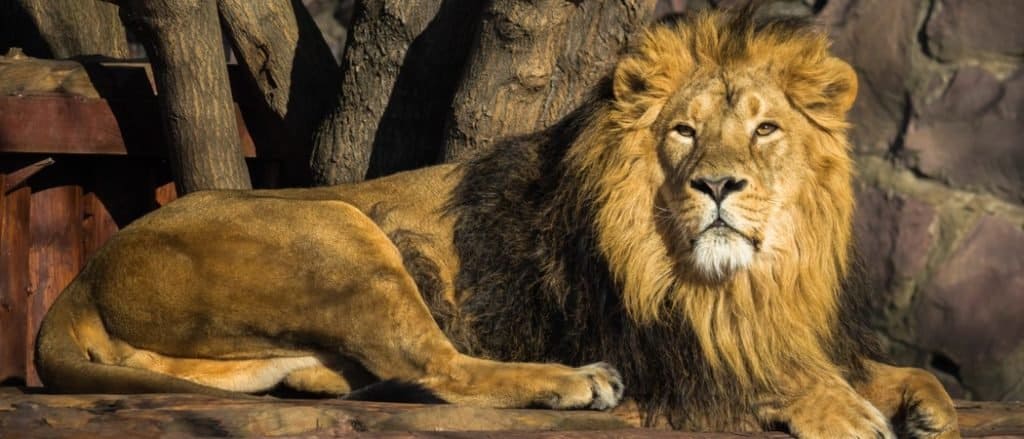
Asiatic lion (Panthera leo leo).
©tgladkova/Shutterstock.com
There are two extant subspecies of lions. The northern lion (Panthera leo leo) includes Asiatic lions in India and lions found in Western and Northern Central Africa. The southern lion (Panthera leo melanochaita) includes lions found in Southern and Eastern Africa.
Asiatic lion populations, once restricted to Gir National Park and its immediate surroundings, have now established satellite populations in several districts across Gujarat, India. From the tip of the nose to the base of the tail, Asiatic lions measure approximately 6.5 feet in length. The largest wild Asiatic lion on record was hunted in 1620 and weighed 675 pounds. Wild Asiatic lions usually weigh between 350 and 420 pounds. According to Guinness World Records, the largest wild lion ever was a southern lion and reportedly weighed 690 pounds and was shot in South Africa in 1936. Southern lions typically weigh between 331 and 496 pounds.
The largest extant lion ever recorded was a male living at the Dublin Zoo in 1959. This lion weighed a massive 827 pounds, making it the largest lion in the world.
Largest Extinct Lion
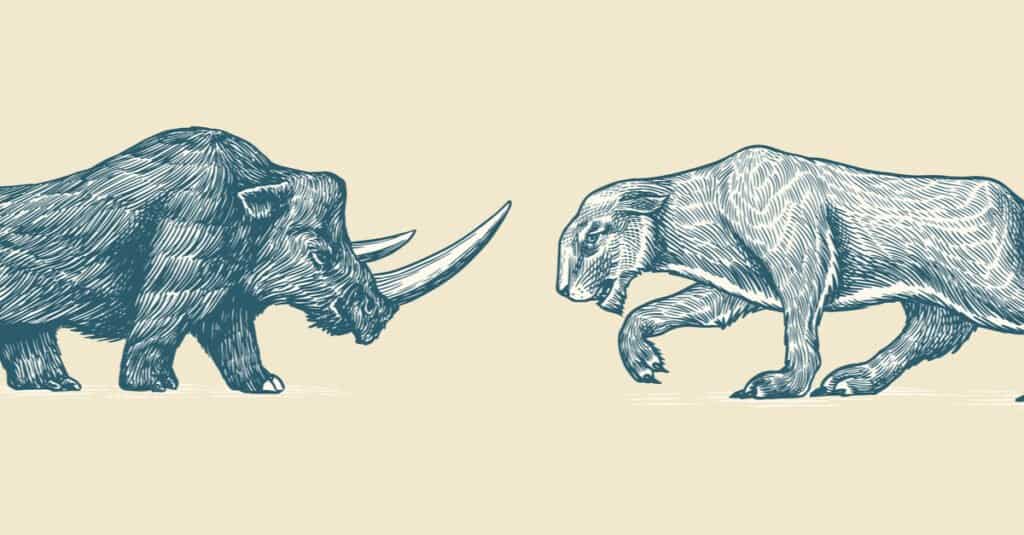
A cave lion faces off against a woolly rhinoceros.
©Arthur Balitskii/Shutterstock.com
Many types of lions have roamed the Earth for hundreds of thousands of years. Two species of prehistoric lions are the American lion (Panthera atrox) and the Eurasian cave lion (Panthera spelaea). Both of these species are extinct, but they are related to modern lions and were known to coexist with human ancestors.
The American lion inhabited North America between 340,000 and 11,000 years ago. Fossils of this species have been excavated from Alaska to Mexico, suggesting it had a large geographical range. Based on fossil evidence, scientists estimate that the American lion was approximately 25% larger than modern lions, making it one of the largest known cats to have ever existed. The estimated maximum length of the American lion was an impressive 8 feet 2 inches. A 2008 study estimated that this lion weighed up to 930 pounds; however, a 2012 study claims that males could have weighed up to 1,153 pounds.
The Eurasian cave lion was also larger than modern lions. It lived throughout Eurasia between 60,000 and 13,000 years ago. The Eurasian cave lion was smaller than the American lion but was approximately 12% larger than modern lions. Based on fossils, the largest Eurasian cave lion was estimated to be 6 feet 11 inches long, not including the tail. The largest specimen ever recovered was estimated to have weighed approximately 750 pounds.
Largest Liger

A liger is the offspring of a male lion and a female tiger.
©Ali West / Flickr – Original
Ligers are the offspring of a male lion and a female tiger. Ligers are the largest extant felines. However, they are not technically a distinct species. Male ligers are sterile, meaning they are incapable of reproducing. Although female ligers are capable of reproduction, because male and female ligers cannot reproduce together, they are not recognized as a species. Instead, their species is denoted as Panthera leo ♂ x Panthera tigris ♀.
Ligers are recognized as the largest living cats on Earth and greatly exceed both of their parent species in size. The largest liger ever recorded was named Hercules and was bred in captivity in 2002. Hercules weighed an exceptional 922 pounds.