
M
Species Profile

Moscow Watchdog

Canis lupus familiaris

Big heart. Bigger guardian.
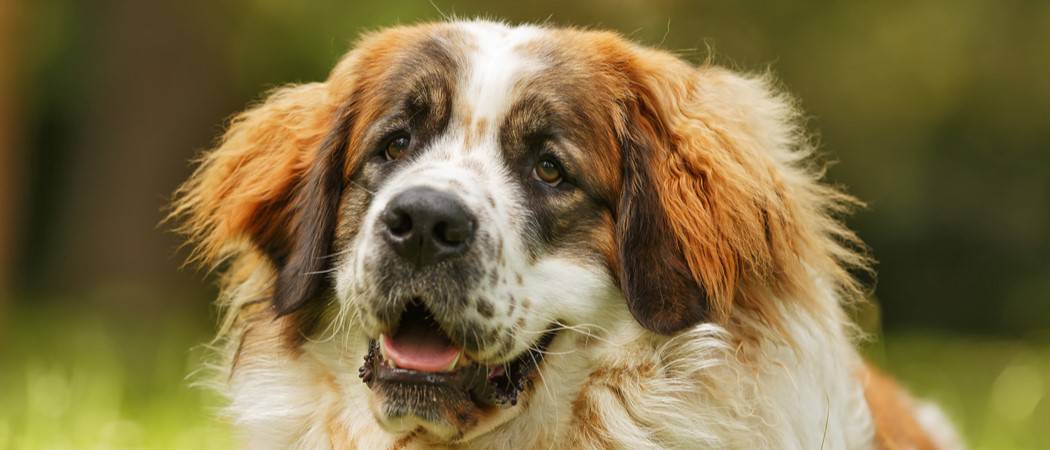
Michal Ninger/Shutterstock.com

Moscow Watchdog Distribution

Click a location to explore more animals from that region

Origin Location

This map shows the native origin of the Moscow Watchdog. As a domesticated species, they are now found worldwide.

Loading map...

Found in 1 country

Size Comparison

Human 5'8"
Moscow Watchdog 2 ft 4 in

Moscow Watchdog stands at 42% of average human height.

At a Glance

Domesticated
Also Known As Moscow Guard Dog, Moskovsky Storozhevoy, Moskovskaya Storozhevaya Sobaka, Московская сторожевая собака
Diet Omnivore
Activity Diurnal+
Lifespan 10 years
Weight 68 lbs
Status Not Evaluated
Did You Know?

Developed in the USSR after WWII at the Red Star military kennel to create a dependable guarding/service dog.

Scientific Classification

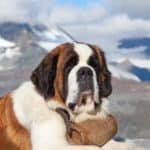
The Moscow Watchdog is a large, powerful Russian working dog developed in the mid-20th century for guarding and protection roles, produced by crossing breeds such as the Caucasian Shepherd Dog and Saint Bernard.

Kingdom
Animalia
Phylum
Chordata
Class
Mammalia
Order
Carnivora
Family
Canidae
Genus
Canis
Species
Canis lupus familiaris

Distinguishing Features

  • Very large, heavy-boned guardian-type dog
  • Dense double coat suited to cold climates
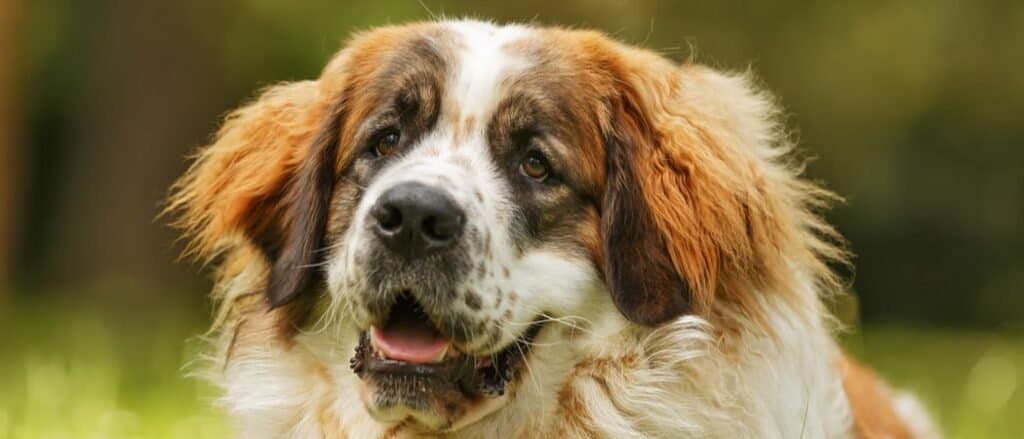
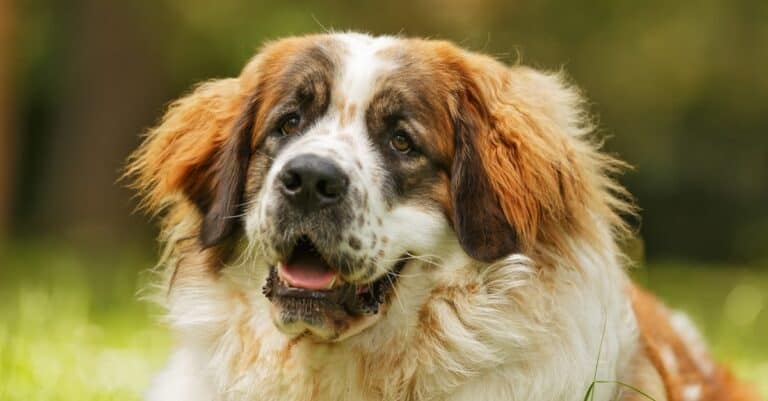
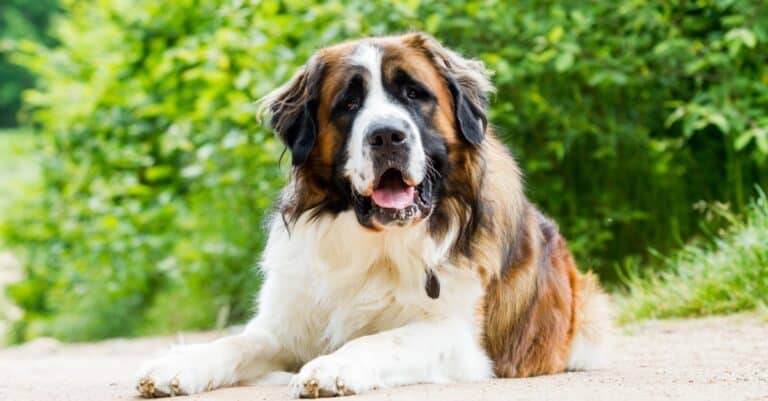
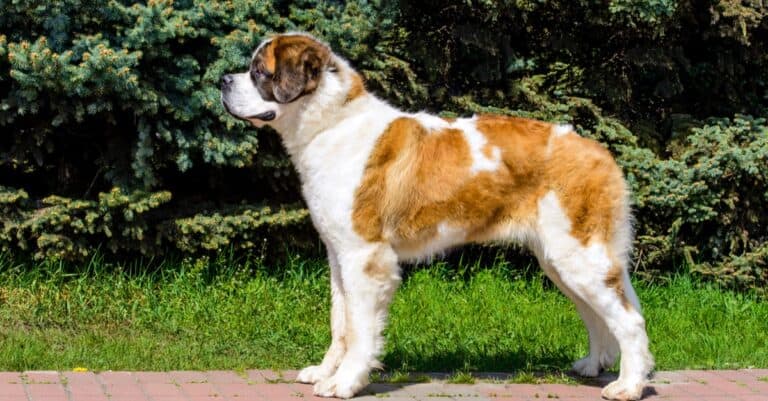
  • Often white with red/brown patches (frequently with darker facial shading)
  • Protective, watchful temperament typical of guard breeds

Physical Measurements

Males and females differ in size

Height
2 ft 5 in (2 ft 3 in – 2 ft 7 in)
2 ft 2 in (2 ft 2 in – 2 ft 4 in)
Length
5 ft 5 in (4 ft 11 in – 5 ft 11 in)
Weight
143 lbs (121 lbs – 165 lbs)
115 lbs (99 lbs – 132 lbs)
Tail Length
1 ft 4 in (1 ft 2 in – 1 ft 6 in)
1 ft 8 in (1 ft 6 in – 1 ft 10 in)
Top Speed
28 mph
running

Appearance

Primary Colors
Secondary Colors
Skin Type Thick, loose skin with a dense double coat; weather-resistant and cold-adapted.
Distinctive Features
  • Domestic dog breed (Canis lupus familiaris) selectively developed in mid-20th-century Russia for guarding and patrol work.
  • Built from foundation breeds including Caucasian Shepherd Dog (guardian traits, robustness) and Saint Bernard (mass, coat, presence).
  • Very large, heavy-boned, powerful frame with deep chest and substantial neck; imposing silhouette.
  • Broad head with pronounced stop; medium drop ears; often a dark mask enhancing stern expression.
  • Dense double coat with a coarse outer layer and thick undercoat; noticeable seasonal shedding and "blow coat."
  • Feathering on tail and rear legs; tail thick and carried low to moderate when relaxed.
  • Protective, territorial guarding temperament; requires early socialization, structured training, and confident handling.
  • Care: frequent brushing (more during shedding), coat drying after wet work, and routine ear/skin checks under dense fur.
  • Care: moderate daily exercise plus mental work; avoid excessive high-impact activity during rapid growth.
  • Heat sensitivity is common due to heavy coat-needs shade, water, and reduced exertion in warm weather.
  • Health concerns: hip and elbow dysplasia risk; maintain lean body condition and use joint-conscious exercise.
  • Health concerns: gastric dilatation-volvulus (bloat) risk; smaller meals, slow feeding, and rest after eating.
  • Health concerns: potential cardiac and eye issues; regular veterinary screening recommended in breeding lines.

Sexual Dimorphism

Males are typically taller, heavier, and more massively headed, with thicker necks and more pronounced ruff. Females are generally lighter-framed with a slightly finer head and less overall bulk, while retaining the same coat type.

  • Greater height and weight; more substantial bone and chest width
  • Broader skull and more pronounced head mass
  • Thicker neck and more noticeable ruff/coat volume
  • Smaller overall size with lighter frame and slightly finer head
  • Less pronounced neck thickness and ruff
  • Often appears more athletic and agile while still heavily built

Did You Know?

Developed in the USSR after WWII at the Red Star military kennel to create a dependable guarding/service dog.

Foundation breeds most often cited are the Caucasian Shepherd Dog and Saint Bernard, blending strong guarding instinct with mass and steadier temperament.

Despite the "watchdog" name, it's not a single-purpose barker-well-bred dogs are typically calm until something truly seems wrong.

The thick double coat and heavy bone reflect selection for outdoor work in harsh Russian weather.

It is a relatively young breed compared with many "ancient" guardian types-its main development occurred in the mid-20th century.

Because of its size and power, early and ongoing training is a safety requirement, not an optional hobby.

Large, deep-chested build means owners must learn bloat (GDV) prevention routines (meal management, calm rest after eating).

Unique Adaptations

  • Cold-weather toolkit: dense double coat, substantial undercoat, and body mass that help conserve heat during outdoor guard duty.
  • Power and stability: broad chest, heavy bone, and strong neck/jaws suited to deterrence and physically holding ground.
  • Behavioral blend from foundation breeds: Saint Bernard-derived steadiness paired with Caucasian Shepherd-type vigilance and territorial confidence.
  • Endurance for stationary work: selected more for long, calm guarding shifts than for sprinting speed.
  • High threat discrimination (when well bred/socialized): tendency to conserve energy and respond when a situation crosses its "problem threshold."

Interesting Behaviors

  • Perimeter patrol: many will routinely "check the fence line" and place themselves between family and visitors.
  • Measured suspicion: tends to watch strangers silently at first, escalating from blocking/standing ground to barking only if needed.
  • Body-blocking and leaning: uses its mass to gently (or not so gently) control movement and create space.
  • Territorial alertness peaks at dusk/night, reflecting typical guardian-dog timing for monitoring threats.
  • Strong bonding to a home base: often prefers staying near property and family rather than roaming far.
  • Guardian-style decision making: can be less "handler-focused" than herding or sporting breeds, pausing to assess before obeying.
  • Protective play: may "referee" roughhousing, stepping in to separate people or dogs it thinks are getting too intense.

Cultural Significance

The Moscow Watchdog (Canis lupus familiaris) came from Soviet state breeding to make large, reliable service and guard dogs for military and civilian sites. Today it still stands as a symbol of postwar utility breeding for function, toughness, and protection.

Myths & Legends

Red Star Kennel stories say post-WWII efforts mixed imported Saint Bernard types with native guardian dogs to make an ideal Soviet guardian, turning the Moscow Watchdog into a 'made for the Motherland' legend.

In Caucasus folk tales, great flock guardians are praised as dogs who stand against wolves and thieves at night. That guarding spirit is said to follow the Moscow Watchdog from its Caucasian Shepherd ancestry.

Saint Bernard rescue legends, especially the famous dog Barry, helped make the idea of big gentle lifesavers. People often use this story when talking about the Moscow Watchdog's calm family side.

Soviet and post‑Soviet guard dog stories tell of one huge watchdog guarding a gate or warehouse all night. The Moscow Watchdog (Canis lupus familiaris) was bred for that job.

Naming-as-myth: the breed's name is often treated like a promise-"Moscow" signaling state pedigree and seriousness, "Watchdog" signaling duty-reflecting a cultural tradition of assigning working dogs an almost official civic identity.

Conservation Status

NE Not Evaluated

Has not yet been evaluated against the criteria.

Population Stable

Life Cycle

Birth 6 pups
Lifespan 10 years

Lifespan

In the Wild
9–11 years
In Captivity
8–12 years

Reproduction

Mating System Promiscuity
Social Structure Managed Domestic
Breeding Pattern Transient
Fertilization Managed Selective
Birth Type Managed_selective

In managed breeding, Moscow Watchdogs are paired briefly during the female's estrus; males show mate-guarding and competition but no stable pair bond. Copulation involves a copulatory tie with internal fertilization; litters are raised by the dam with human support.

Behavior & Ecology

Social Pack Group: 4
Activity Diurnal, Crepuscular
Diet Omnivore Meat-forward meals (e.g., beef or poultry with organ meat)

Temperament

Species context (domestic dog): social, cooperative, pack-oriented; readily bonds with humans.
Breed distinction: selectively social and highly territorial; reserved with strangers compared to typical companion breeds.
Protective, confident, and vigilant; tends to assess threats before engaging when well bred and trained.
Across the breed, guarding drive and suspicion of unfamiliar people are common; intensity varies widely.
Calm indoors when exercised; can be destructive or reactive if under-stimulated or isolated.
Trainability: intelligent but strong-willed; needs firm, consistent, reward-based structure and clear boundaries.
Care requirement: early, frequent socialization to many people/places prevents over-guarding and fear aggression.
Care requirement: substantial daily exercise plus mental work (obedience, tracking, patrol-style walks).
Management: secure fencing and leash control are essential; reliable recall may be weaker under arousal.
Health-linked behavior notes: large-breed joint stress can reduce tolerance; keep impacts low during growth.
Common health concerns: hip/elbow dysplasia, gastric dilatation-volvulus risk, obesity if overfed, possible eye issues.
Handling: benefits from experienced owners; not ideal for crowded urban social expectations without training.

Communication

Deep, booming alarm bark when perceiving intruders or boundary violations.
Growls and low rumbles to increase distance; escalates if warnings ignored.
Whines/whimpers for attention, discomfort, or separation from bonded family.
Howls occasionally in response to sirens or other dogs.
Forward, high, still posture and intense stare to deter; classic guarding stance.
Scent marking and perimeter checking; patrol-like pacing along property boundaries.
Muzzle punches, body blocks, and shoulder leans to control space without biting.
Ear and tail carriage shifts signal arousal; subtle cues matter due to size and power.
Play bows and loose body when relaxed with trusted people; abrupt stiffening indicates concern.

Habitat

Biomes:
Temperate Forest Boreal Forest (Taiga) Temperate Grassland Tundra Alpine Desert Cold Desert Hot Mediterranean Savanna Tropical Dry Forest Tropical Rainforest Wetland Freshwater Marine +8
Terrain:
Plains Hilly Valley Riverine
Elevation: -1969 in – 14763 ft 9 in

Ecological Role

Domestic working/guardian canid (human-managed omnivore)

property and livestock guarding/deterrence of threats companion and working roles (security, patrol; occasionally rescue) scavenging of edible waste in human environments (when unmanaged), contributing to localized nutrient cycling cultural/service value to humans (working dog roles)

Diet Details

Main Prey:
Small mammals Birds and eggs Carrion Human-provided animal proteins
Other Foods:
Berries and fruits Roots and vegetables Grains and starches Plant matter

Human Interaction

Domestication Status

Domesticated

Moscow Watchdog (Canis lupus familiaris) is a Soviet Russian working breed made in the mid-1900s at the Red Star kennel by crossing Caucasian Shepherds and Saint Bernards. Large, cold-tolerant and protective, they were bred for territorial guarding and a steady, watchful temperament. They serve in security, rural family guarding and breeding programs, and need careful introductions and vet care.

Danger Level

High
  • territorial aggression toward strangers if poorly socialized or mishandled
  • serious bite/injury potential due to large size, strength, and guarding drive
  • increased risk during boundary disputes (fence-line, doorways, visitors entering property)
  • resource/space guarding (yard, home entry points) in undertrained individuals
  • accidental injury (knockdowns) from size/force even without intent

As a Pet

Suitable as Pet

Legality: Moscow Watchdog (Canis lupus familiaris) is usually legal where pet dogs are allowed but may face dangerous-dog laws, breed rules, landlord or HOA limits, insurance, import/export rules, and registration differences.

Care Level: Expert Only

Purchase Cost: $700 - $2,500
Lifetime Cost: $25,000 - $65,000

Economic Value

Uses:
Property and personal security (deterrence/guarding) Working-dog breeding and kennel operations Training services (obedience/guard work foundations) Showing and breed clubs (limited outside core regions) Livestock/property protection in rural settings (occasional)
Products:
  • trained/started guardian dogs (where permitted)
  • puppies from working/show lines
  • security and handling training packages
  • boarding/kennel services tailored to large guardian breeds

Relationships

Predators 4

Human
Human Homo sapiens
Gray wolf
Gray wolf Canis lupus
Brown bear
Brown bear Ursus arctos
Tiger or Leopard Panthera tigris / Panthera pardus

Related Species 6

Ecological Equivalents 5

Animals that fill a similar ecological role in their ecosystem

Quick Take

  • This Cold War-era Soviet hybrid was engineered to be the ultimate guard dog, yet its temperament holds a surprising contradiction that makes it equally suited for family life. Explore the temperament →
  • Most giant breeds are notoriously stubborn to train, yet the Moscow watchdog breaks that rule. There is, however, one critical catch that inexperienced owners consistently overlook. See the training details →
  • Feeding this breed the wrong way goes beyond simply causing weight gain. It can trigger a life-threatening condition that every Moscow watchdog owner needs to know about. Read the feeding advice →
  • Before you let this dog near your kids, there's one socialization window you absolutely cannot miss. Most owners are surprised by just how short it is. See the socialization window →

The Moscow watchdog (Moskovskaya Storozhevaya Sobaka) is a giant Russian guard dog that was developed in the late 1940s and 1950s in the former Soviet Union. This hybrid is the result of a cross mainly between the St. Bernard and the Caucasian Ovcharka (Caucasian Shepherd Dog), with smaller contributions from Russian spotted hounds. The “gentle giant” breed is a top choice for a guard dog, with a gentle temperament that makes it great as a family pet and an alpha streak that makes it an excellent working dog or pack leader.

A detailed infographic about the Moscow Watchdog breed, showing its physical appearance, size charts, and Soviet Union origins.
Born from a Cold War military experiment, this 150-pound titan blends St. Bernard gentleness with a guard dog's ferocity. Only one question remains: are you a strong enough leader to handle it? © A-Z Animals

3 Pros and Cons of Owning Moscow Watchdogs

ProsCons
Top guard dog. The Moscow watchdog is one of the best choices for a guard dog. Whether you want to guard your family, your home, or a farm, this breed is strong and protective. Not for new dog owners. Not for the first-time or inexperienced dog owner, this breed is a lot to handle. It needs an active, consistent, and firm owner to lead it.
Gets along with children and other dogs. The alpha protective instinct translates well to children. It also gets along with less dominant dogs. Drooling. Although it probably doesn’t drool as much as, say, a St. Bernard, be prepared to deal with saliva.
Easy to train. This intelligent breed takes commands very well and is the easiest to train during puppyhood. Very large breed. With its huge size, this breed needs a lot of space to move around and play in. It is not appropriate for small homes or homes with no yards.
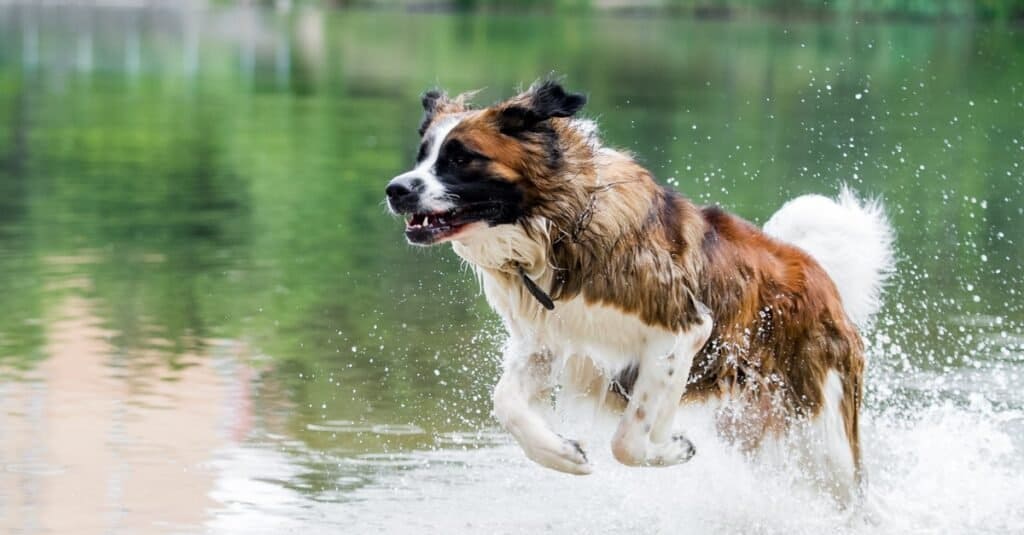
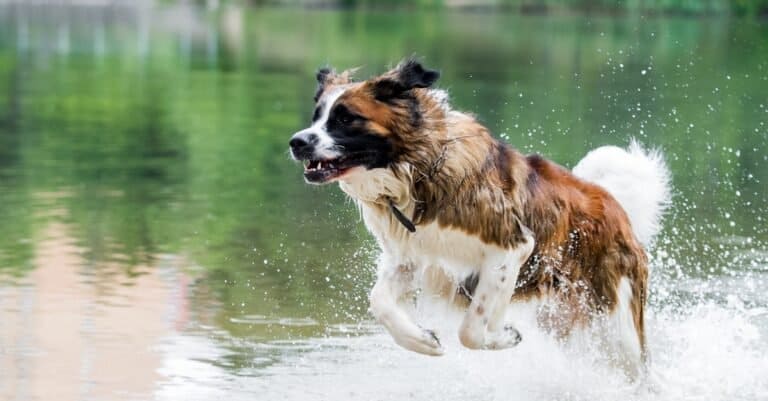
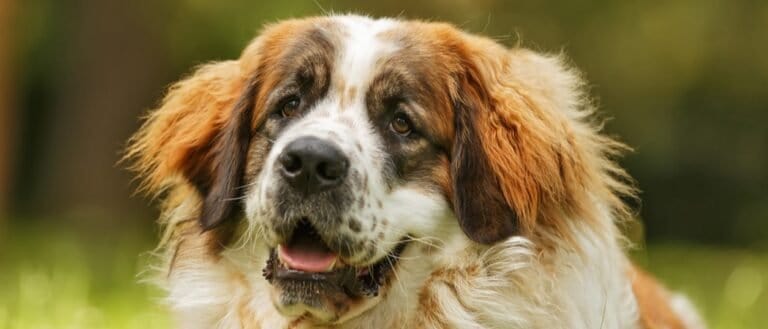
Moscow watchdog playing in the river.

Moscow watchdog is playing in the river.

Size and Weight

This is a giant long-haired dog with an average height of 27 to 31″ for males and 26 to 29″ for females. Males weigh 121 to 150 lbs fully grown, while females weigh over 99 lbs fully grown. The puppies weigh 15 to 22 lbs at 8 weeks and are typically fully grown between 18 and 24 months.

Common Health Issues

The Moscow watchdog tends to be very healthy. However, it is prone to health issues that large breeds have, such as hip dysplasia, patellar luxation, and gastric torsion (bloat). Its health is also connected to getting enough exercise to reduce stress and stay fit. The average lifespan for this breed is 9 to 11 years.

Temperament

The Moscow watchdog’s temperament is stable, gentle, assertive, protective, and intelligent. It has a powerful, affectionate personality with aloof behavior around strangers. This does not mean it is not excellent for a family, however. It gets along well with children and other dogs, as long as it gets to be the leader. The owner should also act as pack leader, which the dog will follow.

How To Take Care of Moscow Watchdogs

New pet owners looking for how to care for these dogs, especially as puppies, must consider a variety of unique needs. Whether addressing health issues such as hip dysplasia or care related to their long hair and large size, Moscow watchdogs have breed-specific needs to keep in mind. Learning about proper care for this breed will help ensure a good quality of life and a long lifespan.

The Best Dog Food

Puppy food: Your puppy should have premium or high-quality puppy food specifically made for large breeds. It must have animal protein as its first and main ingredient. Look for phosphorus, DHA, vitamin K, and fish oil for healthy brain development and other health benefits for your developing puppy.

Adult dog food: Adult dogs need a premium or high-quality adult dog food specifically made for large breeds. Three cups a day is the recommended amount for adult dogs. A joint supplement for strong bones can help. To prevent bloat, make sure your dog’s food has few fermentable ingredients such as beans or soy, feed him from the floor, and avoid exercising him within 90 minutes of eating.

Maintenance And Grooming

The Moscow watchdog does not need professional grooming. Although it is a moderate shedder with a medium-long, thick coat, a weekly brushing and regular bathing (once a month) should be enough to control the amount of fur around the house. A brushing glove to remove dead hair is excellent and can cut down shedding as well.

Training

The protective instinct of this breed comes from its development as a guard dog. When introducing people or other animals for the first time, it’s best to supervise your dog. Early socialization and training from a pack leader will ensure a well-balanced dog rather than an overly headstrong one. Owners will find that it is easy to train and takes commands easily.

Exercise

Having this breed can keep owners active if they are up for the challenge. This breed needs space to freely jog and run around in the backyard. It also needs a long walk every day.

Puppies

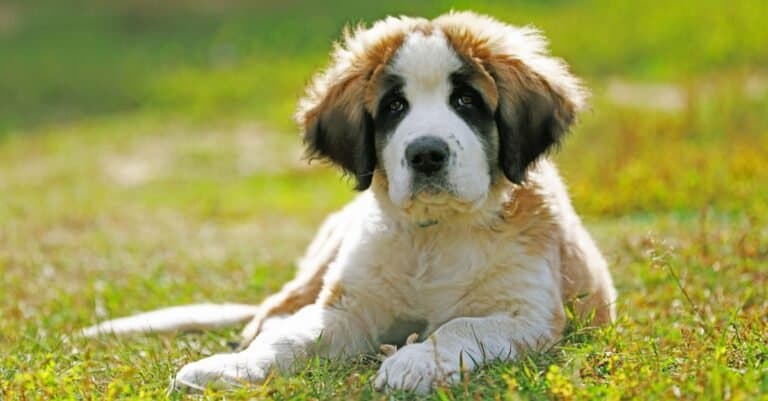
This sturdy breed is a handful as a puppy. Take care not to over-exercise it. 5 minutes per month of age is enough, or simply allow for spontaneous play. Do not overfeed, which will promote excessively rapid growth. The average price of a puppy from a reputable breeder tends to be less than that of a top-quality adult dog.
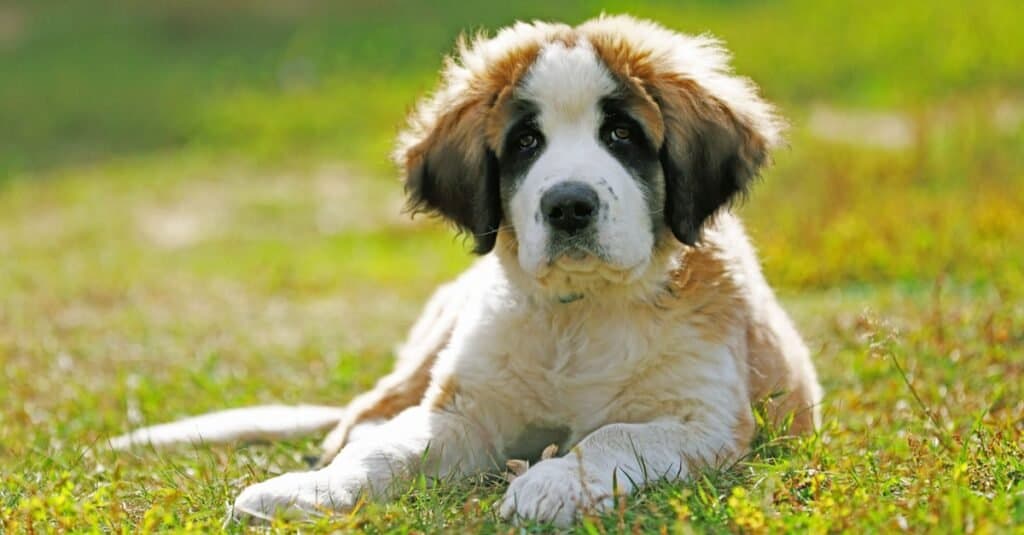
Cute Moscow watchdog puppy playing in the garden.

Cute Moscow watchdog puppy playing in the garden.

Moscow Watchdog And Children

This breed is best socialized with children as early as possible. Doing so serves two purposes: it encourages familiarity and promotes bonding. Once it has bonded with children, it considers them a part of its pack.

Dogs similar to Moscow Watchdog

Dogs that are similar to Moscow watchdogs are Caucasian Ovcharkas (Caucasian shepherd dogs), St. Bernards, and mastiffs.

  • St. Bernard: One of the ancestors of the Moscow watchdog, it is likewise a Molosser-type breed and contributes to its appearance. However, the St. Bernard is about 44 lbs heavier and is used for search-and-rescue, while its Russian cousin is not.
  • Mastiff: Another Molosser-type dog, the Mastiff is large and heavy-boned, but is an ancient breed.
  • Moscow Water Dog: Like the Moscow watchdog, the Moscow water dog has the Caucasian Ovcharka (Caucasian Shepherd Dog) as one of its ancestors. It is also called the Moscow Retriever.

Famous Moscow Watchdogs

This breed is rarely seen outside of Russia. However, one famous Moscow watchdog is the handsome Bart, who has Instagram celebrity status.

View all 329 animals that start with M

Sources

  1. Wikipedia / Accessed October 1, 2021
  2. Labrottie / Accessed October 1, 2021
  3. Indian Dog Breed / Accessed October 1, 2021
  4. Dino Animals / Accessed October 1, 2021
  5. Innovet / Accessed October 1, 2021
  6. Pet Guide / Accessed October 1, 2021
  7. Dog Product Picker / Accessed October 1, 2021
  8. Dog Zone / Accessed October 1, 2021
  9. Animal Wised / Accessed October 1, 2021
  10. My Dog Breeds / Accessed October 1, 2021
  11. The Cutie Pet / Accessed October 1, 2021
  12. Dogell / Accessed October 1, 2021
A-Z Animals Staff

About the Author

A-Z Animals Staff

AZ Animals is a growing team of animals experts, researchers, farmers, conservationists, writers, editors, and -- of course -- pet owners who have come together to help you better understand the animal kingdom and how we interact.
Connect:

Thank you for reading! Have some feedback for us?


Moscow Watchdog FAQs (Frequently Asked Questions)

Yes, it is an excellent guard dog.