
Quick Take
- The adult moth never eats a single leaf, yet it is still responsible for wiping out entire forests. About the adult moth →
- If you have any of these common backyard trees, your property may already be a prime target for a mass infestation. See vulnerable tree species →
- Simply touching these caterpillars can send you to the doctor, and most people don't realize this until it's too late. Caterpillar skin reaction warning →
- The most popular chemical solution for killing spongy moths has a hidden cost that could backfire in your own garden. Risks of chemical sprays →
The spongy moth (Lymantria dispar dispar), previously known as the European gypsy moth or gypsy moth, is a pest unlike any other. It is a non-native invasive species known for destroying hundreds of tree species, damaging homes, and even causing allergic reactions in humans. The larvae of these moths can completely defoliate trees, often killing the tree. They have devastated large tracts of forest, especially in the Northeast and Upper Midwest. Whether you’re dealing with a moth problem on your property or hoping to avoid one, read on to learn more about the spongy moth.
How Do You Get Spongy Moth?
Spongy moth caterpillars consume over 300 different kinds of trees and shrubs. However, they do have preferences. If your land contains the following plants, it may be an inviting habitat for multitudes of spongy moth larvae to deposit their eggs and subsequently feast on the leaves. Consider the spongy moth when choosing ornamental plants that are disease- and insect-resistant.
The following trees are the spongy moth’s preferred plants:
- Oak
- Willow
- Apple
- Crabapple
- White birch
- Witch hazel
- Mountain ash
- Basswood
- Linden
- Pine
- Douglas fir
- Spruce
If they cannot feed on their preferred plants, they will feed on hardwoods such as maple and cherry, as well as elm, box elder, hemlock, and yellow birch, among others.
Signs of Spongy Moths
Spongy moth adults don’t eat. The devastation is caused by the larvae, or caterpillars. As mentioned above, spongy moth larvae eat hundreds of different kinds of plants, but trees suffer the most destruction. Trees lose either part or all of their leaves, and entire tracts of forest can appear barren in the middle of summer. Tree limbs wither and tree tops thin from these pests. Even once-healthy trees may die due to disease and pest infestations that weaken them.
What Do the Moths Look Like?
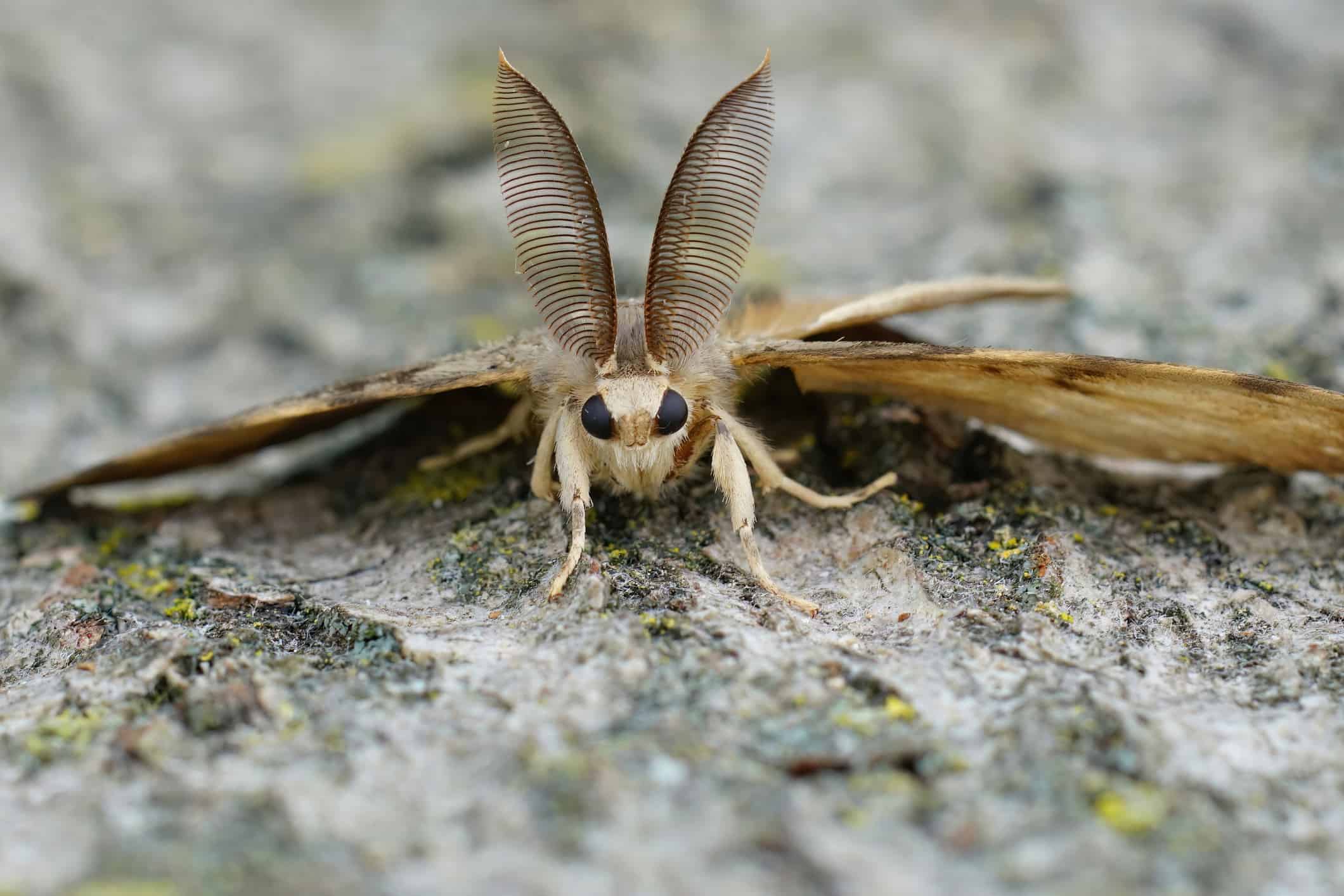
The adults just have one purpose in life, which is to reproduce, living only a few days during the summer. Male moths are brown with a darker brown color pattern and a wingspan of approximately 1.5 inches. Females are almost white with a dark sawtooth pattern on their wings. They are slightly larger with a wingspan of around 2 inches. The females cannot fly and are typically found resting on trees.
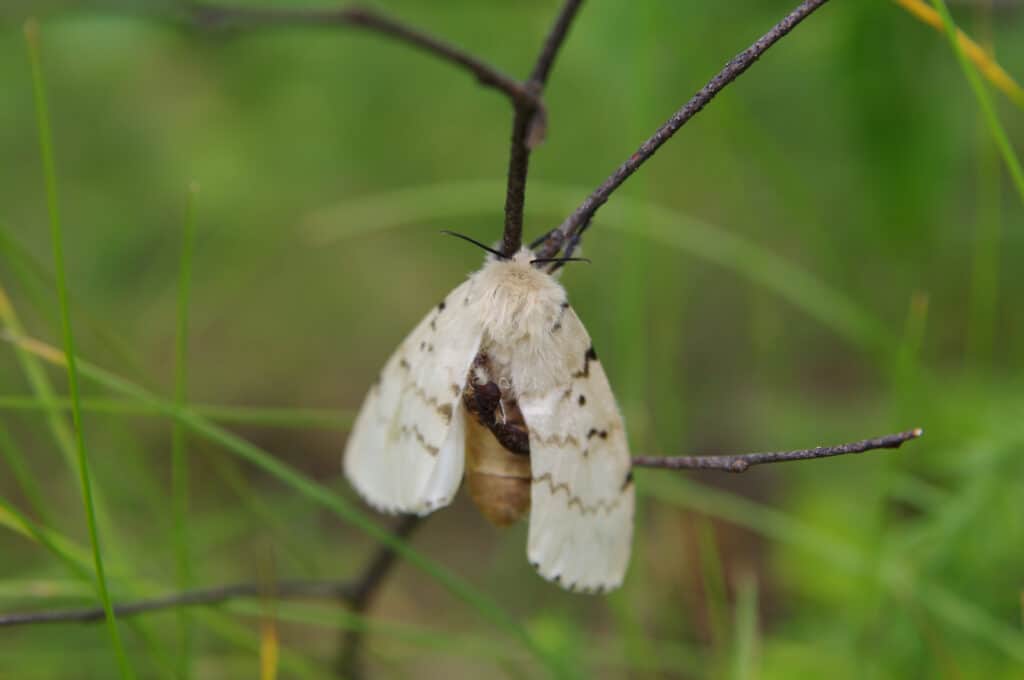
Female spongy moths are almost white with a dark sawtooth pattern on their wings.
©iStock.com/grannyogrimm
What Do the Larvae Look Like?
After mating, the female moth lays 100 to 600 eggs in a tightly packed bundle of silk and eggs that resembles a teardrop. These spongy egg clusters can be seen on tree trunks and limbs in the latter part of July through August. They also can be found in forest detritus close to defoliated trees. These egg masses are encased in brown or buff-colored hairs from the female’s belly.
Caterpillars that have just emerged from their eggs are very fuzzy and dark brown to black. Young caterpillars feed by gnawing tiny holes in leaves. However, older larvae consume entire leaves. The larvae are somewhat lighter in color with fuzzy bodies and two rows of blue and red spots on their backs.
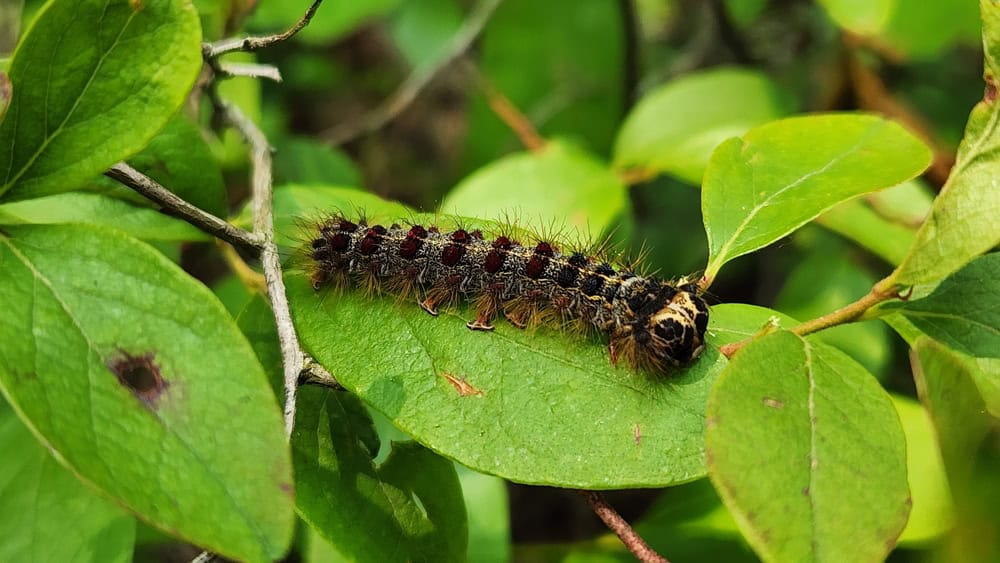
Spongy moth caterpillars have two rows of blue and red spots on their backs.
©Matt Boyer/Shutterstock.com
How to Get Rid of Spongy Moths
When handling caterpillars of spongy moths, it’s beneficial to use gloves. The little hairs carry histamines that can cause an allergic reaction, which is generally an itchy, red rash. Here are some great ways to get rid of these pests.
Burlap Cloth Flap Trap
Use a simple burlap cloth flap trap to shield specific trees. This involves wrapping a foot-wide piece of burlap around a tree, tying it in the center, and folding the top end over the bottom end. This method takes advantage of the caterpillars’ instinct to keep climbing, causing them to gather under the folded burlap. They can then be regularly collected and disposed of.
Soap and Water
During the summer, search for caterpillars and adult moths. Put any you find into sudsy water and discard them. If you observed spongy moth caterpillars or defoliation during the growing season, search on a dry day between September and April for egg masses. The eggs can also be disposed of in sudsy water and discarded.
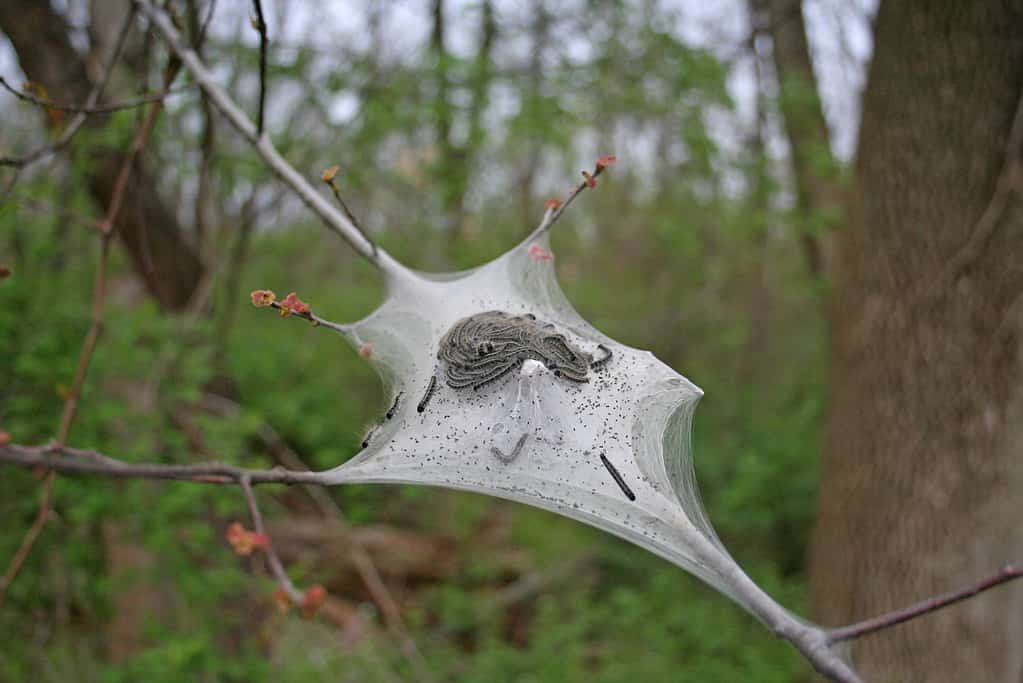
Spongy moth larvae can be spotted on tree branches.
©Beth Schroeder/Shutterstock.com
Chemical Repellent
Insecticide sprays may be the best option if you find significant populations of spongy moth caterpillars. However, keep in mind that certain pesticides and insecticides may not be safe to use around children or pets. Biological sprays may also harm other young moth and butterfly larvae.