





P
Species Profile

Perro De Presa Canario

Canis lupus familiaris

Power with poise-guardianship refined.
Mary Swift/Shutterstock.com

Perro De Presa Canario Distribution

Click a location to explore more animals from that region

Origin Location

This map shows the native origin of the Perro De Presa Canario. As a domesticated species, they are now found worldwide.

Loading map...

Found in 1 country

Size Comparison

Human 5'8"
Perro De Presa Canario 2 ft

Perro De Presa Canario stands at 35% of average human height.

Perro De Presa Canarios close-up

At a Glance

Domesticated
Also Known As Dogo Canario, Canary Mastiff, Canarian Mastiff, Canary Island Mastiff
Diet Omnivore
Activity Cathemeral+
Lifespan 5 years
Weight 65 lbs
Status Not Evaluated
Did You Know?

The breed's name is often translated as "Canarian catch dog," reflecting its historical work as a holding and guarding dog.

Scientific Classification

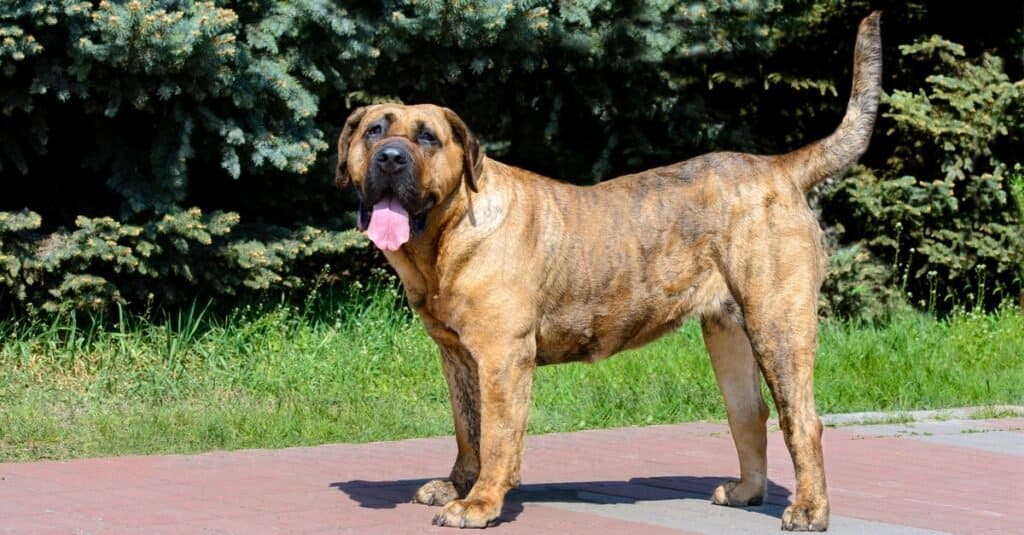
A large, mastiff-type domestic dog breed originating in the Canary Islands, historically associated with guarding and catch-dog work; today kept primarily as a guardian/companion breed where permitted.

Kingdom
Animalia
Phylum
Chordata
Class
Mammalia
Order
Carnivora
Family
Canidae
Genus
Canis
Species
Canis lupus

Distinguishing Features

  • Large, powerful, muscular mastiff-type build
  • Broad head with strong jaws; typically a serious/alert expression
  • Short coat, often fawn/brindle with a dark facial mask
  • Traditionally a confident guardian temperament with strong protective instincts (requires experienced handling and socialization)

Physical Measurements

Males and females differ in size

Height
2 ft 1 in (1 ft 12 in – 2 ft 2 in)
1 ft 11 in (1 ft 10 in – 2 ft)
Length
3 ft 10 in (3 ft 3 in – 4 ft 3 in)
4 ft 3 in (3 ft 9 in – 4 ft 9 in)
Weight
126 lbs (110 lbs – 143 lbs)
104 lbs (88 lbs – 121 lbs)
Tail Length
1 ft 3 in (12 in – 1 ft 6 in)
Top Speed
25 mph
running

Appearance

Primary Colors
Secondary Colors
Skin Type Short, coarse, straight, close-lying single coat; skin thick with slight looseness, especially around neck and chest.
Distinctive Features
  • Domestic dog (Canis lupus familiaris) selectively bred for guarding/catch-dog work; heavier, more muscular, and more block-headed than the base species.
  • Large mastiff-type build: deep chest, strong forequarters, substantial bone, and powerful neck/shoulders.
  • Broad, square head with pronounced stop; thick lips and strong jaws; black mask is common and breed-typical.
  • Compact, athletic gait for size; designed for short bursts of power rather than endurance running.
  • Coat is low-maintenance but sheds; weekly brushing and routine ear/skin checks recommended.
  • Temperament: confident, territorial guardian; requires early socialization, firm reward-based training, and experienced handling.
  • Exercise needs: daily structured walks plus mental work; avoid repetitive high-impact jumping in growth phase.
  • Health concerns seen in large breeds: hip/elbow dysplasia, cruciate injury risk, and gastric dilatation-volvulus (bloat); consider screening and bloat-prevention routines.
  • Possible eye/skin issues in some lines (e.g., entropion, dermatitis); keep wrinkles/skin folds clean if present.
  • Heat sensitivity can occur in warm climates; provide shade, water, and avoid intense midday exertion.

Sexual Dimorphism

Males are typically taller, heavier, and more massively muscled, with broader skulls and thicker necks. Females are usually smaller and more refined in head and body proportions while retaining the same overall mastiff-type outline.

  • Larger overall size and heavier bone
  • Broader, squarer head with more pronounced cheek muscles
  • Thicker neck and more developed forequarter musculature
  • Smaller frame with a more refined head profile
  • Less pronounced neck and cheek musculature
  • Often slightly longer-bodied, with a lighter overall outline

Did You Know?

The breed's name is often translated as "Canarian catch dog," reflecting its historical work as a holding and guarding dog.

It originated on Spain's Canary Islands, where dogs were used to guard farms and handle livestock in rugged terrain.

The breed is strongly associated with the islands' rural working traditions and is sometimes called the Canary Mastiff.

Compared with many domestic dogs, it's notably heavy-boned and muscular, with a broad head and strong jaw suited to gripping and holding.

Its short, dense coat is low to moderate shedding, but the breed is not "hypoallergenic."

Because it is a powerful guardian type, ownership may be regulated or restricted in some regions-checking local laws is part of responsible care.

Well-bred individuals tend to be calm and steady at home, becoming watchful and assertive when they perceive a threat.

Unique Adaptations

  • Mastiff-type build: wide chest, thick neck, and robust musculature adapted for bracing, holding, and deterrence rather than sprinting.
  • Efficient short coat for warm climates: suits the Canary Islands' mild-to-warm conditions while still offering protection.
  • High pain tolerance and steadiness (when well bred): advantageous for demanding working roles, but requires vigilant health checks because issues may be less obvious.
  • Power-to-stability movement: a grounded gait and strong rear drive support controlled force rather than speed.
  • Protective temperament shaping: selective breeding emphasized confidence and suspicion of threats; modern success depends on channeling this through training and management.

Interesting Behaviors

  • Territorial watchfulness: often patrols property boundaries and positions itself between family and unfamiliar visitors.
  • Silent assessment: may observe quietly before reacting, escalating from stillness and blocking to vocal warning if needed.
  • Body-blocking/leaning: uses its mass to steer or hold space, a common guardian-dog strategy.
  • Strong "hold" tendency: can clamp and maintain grip on toys; safe outlets and training are important due to strength.
  • Owner-focused scanning: frequently checks handler and environment, responding best to calm, consistent leadership.
  • Low frivolity, high purpose: many show less "busy" play than lighter breeds, preferring structured interaction and job-like games.
  • Same-sex or dog-selective tendencies can appear; early, ongoing socialization helps prevent reactivity.

Cultural Significance

The Presa Canario (Perro de Presa Canario) comes from the Canary Islands, where strong catch dogs guarded farms and homes. Late 1900s breeders made it a formal breed and a symbol of Canarian guardianship, strength, and need for training and rules.

Myths & Legends

Canarian oral histories and rural anecdotes often describe formidable catch dogs as night guardians that could sense unfamiliar footsteps on volcanic rock before humans did, prompting farmers to trust them as early-warning sentinels.

A common island story says the Presa Canario came from local farm dogs mixed with mastiff- and bulldog-type dogs brought by Atlantic trade, making a Canarian guard dog fit for harsh land and hard work.

In local tales, the Presa Canario is told as a house guardian spirit in real form — a loyal animal that 'keeps the threshold,' a common European folk idea of dogs guarding home and family.

Historical anecdotes from the breed's revival period in the 1970s-1990s are often recounted almost like founding legends: dedicated breeders traveling between islands to locate surviving traditional lines and preserve a working type before it disappeared.

The alternative name Canary Mastiff is sometimes treated in popular retellings as a mark of nobility and island pride-an identity story emphasizing the dog as a symbol of strength from a remote Atlantic archipelago.

Conservation Status

NE Not Evaluated

Has not yet been evaluated against the criteria.

Population Stable

Life Cycle

Birth 7 pups
Lifespan 5 years

Lifespan

In the Wild
2–10 years
In Captivity
9–11 years

Reproduction

Mating System Polygynandry
Social Structure Managed Domestic
Breeding Pattern Transient
Fertilization Internal Fertilization
Birth Type Managed_selective

In Presa Canario, reproduction follows domestic-dog, human-managed polygynandry: selected males may sire multiple litters via internal fertilization. No stable pair bond; breeders screen for hip/elbow dysplasia and brachycephalic/skin issues; early training and socialization are critical.

Behavior & Ecology

Social Pack Group: 4
Activity Cathemeral, Diurnal, Crepuscular
Diet Omnivore Meat-forward foods (e.g., beef or lamb-based diets; high-protein animal tissue)

Temperament

Breed-specific vs base species: more territorial, suspicious of strangers, and physically imposing guardian-drive.
Confident, steady, and serious; typically reserved rather than socially exuberant with unfamiliar people.
High protective instinct; will patrol boundaries and may escalate if perceiving a threat.
Often selective with other dogs; same-sex aggression risk increases without early, ongoing socialization.
Trainable but strong-willed; responds best to calm, consistent, reward-based handling and structure.
Common pattern is calm-at-home vigilance; variation ranges from aloof to reactive based on socialization.
Health concerns: hip/elbow dysplasia, cranial cruciate injury, GDV (bloat), skin allergies, eyelid issues.
Care requirements: early socialization, secure fencing, leash control, regular training, weight management, heat caution.
Exercise needs: moderate daily activity plus mental work; avoid excessive repetitive jumping during growth.

Communication

Deep alarm barking
Low growls
Short warning grunts
Whines during separation/frustration
Occasional howling Uncommon
Forward, still posture and intense stare to challenge or assess
Body blocking/leaning to control space near family members
Raised hackles and stiff tail carriage as arousal signal
Scent marking and ground-scratching at boundaries
Lip licking, yawning, head turns as stress appeasement signals
Muzzle punch/nudge, pawing, and proximity seeking with trusted humans

Habitat

Biomes:
Mediterranean Temperate Forest Temperate Grassland Savanna Desert Hot Desert Cold Tropical Dry Forest Tropical Rainforest Temperate Rainforest Boreal Forest (Taiga) Tundra Alpine Wetland Freshwater Marine +9
Terrain:
Island Coastal Volcanic Rocky Plains
Elevation: Up to 18044 ft 8 in

Ecological Role

Domestic guardian/companion (human-associated omnivorous canid)

property and livestock guarding/deterrence human companionship and working-dog utility opportunistic scavenging of human food waste (when unmanaged) localized rodent/pest deterrence; potential wildlife predation impact if free-roaming

Diet Details

Main Prey:
Complete commercial dog food Meat-based animal proteins Carbohydrate sources
Other Foods:
Fallen fruit Starchy plant foods Vegetables Grasses

Human Interaction

Domestication Status

Domesticated

Domestic dog (Canis lupus familiaris) comes from the gray wolf through human breeding. The Presa Canario (Perro de Presa Canario; Canary Mastiff) was bred in the Canary Islands from local dogs crossed with mastiff and bulldog types. It guarded farms and cattle, was used in past dogfighting, and is kept by experienced handlers; some places restrict it.

Danger Level

High
  • High injury potential due to size, strength, and gripping/holding style if a bite occurs
  • Territorial/protective aggression can escalate with poor socialization, inadequate management, or improper protection training
  • Dog-directed aggression/reactivity may lead to redirected bites during fights or high arousal events
  • Risk increases with intact males, poor containment, chaining/isolation, punitive handling, or owners seeking an 'attack' dog
  • Lower margin for error around unfamiliar visitors and children unless carefully supervised and trained

As a Pet

Suitable as Pet

Legality: Laws vary by country, state, and city. Often legal as a pet but may face breed-specific bans, landlord or insurance rules. Check local rules on ownership, spay/neuter, muzzles, leashes, registration, and insurance.

Care Level: Expert Only

Purchase Cost: $1,500 - $4,000
Lifetime Cost: $20,000 - $50,000

Economic Value

Uses:
Guardian/companion dog ownership (deterrence-focused household security) Working dog services on farms/ranches (property and stock guarding; limited catch/hold work where culturally practiced and legal) Dog sports and training industries (obedience, weight pull, protection-style sports where permitted) Breeding programs and stud services (regulated/ethical breeding vs. backyard breeding risk) Rescue, rehoming, and behavior modification services (disproportionately utilized due to restrictions and management needs)
Products:
  • Puppy sales/adoptions
  • Stud fees and breeding contracts
  • Professional training/handling packages (socialization, neutrality, impulse control, management)
  • Specialized equipment (heavy-duty crates, secure fencing, bite-proof leashes/collars, muzzles where required)
  • Veterinary orthopedic care and preventive health services typical of large breeds

The Perro De Presa Canario is an ancient breed, dating back to the 15th century. Developed in the Canary Islands, the breed was used to protect and herd cattle. Unfortunately, his size and strength made him a popular choice for those involved in dog fighting. After many generations, with a history of attacking predators and fighting dogs in his bloodlines, today’s version can be a good companion for the right household, but does not generally do well in homes with other pets and children.

Unfortunately, the tremendous strength and bite force of the breed, along with some fatal attacks that have made the news, mean the Presa is not welcome in some areas.

Mixes

The Perro De Presa Canario is a rare breed, so many breeders choose to devote their efforts to purebred breeding. There are a few crosses that are available for those looking for something different. They include a cross between the Presa Canario and Bulldog, known as the English Presa Bulldog, the Presa Canario and Great Dane, known as the Presa Dane, and the Presa and the Mastiff, known as the English Presa Mastiff.

History Of The Breed

The Perro De Presa Canario, also called the Presa Canario, originates from the Canary Islands of Spain and was once known as the Dogo Canario, also sometimes referred to as the Canary Mastiff. This breed is said to have derived from the Bardino Majorero, another dog common to the Canary Islands and used as a cattle and guard dog. It is believed that the Presa Canario first originated during the 15th and 16th centuries.

3 Pros And Cons Of Owning A Perro De Presa Canario

Pros!Cons!
A short coat with no undercoat means minimal grooming. Often dominant and strong-willed.
Excellent watchdog capabilities. Tremendous bite force and history of attacks make the breed unwelcome in many communities and may make finding homeowner’s insurance a challenge.
Loyal Require an experienced, dedicated owner for training.
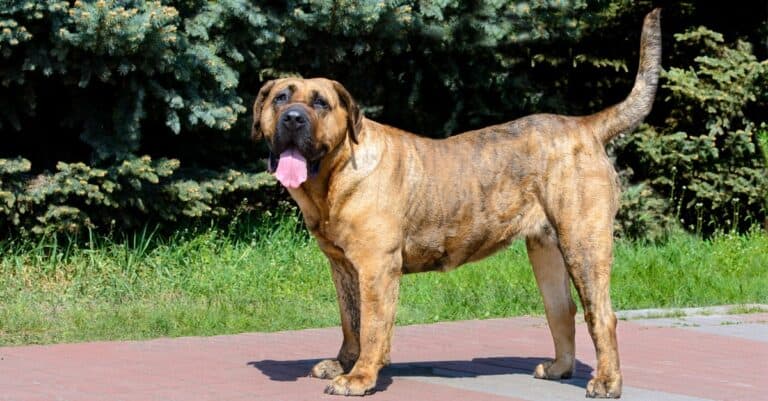
Perro De Presa Canarios in the city park.

Perro De Presa Canarios are dominant and strong-willed.

Size And Weight

The breed is a large, short-haired dog that can reach 26 inches at the shoulder and routinely tops 100 lbs. In fact, males may reach nearly 150 lbs at maturity. The dog is longer than he is tall and has a sturdy build.

Height (Male) 26″ Tall
Height (Female) 24″ Tall
Weight (Male) 143 lbs, fully grown
Weight (Female) 110 lbs, fully grown

Common Health Issues

Most large breeds are predisposed to the same health conditions, and the Perro De Presa Canario is no different. Hip dysplasia, patellar avulsions, patellar luxation, and osteochondrodysplasia can all affect the breed. In addition, they are also prone to dilated cardiomyopathy and other heart conditions, cancers, and mast-cell tumors. Less serious conditions they may develop include demodectic mange and skin cysts.

Temperament

The breed is expected to be calm and attentive. Very confident, the breed is obedient to those it knows and suspicious of strangers. They have a tendency towards expressing dominance, making it important that they have an experienced owner. If other pets are in the home, they should always be supervised.

How To Take Care Of A Perro De Presa Canario

Owning a Perro De Presa Canario is not a commitment to take lightly. Even the cost of providing quality food is significantly more than with many other breeds. Combined with the time and energy needed to keep the dog exercised and trained, it is easy to see that this isn’t the breed for everyone.

The Best Dog Food For Perro De Presa Canarios
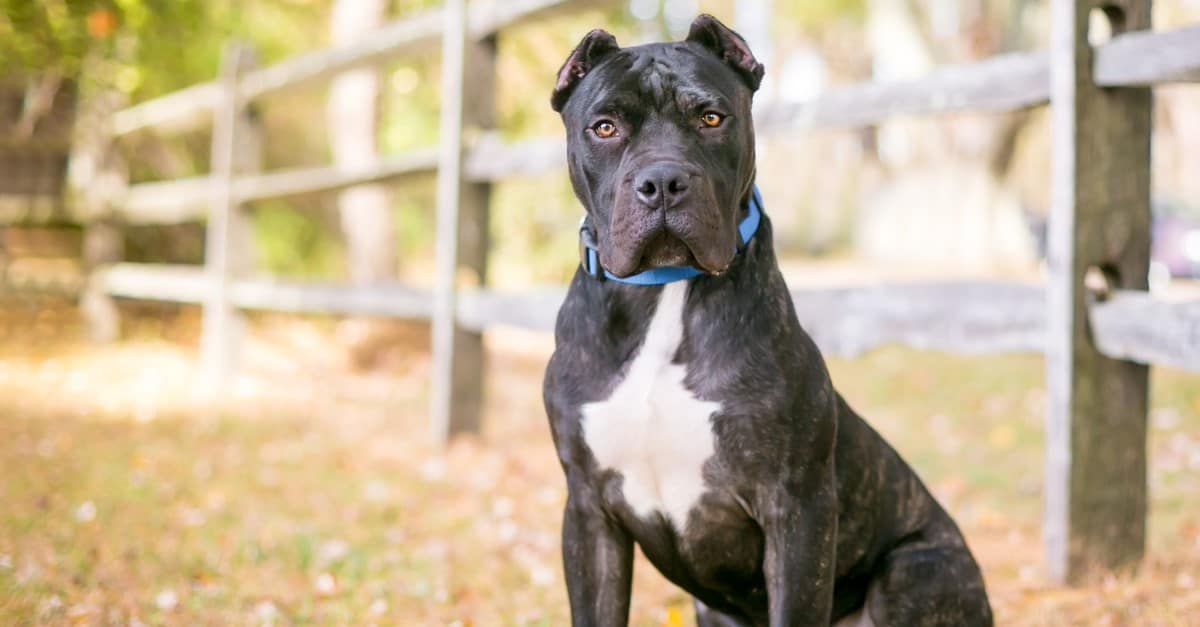
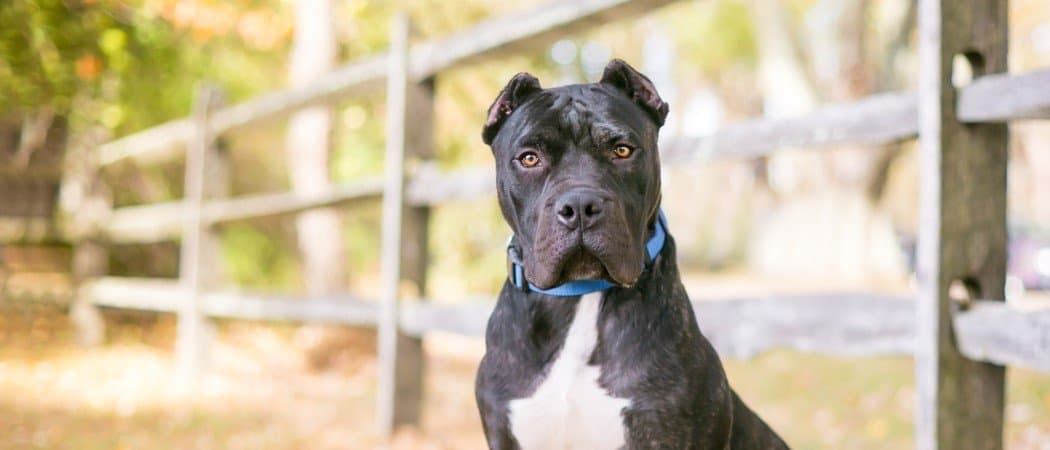
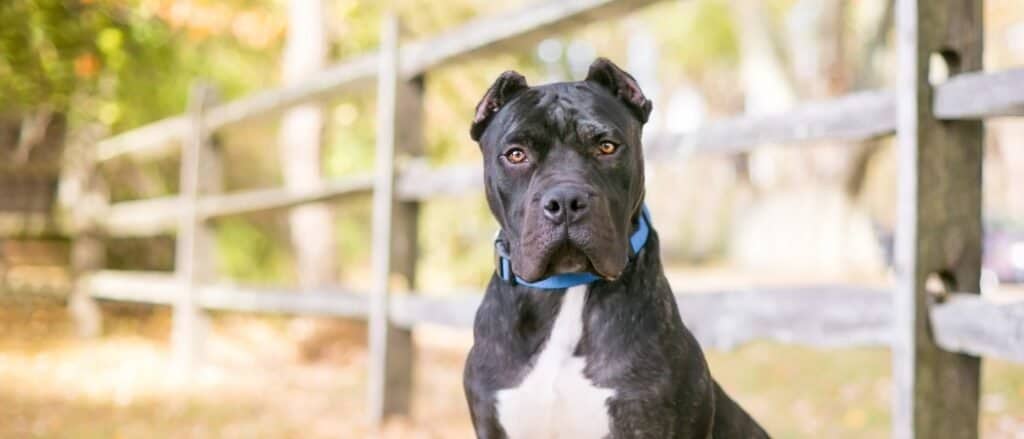
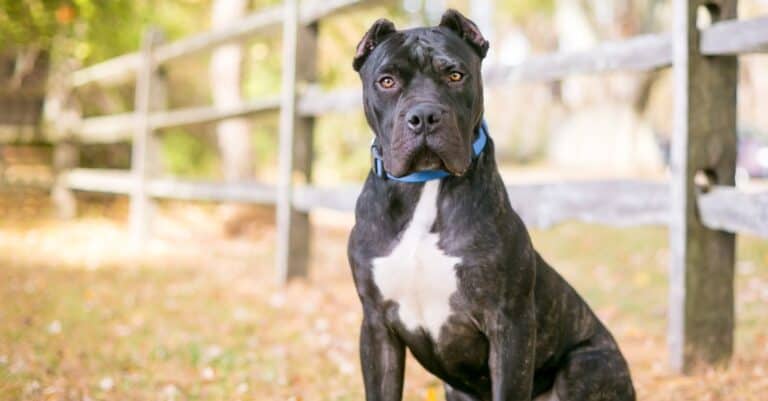
A brindle and white Perro De Presa Canarios dog with cropped ears sitting outdoors by a rustic wooden fence.

A Perro De Presa Canario dog should have a balanced diet to ensure it receives all the necessary nutrients.

Feeding a high-quality, commercially prepared diet ensures that your Perro De Presa Canario has the nutrients needed to develop into a strong, healthy dog. Feed young dogs 3 times a day.

As adults, twice-a-day meals ensure your dog doesn’t need huge portions at each meal, and he is more likely to take his time eating. Like other large breeds, using an elevated feeder makes eating easier and reduces the risk of gastric torsion.

Maintenance And Grooming

While the size and temperament of the Presa raise the price on nearly everything involved in dog ownership, the short coat makes grooming a breeze. Brushing with a bristle brush a few times a week and wiping with a damp cloth to remove loose hair and surface dirt is all you need to keep your dog looking good. He only needs the occasional bath.

It is important to clean his ears regularly and trim his fast-growing nails frequently. Both of these tasks are easiest if you introduce the process to your dog when he is young.

Training
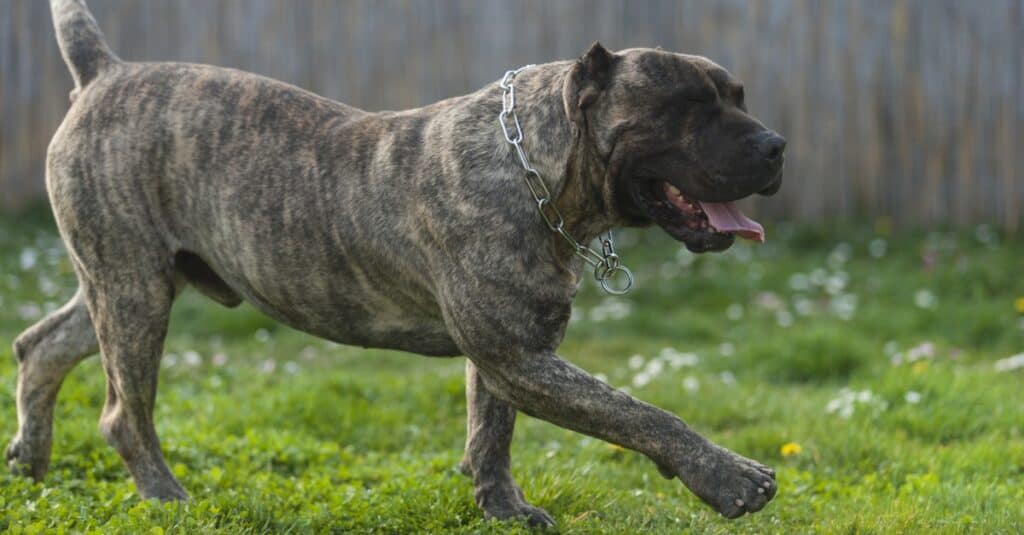
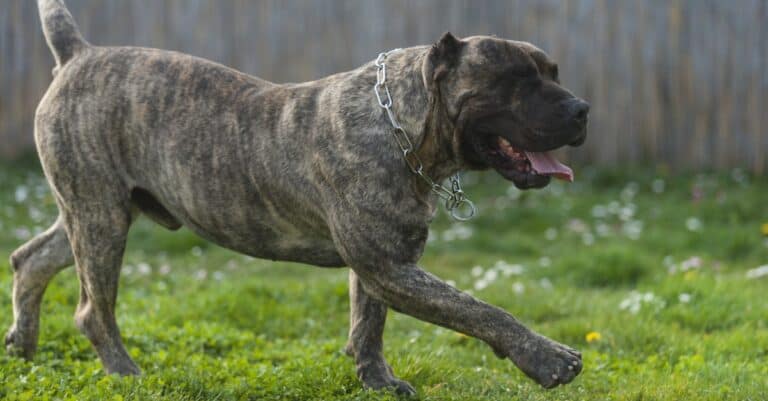
Perro De Presa Canarios running in the garden.

Perro De Presa Canarios are stubborn, with plenty of energy, and do best with multiple walks.

This breed is intelligent but lacks the eagerness to please, which can make it more challenging to train compared to other breeds. Instead, expect a dog that can be stubborn, strong-willed, and test boundaries. Patience and experience are needed for successful training. It is also important to socialize the dog from a young age. The breed is suspicious of strangers by nature, and a lack of socialization will only encourage this trait.

Exercise

Despite his ponderous size, the Perro De Presa Canario has plenty of energy. Bred to be a working dog, he does best with multiple daily walks along with outdoor play.

Puppies

The Perro De Presa Canario typically has between 7 and 9 puppies in each litter. Because of the Presa’s rapid growth and eventual size, it is important to offer high-quality puppy food from an early age.

Take advantage of the Presa’s natural curiosity as a pup for intensive socialization. Don’t take the pup in public until you get the okay from your veterinarian. Most vets prefer that you wait until your pup has at least one round of vaccinations before taking them out. Once it is safe to do so, spend time walking and playing with your pup in parks and other areas where he can observe other people and pets. Enrolling him in a puppy obedience class is another great way to work on socialization.

Perro De Presa Canarios puppy sitting outdoors on green grass.

Perro De Presa Canario puppies have a natural curiosity and should be socialized early.

Perro De Presa Canario And Children

This breed is large, stubborn, and aloof. Combined with a powerful bite force (often estimated to be among the strongest of dog breeds), it is easy to see why they are not a good choice for most families. Attacks from a dog of this size and strength are devastating. In fact, the Perro De Presa Canario is a challenging breed and should be eliminated as the breed of choice for many people. Only an experienced dog owner with time to dedicate to training should consider one.

Dogs Similar To The Perro De Presa Canario

If you are interested in large guardian breeds, there are several to choose from.

  • Cane Corso: Often mistaken for the Presa. Lower prey drive and more affectionate temperament than the Presa, although still a guardian that requires experienced handling.
  • English Mastiff: A good choice for those looking for a large guardian who is also loving and fits in well with the family.
  • Fila Brasileiro: Also known as the Brazilian Mastiff, this large guardian breed has superior tracking skills, making it prone to following its nose.
View all 246 animals that start with P

Sources

  1. American Kennel Club / Accessed October 4, 2021
  2. Wag! / Accessed October 4, 2021
  3. PCCA Club / Accessed October 4, 2021
  4. So Cal Presa / Accessed October 4, 2021
Melissa Bauernfeind

About the Author

Melissa Bauernfeind

Melissa Bauernfeind was born in NYC and got her degree in Journalism from Boston University. She lived in San Diego for 10 years and is now back in NYC. She loves adventure and traveling the world with her husband but always misses her favorite little man, "P", half Chihuahua/half Jack Russell, all trouble. She got dive-certified so she could dive with the Great White Sharks someday and is hoping to swim with the Orcas as well.
Connect:

Thank you for reading! Have some feedback for us?


Perro De Presa Canario FAQs (Frequently Asked Questions)

Puppies can be purchased for $1500 to $2500. Ongoing costs can be high, due to the breed’s size. Expect a higher price for everything from food to beds.