



S
Species Profile

San Francisco Garter Snake

Thamnophis sirtalis tetrataenia

Peninsula wetlands' living ribbon
reptiles4all/Shutterstock.com

San Francisco Garter Snake Distribution

Click a location to explore more animals from that region

Endemic Species
Loading map...
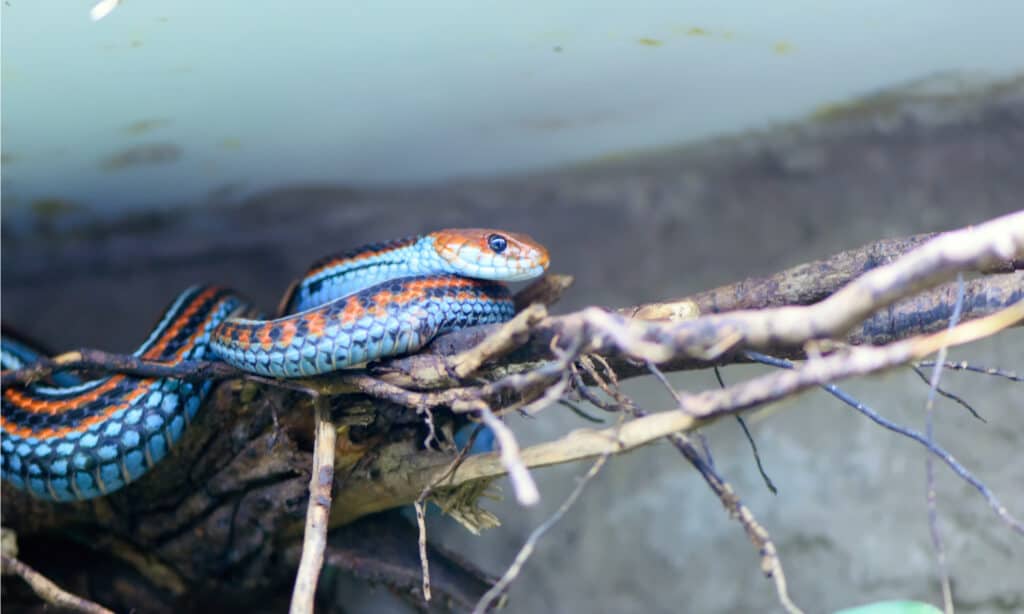
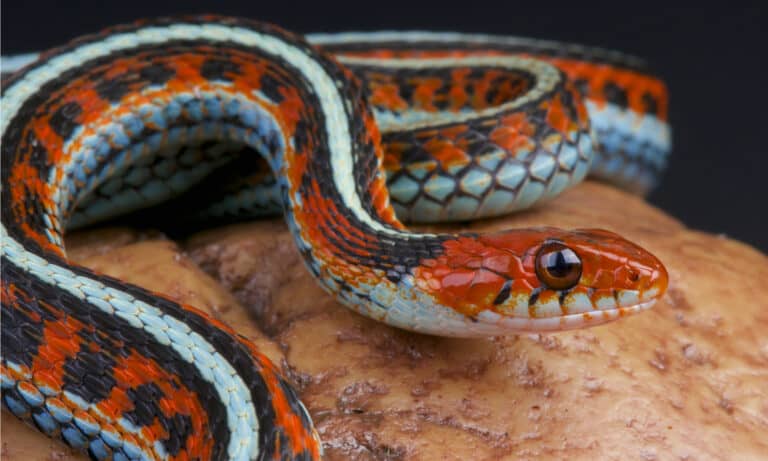
The San Francisco Garter Snake characterized by bright blue-green or green-yellow coloration along the stomach and sides.

At a Glance

Wild Species
Also Known As Garter snake, Common garter snake, Garden snake
Diet Carnivore
Activity Diurnal+
Lifespan 4 years
Weight 0.25 lbs
Status Not Evaluated
Did You Know?

Taxonomy: a subspecies of the common garter snake-Thamnophis sirtalis tetrataenia (Cope, 1875).

Scientific Classification

A strikingly colored subspecies of the common garter snake, notable for bold red/orange and black patterning with blue-green striping. It is strongly associated with wetland and pond-edge habitats on the San Francisco Peninsula and is a flagship reptile for regional conservation.

Kingdom
Animalia
Phylum
Chordata
Class
Reptilia
Order
Squamata
Family
Colubridae
Genus
Thamnophis
Species
Thamnophis sirtalis

Distinguishing Features

  • Very vivid coloration compared to most garter snakes (strong red/orange lateral bars with contrasting dark patterning and blue-green striping)
  • Slender garter-snake build; typically active by day around wetlands
  • Often associated with pond/marsh edges where amphibians are abundant

Physical Measurements

Males and females differ in size

Length
♂ 2 ft 4 in (1 ft 6 in – 3 ft 3 in)
♀ 2 ft 7 in (2 ft – 3 ft 4 in)
Weight
♂ 0 lbs (0 lbs – 1 lbs)
Tail Length
♂ 8 in (4 in – 12 in)
Top Speed
3 mph
slithering
Venomous

Appearance

Primary Colors
Secondary Colors
Skin Type Keratinized reptile skin with strongly keeled dorsal scales; smooth, glossy appearance when clean or wet.
Distinctive Features
  • Subspecies of the common garter snake: Thamnophis sirtalis tetrataenia (not a full species).
  • Adult total length reported as ~46-140 cm (USFWS Recovery Plan, 1985).
  • Neonates typically ~13-23 cm total length at birth (USFWS Recovery Plan, 1985).
  • Extremely vivid red/black/blue-green striping is a key diagnostic field character within T. sirtalis.
  • Strong wetland dependence on the San Francisco Peninsula (primarily San Mateo County) near ponds, marshes, and slough edges (USFWS Recovery Plan, 1985; USFWS 5-year review).
  • Federally listed as Endangered; major threats include wetland loss/fragmentation and reductions in amphibian prey (USFWS Recovery Plan, 1985; USFWS 5-year review).
  • Often observed basking near emergent vegetation; retreats quickly to dense cover or water when disturbed (USFWS Recovery Plan, 1985).
  • Diet in core habitats commonly includes amphibians (e.g., California red-legged frog and other ranids) and small fishes; foraging is concentrated along pond margins (USFWS Recovery Plan, 1985).

Sexual Dimorphism

Females are typically larger-bodied and longer overall, while males tend to be slimmer with proportionally longer tails due to hemipenal anatomy. These differences are most obvious in mature adults during the breeding season.

♂
  • Smaller average body size and mass than females at maturity
  • Proportionally longer tail (post-vent length)
  • More tapered tail base due to hemipenes
♀
  • Larger average body size and mass, especially gravid females
  • Proportionally shorter tail than males
  • Broader midbody when gravid with live young (viviparous)

Did You Know?

Taxonomy: a subspecies of the common garter snake-Thamnophis sirtalis tetrataenia (Cope, 1875).

Size: adults are commonly reported at ~46-137 cm total length for this subspecies in agency/field references (e.g., USFWS Recovery Plan, 1985; Stebbins field guides).

Reproduction: like other Thamnophis, it is live-bearing (viviparous); litters are commonly reported in the ~10-30 young range for T. sirtalis populations (species-level data; detailed tetrataenia-only litter datasets are limited in the literature).

Habitat dependence: strongly tied to pond edges, marshes, and wet grasslands with nearby upland refuges for cover and overwintering-wetland loss/fragmentation is a primary threat (USFWS).

Range: endemic to the San Francisco Peninsula (primarily San Mateo County; historically reported more broadly on the Peninsula), making it one of California's most range-restricted reptiles (USFWS; NatureServe).

Conservation status: federally listed as Endangered in the U.S.; recovery actions focus on wetland protection/restoration and reducing impacts from invasive predators and habitat fragmentation (USFWS).

Defense: can release a strong-smelling musk from cloacal glands-common across garter snakes (Thamnophis) and effective at deterring predators (general Thamnophis natural history: Ernst & Ernst; Stebbins).

Unique Adaptations

  • Diagnostic coloration: bold red/orange dorsal striping with strong black patterning and blue-green lateral striping-among the most distinctive color patterns within the Thamnophis sirtalis complex (field-diagnostic trait noted in regional herpetology references such as Stebbins).
  • Wetland-edge specialization: thrives in a mosaic of shallow-water habitat plus dense bankside cover-an adaptation to hunting amphibians/fish while escaping into vegetation or water rapidly (USFWS habitat descriptions).
  • Live-bearing (viviparity): avoids the need to lay eggs in exposed nest sites; females retain embryos and give birth to fully formed young-common in garter snakes and advantageous in cool/coastal climates (Thamnophis natural history).
  • Mild oral secretions: like other garter snakes, has Duvernoy's gland secretions that help subdue prey (not medically significant to humans under normal circumstances; general colubrid/Thamnophis biology).
  • Group-level note (species complex diversity): Thamnophis sirtalis shows major geographic variation in color pattern and diet across North America; tetrataenia is one of the most localized and visually striking forms within that broader, highly variable species.

Interesting Behaviors

  • Edge-hunting: patrols pond and marsh margins, using quick strikes to capture small, slippery prey (typical Thamnophis foraging behavior; often observed along shoreline cover).
  • Basking-and-dash routine: alternates sunning for thermoregulation with rapid dives into dense vegetation or water when disturbed-classic wetland garter behavior.
  • Seasonal shifting: concentrates near water during active months but relies on adjacent uplands (grassland/brush, small mammal burrows, debris) for refuge and overwintering sites-so conservation must include both wetland and upland buffers (USFWS recovery guidance).
  • Chemical tracking: uses tongue-flicking and the vomeronasal (Jacobson's) organ to follow scent trails of prey and mates (shared trait across Squamata and well-studied in garter snakes).
  • Predator deterrence: may flatten the body, thrash, and musk; coloration also makes it highly conspicuous when moving through emergent vegetation.

Cultural Significance

The San Francisco garter snake (Thamnophis sirtalis tetrataenia) is an endangered, key reptile on the Peninsula. Its rare status helped protect wetlands, restore ponds, and teach that small marshes and uplands can support rare wildlife like the California red-legged frog.

Myths & Legends

Name-origin lore: "garter snake" is commonly explained as a reference to the long, stripe-like markings resembling 18th-19th century clothing garters-an enduring etymological story repeated in North American natural history writing.

The epithet tetrataenia comes from Greek for 'four stripes,' a taxonomic name that says the San Francisco garter snake has those stripes, named by Cope in the 19th century.

The San Francisco garter snake is a Bay Area conservation icon: its bright look and rarity made it a poster species for saving small Peninsula wetlands, a common local story in guides and recovery campaigns.

The 'most beautiful snake' tradition: naturalists and field guides call the San Francisco garter snake (Thamnophis sirtalis tetrataenia) one of North America's most brightly colored snakes, a lasting local naturalist legend.

Collector lore: the San Francisco garter snake's bright, rare colors made it highly sought by collectors, which led to legal protection and rules against collecting as part of its conservation history.

Conservation Status

NE Not Evaluated (this subspecies has not been assessed separately by the IUCN Red List; the parent species Thamnophis sirtalis is assessed as Least Concern, LC).

Has not yet been evaluated against the criteria.

Population Unknown

Protected Under

  • United States Endangered Species Act (ESA) - listed as Endangered
  • California Endangered Species Act (CESA) - listed as Endangered
  • California Fish and Game Code take prohibitions/permits apply to listed species (e.g., sections implementing CESA, including take restrictions)

Life Cycle

Birth 20 neonates
Lifespan 4 years

Lifespan

In the Wild
1–10 years
In Captivity
7–20 years

Reproduction

Mating System Polygynandry
Social Structure Aggregation Group
Breeding Pattern Transient
Fertilization Internal Fertilization
Birth Type Internal_fertilization

After winter brumation, receptive females attract many males and "mating balls" form. Both sexes mate with multiple partners and multiple paternity is common in T. sirtalis; pair bonds do not persist. Females later give live birth without assistance.

Behavior & Ecology

Social Congregation Group: 2
Activity Diurnal, Crepuscular
Diet Carnivore Frog tadpoles (amphibians), particularly ranid and hylid tadpoles in pond-edge habitats.
Seasonal Hibernates

Temperament

Generally nonaggressive; primary responses are fleeing into cover or water and remaining motionless.
Defensive behaviors include biting and releasing cloacal musk/feces when handled (Rossman et al., 1996).
Seasonal social tolerance increases during overwintering and spring mating aggregations, otherwise solitary.
HUBS pattern: most individuals are sit-and-wait/active foragers near wetlands; bolder behavior varies with temperature and disturbance.

Communication

None known; snakes lack vocal cords and do not produce true vocal calls Rossman et al., 1996
Chemical: tongue-flicking to detect prey and conspecific scent trails via vomeronasal organ.
Chemical: sex pheromones from female skin/cloacal secretions drive male trailing and mating aggregations Mason, 1993
Tactile: courtship involves body alignment, chin-rubbing, and sustained contact during copulation Rossman et al., 1996
Chemical: defensive cloacal musk can deter predators and may signal distress to nearby snakes Rossman et al., 1996
Visual: body posture and rapid escape displays; coloration likely functions primarily in predator deterrence rather than intraspecific signaling.

Habitat

Biomes:
Wetland Freshwater Mediterranean Temperate Grassland Temperate Forest
Terrain:
Coastal Hilly Valley Riverine Muddy
Elevation: Up to 1000 ft 8 in

Ecological Role

Wetland-edge mesopredator with strong trophic linkage to amphibian production in coastal pond and marsh systems.

Regulates amphibian larval/juvenile survival locally (top-down control in pond-edge food webs) Links aquatic and terrestrial food webs by transferring biomass/energy from aquatic prey (tadpoles, small fish) to terrestrial predators that consume snakes (e.g., herons/egrets/raptors) Indicator of wetland habitat quality and amphibian prey base in highly fragmented coastal ecosystems

Diet Details

Main Prey:
Amphibians California red-legged frog Pacific treefrog American bullfrog tadpoles Small fish Soft-bodied invertebrates

Human Interaction

Domestication Status

Wild

The San Francisco garter snake has not been domesticated and has no domestication history; it is a wild subspecies. It is protected as an endangered animal, and capture, possession, transport, or sale generally requires state and federal permits.

Danger Level

Low
  • Non-venomous; may bite if handled-typically superficial punctures
  • Defensive musk/fecal discharge (odor, minor irritation)
  • Zoonotic risk common to reptiles if handled (e.g., Salmonella) without proper hygiene
  • Rare allergic reactions to bites/secretions are possible but uncommon

As a Pet

Not Suitable as Pet

Legality: San Francisco garter snake (Thamnophis sirtalis tetrataenia) is federally endangered (ESA) and listed by California. Keeping, taking, or selling it is illegal without federal and state permits, usually only allowed for approved conservation, research, or education.

Care Level: Expert Only

Purchase Cost:
Lifetime Cost: $2,000 - $6,000

Economic Value

Uses:
Conservation flagship / outreach value Ecosystem indicator for wetland health Scientific research value (population monitoring, habitat management effectiveness)
Products:
  • Non-consumptive value only (education, conservation branding); no legitimate commercial products due to protected status

Relationships

Related Species 8

Common garter snake
Common garter snake Thamnophis sirtalis Shared Species
California red-sided garter snake Thamnophis sirtalis infernalis Shared Species
Valley garter snake Thamnophis sirtalis fitchi Shared Species
Eastern garter snake Thamnophis sirtalis sirtalis Shared Species
Aquatic garter snake Thamnophis atratus Shared Genus
Western terrestrial garter snake Thamnophis elegans Shared Genus
Giant garter snake Thamnophis gigas Shared Genus
Ring-necked snake Diadophis punctatus Shared Family

Ecological Equivalents 5

Animals that fill a similar ecological role in their ecosystem

Aquatic Garter Snake Thamnophis atratus Overlaps in coastal California wetlands and pond margins and feeds heavily on amphibians and small fish; shares semi-aquatic, diurnal foraging along shallow water edges and emergent vegetation — a very similar microhabitat niche to Thamnophis sirtalis tetrataenia on the San Francisco Peninsula.
Giant garter snake Thamnophis gigas Functional ecological analog in California. A wetland-obligate garter snake strongly tied to emergent marsh and pond edges with a diet of amphibians and fish; differs mainly by range (Central Valley) and habitat type (large managed marsh systems), but fills a comparable trophic role.
Western terrestrial garter snake Thamnophis elegans Often uses pond edges and wet meadows and preys on amphibians. Less wetland-obligate than Thamnophis sirtalis tetrataenia but commonly overlaps in behavior—an active, diurnal visual hunter—and in prey base, especially where upland cover meets wetland margins.
American bullfrog
American bullfrog Lithobates catesbeianus Non-native American bullfrogs share pond edges with San Francisco garter snakes, compete for amphibian prey, consume young garter snakes, and reduce native frog populations, which lowers the snakes' hunting success.
Great blue heron
Great blue heron Ardea herodias Uses the same shallow-water/pond-edge hunting zone. Not a taxonomic relative but a key niche-linked interaction partner because both concentrate along emergent-vegetation edges where snakes bask and forage while herons hunt amphibians, fish, and occasionally small reptiles.

The San Francisco garter snake is among the rarest snake species in the United States.

The San Francisco garter snake is a subspecies of the common garter snake. Swathed in bright, flamboyant colors, it is also among the most unique-looking species. While almost completely harmless to humans, they are surprisingly effective and deadly predators against smaller animals. This article will cover some interesting facts about the appearance, behavior, lifespan, and location of the San Francisco garter snake.

5 San Francisco Garter Snake Amazing Facts

  • The reproductive season of the San Francisco garter snake takes place in the spring and perhaps even the fall. The females produce anywhere between 10 and 40 young per clutch each year. Instead of eggs, she gives birth to live young, which begins to hunt almost immediately. The lifespan is thought to reach a maximum of about 14 years.
  • The San Francisco garter snake is mostly active during the day. They are considered to be excellent swimmers and also move quickly on the ground.
  • One of the most interesting facts is that the San Francisco garter snake is immune to the dangerous toxins of the Pacific newt. In fact, a kind of evolutionary arms race has developed between the two species. The toxicity of the newt and the resistance of the snake both tend to vary together by location.
  • Hawks and herons appear to be the main predator of the San Francisco garter snake.
  • Like other types of snakes, the San Francisco garter snake has the ability to sense smell with an organ located on the roof of its mouth. When it flicks out its tongue, the snake is gathering odor molecules from the air.

Where to Find San Francisco Garter Snakes

The San Francisco garter snake is found exclusively around the San Francisco Peninsula area of California. They prefer to inhabit grasslands or wetlands near ponds and marshes. It is possibly the rarest and most difficult to find of all the subspecies of the common garter snake. The closest related subspecies geographically is the California red-sided garter snake.

San Francisco Garter Snake Scientific Name

The scientific name of the San Francisco garter snake is Thamnophis sirtalis tetrataenia. Thamnophis essentially means bush or shrub snake in Greek. Sirtalis is thought to derive from the Latin word for a garter. Tetrataenia means four ribbons, a reference to the number of stripes on its body.

San Francisco Garter Snake Population & Conservation Status

Although the common garter snake as a species is classified as least concern by the IUCN Red List, the San Francisco garter snake subspecies have not been given a specific classification by that organization. However, it is considered to be an endangered species by the US government, and as a result, it is protected by the US Endangered Species Act. Some of the greatest threats posed include poaching, accidents, and habitat loss from commercial and urban development. Exact numbers are not available, but the remaining populations are thought to be heavily fragmented from each other. An isolated population of 1,300 was found to reside near the San Francisco international airport.

How to Identify the San Francisco Garter Snake: Appearance and Description
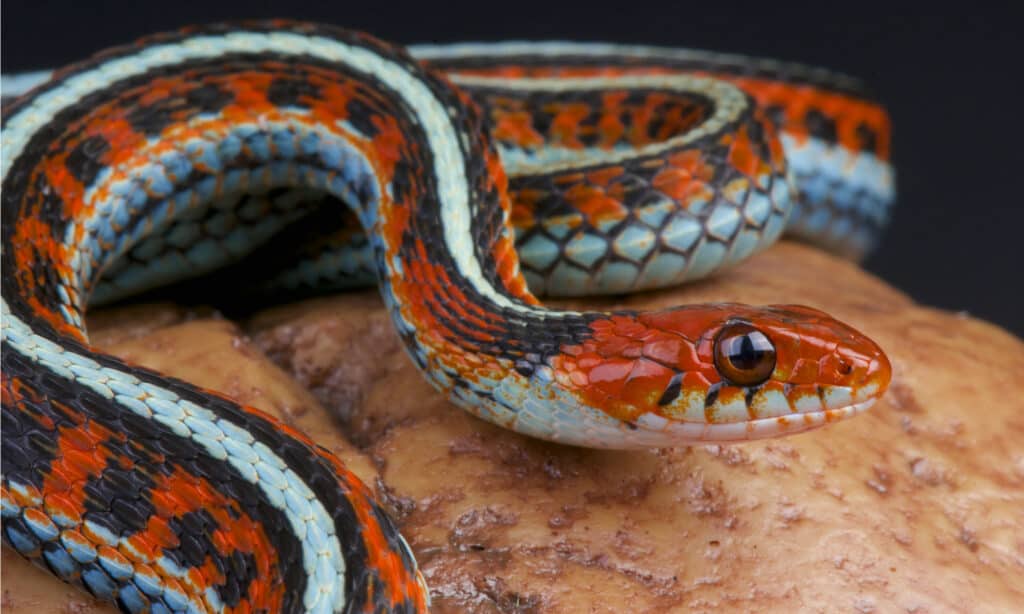
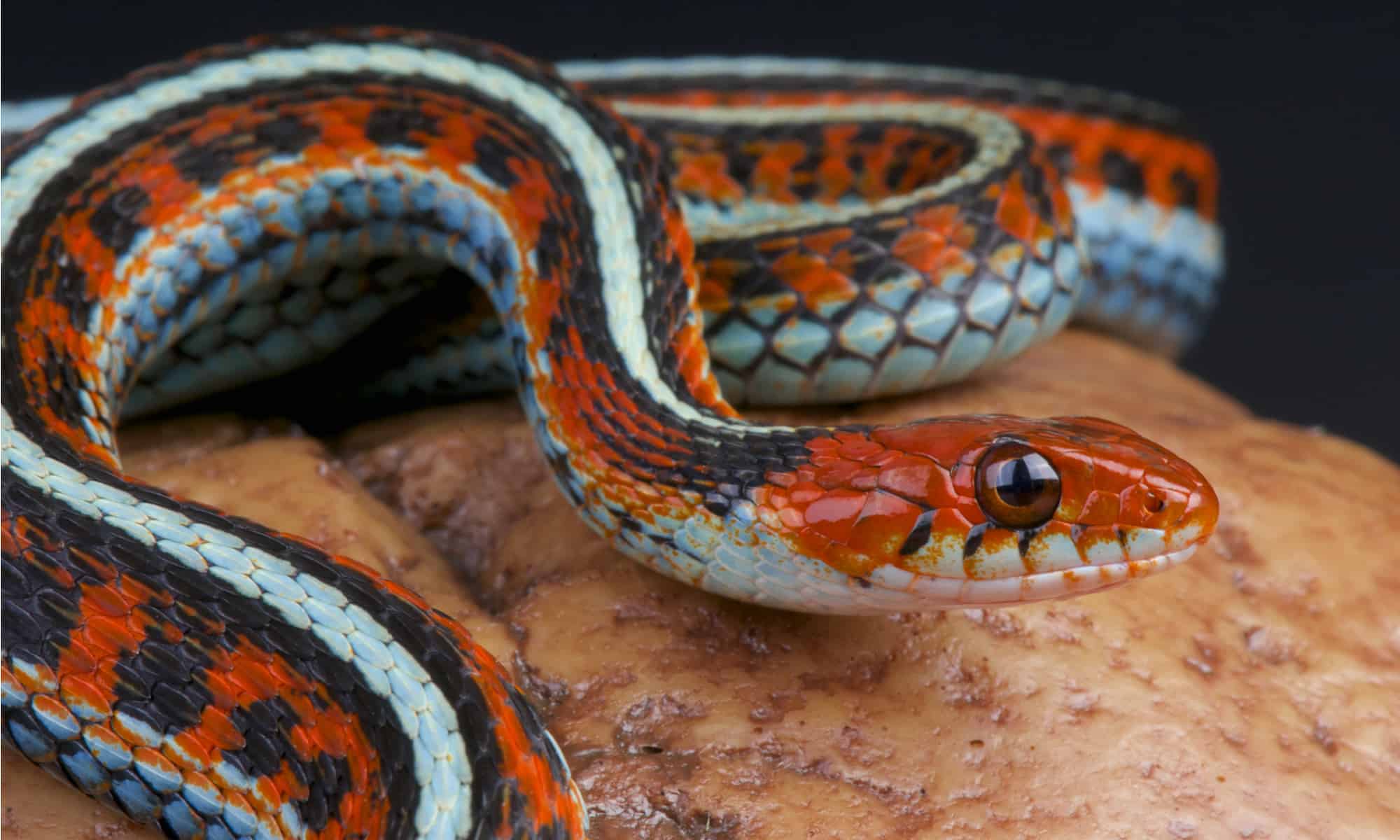
The San Francisco Garter Snake characterized by bright blue-green or green-yellow coloration along the stomach and sides.

The San Francisco Garter Snake is characterized by bright blue-green or green-yellow coloration along the stomach and sides.

The San Francisco garter snake has one of the most unique patterns of any snake in the world. It is characterized by bright blue-green or green-yellow coloration along the stomach and sides, plus another green stripe running along the entire length of the upper back. This is surrounded on both sides by two black stripes and a deep red stripe in between. The upper half of the head is colored red and orange, whereas the lower jaw and cheeks are colored bluish-green. The average length is about 3 feet long, but they can sometimes reach a length of more than 4 feet as well.

Here is how to identify the San Francisco garter snake:

  • Small, slender body measuring an average of 3 feet
  • Alternating stripes of green, black, and red
  • Large round eyes in comparison to body size
  • The head is slightly larger than the neck
  • Prominent keeled scales on the back

San Francisco Garter Snake Pictures
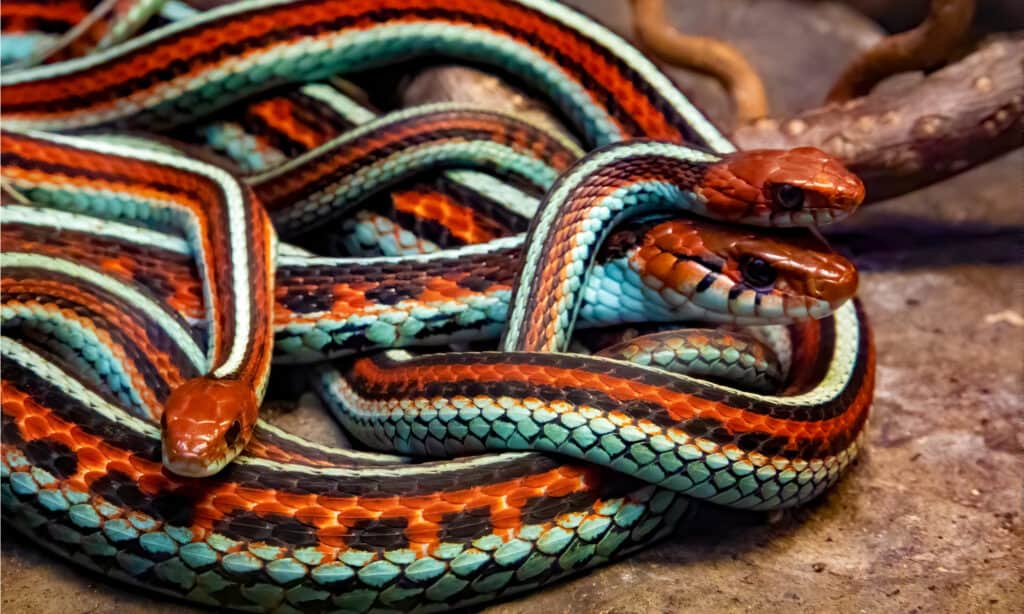
San Francisco garter snakes, endemic of California, have small, slender bodies measuring an average of 3 feet.

San Francisco garter snakes, endemic to California, have small, slender bodies measuring an average of 3 feet.

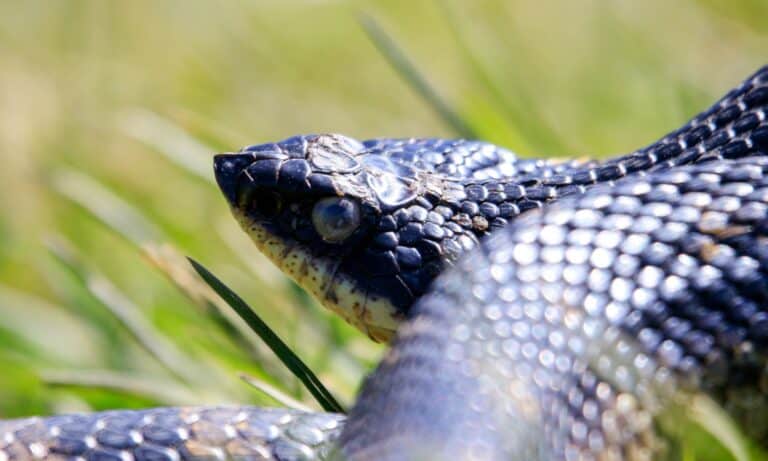
The upper half of the head of the San Francisco garter snake is colored red and orange, whereas the lower jaw and cheeks are colored bluish green.

The upper half of the head of the San Francisco garter snake is colored red and orange, whereas the lower jaw and cheeks are colored bluish-green.

San Francisco Garter Snake: How Dangerous Are They?

The San Francisco garter snake is completely harmless to humans. Although they do have the ability to produce venom in their saliva that kills their prey, this snake does not actually have any fangs to deliver the venom deep into the body. The venom will cause nothing more than mild irritation to the human skin. It does not require any medical attention unless symptoms happen to persist for a long time.

San Francisco Garter Snake Behavior and Humans

The San Francisco garter snake is very timid and wary around humans. When threatened, their first instinct is to run away and hide, usually straight into the water. If mishandled, this snake may release a foul-smelling odor and attempt to bite its assailant. While they pose no danger to people, they should be left alone. Because they prefer to live in wetland habitats, they are rarely seen and difficult to catch.

Similar Animals

View all 391 animals that start with S

Sources

  1. California Herps / Accessed May 9, 2022
  2. The Guardian / Accessed May 9, 2022
Thank you for reading! Have some feedback for us?


San Francisco Garter Snake FAQs (Frequently Asked Questions)

This snake’s saliva is considered to be mildly toxic, but it causes nothing more than minor skin irritation to humans.