
Quick Take
- An international ban has been in place for nearly 50 years, yet the tortoiseshell trade continues to thrive in some of the world's largest markets. See how bans are evaded →
- One government is actively blocking scientists from exposing a booming illegal turtle trade, and conservationists can't safely go in to find out how bad it's gotten. Nicaragua's hidden trade →
- Many tourists unknowingly buy hawksbill products, and their doing so has nothing to do with indifference to wildlife. Changing tourist behavior →
- SEE Turtles is trying to protect hawksbills inside one of the most politically untouchable territories on Earth, a place where outsiders aren't even allowed in without special permission. Conservation in Guna Yala →
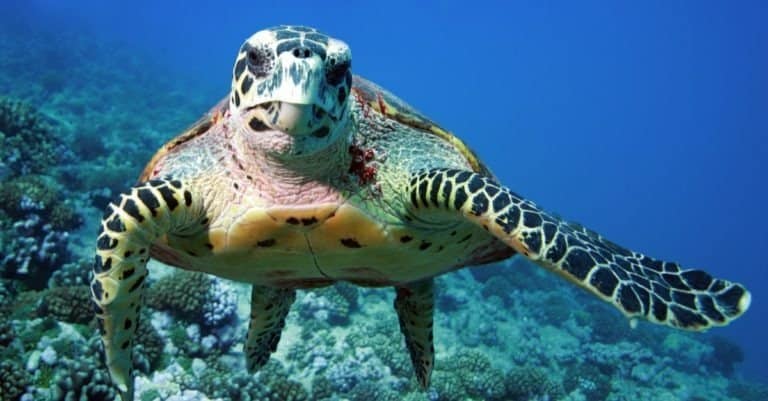
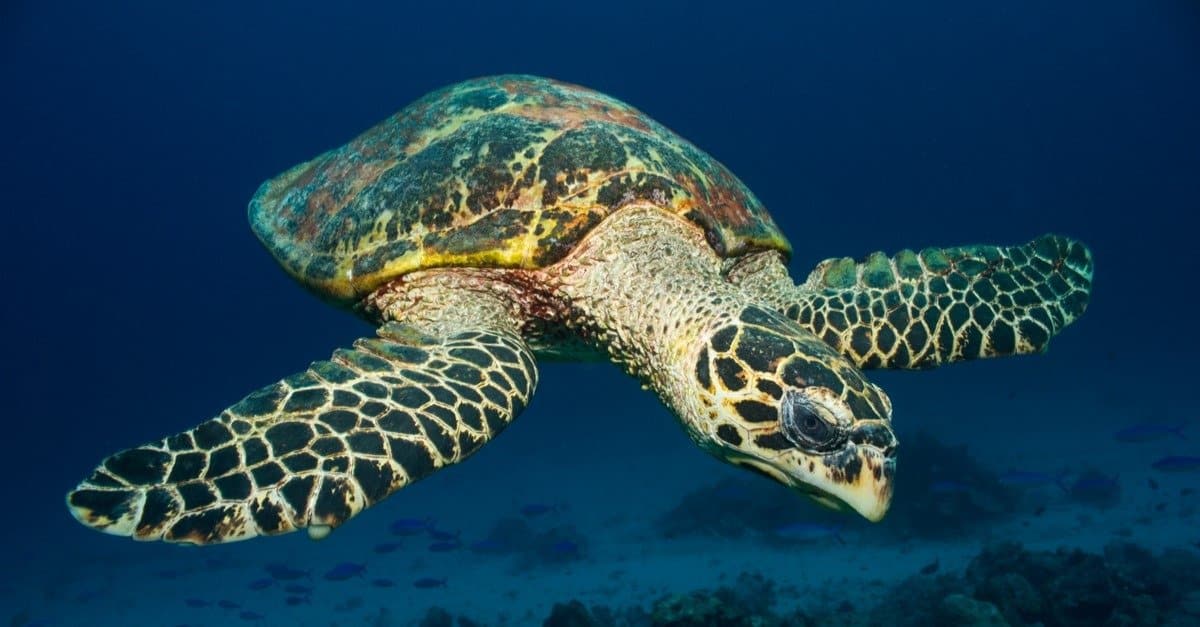
A mottling of yellows, browns, oranges, and amber makes the outer shell of the hawksbill sea turtle one of the most elaborate in the ocean. For centuries—dating back to ancient Rome, Greece, and pre-dynastic Egypt—hawksbills have been hunted for their shells, which are often used for decorative furniture, box inlays, and smaller trinkets such as rings, bracelets, and combs.
Although the hawksbill was hunted for its ornate shell, its population remained abundant prior to the 19th century. By the 1840s, larger-scale exploitation of tortoiseshell, sparked by an expansion of the Pacific trade network, led to mass hunting of the species and a sharp decline in the number of hawksbills within a century’s time. Between 1844 and 1992, nine million hawksbills were killed for the tortoiseshell trade, according to a 2019 study published in the journal Science Advances — a number that has left the turtle critically endangered.
Hawksbill numbers have declined globally by more than 80 percent over the past century. Today, estimates of remaining nesting female hawksbill turtles vary widely by source, ranging from approximately 8,000 to 23,000 worldwide; the Sea Turtle Conservancy places that figure between 20,000 and 23,000.
Although an international trade ban on hawksbill shells was enacted under CITES in 1977, significant illegal trade continues in Latin America, the Caribbean, and Japan, making it the largest threat to the species.
Skirting Bans
Tortoiseshell is still illegally traded or sold at local markets and is made into jewelry—called “carey” in Spanish or “bekko” in Japanese—as well as ornaments, sunglasses, guitar picks, and some apparel, including boots made from the turtles’ skins. Juvenile hawksbills are also hunted and stuffed for sale as souvenirs.
An illegal tortoiseshell trade continues in Japan, despite imports apparently ending in the country during the 1990s, coinciding with the ban on the legal international trade and following U.S. sanctions and international conservation pressure.
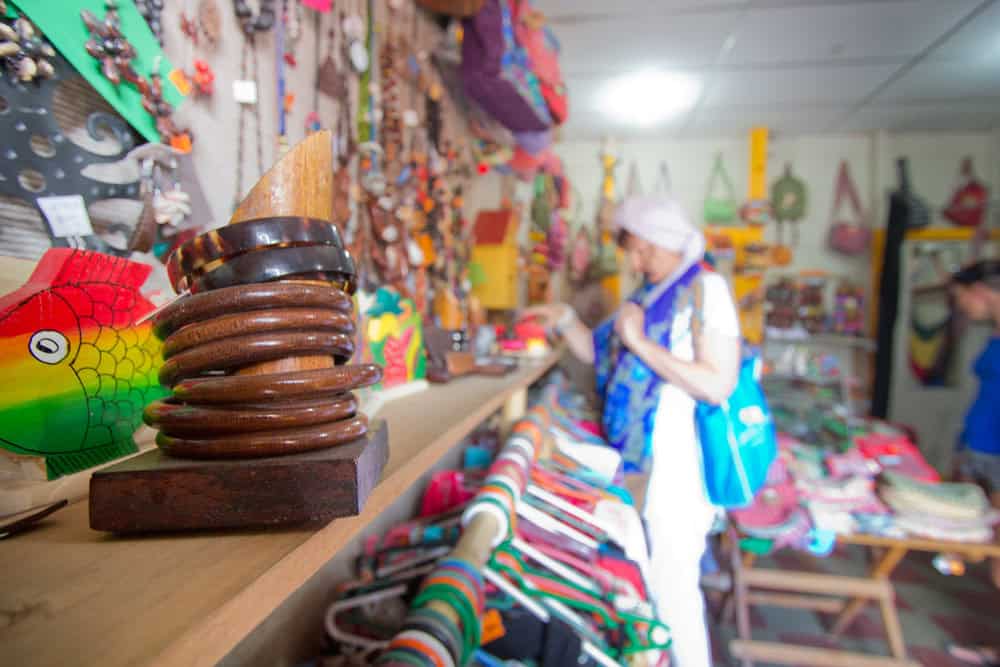
Often sold at local markets, tortoiseshell jewelry—called “carey” in Spanish—is prevalent, along with ornaments, sunglasses, guitar picks, and more made of hawksbill shells.
“There was suspicion in the conservation community that the ban on imports was being skirted in Japan,” says Brad Nahill, co-founder and president of SEE Turtles, a non-profit organization dedicated to protecting endangered sea turtles and supporting conservation efforts worldwide. Along with Japan, the tortoiseshell trade continues in several regions, says Nahill, including China, where products are illegally sold via social platforms like WeChat and WhatsApp.
Vietnam and Indonesia are also regions of concern, as they still have significant markets for the shell trade, although conservation efforts have helped reduce hunting in some parts of Latin America. SEE Turtles’ projects have seen progress in hawksbill populations in the Yucatan Peninsula and parts of Panama, where more nesting has occurred. According to SEE Turtles, conservation efforts at Bastimentos National Park in Panama have increased the number of nests from 688 in 2014 to more than 1,200 by 2025.
“Those were two primary areas where they were being hunted and sent to, primarily, Japan,” says Nahill. “But we’re actually seeing some growth in some of the populations in Latin America now, which is exciting.”
Nicaragua
In Colombia, the situation has also improved, specifically in the SEE Turtles monitored region of Cartagena, where training of local police and enforcement authorities has helped the population. Working with partners at Fundación Tortugas del Mar, SEE Turtles has helped reduce the trade by 80 percent in the region.
Nicaragua remains one country where the trade is still presumably high, yet the current government has prevented conservationists from compiling or releasing any recent data exposing the trade.
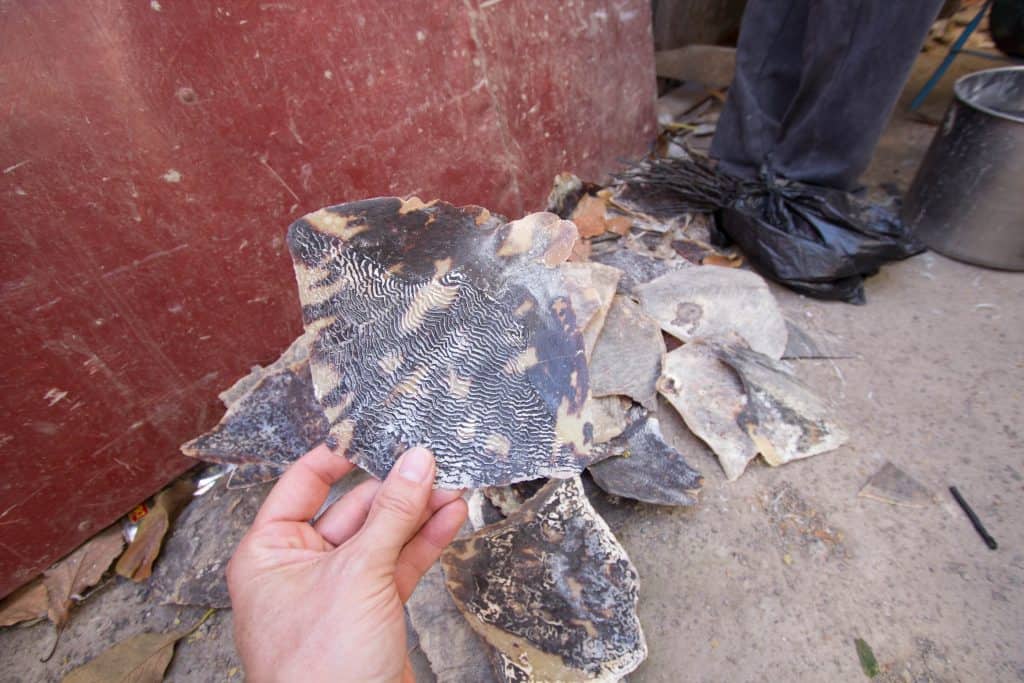
Hawksbill Sea Turtle shell scales (scutes) waiting to be used by artisans in Managua to produce sea turtle shell jewelry in Nicaragua.
“The way that it has gone politically there, it is no longer viable, nor safe for our local partners to be doing the counts and publishing the results,” says Nahill, who visited Nicaragua before the pandemic and remembers seeing tortoiseshell products in nearly every stall at one popular marketplace.
“It was depressing,” Nahill adds, revealing that there’s been no new data on the trade in Nicaragua released since 2000.
Too Rare
To help combat the global sale of tortoiseshell, SEE Turtles launched the Too Rare to Wear campaign in 2016 to raise awareness of the illegal trade and reduce the purchase of turtle products.
Anecdotally, we believe that people buy it not knowing that it’s hawksbill. Some people hear ‘tortoiseshell,’ and may think of the pattern and not the shell itself.
Brad Nahill, co-founder and president, SEE Turtles
The project also launched two international reports on the tortoiseshell trade and the SEE Shell App, which uses AI to identify products made from shell. The organization is also addressing the trade on a local level in Indonesia and Costa Rica.
“Anecdotally, we believe that people buy it not knowing that it’s hawksbill,” says Nahill. “Some people hear ‘tortoiseshell’ and may think of the pattern and not the shell itself. We don’t think international travelers are seeking it out, but there needs to be more education around it, so people can avoid them — even fakes — since it is really hard to tell the difference.”
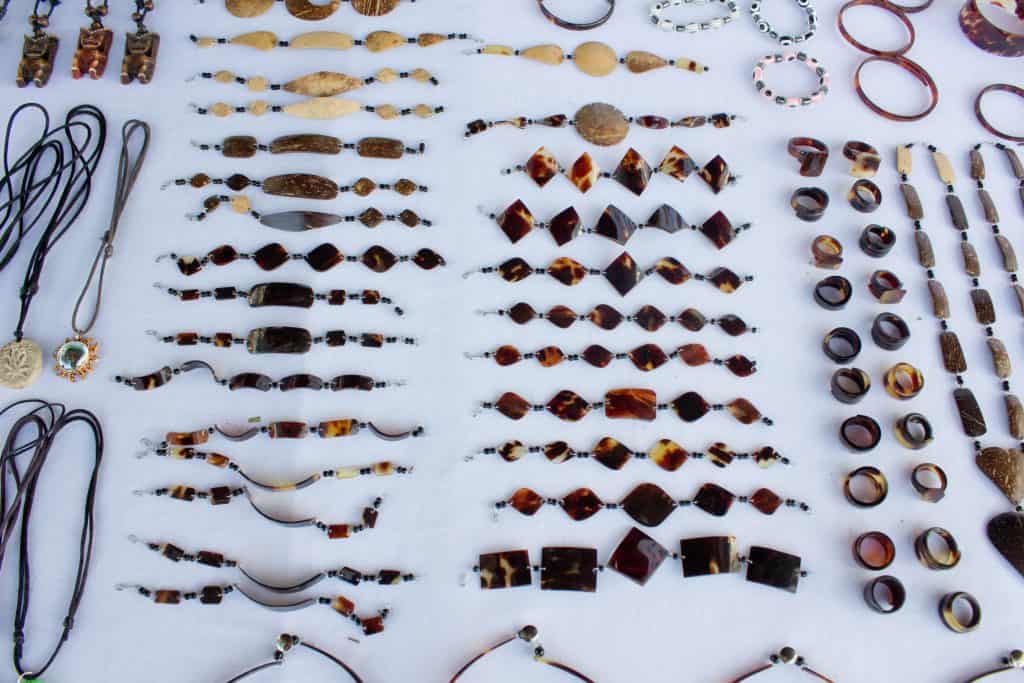
Sea turtle shell bracelets for sale in Managua, Nicaragua.
For years, Nahill worked on acquiring a multi-year grant from the U.S. Fish and Wildlife Service to expand and enhance the Too Rare to Wear Campaign, which included upgrades to the app and further support across SEE Turtles’ global network of partners, before the funding was cut by the current administration in early 2026.
Conservation groups had typically received funding from the U.S. Agency for International Development, the U.S. Fish and Wildlife Service, and other government agencies, but this support was “wiped out overnight” for many organizations.
“It was a big blow to the Too Rare to Wear program, but our organization is diversified enough through trips and other sources of donations that it wasn’t as devastating to us,” says Nahill. “We hope that we’re able to help grow the funding that we offer to nesting beaches, to plastic projects, to tortoiseshell projects. It’s a pipe dream to replace U.S. government funding, but at least we can help keep these programs going.”
Along with the illegal poaching, hawksbills face other threats, including entanglement as fishing bycatch and habitat loss resulting from coastal development and climate change, with rising sea levels destroying nesting sites. Damage to coral habitats, including bleaching, is another problem, since hawksbills tend to feed on sponges on reefs. Climate change also impacts the balance of turtle populations, since warmer sands produce more female turtles.
Often nesting on remote beaches in small numbers, the largest populations of hawksbills are found throughout the Atlantic, Pacific, and Indian Oceans, with significant nesting populations in Australia, Indonesia, the Seychelles, and the Solomon Islands.
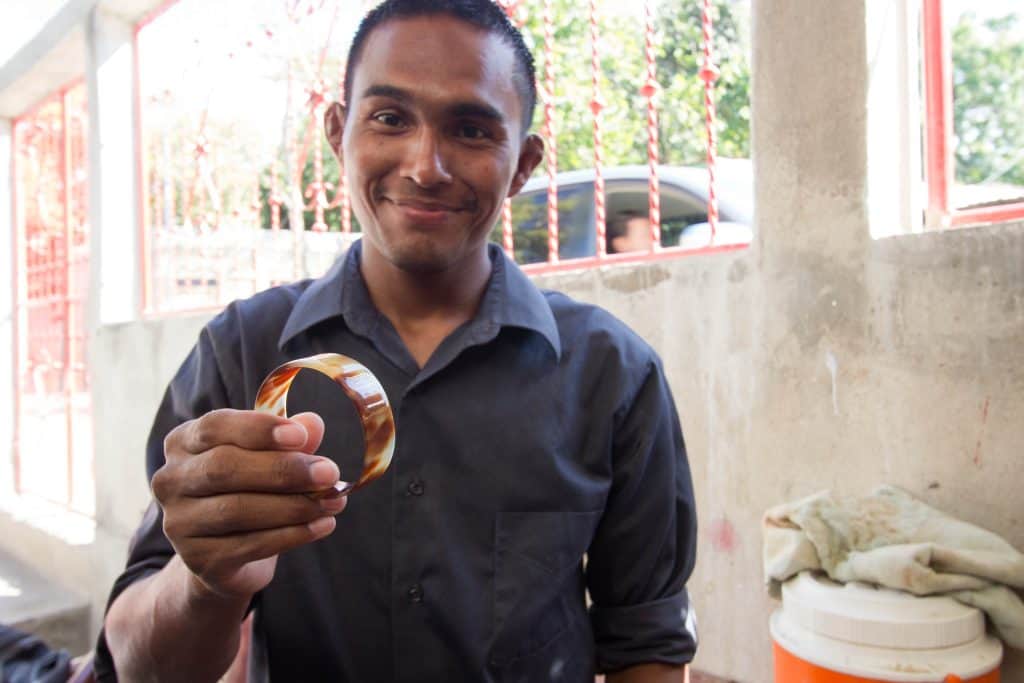
Local artisans in Managua are still producing hawksbill shell jewelry in Nicaragua.
In the Atlantic, major nesting and feeding sites for hawksbills are Barbados, Mexico, along the Yucatán Peninsula, Cuba, and the Lesser Antilles. Within the United States, regular nesting spots for hawksbills lie around Puerto Rico, the U.S. Virgin Islands, southeast Florida, and the Florida Keys.
With nesting habitats disappearing and other ocean threats reducing hawksbill numbers, another challenge for the species is the long gap between their reproduction cycles. Hawksbills generally nest every two to four years, laying an average of 160 eggs per clutch.
Moving forward, outreach programs with law enforcement and educational partners will build on the progress SEE Turtles has already made in Latin America. The organization recently acquired a student travel company to help support coastal communities worldwide. Volunteers work with local businesses within these regions where people are no longer able to sell turtle products, including eggs or meat, and help them find alternatives. “They’re helping these communities thrive,” says Nahill, “while the turtles thrive as well.”
Panama
In Panama, SEE Turtles has also had a successful Leatherback program, but still faces challenges reaching a sovereign indigenous group in the Guna Yala province along the northeastern Caribbean coast and the San Blas Islands, who are known for eating hawksbill meat.
In partnership with Sea Turtle Conservancy, SEE Turtles has made progress in northern Panama by supporting hawksbill nesting projects, but accessing the Guna Yala region is difficult due to its autonomy—even Panamanians are required to carry a visa to enter.
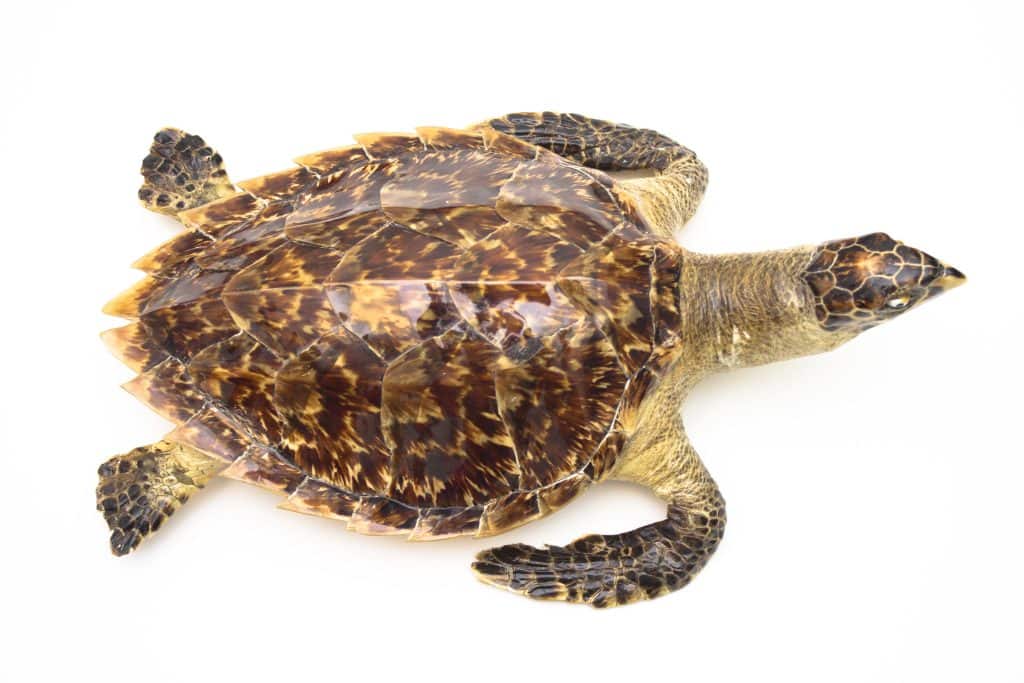
Juvenile hawksbills are also hunted and stuffed for sale as souvenirs.
“They may be the most politically powerful indigenous community in the world,” says Nahill, who still hopes to visit the region. While turtle consumption has been part of their culture for centuries, the Guna people hold deep beliefs about leatherback sea turtles, considering them sacred and ancestral.
“There is a taboo against touching them,” Nahill says of the leatherback. “There is a belief that they’ll take you back into the water with them, but they’re still eating the hawksbill. They’re still using their shells.”
SEE Turtles is currently supporting two local biologists from the region, whom they hope can help educate the communities from within. A similar approach, he says, is necessary when approaching the Japanese market, for example. “If anyone from the outside tells Japan that they can’t do something, it’s an immediate ‘We’re going to do it just because you don’t want us to,’” says Nahill.
“Coming from the outside and telling them what to do is an immediate ‘No,’ because they’ve had decades of people trying to exploit them,” adds Nahill of Guna Yala. “We hope that if we’re funding these local biologists and they’re talking to their communities about the importance of these species, and not outwardly shaming them, that maybe over time things will change.”