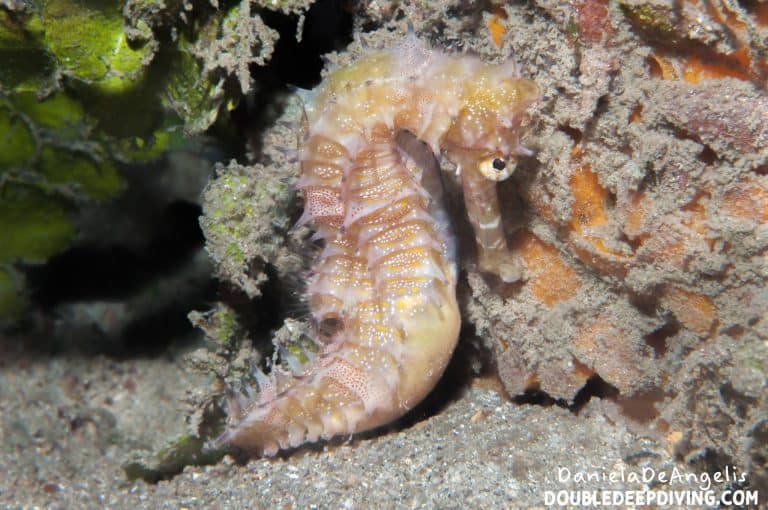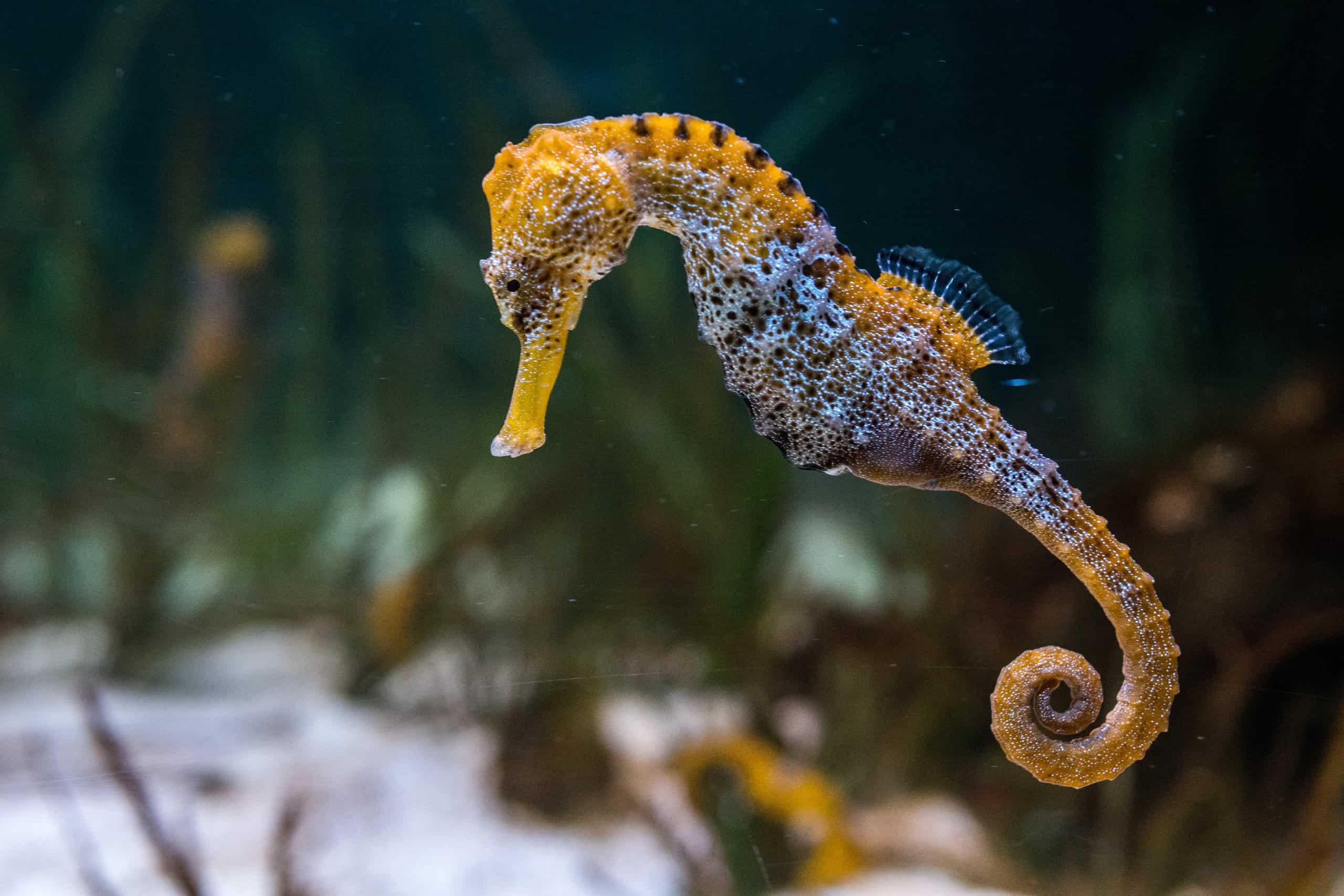

There are 46 species of seahorse scattered throughout the world’s oceans. They are not adept swimmers; seahorses move by using a small fin on their backs and an even smaller pair on the back of their heads to steer. Seahorses use their tails to anchor themselves to vegetation to avoid being swept away by currents. They are an ovoviviparous species, with males gestating the females’ eggs inside their bodies, which is the opposite of most other species. Continue reading to learn about the nine largest species of the Hippocampus genus.
9. Barbour’s Seahorse
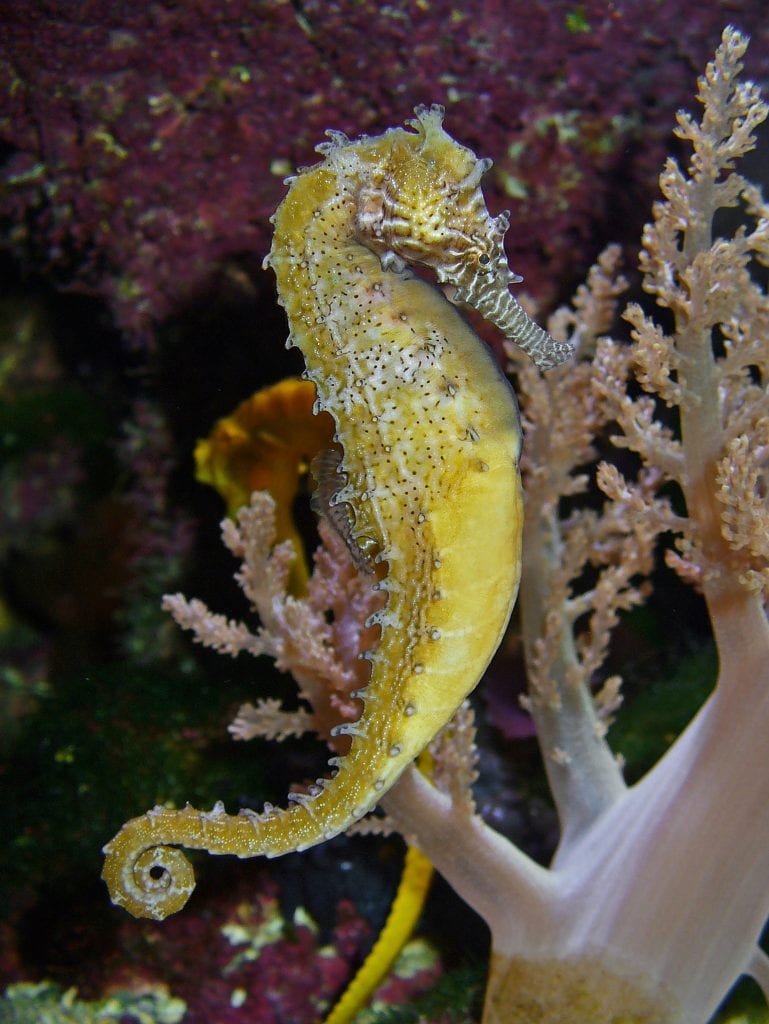
A zebra-striped pattern on their noses helps identify Barbour’s seahorse.
©H. Zell, CC BY-SA 3.0 <https://creativecommons.org/licenses/by-sa/3.0 – Original / License
Barbour’s seahorses (Hippocampus barbouri) measure up to 6 inches long. Endemic to Southeast Asia, specifically the Philippines, Malaysia, and Indonesia, they live in shallow coastal waters full of seagrass. Barbour’s seahorses are recognized by the zebra-striped pattern along their snout and their bright yellow color. Females are slightly smaller than males.
8. Spiny Seahorse
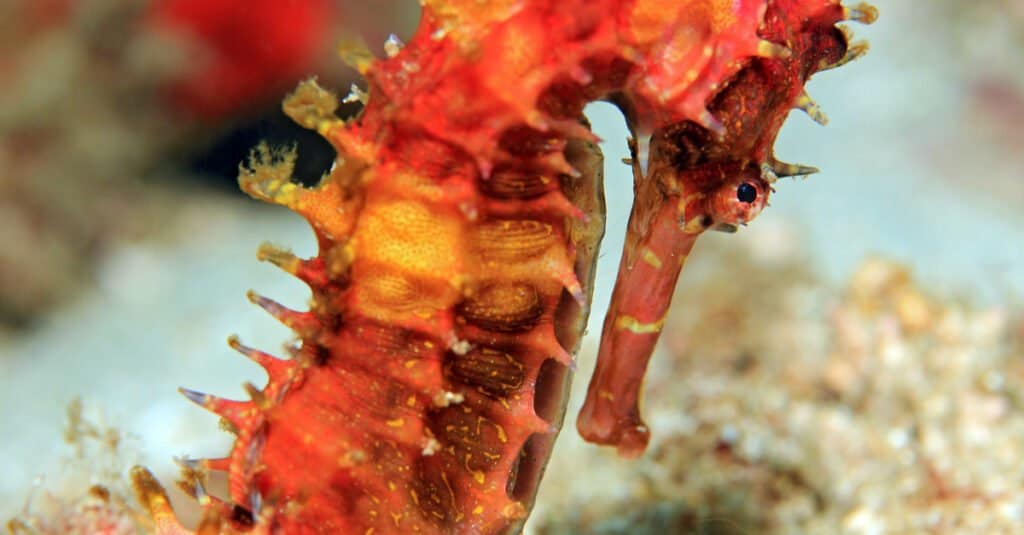
The spiny seahorse can grow to between 6 and 7 inches long.
©iStock.com/AndamanSE
The spiny seahorse (Hippocampus histrix) measures 6 to 7 inches long. Though relatively rare, this species ranges widely and is found in Australia, Indonesia, Papua New Guinea, New Caledonia, and Japan. The snout is very long and tapered, and the color varies depending on the environment. They are classified as Vulnerable by the IUCN.
7. Slender Seahorse
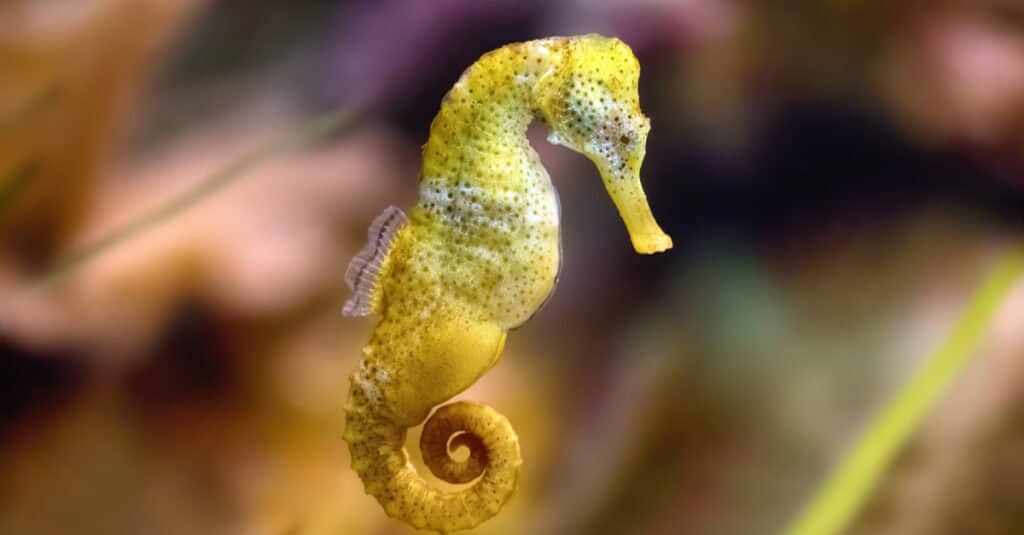
Slender seahorses are a vibrant yellow.
©Soonios Pro/Shutterstock.com
The slender seahorse (Hippocampus reidi) measures up to 6.89 inches long and is found in subtropical regions. They live in coral reefs and seagrass beds in shallow waters. The slender seahorse, also called the longsnout seahorse, is at risk in China and Brazil, where they are used in traditional medicine and as talismans and souvenirs. Males are usually a vibrant orange color, while females are yellow.
6. Tiger Tail Seahorse
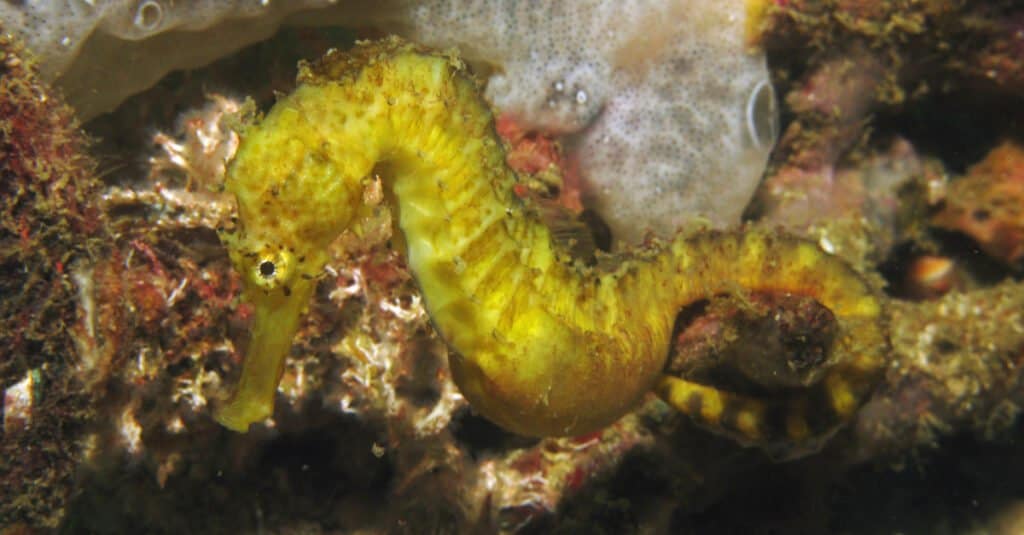
Tiger tail seahorses are found in waters around Southeast Asia.
©S J Carr/Shutterstock.com
The tiger tail seahorse (Hippocampus comes) measures up to 7.36 inches long. This species is found in tropical waters around Malaysia, Singapore, Thailand, Vietnam, and the Philippines. As their name suggests, they have yellow and black stripes. They are nocturnal and live in pairs on coral reefs, sponge gardens, or kelp. Like the slender seahorse, they are used in traditional Chinese medicine.
5. Lined Seahorse
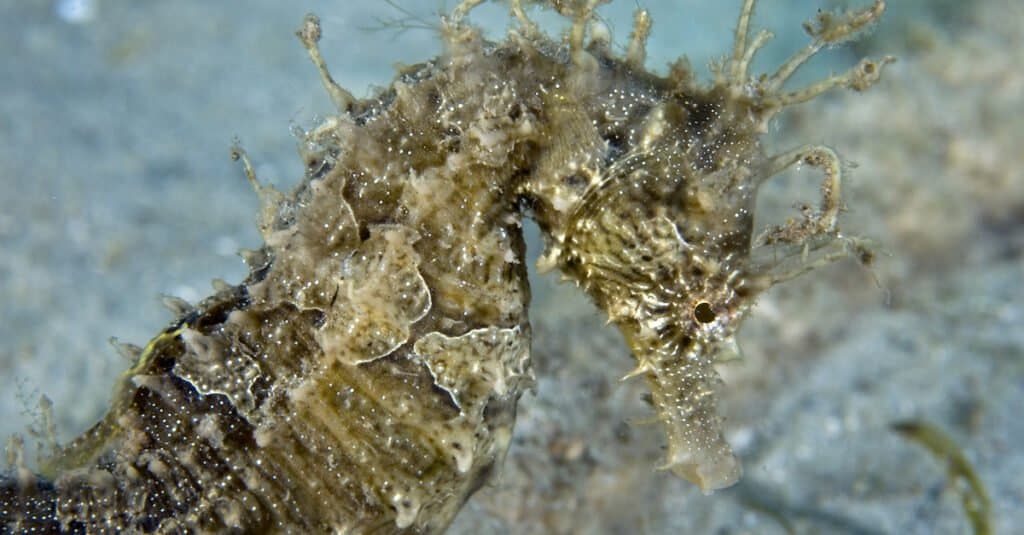
The lined seahorse has a broad color spectrum.
©Peter Leahy/Shutterstock.com
Found throughout the Western Atlantic Ocean, the lined seahorse (Hippocampus erectus) is the only seahorse species found in Chesapeake Bay. They are diurnal and prey on crustaceans, mollusks, and zooplankton. Measuring up to 7.48 inches, lined seahorses are also known for their characteristic pattern of white lines running along their bodies, giving them their name. These lines, along with their ability to change color, provide natural camouflage. They are listed as Vulnerable by the IUCN.
4. Long-snouted Seahorse
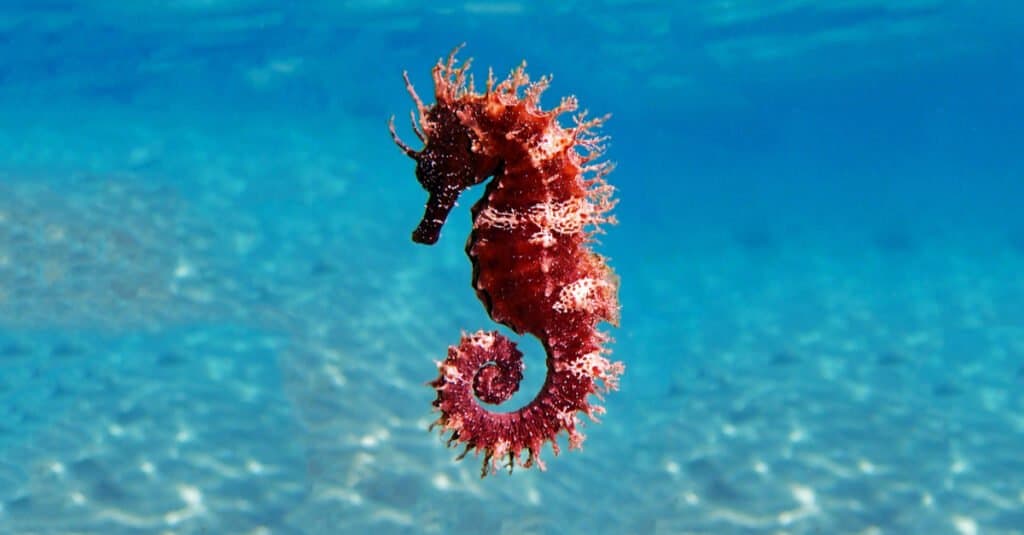
A long-snouted seahorse can measure up to 8.46 inches long.
©Vojce/Shutterstock.com
The long-snouted seahorse (Hippocampus guttulatus) lives in coastal waters between 3 and 66 feet deep. They are found in the Northeast Atlantic Ocean and the Mediterranean Sea, where they live in seagrass. They measure up to 8.5 inches long. The long-snouted seahorse varies in color from dark green to red-brown, with small white dots speckled across its body.
3. Flat-faced Seahorse
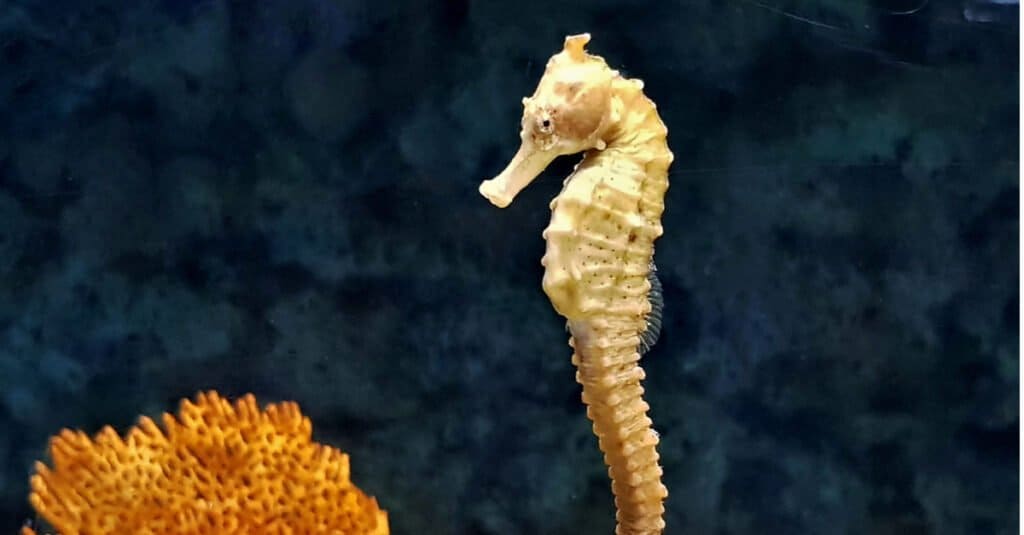
The flat-faced seahorse is native to the Indo-Pacific region.
©Arunee Rodloy/Shutterstock.com
Flat-faced seahorses (Hippocampus trimaculatus) are found primarily in shallow water, where they live in gravel and sand bottoms around coral reefs. The flat-faced seahorse has a typically flat body, with eye spines, a narrow head, and no nose spines. The coloration can be golden orange, sandy-colored, or black. This species can measure up to 8.66 inches long. They are also used in traditional Chinese medicine.
2. Great Seahorse
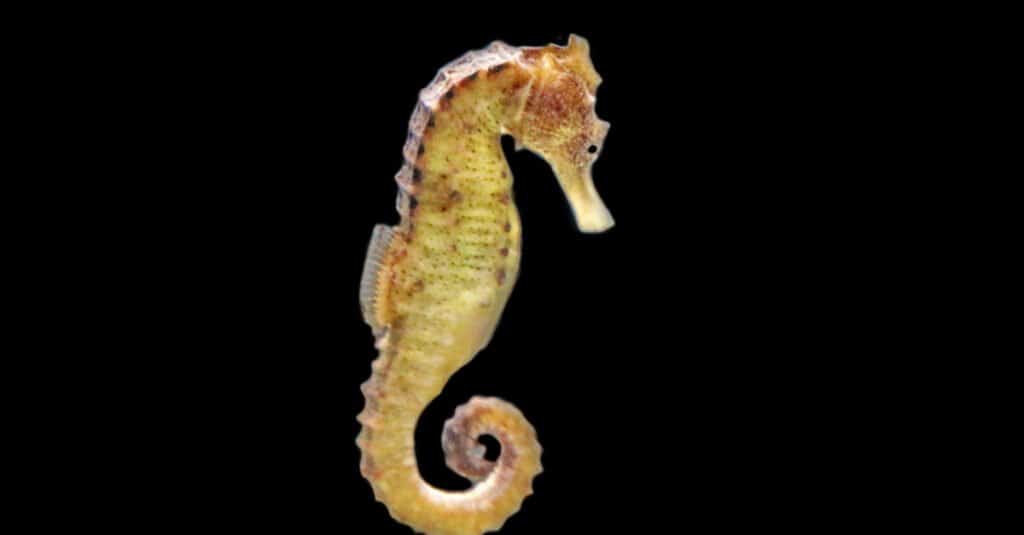
The great seahorse can grow to nearly a foot long.
©Arunee Rodloy/Shutterstock.com
The great seahorse (Hippocampus kelloggi) measures up to 11 inches. They are found in the Indo-Pacific region, from the coast of East Africa to Japan. They are usually found in shallow waters around coral reefs; however, some specimens have been found at depths of almost 500 feet. Once again, the use of this species in traditional Chinese medicine and its being dried and sold as a souvenir has led the IUCN to classify it as Vulnerable.
1. Big-belly Seahorse
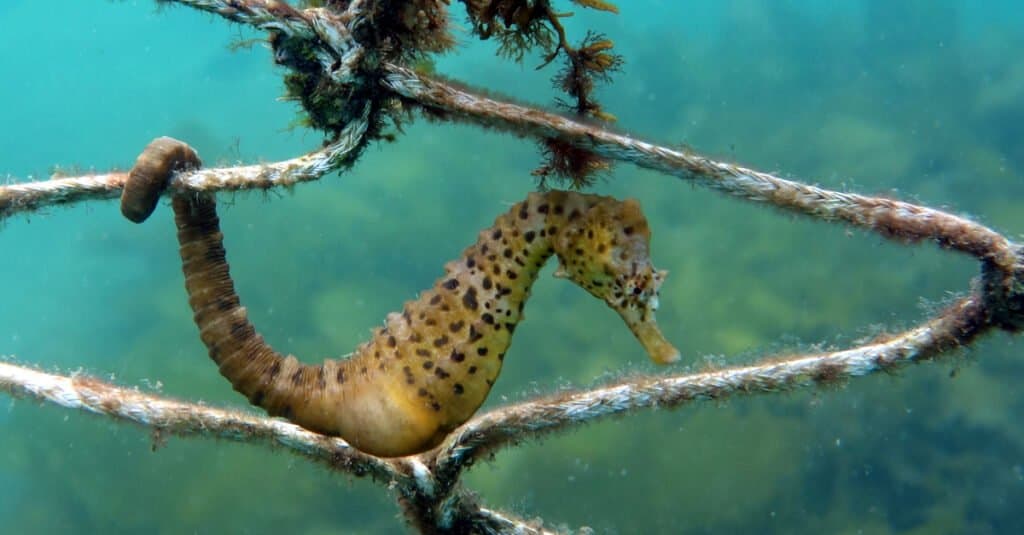
The big-belly seahorse has a name that says it all.
©Dirk van der Heide/Shutterstock.com
Big-belly seahorses (Hippocampus abdominalis) are the world’s largest seahorses. The big-belly seahorse measures up to 14 inches. Unlike the rest of the entries on this list, big-belly seahorses are proficient swimmers. Found primarily along the coast of Australia and New Zealand, they are ambush predators that live in vegetated areas. This extra-large species has a long snout, a narrow potbelly, and a long, coiled tail. The species is typically brown and yellow with a few darker splotches, while the tail is often circled with yellow bands.