
Quick Take
- Seahorses change color instantly, and the biological mechanism behind it is nothing like what you would expect from a fish. See the biological mechanism →
- Camouflage is only part of the story. Seahorses also use color to send messages that can determine whether they mate or get ignored. Explore the color signals →
- The rarest seahorse colors aren't always the vivid tropical ones you'd guess from looking at an aquarium tank. Discover rare seahorse colors →
- One seahorse species holds a swimming record so extreme it barely qualifies as moving, yet its coloring is part of why it survives anyway. Check the swimming record →
If you head to the aquarium and look for those adorable little seahorses, you’ll see some vividly colored creatures of the deep. Yet, what if the next time you visit, the same individuals are different colors? Why is that? Do seahorses change over time? Do the same seahorse species come in different colors? Let’s take a look at these fascinating animals of the ocean and learn the what, why, and how of their colors, and whether their colors change.
Seahorse Facts
The “horses of the sea” offer beautiful, vibrant colors and unique looks wherever they go. Seahorses are generally docile and social bony fish. They don’t have scales, but rather skin that stretches over their series of bony plates arranged in rings throughout their bodies. Each species of seahorse has a distinct number of rings that make up the body armor they have, which protects them from predators. Their coloration also plays a role in their protection, as discussed in the following section.
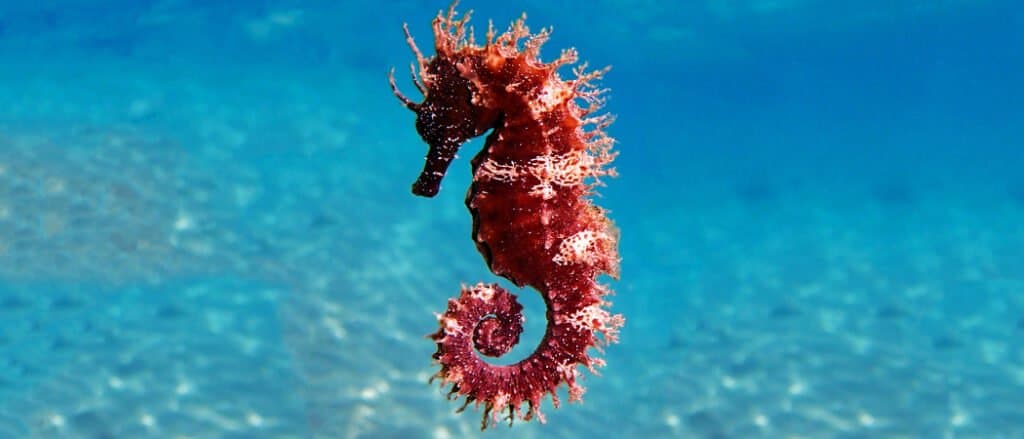
Seahorses come in many shades and sizes, some with spines, and some without.
©Vojce/Shutterstock.com
These tiny fish may be as small as 0.6 inches and as large as 14 inches. Their name is derived from their equine-like appearance. The bent necks, distinctive trunks and tails, and long snouts all evoke a horse. They swim upright, propelling themselves along using their dorsal fins. The only other known fish to swim like this is the razorfish. Seahorses have pectoral fins on either side of their heads, behind their eyes, and use them for steering. They don’t have caudal fins (on their tails) and their prehensile tails are made up of square rings that may unlock in extreme conditions.
Because of their body makeup, these little fish tend to be poor swimmers. They flutter their dorsal fins rapidly and use the pectoral fins to steer, but they’re one of the slowest moving fish species in the world. The dwarf seahorse (Hippocampus zosterae) is actually believed to be the absolute slowest-swimming fish on the planet, with a top speed of only 5 feet per hour.
Seahorse Colors
There are 47 different species of seahorses with many different shades and patterns. Many have multiple colors, depending on their environment, mood, or diet. Seahorses can be every color in the rainbow, including shades of yellow, orange, red, green, blue, black, pink, purple, grey, and brown.
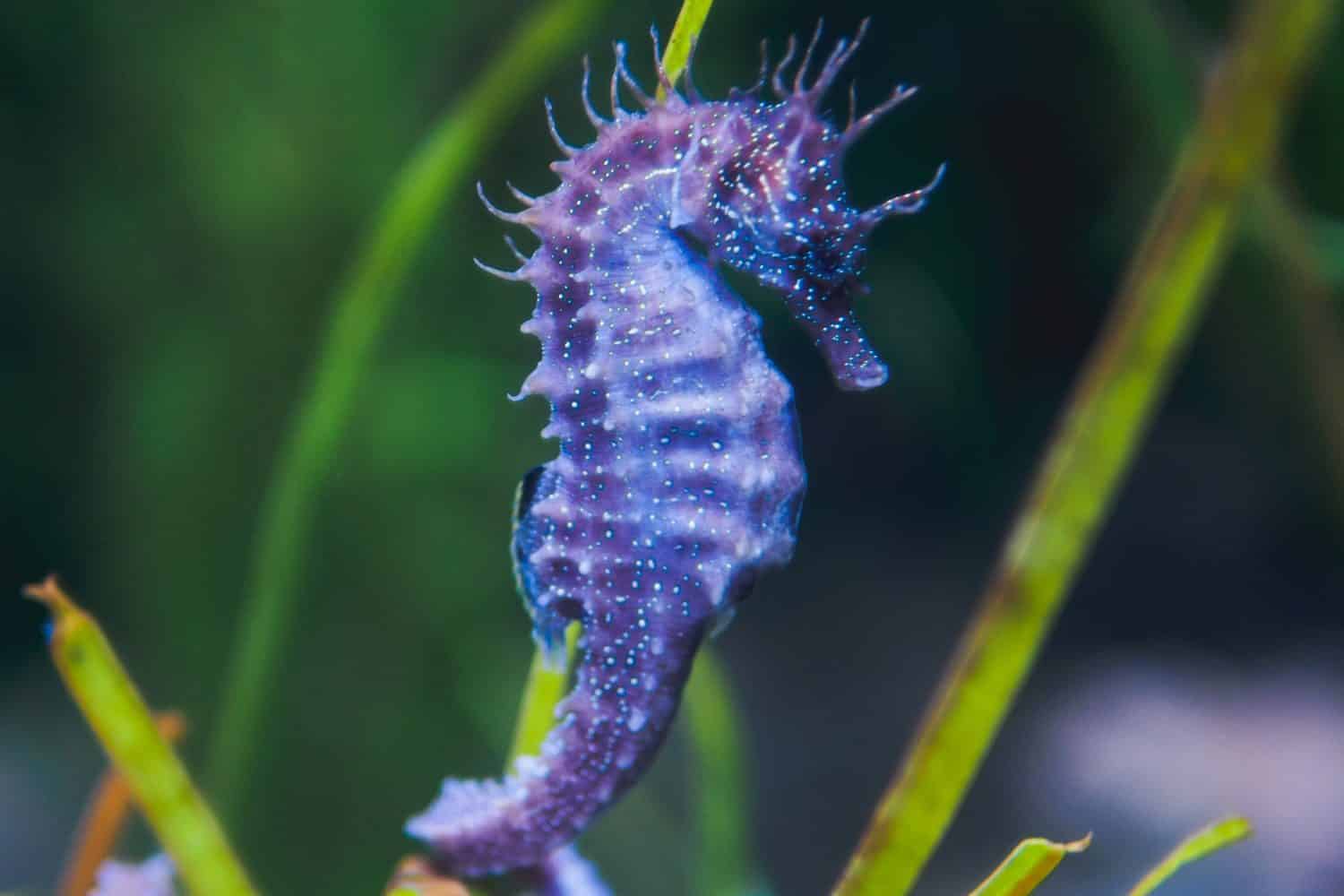
The rarest seahorse shade is purple.
©paulzhuk/Shutterstock.com
The intriguing part about seahorse colors, though, is that they actually change their colors like chameleons in their habitats. Seahorses also have markings on their bodies that add another layer to their color patterns. They may have spots, stripes, squiggles, or other markings. The bony ridges, bumps (tubercles), frills, spikes, and other shapes on their skin help break up their silhouettes so they can camouflage more easily.
Why Do Seahorses Have Such Bright Coloration?
As touched on above, research indicates that the colors help them to naturally blend into their environment for safety reasons. Typically, seahorses that live in coral reefs have brighter colors, while those in darker waters tend to be darker in shade. They match their surroundings quickly when they feel threatened, blending into the background when predators are near. This is especially thought to be true for males building their nests among corals and plants.
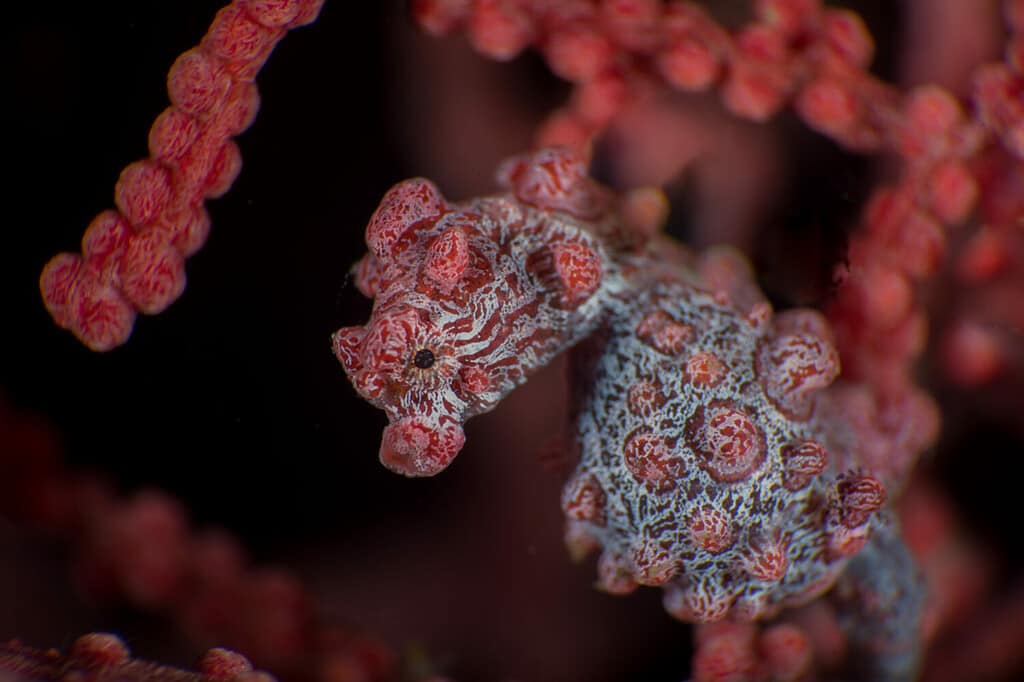
The tiny pygmy seahorse not only comes in many bright colors, but it has unique markings.
©Albert Saiz Tezanos/Shutterstock.com
Other theories suggest that the bright colors help the seahorses communicate with one another. Their coloration signals mood, and since these animals are highly social, this is believed to help other seahorses know how to respond to each other. The coloring and markings are thought to help distinguish one seahorse from another, which may also help them communicate. Seahorses also change colors as a part of their courtship rituals, using bright colors to attract a mate.
How Do Seahorses Change Color?
Seahorses have special cells in their skin called chromatophores. These cells contain pigments and the muscles within the cells allow them to expand or shrink, under control of the seahorse’s nervous system. Expanding and contracting the cells pushes pigment to the surface layer of the skin, allowing seahorses to quickly change the color of their skin in response to external conditions.