
Quick Take
- Seals evolved two completely different ways of swimming, and why geneticists had to step in to settle the debate is stranger than you'd expect. See the two techniques →
- You'd assume the biggest seals are the slowest, but the speed rankings flip that logic entirely. Check the speed rankings →
- One seal species can hit speeds that rival a car on a residential street, and it is probably not the one you would guess. See the fastest seal species →
- The physics behind why bulk becomes a speed advantage in water challenges everything intuition says about size and drag. Explore the size-speed physics →
Seals are semi-aquatic marine mammals known as pinnipeds. They are made up of three diverse groups, which include 33 seal species from around the globe. The three groups are: Otariidae, or eared seals such as sea lions and fur seals, Phocidae, the true seals, and Odobenidae, which includes only walruses. Seals are excellent swimmers and use speed to their advantage when hunting or escaping predators. But how fast can seals swim?
Seal Swimming Techniques
Interestingly, seals have evolved two distinct ways of swimming, despite inhabiting the same environment and exhibiting similar behaviors. For example, one group primarily uses its rear flippers to push through the water, while others use their front flippers to propel themselves. Researchers find this particularly unusual because both groups are descendants of the same ancestor. True seals that mainly occur in the northern hemisphere, like harbor seals and gray seals, use their rear flippers in a side-to-side motion, to push them through the water, similar to fish. Their front flippers are tucked against their sides and are mainly used for steering.
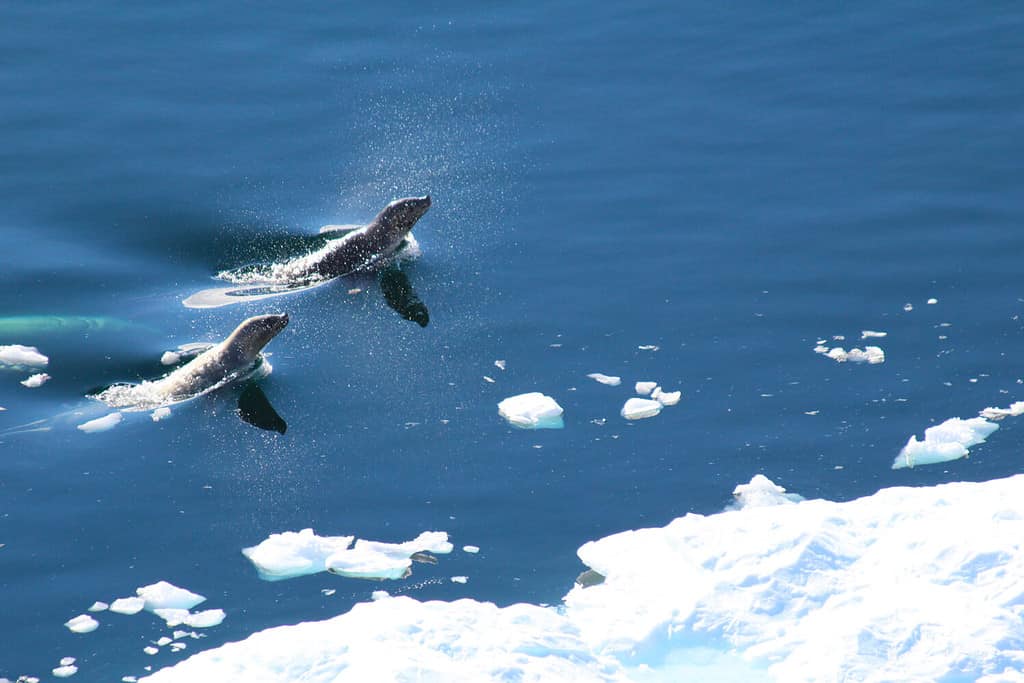
Leopard seals have elongated, paddle-like front flippers.
©Marco Ramerini/Shutterstock.com
However, sea lions and fur seals are otariids, inhabiting subpolar, temperate, and equatorial waters across the Pacific and Southern Oceans. They have elongated, paddle-like front flippers, which help them move swiftly through the water. For example, leopard seals, huge predators that occur in Antarctica, use their streamlined front flippers to propel them as they hunt down speedy penguins. Their rear flippers are used for steering. The differences in the swimming styles of these two groups of seals are so great, researchers originally believed they evolved from separate ancestors. However, genetics disproved this theory and showed they came from the same group of animals.
Top Swimming Speeds
Most sourced estimate seals’ average swimming speeds are between 2.5 mph and 6 mph, depending on the species. However, seals need to swim faster to catch prey and avoid predators. So they are able to swim very quickly in short bursts. Researchers found that seals swim 10%–20% faster on their way to capture prey. Grey seals can swim between 14 and 23 mph, while fur seals can swim up to 15 mph. Harbor seals and harp seals can both swim up to 12 mph for short periods.
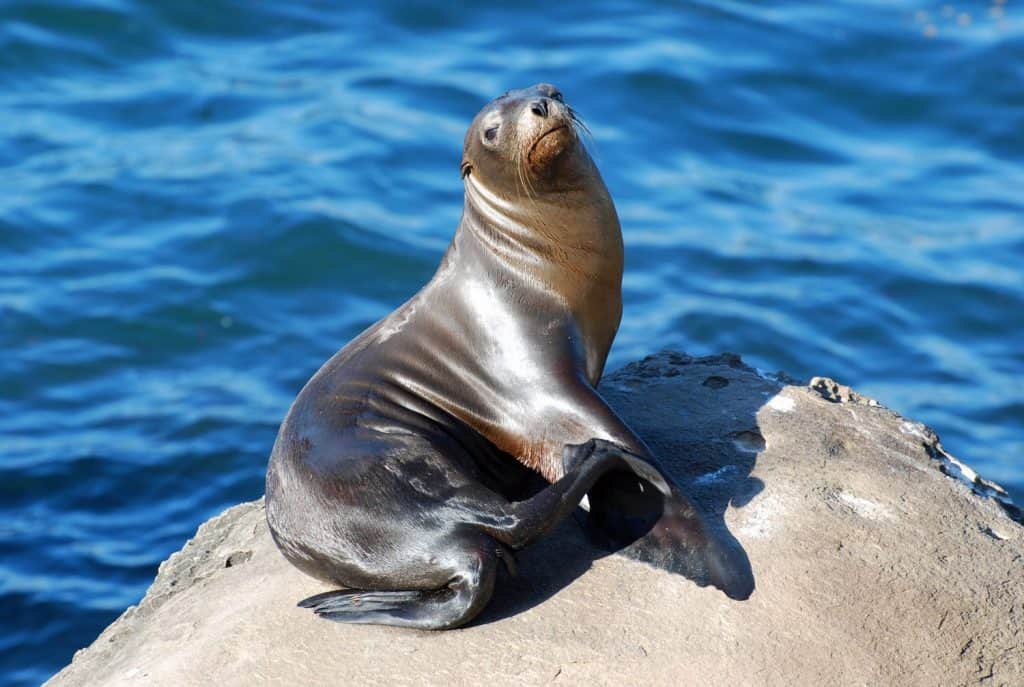
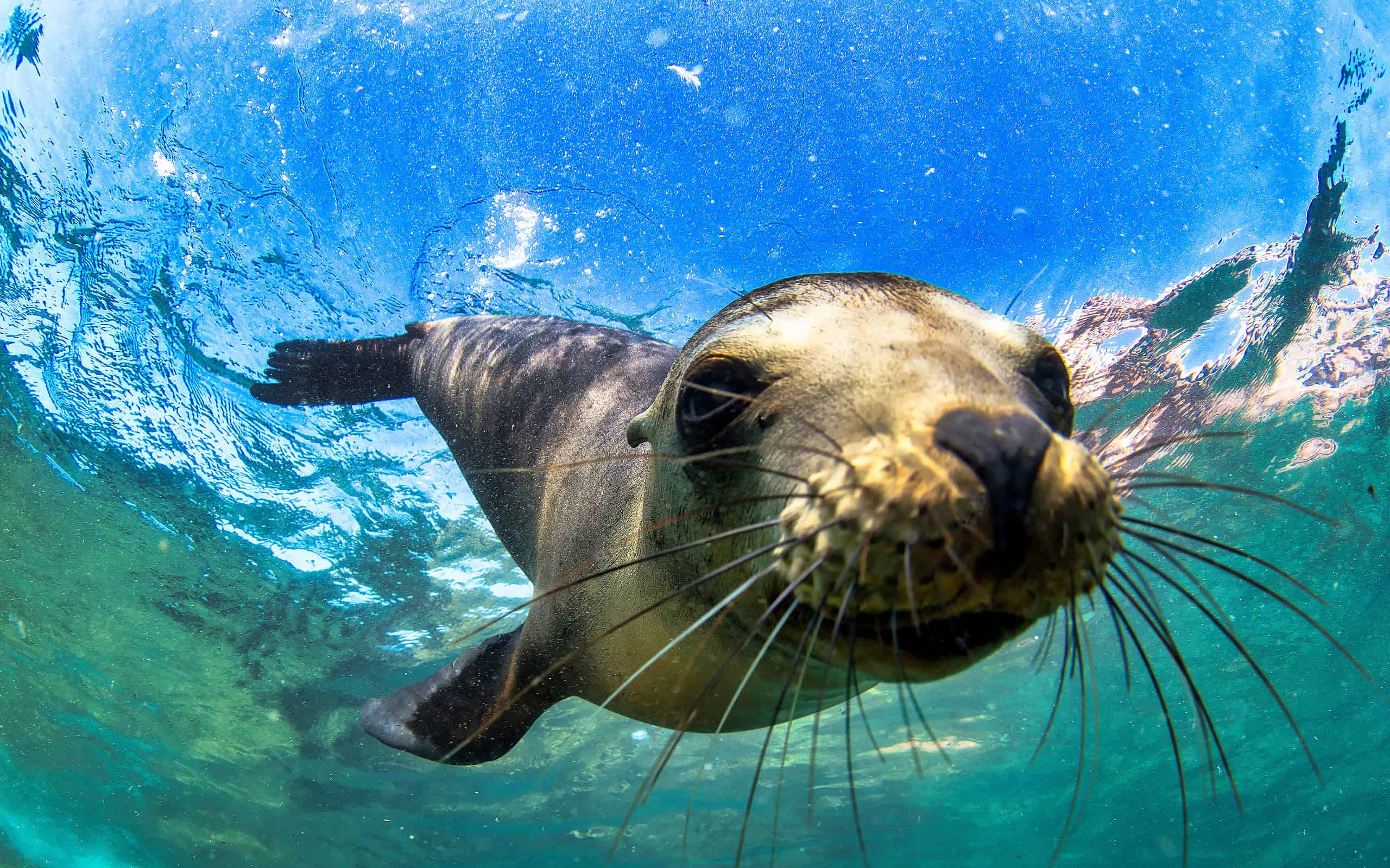
California sea lions are widely recognized as the fastest pinniped species.
©Moarly/Shutterstock.com
Elephant seals are the largest seal species, with some large male Southern elephant seals weighing up to 8,800 pounds. Yet they can swim up to 10 mph. Leopard seals can swim at speeds of 25 mph even though they can weigh up to 1,300 pounds. California sea lions are believed to be the fastest pinnipeds. They can reach up to 1,000 pounds, but they can swim at speeds of 25 to 30 mph. despite their considerable size of nearly 2 tons, walruses can also swim quickly, reaching speeds of up to 22 mph.
How Do Larger Seals Swim Faster Than Smaller Seals?
It may seem counterintuitive for such large seals to swim faster than smaller seals. However, in the water, buoyancy, which is the upward force exerted by water, counteracts gravity. This force is equal to the amount of water that the animal displaces. Large seals can float because they are not denser than the water they displace. Researchers have also found that an animal’s maximum sustainable swimming speed increases with mass. So larger animals swim faster.
Yet, how do they compensate for drag? Even though drag increases with the amount of an animal’s surface area, its muscle power also increases with volume. Larger animals have more muscle mass, so they can produce greater thrust compared to drag, more easily overcoming the effects of water resistance. Larger seals also tend to have lower metabolic costs per unit of mass than smaller seals, which means that they can maintain higher speeds for longer periods.