
Sharks have long been feared, and one of the main reasons is that we often think of them as being dangerous and bloodthirsty killers. Films such as Jaws do not exactly provide great publicity for sharks. Plus, we’ve all heard the myth about sharks and blood. Yet is the chilling rumor that sharks can smell blood from several miles away, detecting even the smallest drop in the ocean, actually true? Join us as we discover how sharks detect their prey and learn exactly how far sharks can smell blood in the water.
How Sharks Detect Prey
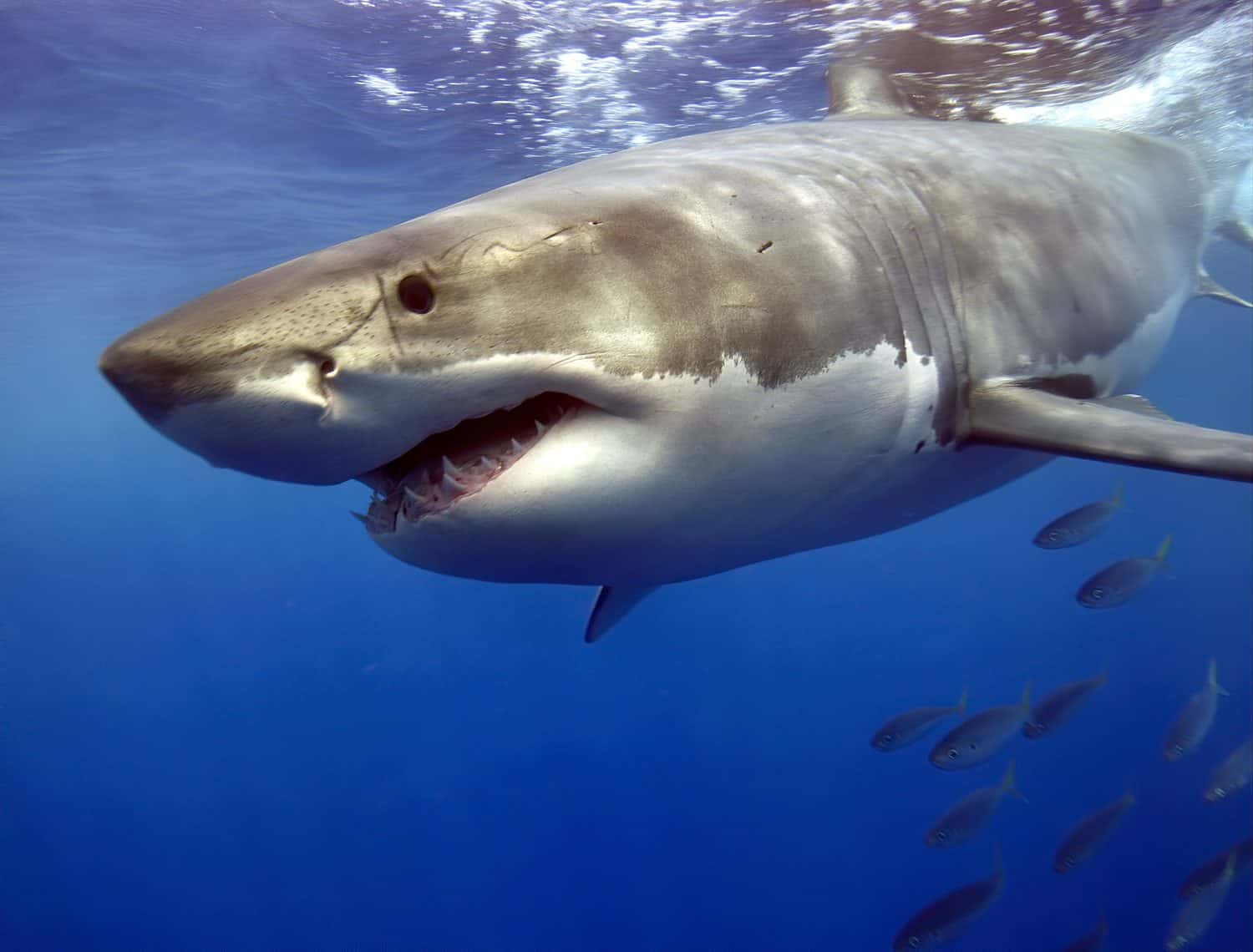
Sharks can detect the electrical impulses given off by every living thing.
©Aquabluedreams/Shutterstock.com
One of the first senses that sharks use to detect their prey is sound. Sound travels much faster, and often farther, in water, so they can hear sounds over great distances, well before their prey comes into sight. Sharks have fluid-filled canals in their inner ears. Sound waves cause the fluid to vibrate, which in turn causes the hairs lining the canals to vibrate. The shark’s brain interprets these signals and determines the location of the sound. Sharks are particularly attracted to low-frequency sounds, especially those made by wounded prey.
In addition to sound, sharks use the lateral line system to detect their prey. This system is a series of pores underneath the skin, running along the sides of the body from snout to tail. When water flows through the pores, sensory cells allow the shark to detect water movements, such as currents and pressure changes. This aids the shark in orientation and navigation.
Another way that sharks detect their prey is through electroreception. Electroreception allows sharks to detect the electrical impulses given off by every living thing. Sharks can detect these impulses because they have many small pores in their skin around their snout, known as the ampullae of Lorenzini. These pores help sharks to detect their prey at close range, even if the prey is hidden beneath the sand.
The Shark’s Olfactory System
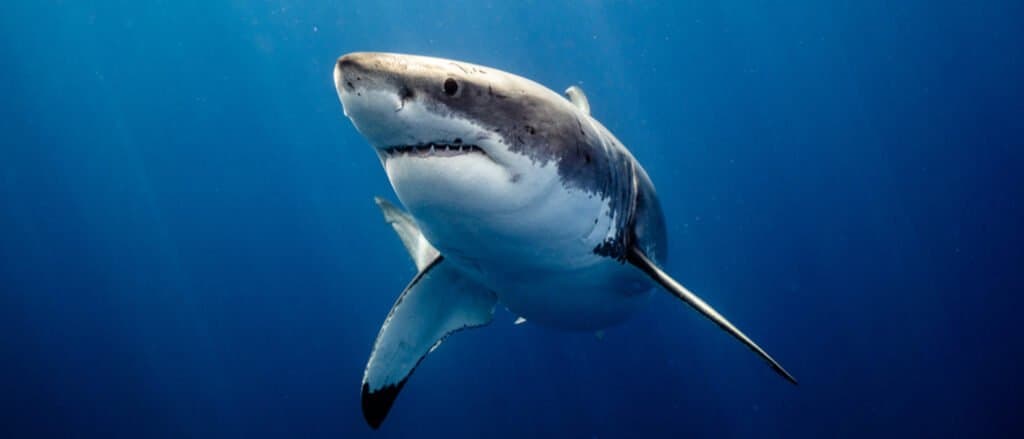
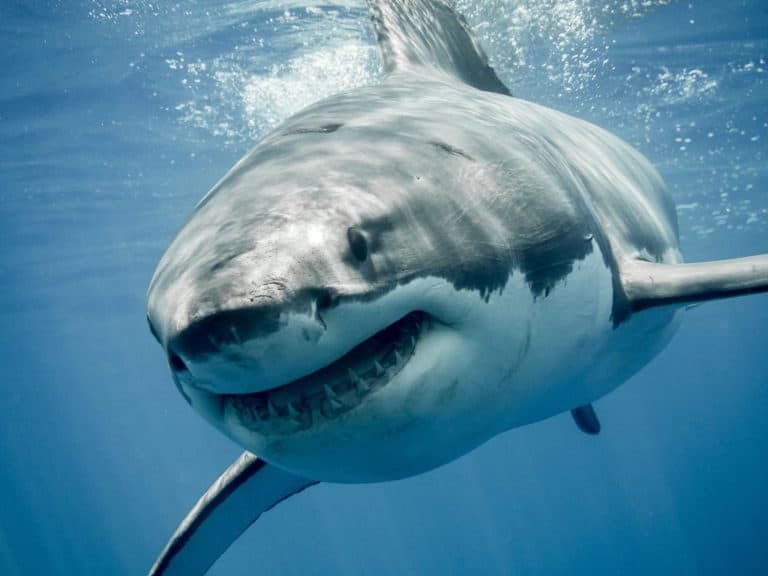
Sharks have two nostrils on the underside of their snouts.
©Jsegalexplore/Shutterstock.com
Before we explore how far sharks can smell blood, we need to discuss how they can detect scents underwater. Sharks have two nostril-like openings called “nares” that are located on the underside of their snout. However, unlike mammals, they don’t use them for breathing. Their nostrils aren’t even connected to their throat or lungs because they breathe through their gills. Instead, sharks use their nostrils solely for detecting scents.
Smells are carried in the water by the currents, which disperse and transport molecules from various substances, such as blood. The water enters the shark’s nostrils and flows over the olfactory sacs. Inside the olfactory sacs, folds covered in sensory cells detect tiny scent particles carried in the water. Once a scent is detected, a signal is sent to the shark’s olfactory bulb, and the olfactory tracts then carry signals from the bulb to the olfactory lobe for interpretation. The great white shark has the largest olfactory bulb of any shark.
Amazingly, sharks’ nostrils function independently. There is sometimes a delay between the two nostrils when detecting a scent, especially if the scent particles are coming towards the shark at an angle. Sharks always turn their heads in the direction of the nostril that has detected the scent first, even if the time delay is only a fraction of a second.
What Determines the Distance from Which Sharks Can Detect Scents?

Some sharks can detect strong scents in concentrations of one part per 10 billion parts.
©frantisekhojdysz/Shutterstock.com
As mentioned above, sharks rely on tiny particles entering their nostrils to detect scents. Sharks have extremely sensitive nostrils and can detect scents from far away, but the distance from which they can detect these scents depends on a few factors. Particles from different scents disperse in the water differently. Depending on the scent, sharks can detect some scents in the water at concentrations as low as one part in 25 million to one part in 10 billion. To put the latter into perspective, that’s around one drop in an Olympic-sized swimming pool.
However, it’s not just the concentration of particles that determines how far sharks can smell blood. Water currents also affect the distance. This is because the scent particles become diffused in the water. The only way a shark can pick up the scent is by the water carrying those tiny particles to them. Because these particles are carried by the currents, the major factors determining how far a shark can detect blood are the direction and speed of the water. Generally, it takes a long time for particles to travel in the water once they are dispersed. However, faster currents mean that the scent will travel farther and more quickly.
The distance also depends on the species of the shark, as some sharks have a more acute sense of smell than others. Great whites, nurse sharks, and tiger sharks are believed to have the largest olfactory organs, suggesting they can probably detect scents from the farthest away.
How Far Can Sharks Actually Smell Blood?
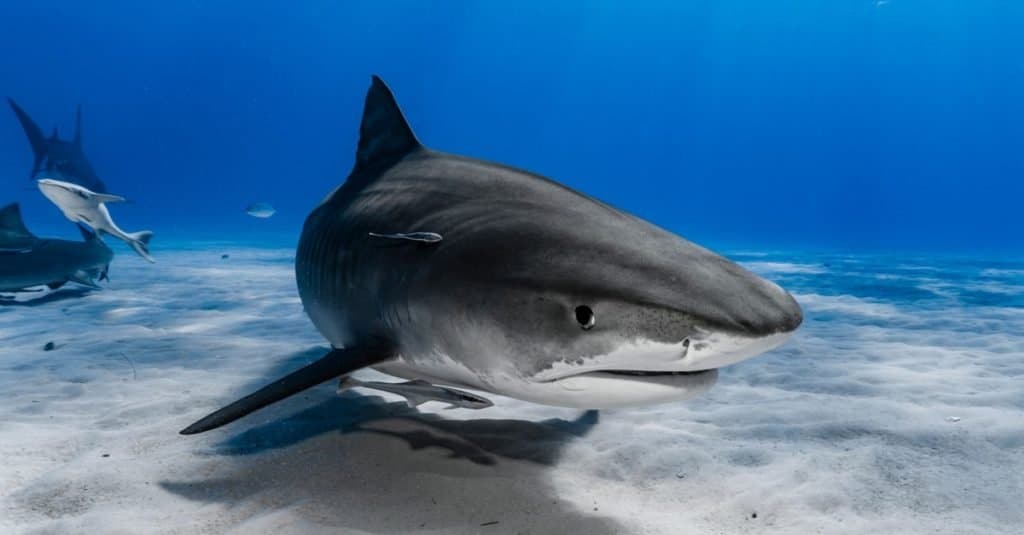
Despite the myth, sharks can’t smell blood from miles away.
©kaschibo/Shutterstock.com
Under optimal conditions, a shark can smell blood from a maximum of a quarter of a mile away. However, the shark cannot smell anything until the scent reaches its nostrils. The wounded prey’s blood would first need to diffuse in the water. Next, the water would have to carry the blood to the shark for it to detect the scent. Only then could the shark pinpoint the location of prey up to a quarter of a mile away.
How Do Sharks React When They Smell Blood?
Along with the myth that sharks can smell blood from miles away, there’s also the myth that sharks go crazy if they smell even a drop of blood. This myth has led to many people being terrified of getting even a tiny cut while in the water. However, the truth is that sharks don’t go into a frenzy as soon as they smell blood. A few experiments conducted by brave individuals have proven this myth wrong.
Feeding frenzies do occur; however, they are typically caused by too many sharks competing for too little prey. Former NASA engineer Mark Rober and marine biologist Luke Tipple experimented in 2019 as part of Shark Week to find out if sharks become aggressive when scenting blood. Over the course of an hour, they used devices attached to surfboards to pump out cow’s blood, seawater, urine, and fish oil to see which scent attracted the most sharks in an area that was already shark-infested. Four went to the fish oil, and none to the seawater or the urine. However, after 45 minutes, around 40 lemon sharks and tiger sharks investigated the cow’s blood. The result of the experiment showed that even when blood is virtually on top of them, sharks don’t go crazy just for a single drop.
However, the researchers went even further and donated blood so they could see how interested sharks were in human blood. This experiment involved a control, one that pumped out blood quickly, and one that pumped it out slowly. The result? The experiment found that sharks showed little to no interest in human blood compared to fish blood.
Why Do Sharks Attack?

Many shark attacks are believed to be a result of curiosity.
©NNER/Shutterstock.com
So, if sharks can’t smell blood from miles away, and don’t go crazy when they do smell it, why do they still attack people? Many scientists believe that shark attacks are actually the result of the “bump and bite” action. When sharks are curious about something and want to find out what it is, they touch it. However, since they don’t have hands, they use their noses to touch objects. This is known as the bump. The bite is when the shark takes a bite to see if something, or someone, is edible. So, some shark attacks are caused by sharks being curious and taking a “taste test.” Unfortunately for us, that taste test is often fatal.
So, what this tells us is that sharks do have an excellent sense of smell, especially when it comes to blood. Yet, anything more than a quarter of a mile away is unlikely to reach them. Also, a little bit of blood is unlikely to instigate a feeding frenzy. However, if one comes up to you and bumps you with its nose, then you might be in trouble.