Quick Take
- One prehistoric shark so baffled scientists when first discovered that they thought its fossilized remains belonged to an entirely different animal. See the misidentified shark →
- Not all sharks on this list are extinct. One species alive today has been lurking since the age of dinosaurs. Meet the living relic →
- One ancient shark hunted in a way no modern species does, and its technique was as brutal as it sounds. Discover the scissor-tooth technique →
- The shark that survived Earth's worst mass extinction did so thanks to a biological trick no shark before it had ever pulled off. Explore the tooth-regrowing survivor →
Sharks are cartilaginous marine fish with an evolutionary history that spans over 450 million years. While there are over 500 extant shark species, there are thousands of extinct species, many of which have been extinct for millions of years. Continue reading to discover 10 prehistoric sharks, including one extant species.
Hybodus
Hybodus lived from the Middle Triassic to the Late Cretaceous, approximately 247 million to 66 million years ago, and is possibly one of the longest-living prehistoric sharks of all time. it is definitely the longest-living one on this list. The Hybodus looked quite similar to modern-day sharks, which can’t be said about the other sharks here, though it did have large spikes that protruded from its dorsal fins. These spikes most likely served as a means of defense against potential predators.

The Hybodus lived for more than 200 million years.
©Herschel Hoffmeyer/Shutterstock.com
The Hybodus shark lived for a very long time in various places around the world. Today, fossils have been found worldwide, spanning many different eras.
One of the more interesting features of the Hybodus has to do with its teeth. The Hybodus had teeth that were arranged into two sets in its mouth: teeth at the front, and then teeth at the back. The teeth at the front were useful for seizing prey, while the teeth at the back were rounder and useful for crushing shells.
Because of this dual tooth arrangement, it appears that no prey could successfully escape the Hybodus. Other than much larger creatures in the ocean that preyed on Hybodus, this shark was a major predator in the ocean.
Cretoxyrhina
The Cretoxyrhina lived during the Cretaceous geological period, a time when there were many large creatures in the ocean, all fighting for supreme dominance over others. While not the biggest creature in the sea during this time, the Cretoxyrhina was certainly an apex predator in many areas. Some fossils have shown that Cretoxyrhina wasn’t even afraid to take on much bigger predators.
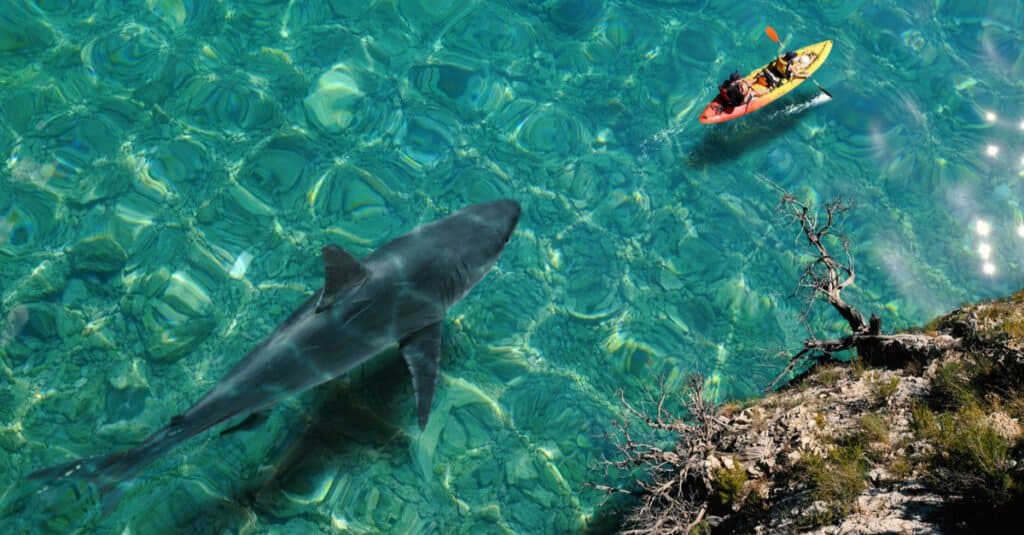
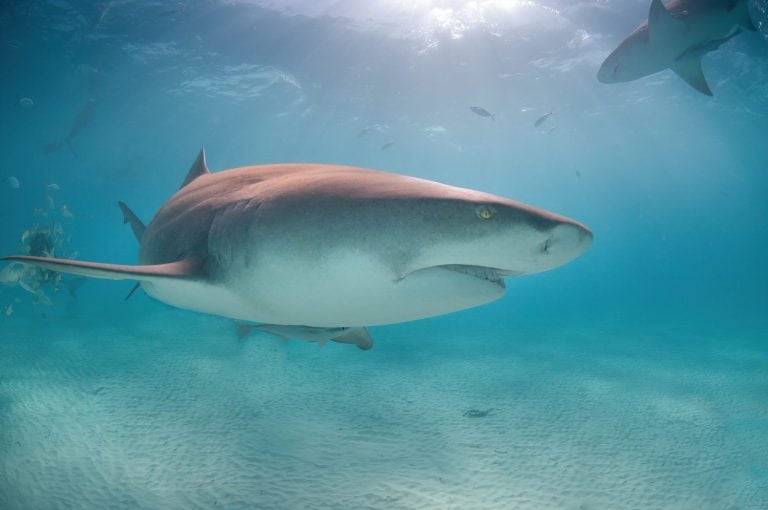
Ginsu sharks were larger than modern great white sharks (pictured), growing up to 26 feet in length.
©karelnoppe/Shutterstock.com
The Cretoxyrhina lived about 107 million to 73 million years ago – meaning it’s nearly the youngest shark listed here. It is also often called the Ginsu shark, named after the Ginsu knife, because of its very sharp teeth. The teeth of a Cretoxyrhina were razor-sharp and are thought to have been able to easily cut through flesh and even bone.
Stethacanthus
The Stethacanthus lived from about 360 to 300 million years ago, making it one of the very oldest sharks on this list! Often called the anvil shark, the Stethacanthus had an odd dorsal fin that it’s now known for.

Stethancanthus is known as the anvil shark for obvious reasons.
©Zero Smany/Shutterstock.com
We all know what the fin on a modern-day shark’s upper back looks like. A Stethacanthus’ dorsal fin is in the same location, yet it’s not pointed like a modern-day shark’s. Instead, it had a flat top that looked like an anvil. On top of this flattened fin were enlarged denticles, which experts have been attempting to explain for a long time now.
While many theories suggest why this dorsal fin was shaped the way it was, the most common theory suggests that the fin has something to do with mating among Stethacanthus individuals, as only males appeared to have the anvil.
Other than this intriguing feature, Stethacanthus didn’t get very big in length and was often much smaller than the average human today. This shark also bears a strong resemblance to modern ratsharks.
Edestus
Having lived about 300 to 320 million years ago, the Edestus is another prehistoric shark that looks quite peculiar. Also called the scissor-toothed shark, the Edestus had curved jaws that resulted in its teeth sticking out at odd angles. While its appearance is unusual, It was a large shark, with the biggest species, Edestus heinrichi, estimated to have reached over 6.7 meters (22 feet) in length — comparable in size to the largest great white sharks alive today.

Edestus could grow to the same size as today’s great white sharks!
©Michael Rosskothen/Shutterstock.com
The most interesting thing about the Edestus is the way it hunted. While prehistoric sharks’ hunting methods often remain poorly understood, Edestus is a notable exception.
While some parts of their hunting do remain a mystery, it is thought that Edestus would thrash its head up and down and create wounds on its prey, something not seen in today’s sharks.
Xenacanthus
Often called an eel shark, the Xenacanthus became extinct about 202 million years ago, making it one of the older sharks on this list. While it is a shark, the Xenacanthus definitely doesn’t look like one. Plus, Xenacanthus was a freshwater shark.

Xenacanthus is known as the “eel shark!”
©Warpaint/Shutterstock.com
Because this shark was a freshwater shark, the Xenacanthus possibly thrived in waters such as swamps, allowing its eel-like body to help it navigate. A larger, modern-looking type of shark definitely wouldn’t have thrived in these types of freshwaters.
Xenacanthus didn’t get too big and is mainly thought to only have grown to be about a meter in length. This shark also looked quite a lot like modern-day eels, hence its name.
The most interesting feature of this shark is its spine. The Xenacanthus had a sharp spine that possibly contained venom, making the shark act almost like a stingray can. This spine, therefore, is thought to have been the main form of protection against predators that often were much bigger than the Xenacanthus.
Ptychodus
Ptychodus was one of the largest prehistoric sharks, with some estimates placing it at up to 35 feet in length. Like today’s whale sharks, it had a mouth full of crushing teeth. However, Unlike whale sharks, Ptychodus had larger molars used to crush shellfish rather than filter plankton and krill. Ptychodus went extinct at least 80 million years ago, though the exact date remains debated among scientists.

A comparison of the minimum (top) and maximum (bottom) size estimates of Ptychodus. Image credit from PLOS ONE.
©Jambura PL, Kriwet J, CC BY 4.0, via Wikimedia Commons – Original / License
Cladoselache
Often called the first true shark, Cladoselache lived approximately 360–380 million years ago. While considered a shark, Cladoselache was smaller, less muscular, and had a longer, slimmer body than modern sharks.

Cladoselache lived 380 million years ago.
©Catmando/Shutterstock.com
Cladoselache also didn’t have scales or any type of armor plates on its body, another very interesting appearance trait. During this time, the Cladoselache was not a major predator in the ocean, possibly because of its very fragile appearance. However, these sharks did manage to get away from apex predators by swimming very fast.
Helicoprion
Helicoprion, also called the buzzsaw shark, lived about 290 to 250 million years ago. This prehistoric shark is one of the most fascinating on this list. When the first Helicoprion fossil was found, paleontologists had no idea what they were looking at and initially thought they had found an ammonite.
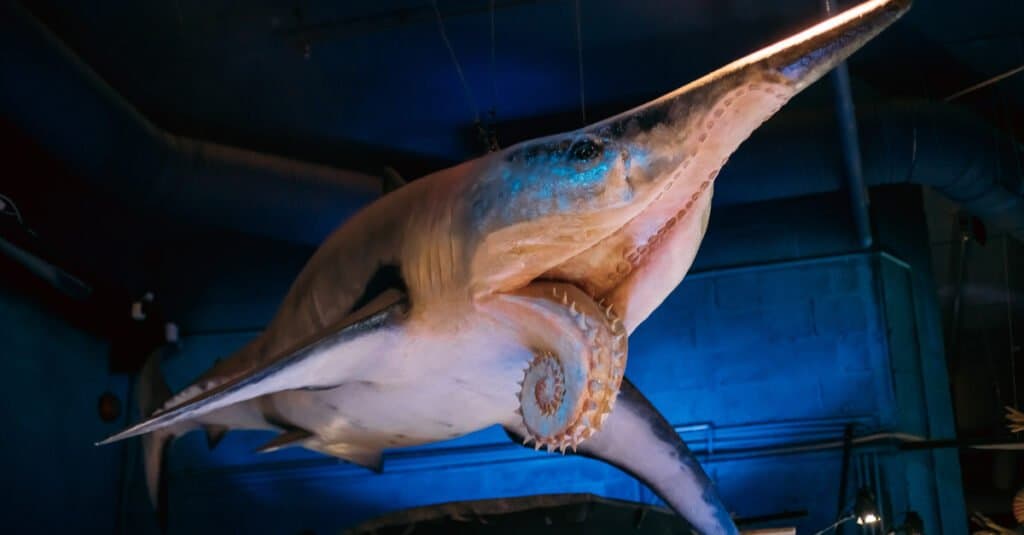
The Helicoprion is known as the buzzsaw shark.
©Grisha Bruev/Shutterstock.com
Eventually, it was discovered that this odd whorl of patterns was actually teeth. The Helicoprion had a curled-up jawbone of teeth that rounded and protruded from the lower half of its jaw. It is thought that Helicoprion was the first shark to regrow its teeth after losing them, something modern sharks must do to survive, therefore making this shark an excellent example of evolutionary adaptation in sharks.
Helicoprions were formidable sharks, especially as no shark before them could regrow its own teeth. These sharks also managed to live for about 40 million years and survive the Great Permian Extinction, which killed 90–95% of all living things on Earth and is thought to be the worst mass extinction in Earth’s entire history.
Bluntnose Sixgill Shark
Here’s something different on this list: a prehistoric shark that’s not extinct. The bluntnose sixgill shark (Hexanchus griseus) can trace its lineage back to the Jurassic era when dinosaurs roamed the Earth. This type of shark can grow up to 20 feet in length, about the same length as a great white shark, yet it’s rarely observed thanks to its deepwater habitat.
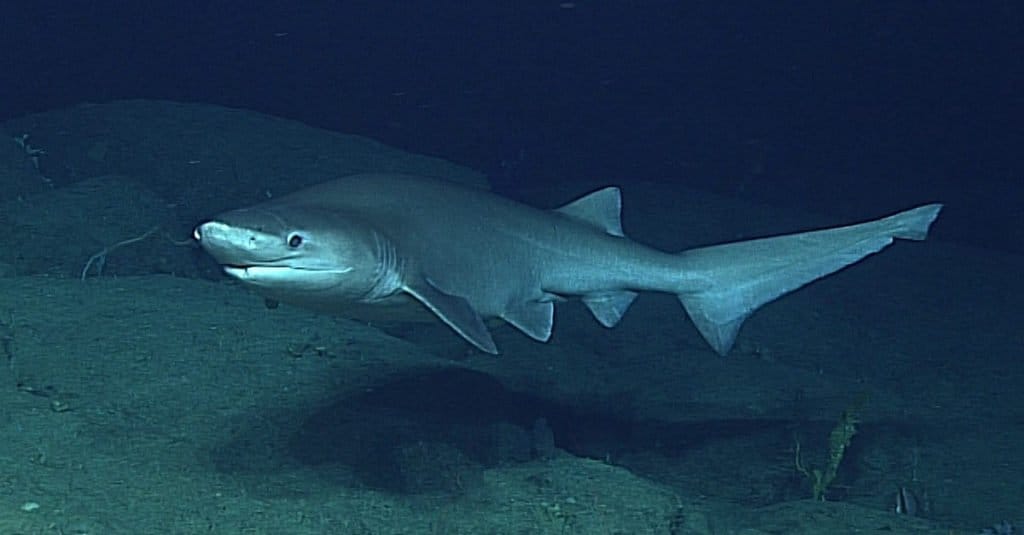
The Sixgill shark was seen while exploring Santa Rosa Reef, south of Guam, during the first dive of the Deepwater Exploration of the Marianas expedition.
©NOAA Ocean Explorer from USA / CC BY-SA 2.0 – Original / License
Megalodon
No list of prehistoric sharks is complete without including the megalodon. Thought to be the largest fish and shark to ever live, megalodons were huge prehistoric sharks that were apex predators during their time. These giants lived from 23 million to 2.6 million years ago and ate large prey, such as whales and other large sharks.
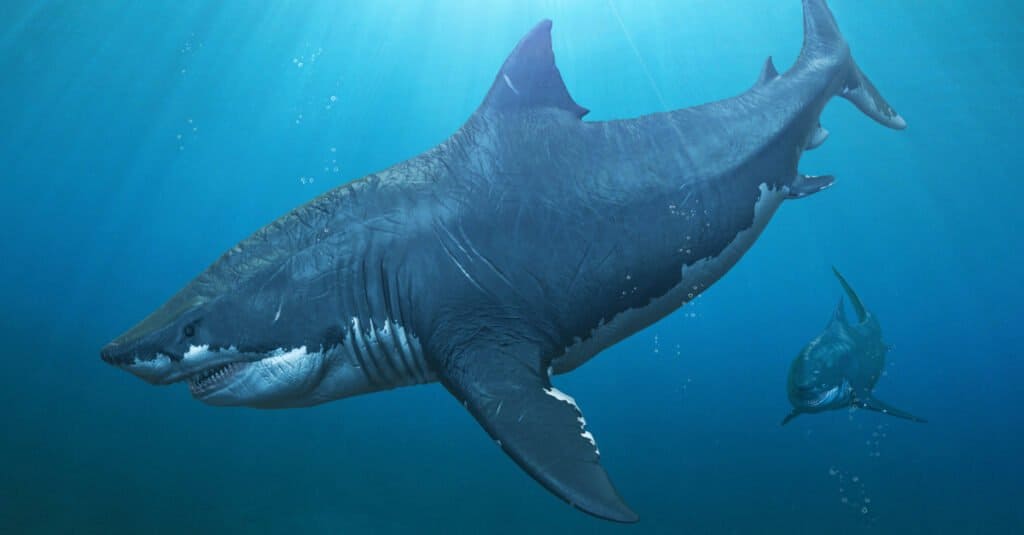
Megalodons could grow to sizes that have been estimated past 50 feet.
©Herschel Hoffmeyer/Shutterstock.com
Megalodons are possibly the most well-known creatures on this list, largely because they are such fascinating animals. The only fossils we have to understand these sharks are their teeth – which tend to be about three times larger than an average modern great white shark’s tooth.
Through these fossilized teeth, experts were able to determine just how large megalodons were. These sharks were thriving throughout the world back when they were alive, as their teeth have been found on every single continent, save Antarctica.
Megalodons were apex predators during their time. Even their rivals could not compare to them. However, climate change brought cold weather and water temperatures, resulting in megalodons slowly dying out, as they only thrive in warm water. Plus, it is thought that they also lost a lot of their prey during this change. However, megalodons are still known as one of the most interesting prehistoric sharks.