
Quick Take
- Shark ears vary between species, yet habitat and diet explain none of it. See the surprising finding →
- A shark's 'ear' is barely a pinhole on the outside, yet it pulls off two critical jobs at once. Explore the dual functions →
- Sharks have a sixth sense that most people have never heard of, and it is not hearing. Discover the sixth sense →
- The real driver behind shark ear evolution is something scientists didn't expect to find. Find out what drives evolution →
All sharks need to be able to pick up sounds through the medium of water, so you’d be forgiven for assuming that their ears would have similar anatomy across species. Amazingly, this is not the case, and a new detailed study of sharks’ inner ears has revealed that they are surprisingly diverse. What’s more, those differences cannot be attributed to variations in habitat or diet. So, why are shark ears so different, and what has driven those changes? Read on to discover the hidden depths of shark ears!
How Do Sharks Sense the World?
Before we delve into shark ear anatomy, let’s look at how sharks sense the world around them using all of their senses. These magnificent animals use a variety of information to build a picture of their environments.
Firstly, their eyes are similar to those of all vertebrates, but their lens is large and spherical. The special rod cells on their retina are highly sensitive, so they can pick up moving objects.
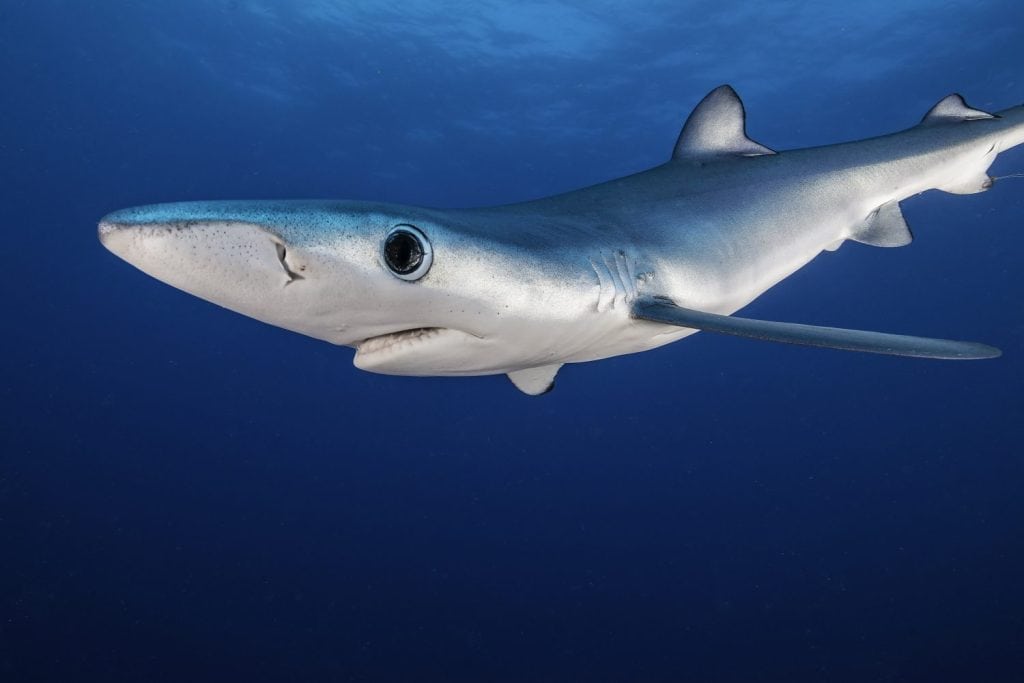
Sharks use multiple senses.
©wildestanimal/Shutterstock.com
Sharks can also taste chemicals in the water and have been known to spit things out if they don’t find them palatable! They also have paired external nostrils leading to olfactory organs. Their sense of smell is acute, and they can detect minute quantities of substances such as blood in the water.
Another organ, called the ampullae of Lorenzini, forms a complex and extensive sensory system around the shark’s head. It can detect weak electrical fields at short ranges. Also, sharks have sensory pits distributed on their backs, flanks, and lower jaws. No one knows their exact function, but they are likely connected to detecting physical changes in their surroundings, such as water current.
Shark Ears Have Two Roles
There is nothing very noticeable about a shark’s outer ear; it is essentially just a tiny hole. Anything bigger would get in the way of their streamlined shapes. Yet sharks rely on their hearing just as much as their other senses, if not more. Sound travels faster underwater, and they can detect their prey from distances of up to around 243 feet.
Their ears are made up of three semicircular canals whose main role is actually to provide balance (equilibrium). The inner ear contains four sensory maculae, and three of these (the sacculus, the lagena, and the utriculus) are responsible for both balance and hearing. Just as in mammals, sharks have tiny hairs called stereocilia that vibrate when sound moves through water. The stereocilia are arranged in the fluid-filled tubes. This means that sharks can hear in multiple directions. Shark ears are best at detecting deep, low-pitched sounds.
Studying Sharks’ Inner Ears
This new study was led by scientists from the Department of Biological Sciences at California State Polytechnic University. They used detailed CT scans to examine the inner ear anatomy of 10 shark species. The three-dimensional images allowed them to see the inner ear structure (skeletal labyrinth) in detail.
The 10 shark subjects were chosen from different habitats and were all squalomorphs. This is a superorder of sharks and has the widest range of shark species. In all, there are about 163 species, and they vary in size and shape. Within this group, there are between four and six orders, depending on the classification system used, including the Hexanchiformes and the Squaliformes, which were included in this study.

Sharks use their ears to maintain balance as well as to hear.
©Daniel Lamborn/Shutterstock.com
The sharks and dogfish examined for this research were a frilled shark or lizard shark (Chlamydoselachus anguineus), a sharpnose sevengill shark or one-finned shark (Heptranchias perlo), a bluntnose six gill shark or cow shark (Hexanchus griseus), a broadnose sevengill shark (Notorynchus cepedianus), a Pacific angelshark (Squatina californica),a leafscale gulper shark (Centrophorus squamosus), a spined pygmy shark (Squaliolus laticaudus), an angular roughshark (Oxynotus centrina), a cookiecutter shark or cigar shark (Isistius brasiliensis), and a lined lanternshark (Etmopterus bullisi). The specimens were obtained from Cal Poly Humboldt Fish Collection Database, and museums around the world.
How Do Shark Ears Differ?
The researchers were not that surprised to find differences in the inner ear anatomy of these sharks. After all, they are a fairly eclectic group including a tiny bioluminescent lantern shark and a flat ambush predator angel shark. However, they were expecting those differences to be shaped by the shark’s ecology, with influences from their habitat and diet. This has been the pattern seen in studies of other vertebrates. For example, they expected hearing to be shaped by how deep the sharks swam or by what type of prey they needed to detect.
However, they found that sharks with similar diets and habitats had different inner ear shapes. The observed differences seemed to be based on evolutionary pathways instead of ecology. The Hexanchiformes had more robust skeletal labyrinth spaces housing the semicircular canals and ampullae. In contrast, the Squaliformes have more slender labyrinths.
This work is important because it gives experts a new angle on shark evolution and how their sensory systems evolved. It also shows just how useful publicly available animal specimen data can be!