
Quick Take
- Sloths aren't slow by accident. Their food is the actual culprit, and the mechanism is stranger than you'd expect. See how diet drives slowness →
- A single leaf can spend an almost unbelievable amount of time inside a sloth before digestion is complete. Explore the 30-day digestion →
- A short cold snap can permanently destroy a sloth's ability to digest food, and this damage persists even after temperatures recover. How temperature wrecks gut bacteria →
- Sloths follow a strict dietary rotation passed down from their mothers, and skipping it could slowly poison them. How mothers shape their diet →
Sloths spend most of their lives dangling upside down or navigating through lowland rainforest trees with their long, hooked claws. Everything takes place in the trees, including eating, sleeping, resting, mating, and giving birth. Sloths are known for moving slowly, but did you know their diet is partially responsible for their lack of speed? Read on to learn about the sloth’s specialized diet and how the food they eat causes them to move so slowly.
What Does a Sloth Eat?
There are seven species of sloths living in Central and South America: two species of two-toed sloths (Choloepus) and five species of three-toed sloths (Bradypus). Most sloth species are folivores. This means they eat leaves and other foliage, though two-toed sloths have a more varied diet that can include fruits, twigs, and occasionally insects or small animals. Two-toed sloths have a more diverse diet that consists of leaves, buds, stems, moss, seed pods, flowers, and some fruit. Three-toed sloths primarily consume leaves and occasionally seed pods, particularly cacao pods.
Between the six species of sloths, they consume the leaves of over 90 types of trees, although any given individual typically alternates between 6-12 distinct species. Sloths inherit their preference for specific leaves from their mothers. Sloths also rotate plants to ensure that toxins do not build up to dangerous levels in their bodies. They favor young leaves and shoots, as these contain less tough fiber and are easier to digest, and contain fewer toxins.

All sloth species are folivores, which means they primarily eat leaves.
©Damsea/Shutterstock.com
Specific trees that two-toed sloths favor include:
- Anacardium excelsium (preferred by all species)
- Chrysophyllum panamensis
- Dipteryx panamensis (preferred by all species)
- Sapium caudatum
- Spondius nigrescens
- Terminalia amazonica
- Trattinickia aspera
Three-toed sloths are more specialized, feeding almost exclusively on Cecropia, as well as Clethraceae and Clusiaceae leaves on occasion.
How Much Do Sloths Eat?
Sloths have the lowest basal metabolic rate (BMR) of any mammal, which means they require the lowest number of calories for their size among all mammals. Two-toed sloths require just 37%-45% and three-toed sloths require 38% of what would normally be expected for an animal of their body size. Sloths have about 25–30% muscle mass compared to 40–45% in most mammals, which keeps their BMR low.
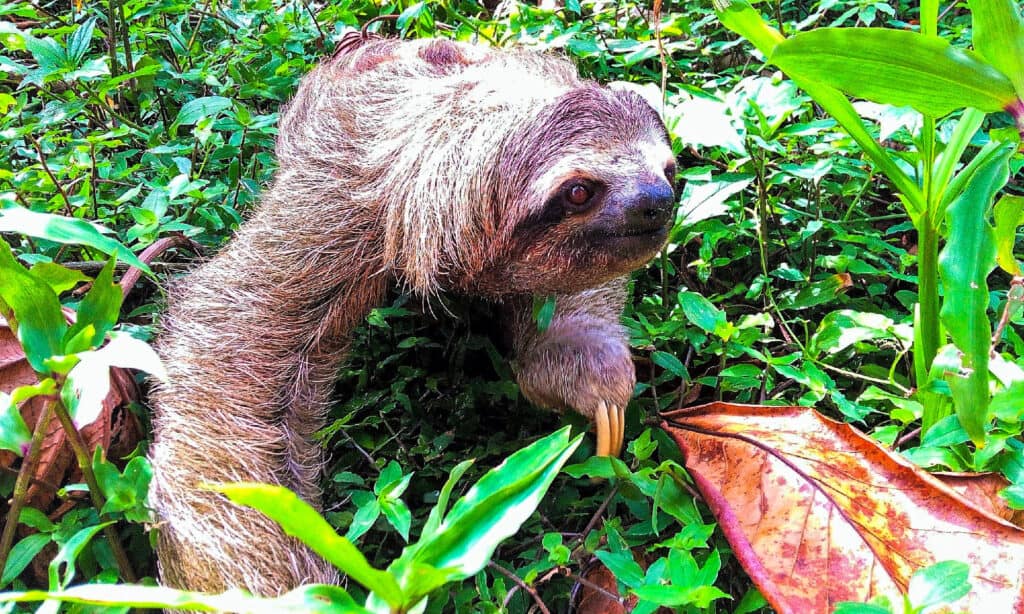
Sloths have the lowest BMR of any animal.
©phortun/Shutterstock.com
This means a sloth does not consume a lot of food every day. According to the USDA, a two-toed sloth should eat around 10% of its body weight per day. So a 10-pound sloth should eat about one pound of food. Fortunately, sloths do not require much energy. They remain in a small home range and sleep 8-10 hours a day in the wild or 15 to 18 hours in captivity. They only drop down to the ground to urinate and defecate once a week.
Sloth Biology
Leaves may have very few calories, but sloths have up to 90% food digestibility. The high cellulose content in the plant matter means the food must remain in the sloth’s four-chambered stomach for a long time to allow bacteria to ferment it. Sloths have the slowest digestive rate of any mammal, but the true rate is still debated. Some sources claim it can take up to 30 days for a leaf to pass through a sloth’s entire digestive tract.
Although sloths maintain a lower body temperature to conserve energy, at lower temperatures, their metabolic rates and digestion can become dangerously slow. The cold can kill the bacteria in their gut, leaving the sloth unable to digest any more food, even after the temperature warms up. Maintaining temperatures between 75° and 85 °F is crucial for a sloth’s digestion.