
Quick Take
- Snails enter a period of inactivity that shares some characteristics of sleep.
- Snails sleep in short bursts for 12 to 14 hours, then remain continuously awake for up to 41 hours.
- A snail may also hibernate, or estivate, to conserve energy and moisture during extreme conditions.
Snails can make amazing pets. They’re quiet, easy to care for, and fun to watch. But occasionally, there may be a time when you go to check on your snail and it’s completely still. You may have wondered what was wrong with your pet. Do snails actually sleep? Is it just resting or hibernating? Read on to find out.
Do Snails Even Sleep?
Do snails sleep? In a way, yes, but their sleep is very different from what humans experience. There hasn’t been much research on snails and their sleep habits, but a 2011 study closely observed pond snails to determine if and how they sleep. The study concluded that snails enter a period of inactivity that shares some, but not all, characteristics of sleep.
In the study, they followed eight pond snails over the course of 45 days and learned that they all had similar patterns. Over a 12- to 14-hour period, the snails would enter a brief sleep-like state seven times. The snails would be inactive for around 21-23 minutes at a time. After this rest period, they would remain continuously active for 33 to 41 hours before needing to rest again.
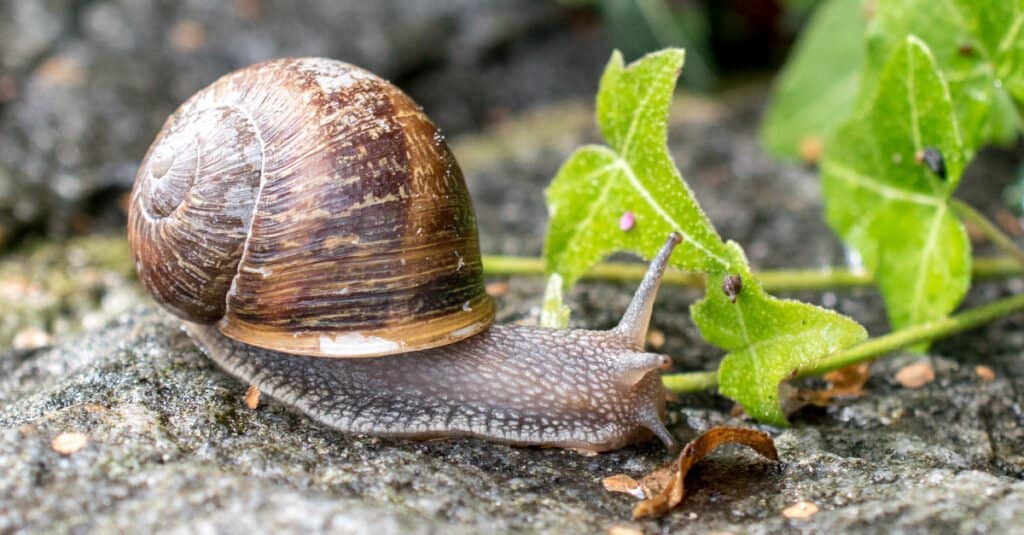
Snails sleep in short bursts for 12 to 14 hours, then remain continuously awake for up to 41 hours.
©iStock.com/Daniela Schröder
The results are helpful, as it’s possible that some land snails, which are what most people keep as pets, have similar behavior. Still, it’s important to note that the sleep habits of animals can vary drastically between species. Just look at how much it can vary between humans.
Signs That Your Snail Might Be Asleep
Although the study was specifically about pond snails, researchers used the following criteria to determine whether the snails had entered a sleep-like state:
- The ratio of the width to the height of the foot decreased compared to when in motion. The foot is less elongated at the front and back of the body, but the snail does not completely withdraw into its shell.
- The tentacles are also shortened, but not completely withdrawn. They also appear less distended and sometimes curved.
- They stop moving and cease the rasping movements of their radula.
- If the snail is attached to a vertical surface, its shell may slightly droop away. Researchers believe this may be due to relaxation of the columella muscle, which attaches the snail to its shell.
- The responsiveness to stimuli was significantly reduced.
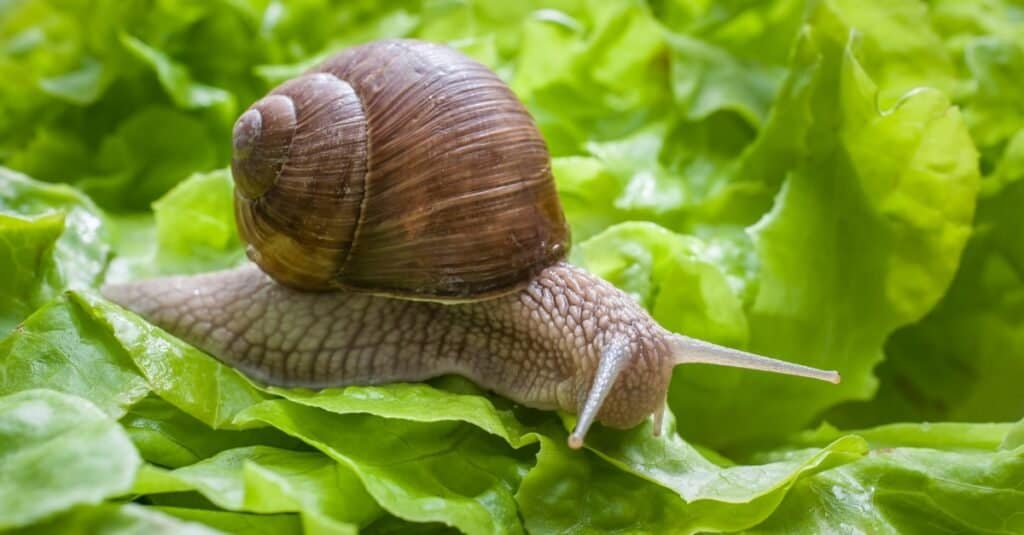
Snails are generally nocturnal, but they aren’t picky when it comes to sleeping.
©Alexander Raths/Shutterstock.com
Are Snails Nocturnal or Diurnal?
Land snails are generally nocturnal, making use of cooler and damper conditions at night. This simply means that they are most active during the night, but human handling often disrupts this. Humans are diurnal, meaning we sleep at night and are active during the day, although some people have different schedules.
Snails do not have as regular sleeping habits. According to the study, the time of day had little influence on their sleep-like behavior. There was also little evidence that constant light or darkness significantly affected their periods of inactivity.
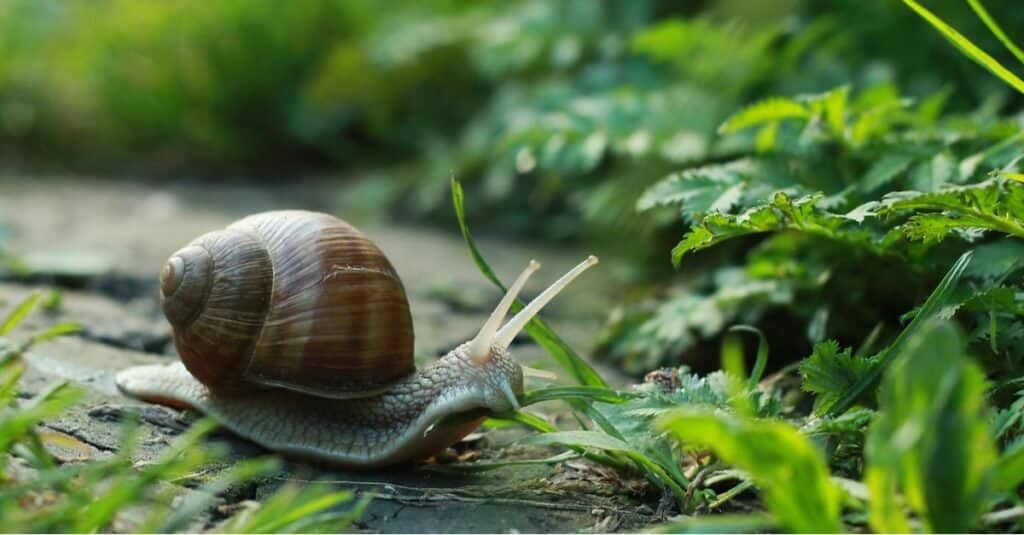
Snails estivate, or hibernate, when conditions become too extreme.
©Zuzha/Shutterstock.com
Sleeping vs. Hibernating
Snails also hibernate. Generally, snail hibernation is referred to as estivation. Estivation is a strategy used by certain animals to conserve energy and moisture during extreme conditions. This is especially advantageous for snails because they depend on staying moist. In the wild, estivation is much more common because snails are more exposed to the elements. For pet snails, estivation is less common because temperature and moisture levels can be controlled.
In this state, snails close themselves in their shells with an epiphragm, a temporary, hardened mucus membrane (often reinforced with calcium carbonate) that seals their shell opening during estivation. This keeps them from drying out and protects them from predators. During estivation, their metabolic rate drops to less than 30% of the snail’s typical resting rate. Snails can estivate for several months, and there are reports of some snails estivating for up to three years.