
Quick Take
- Male giant water bugs have a bizarre trick for making sure the eggs they carry are actually theirs, and this trick involves a mating ritual. See the mating ritual →
- Doing press-ups underwater sounds absurd, yet for these dads, it's the difference between life and death for their offspring. Discover the press-up technique →
- Carrying 150 eggs costs the father dearly, yet evolution has a calculated reason why he does it anyway. Explore the evolutionary trade-offs →
- Even a starving brooding male won't eat his own freshly hatched young, and the reason why turns out to be stranger than you'd expect. See what happens at hatching →
Male giant water bugs take on an unusual parental role for insects, carrying their eggs on their backs until they hatch. The details of this behavior are fascinating. A male performs special movements to keep the eggs oxygenated and goes to great lengths to make sure the kids are his.
What Are Giant Water Bugs?
Giant water bugs are aquatic insects that can grow to over an inch long. They are true bugs, which means that they belong to the insect order Hemiptera. It also means that they have piercing-sucking mouthparts. Most giant water bugs belong to one of two big subfamilies: Lethocerinae or Belostomatinae.
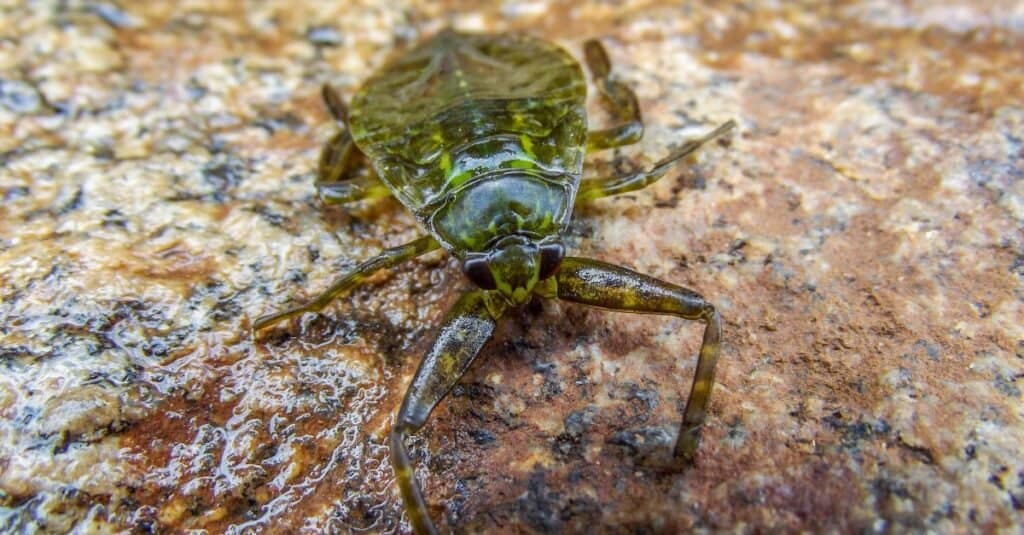
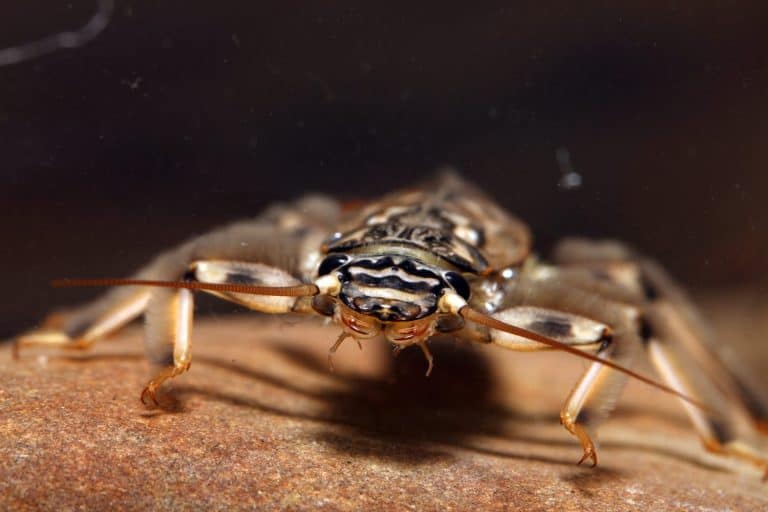
Giant water bugs feed on aquatic insects.
©iStock.com/Eric Kukulowicz
We will focus on the Belostomatinae, particularly Abedus herberti, which is sometimes called the toe biter or the ferocious water bug. Though they will bite if they feel threatened, they are not dangerous to humans. They live in streams in Arizona, New Mexico, and Utah in the U.S., as well as northwestern Mexico. The adults are typically between 0.8 and 1.6 inches long. They cannot fly but can move on land.
These bugs are sit-and-wait predators. They wait until small creatures wander past and then grab them with their strong front legs. They feed on aquatic insects, snails, young fish and tadpoles, which they pierce with their proboscis (mouthparts) and inject with saliva. Their saliva contains chemicals that incapacitate and dissolve the prey!
Insect Daddy Day Care
In the insect world, it is unusual for males to be solely in charge of raising the kids, but that’s what happens with the Belostomatinae subfamily. This arrangement has a direct effect on how the bugs mate. Before the male is willing to devote time and energy to raising the offspring, he will verify that they are his. The pair go through a prolonged mating and egg-depositing process that lasts between 12 and 48 hours, allowing the male to confirm that he is the last to mate with her before the eggs are fertilized.
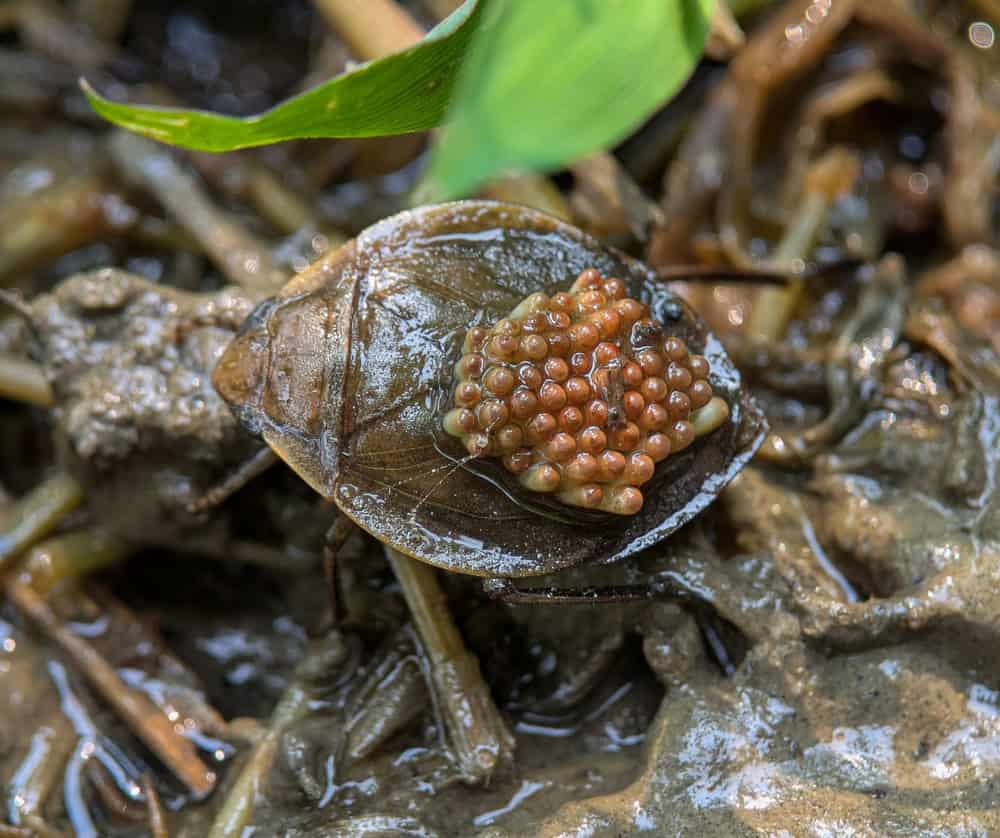
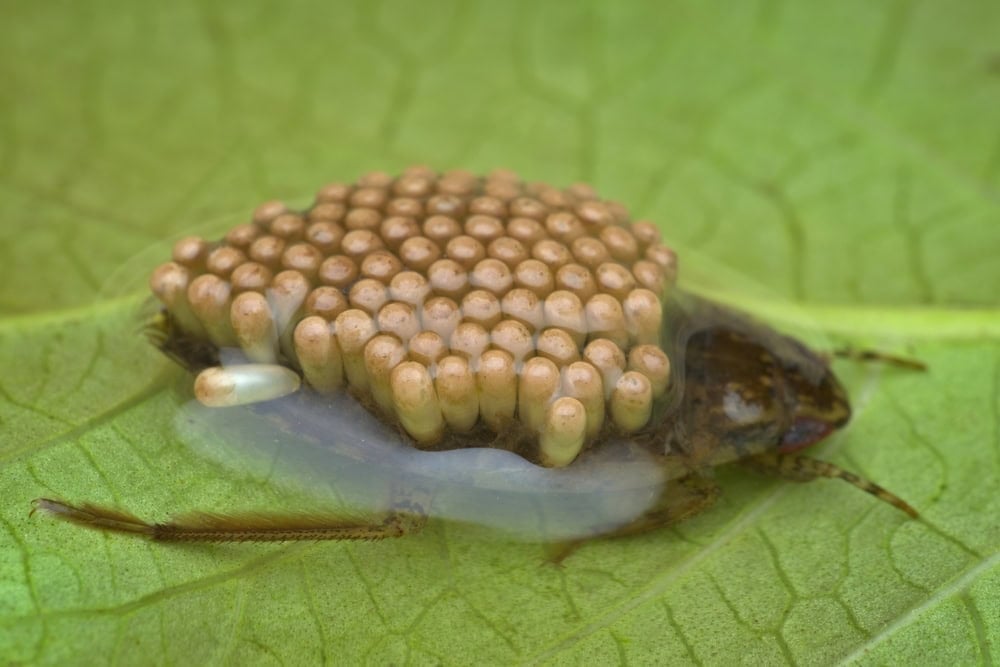
Giant water bug dads put a lot of effort into parenting.
©BIBHAS MAJHI/Shutterstock.com
The female lays a total of around 150 eggs on the male’s back, secured in place by a mucinous glue. She starts at the back and works forward towards his head until his back is evenly covered. In most cases, the male carries the eggs of just one female.
The freshly laid eggs start to swell immediately, making them more structurally stable on the male’s back. This arrangement works very well as long as the eggs are kept moist. If they dry out (exposure to air for just 60 minutes is enough), the gelatinous pad becomes brittle and will eventually fall off.
How Do Male Water Bugs Care for the Eggs?
The eggs continue to get bigger as the nymphs grow and develop inside them. Scientists have observed a 95 percent or more brood survival rate in these water bugs, an achievement that is primarily due to the male’s hard work! Incubation periods range from 2 to 23 days in laboratory studies.
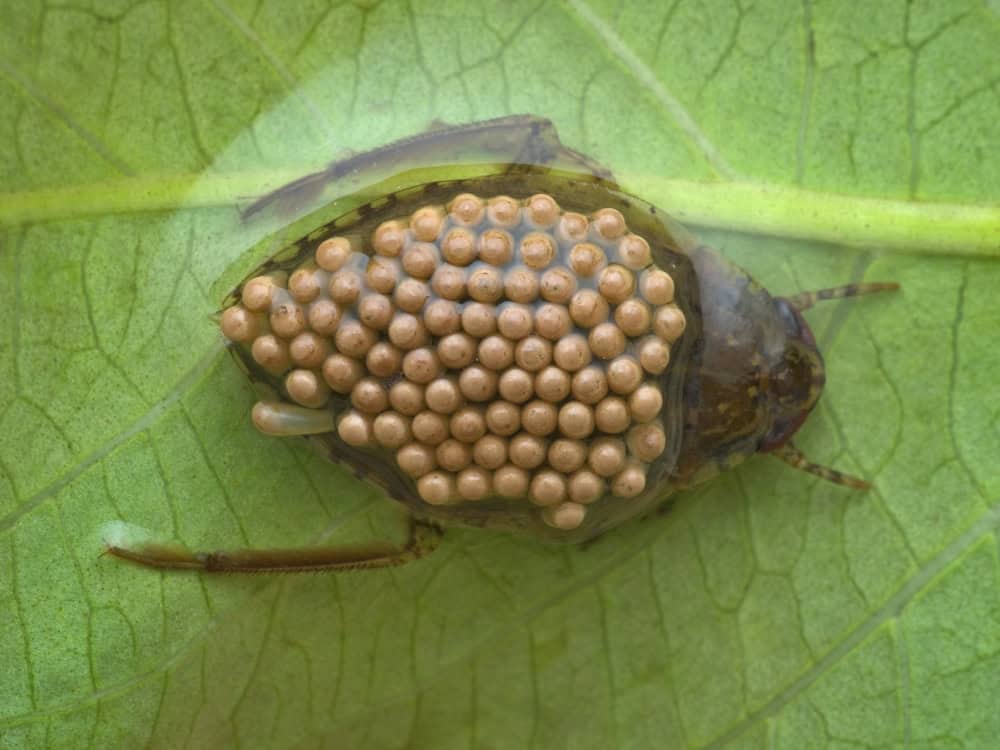
Giant water bug fathers perform press-ups called brood pumping.
©abdullatifspi/Shutterstock.com
During the incubation period, the male makes sure that the developing young get sufficient oxygen to fuel the cellular respiration needed for the embryo to grow and develop. Cellular respiration requires oxygen to complete the chemical process that produces energy. The closer the young get to hatching, the more oxygen they need. The male helps the eggs receive oxygen by maintaining an intermittent flow of water over them. He does this by performing press-ups under the water (rocking up and down on the longitudinal body axis). This is called brood pumping.
He also takes his clutch to the surface periodically; this is where having them on his back is especially useful. He exposes them to air briefly, allowing for a more efficient way to access the oxygen they need.
Costs and Benefits of Male Brooding
The male pays a price for taking on the sole responsibility for brooding. He is not so good at hunting for food when he is carrying his family on his back and therefore cannot feed efficiently. At the same time, he uses up more calories carrying them around, performing his brood pumping, and making frequent trips to the surface. He is also potentially more exposed to predators.
However, most (if not all) of the eggs he is carrying contain his genes, and they have a very high chance of survival. If conditions get really bad for the male, he can abort the brood.
Hatching and Leaving Dad
The eggs are ready to hatch within 24 hours, when they start to swell at one end. Eventually, the eggs rupture, and the nymphs (first life stage, which is called 1st instar) emerge towards the rear. Though hungry brooding males are inhibited from feeding on 1st instars, the nymphs are still careful to avoid dad’s mouth. They linger in proximity to their father for several minutes and then move away. The young go through several instars (molting and life stages) before reaching adulthood.