
Quick Take
- REM sleep burns energy during rest, a phenomenon scientists still can't explain. A tiny spider might finally crack the mystery. See the REM-like sleep →
- Researchers couldn't monitor brain activity, so they exploited a bizarre anatomical quirk of jumping spiders to detect dreaming instead. See the quirky method →
- When scientists woke jumping spiders mid-sleep, the spiders did something surprisingly human the next day. See the sleep rebound →
In 2020, when ecologist Daniela Roessler came across what she thought was a sleeping spider, she had questions. To answer them, she collected jumping spider specimens and kept them in transparent boxes on her windowsill. Her observations led to large-scale experiments that confirmed something remarkable.
All mammals, and even birds, experience Rapid Eye Movement (REM). Although tens of thousands of species, including humans, show this behavior, scientists still don’t know why. Its fundamental purpose remains unknown, and the state itself is somewhat contradictory. During rest, REM requires energy, going against the idea of “sleep” altogether.
Scientists have now discovered that we might not be alone in this unexplored deep-sleep state. The jumping spider (Evarcha arcuata) exhibits a similar sleep pattern. This may be the proof researchers need to confirm that spiders not only sleep, but also enter a dream state.
The Sleepy-Eyed Jumping Spider Experiment
Researchers from the University of Konstanz conducted a study to determine whether spiders actually sleep. To do this, they recorded Australian jumping spiders for days, observing and cataloging every behavior. Researchers placed each jumping spider in a clear dish and exposed it to varying light levels, which mimicked daytime and nighttime conditions.

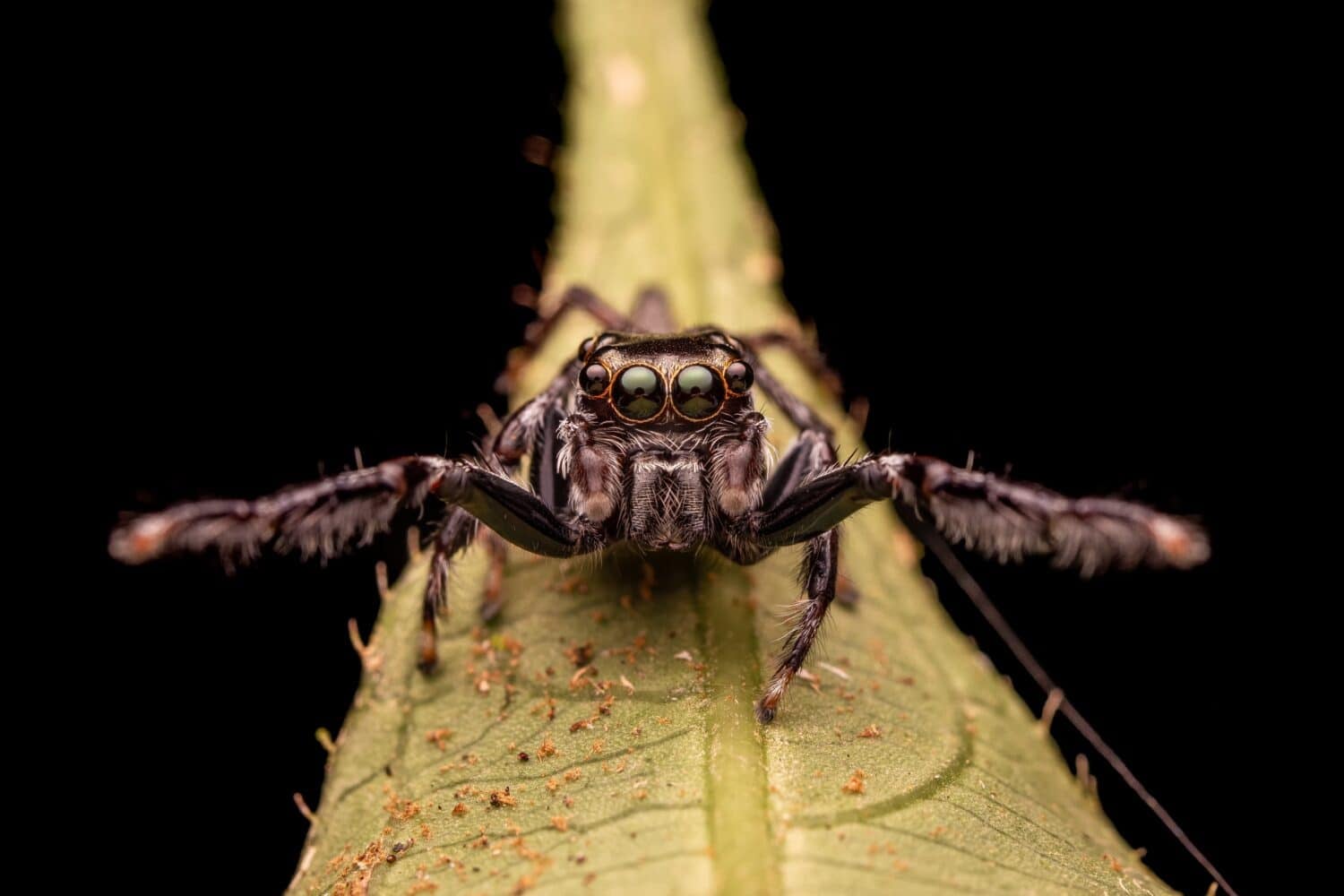
Jumping spiders are extremely intelligent, but sleep studies reveal a new level of brain activity.
©common human/Shutterstock.com
Researchers used infrared cameras to record the spiders at night. Throughout the experiment, they closely monitored the jumping spiders’ positions and rest periods. At random intervals, they even interrupted the jumping spiders when they seemed to be asleep. They recorded any subsequent reactions as evidence of a potentially disturbed sleep cycle.
Monitoring the spiders at all times was crucial. Because researchers couldn’t monitor brain activity as they can in humans, they had no way to distinguish one resting state from another. But thanks to jumping spiders’ translucent exoskeletons, researchers could easily see REM-like movement in their eyes.
Researchers Observed Two Distinct Sleep Stages
Like mammals, jumping spiders also exhibited two sleep stages. The first was sleep, or light rest, without REM. This is similar to how humans fall asleep but can be easily aroused by sounds or movement. It doesn’t provide a significant recharge, but it’s equivalent to napping.
The second was confirmed as REM with 77- to 83-second-long eye movements. Beneath the spiders’ eyelids, researchers watched as retinas appeared to dart back and forth while the spiders remained still. If they had been hooked up to a brain scan, the results likely would have shown patterns consistent with deep sleep or dreaming.

It was previously unclear whether spiders sleep, but researchers have now confirmed two sleep stages.
©iStock.com/Emilie Billaudel
These movements occurred roughly every 17 to 28 minutes, according to another 2022 study. However, that wasn’t all that researchers observed.
In addition to rapid eye movements, researchers recorded unique movements in spiders, including leg curling, twitching, and abdomen wiggling. The longer they watched, the more similarities they found between a spider’s REM stage and a human’s REM stage. It’s still unclear whether spiders actually dream during this REM stage, but their movements match those observed in mammals.
Jumping Spiders Also Catch Up on Lost Sleep
In the University of Bonn study, researchers occasionally kept the jumping spiders awake. Their goal? To determine if–like mammals–jumping spiders required a set rest period to function. Whereas humans need 7 to 9 hours of sleep to feel well-rested, jumping spiders seemed to need something similar.
To test this, researchers released a group of buzzing insects into the spiders’ enclosures. The goal was to show that noisy buzzing disrupts their sleep cycles. On nights when researchers woke the jumping spiders early, they rested an hour longer the next day. This is called sleep-rebound and happens when the body is sleep-deprived. In an attempt to catch up on rest and give the brain a break, we often sleep longer to make up for lost downtime.

In addition to being adorable, jumping spiders also nap and need a specific amount of sleep.
©shuttertim82/Shutterstock.com
Jarring wake-up calls also gave researchers further evidence that spiders sleep. When researchers woke them with loud noises, the spiders responded to stimuli three seconds more slowly. This reaction suggests they enter a deep sleep state.
One of the study’s most significant pieces of evidence shows that jumping spiders are highly intelligent arachnids. They exhibit true, regulated sleep with two clearly distinguishable sleep stages, including a REM-like state, indicating a level of sophistication rarely seen in other arachnids. Just when we thought jumping spiders couldn’t get any cuter, turns out they also appreciate a good nap.