
Quick Take
- Copperheads look angry, but that facial expression is a biological trick with a surprisingly mundane explanation. See the angry expression explained →
- Baby copperheads carry a secret weapon on their tails that adult snakes completely lack, which changes how you should react if you spot one. Discover the tail tip secret →
- Copperhead bites are rarely fatal, yet experts still treat every bite as an emergency, and the reason why reveals something unsettling about the venom. Check the venom danger level →
The eastern copperhead (Agkistrodon contortrix) is among the most common venomous snakes in the eastern United States. These venomous reptiles are responsible for the most bites of any snake in the U.S. Bites are most often the result of accident, as they have incredible camouflage, or deliberate handling. In this article, we’ll take a look at these snakes and learn how to identify them so both you and the copperhead can go on your way undisturbed.
About the Eastern Copperhead
Copperheads are a type of pit viper belonging to the subfamily Crotalinae. There are three common types of pit vipers in the U.S.: copperheads, cottonmouths (also called water moccasins) and rattlesnakes. They have small, heat-sensing pits between their eyes and nostrils that detect infrared radiation from warm-blooded prey. These snakes also have long, hollow fangs attached to the jaw by a hinge. Their fangs fold up flat against the roof of their mouths, which allows them to grow very long fangs that can exceed one inch in length. Most pit vipers have hemotoxic venom that destroys red blood cells, interferes with blood clotting, and damages blood vessels and other tissues.
The copperhead is widely distributed across the eastern and southern U.S. They live as far north as New York and Massachusetts, south to the Florida Panhandle, and west through the southern Great Lakes states, southeastern Nebraska, and eastern Texas. Their typical habitats include deciduous forests, mixed woodlands, and rocky hills. They are often found basking or sheltering near rocky outcroppings and hiding under leaf litter for camouflage. In the south, copperheads can be found in floodplains and at swamp edges.
Although these snakes are venomous, they are the least venomous of the three types of pit vipers, and fatal bites are extremely rare. However, bites should still be treated as a medical emergency. As noted above, bites most often happen when a human accidentally steps on or touches the snake or if the snake is deliberately handled. Copperheads are generally not aggressive and would rather escape than strike.
How to Identify a Copperhead
Most of the time, you won’t see a copperhead if it doesn’t want to be seen, but sightings do occur because these snakes are so common. Here is our guide to help you learn how to identify them.
1. Color Pattern
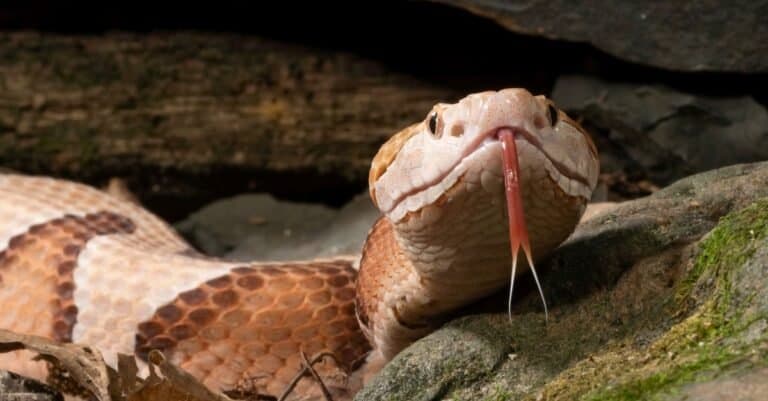
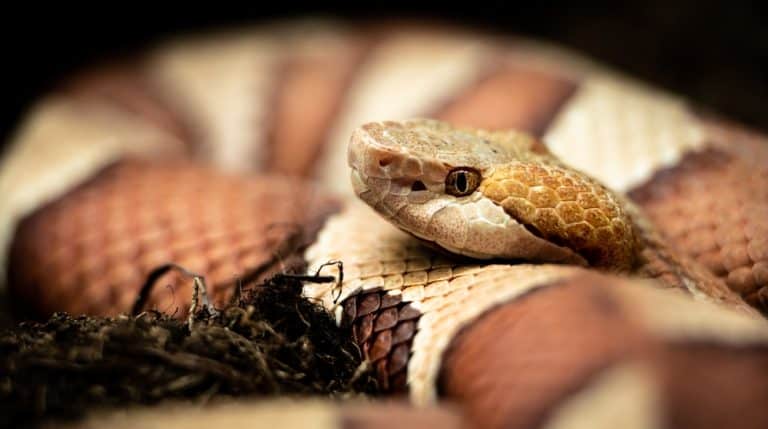
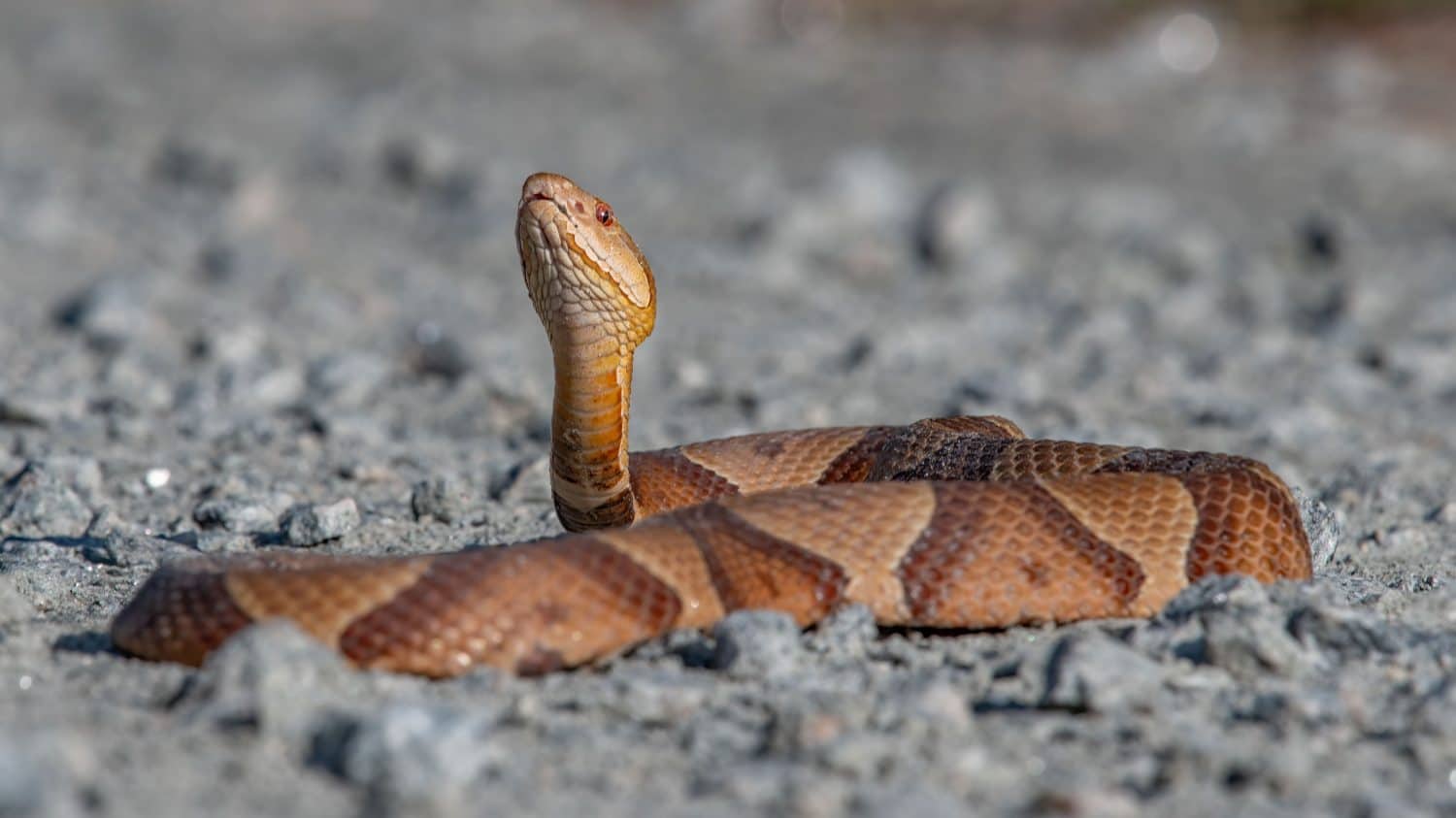
The first thing you should look at is the color pattern. However, there are some slight variations depending on the region where the snake was found. As their name suggests, copperheads generally have unmarked, coppery-colored heads. Their base color may be a pale beige, tan, or reddish to pinkish-brown.
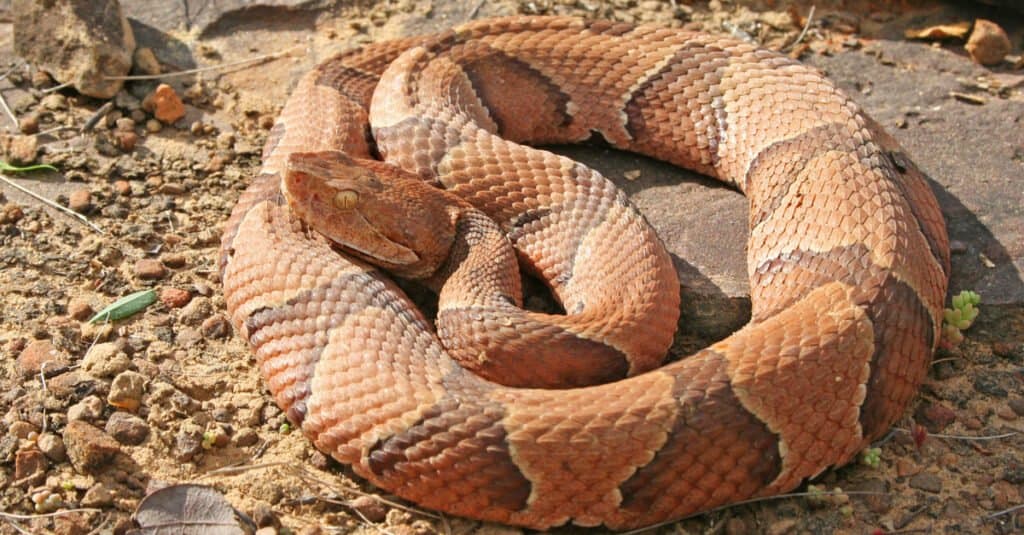
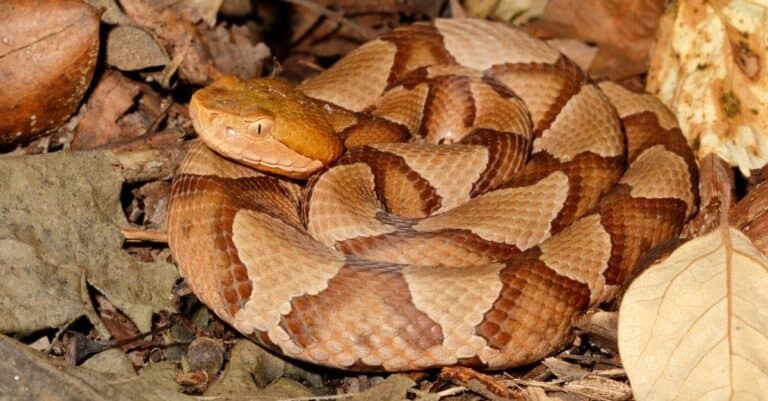
Copperheads have a brown hourglass pattern on their backs.
©Creeping Things/Shutterstock.com
On top of that brownish base color is a banding pattern that runs from the snake’s head to the tail. The banding pattern will almost always be in the shape of an hourglass, with the thinnest portion of the hourglass shape lying on the spine and the wider ends (sand reservoirs) on the sides of the snake. Some people have also likened the pattern to Hershey’s kisses, wide at the bottom and narrow at the top. The hourglass shape isn’t always perfect, but it is by far the most identifiable pattern that distinguishes the snake from other species.
If you are able to see the belly of the snake (don’t try to flip it over), they are usually white or cream with a black spotted or checkerboard-like pattern. Other snakes do share this feature, including harmless corn snakes, so the belly pattern alone shouldn’t be used as an indicator.
An important note: Some subspecies of copperhead don’t have an hourglass pattern but a thick banding pattern. This is most common in Texas near desert regions where the “broad-banded copperhead” lives. Still, the rest of the steps should be enough to complete the identification.
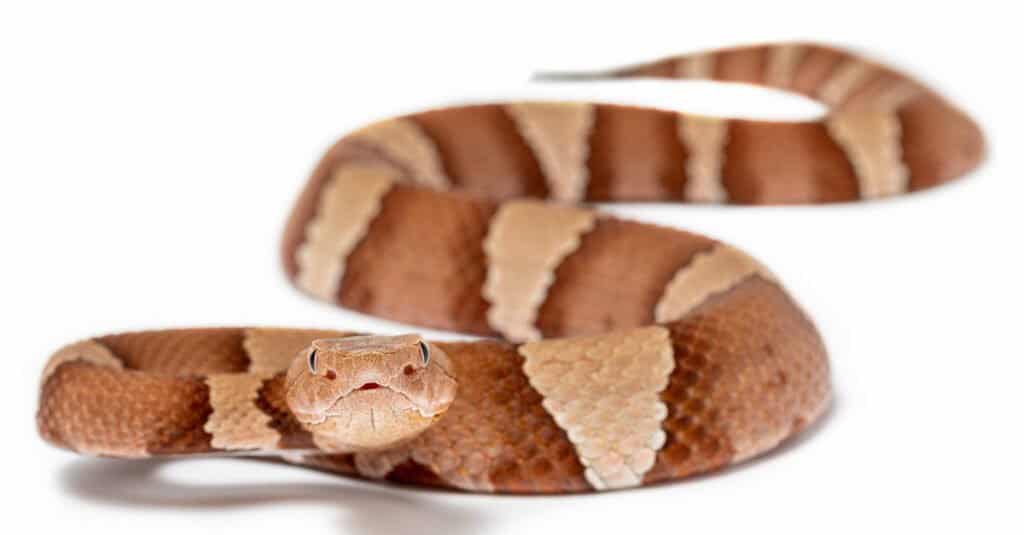
The broad-banded copperhead does not have bands that narrow across the spine like an hourglass.
©Scott Delony/Shutterstock.com
2. Head and Body Shape
A key factor in identifying a copperhead is the shape of the head, which is wider than the neck. They have broad, angular heads shaped like a rounded triangle. The base of the triangle is at the neck, and the pointed end is at the snout. Copperheads also have thick, heavy bodies with keeled (ridged) scales. Adults typically measure between 2 and 3 feet long, with some individuals reaching up to 4 feet.
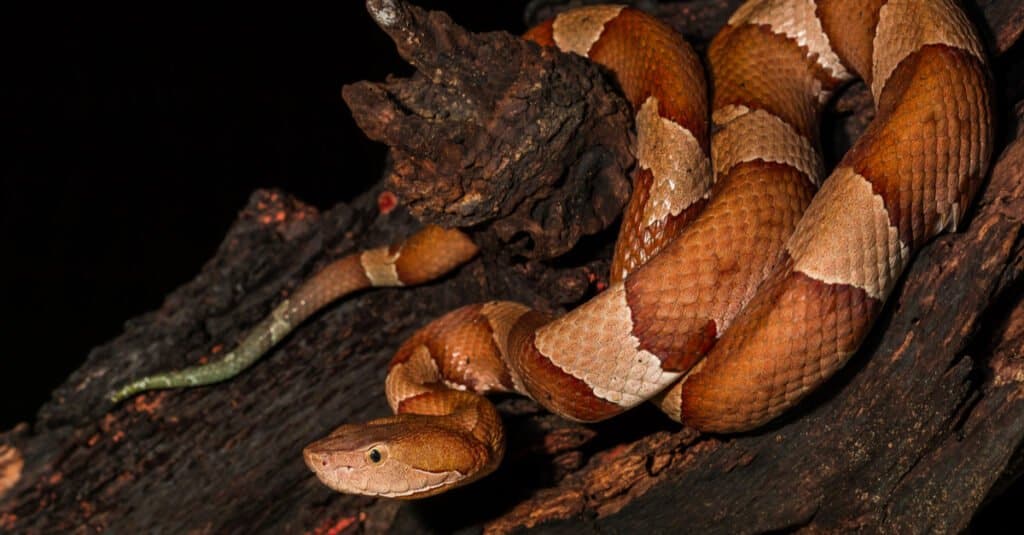
Copperheads have triangular heads with pointed snouts.
©Wildvet/Shutterstock.com
3. Eyes
The eyes of the copperhead are another great identification tool since they are so distinct. All copperheads have a vertical pupil that is narrow at the top and bottom and thick in the middle. This cat-like pupil is found only in venomous snakes in the United States, but not all venomous snakes have cat-like pupils.
In addition to the shape of the eye, copperheads have either golden, yellow, or brown eyes. Golden or yellow eyes are the most common, but a light brown or sandy tan-colored eye is also possible. Above the eyes is a keeled scale that gives the impression of an eyebrow. This scale gives the snake an “angry” look, but as we noted above, these snakes are not aggressive.
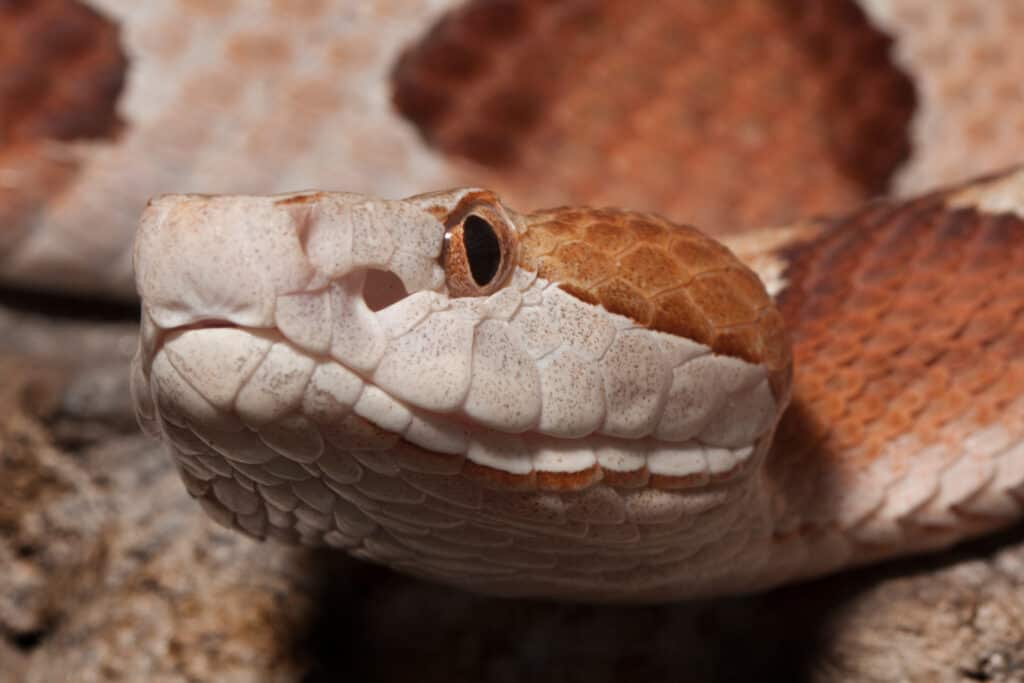
Copperheads have yellow, golden, or brown eyes, cat-like pupils, and an eyebrow scale.
©Mark_Kostich/Shutterstock.com
4. Heat-Sensing Pits
As discussed previously, copperheads have two heat-sensing pits located between the eyes and nostrils. Their nostrils are located at the front tip of their snouts. The pits are larger, deeper cavities set further back toward the eyes.
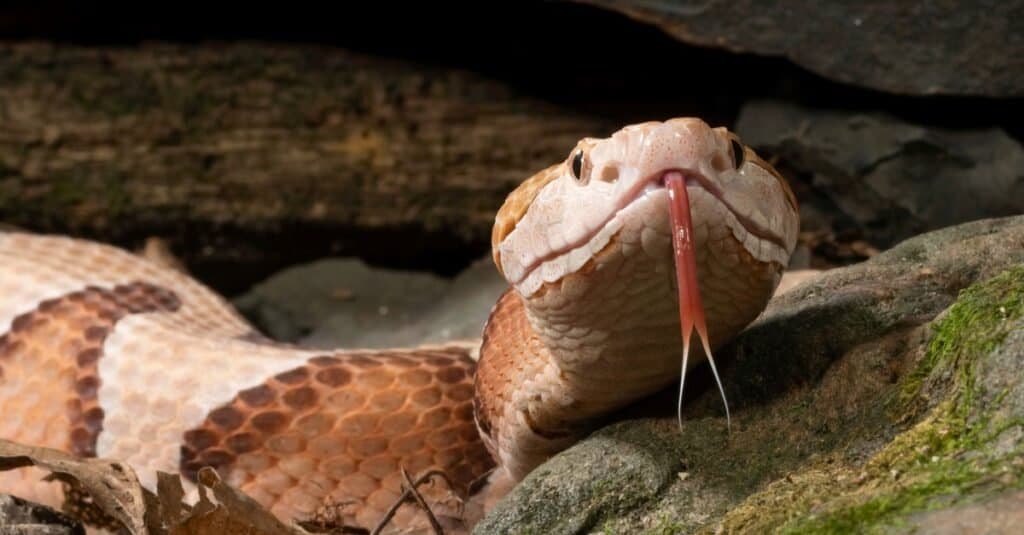
Heat-sensing pits are visible between the eyes and the nostrils on a copperhead.
©Joe McDonald/Shutterstock.com
5. Juvenile Identification
Baby copperheads are very similar to adult copperheads, although there are a few variations. First, juveniles tend to be grayer than adults. They also have a neon-yellow or green tip on their tails that is thought to be used to attract insects. Additionally, the bellies of juveniles lack the checkerboard pattern, but they are still a lighter cream color.
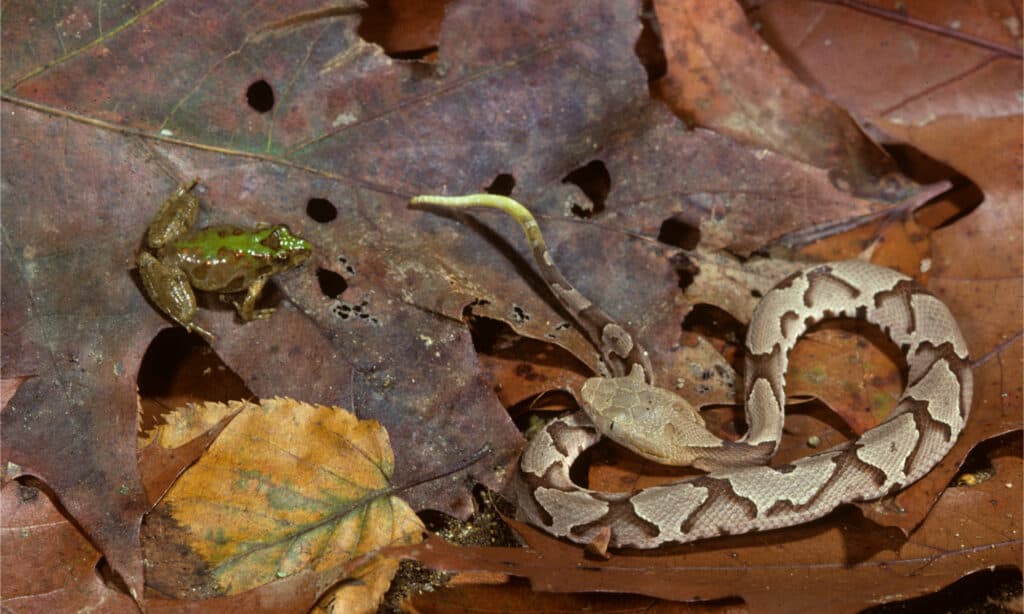
Juvenile copperheads have a yellow or green tail to attract small prey.
©Breck P. Kent/Shutterstock.com
Common Snakes Copperheads Are Mistaken For
Harmless snakes like the eastern rat snake (Pantherophis alleghaniensis) and the common, or northern, watersnake (Nerodia sipedon) are among the snakes most often mistaken for copperheads due to their blotched patterns. Juvenile eastern ratsnakes have a distinct pattern of grey or brown blotches on a light grey background. However, the blotches of the eastern ratsnake are only on the back and do not extend to the sides like the copperhead’s hourglass pattern. As they mature, eastern ratsnakes become mostly black.
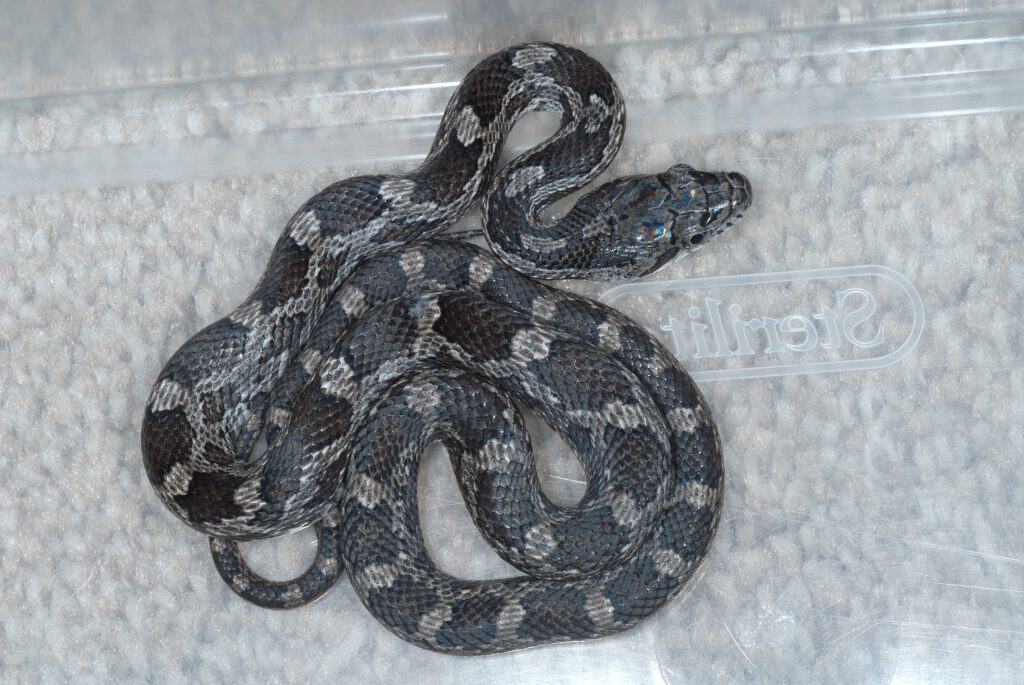
Juvenile eastern ratsnakes are sometimes mistaken for copperheads due to their pattern.
Northern watersnakes are also frequently mistake for copperheads due to their color and pattern. Young northern watersnakes’ patterns can vary in color from dark grey to reddish-brown, which can appear similar to the color of some copperheads. However, the pattern on the watersnake is narrower on the sides and wider near its backbone, which is the opposite of the copperhead’s pattern. Some snakes may keep this pattern into adulthood, while others become mostly brown.
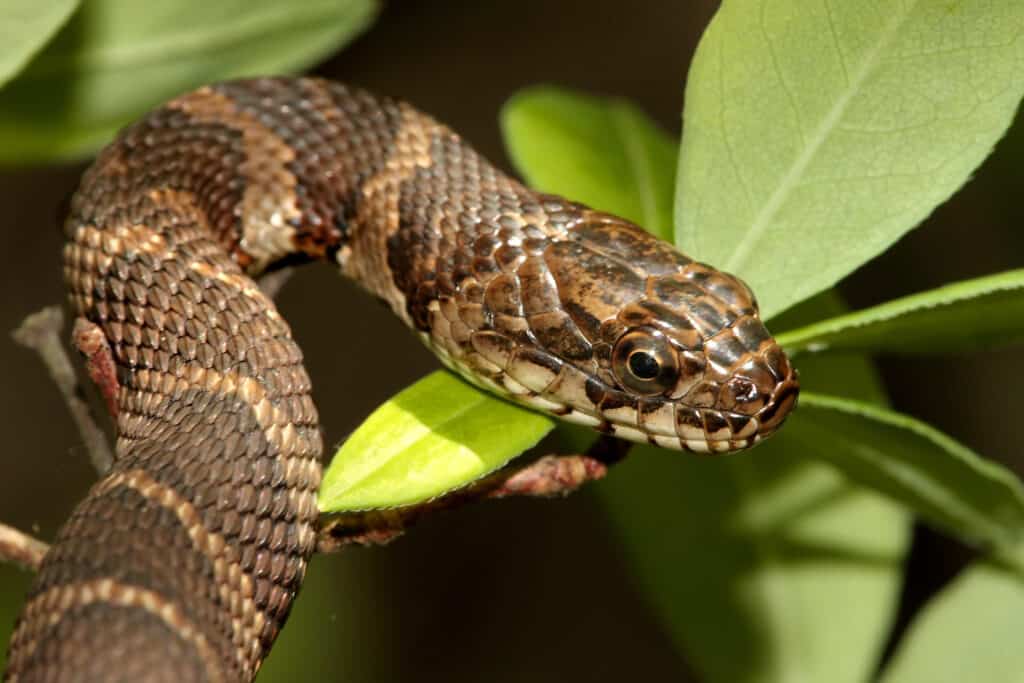
Northern watersnakes have color patterns similar to some copperheads.
©Steve Byland/Shutterstock.com