

C
Species Profile

Copperhead

Agkistrodon contortrix contortrix

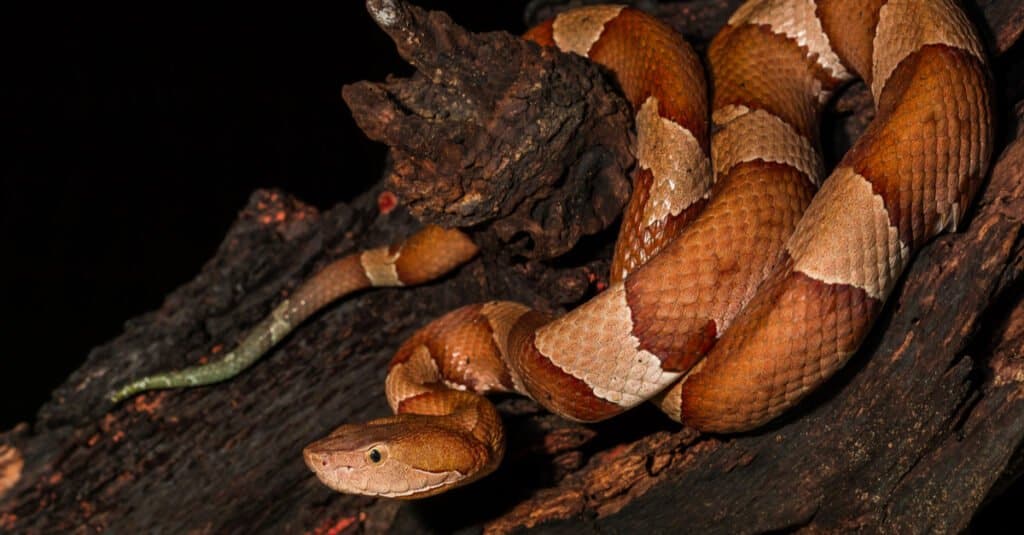
Hourglass bands, hidden in plain sight
iStock.com/Mark Kostich
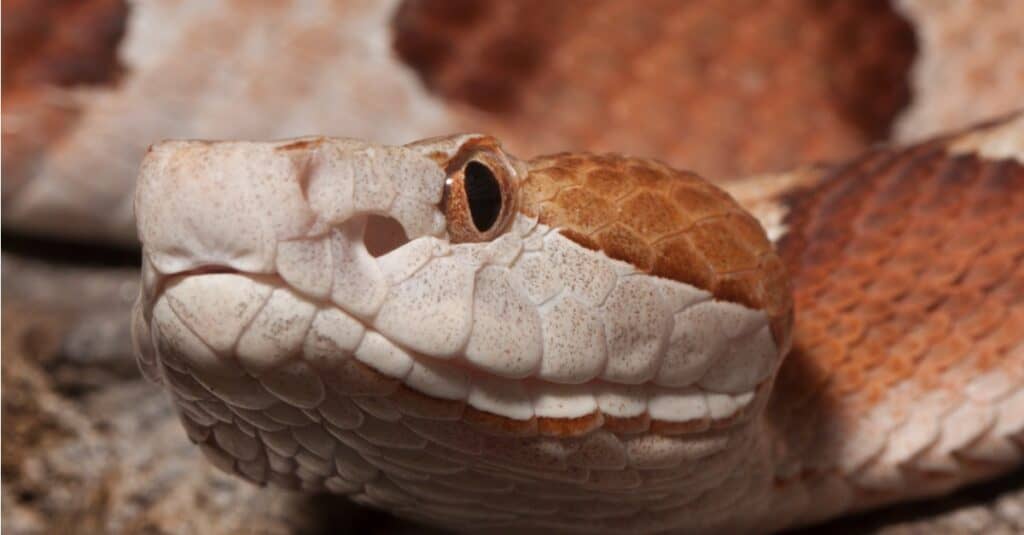
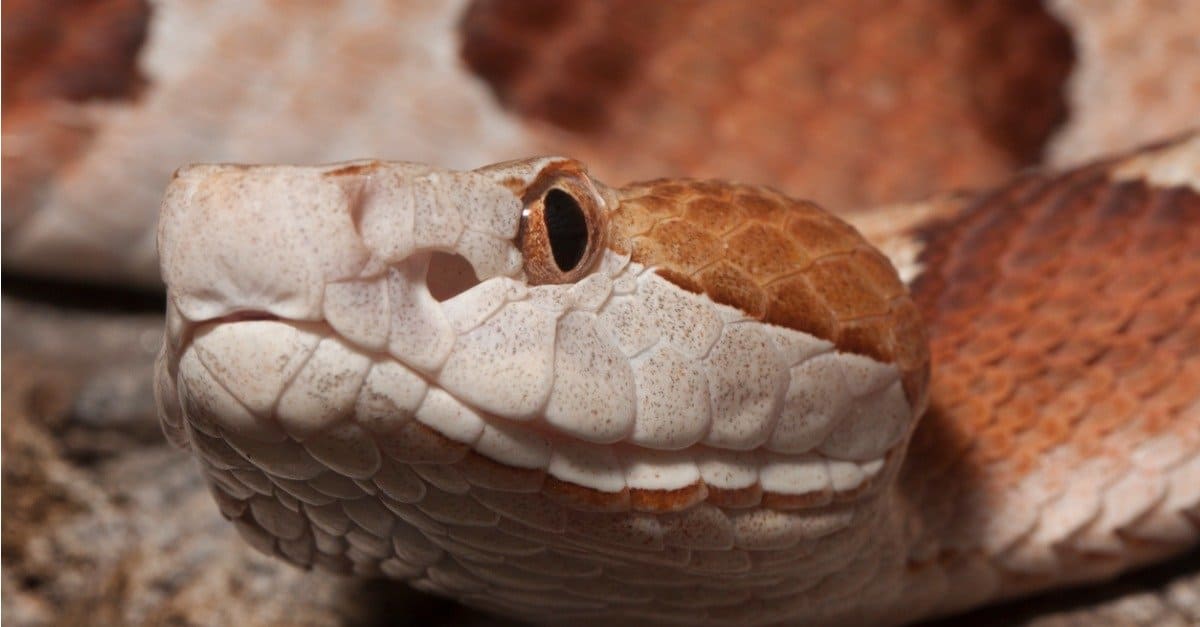
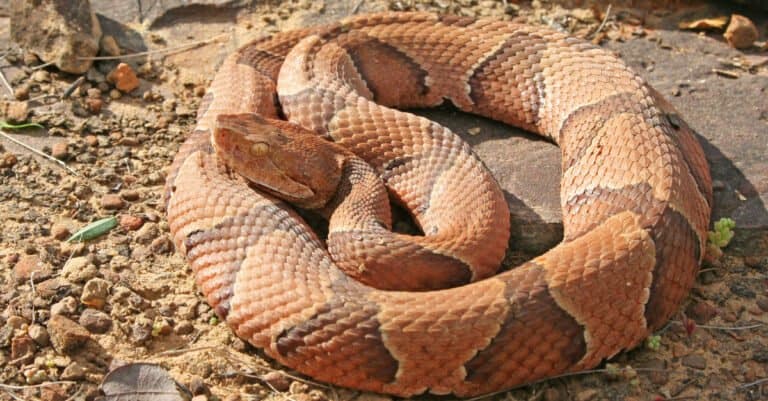
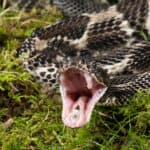
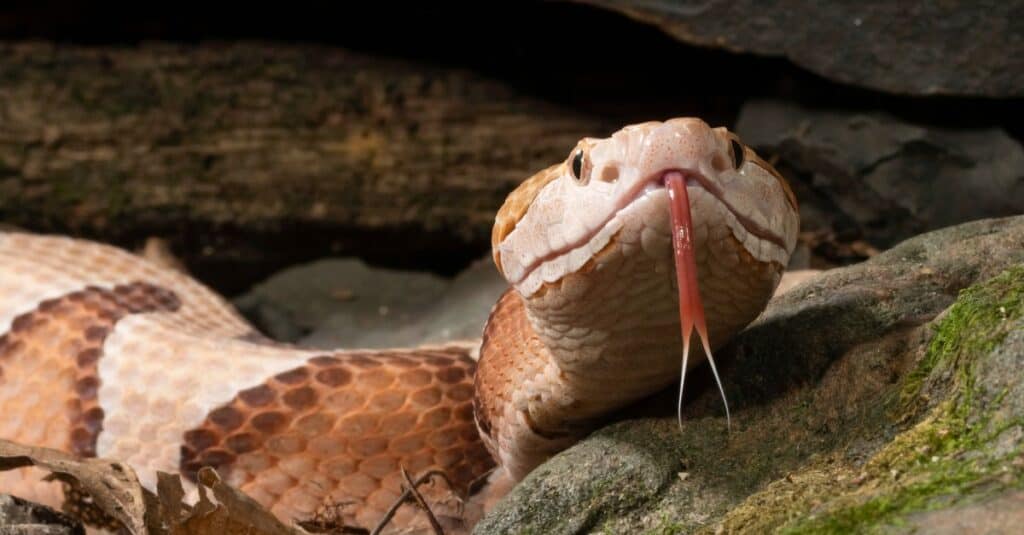
Close-up of venomous Copperhead Snake. Its head, whose color gives the snake its common name, is broad and wedge-shaped.

At a Glance

Wild Species
Also Known As Copperhead, Copperhead snake, Common copperhead, American copperhead, Highland moccasin
Diet Carnivore
Activity Diurnal+
Lifespan 8 years
Weight 0.7 lbs
Status Least Concern
Did You Know?

Typical adult total length is ~53-91 cm; record length reported for A. contortrix is 134.6 cm (Gloyd & Conant, 1990; Ernst & Ernst, 2003).

Scientific Classification

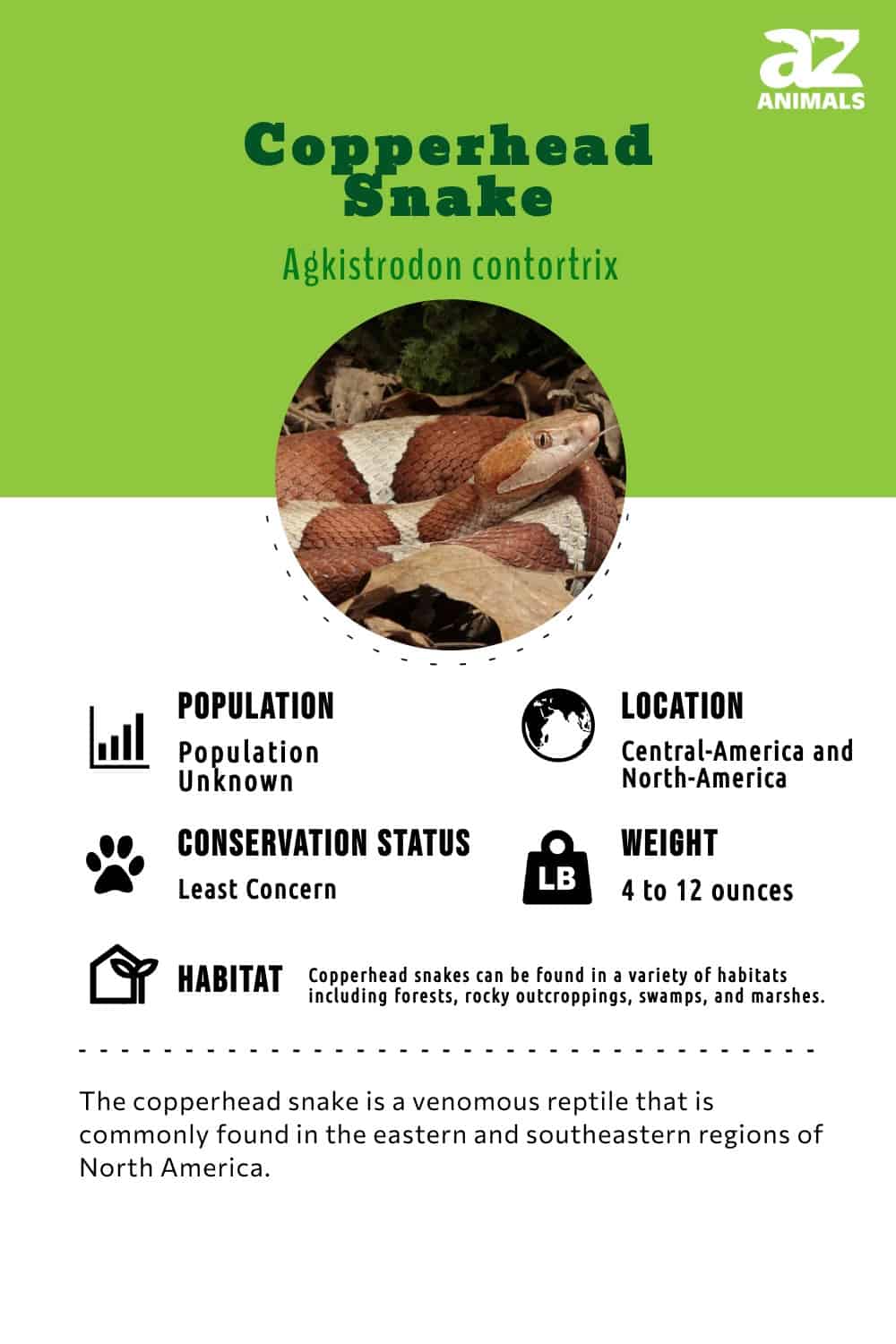
The Eastern Copperhead is a venomous New World pit viper (a “copperhead” in the North American sense), known for its coppery head coloration and hourglass-shaped crossbands. It is generally secretive and relies on camouflage; bites to humans occur mostly from accidental encounters.

Kingdom
Animalia
Phylum
Chordata
Class
Reptilia
Order
Squamata
Family
Viperidae
Genus
Agkistrodon
Species
Agkistrodon contortrix

Distinguishing Features

  • Coppery/orange-brown head with relatively slender neck
  • Dark, hourglass-shaped crossbands (narrow along the spine, broader on the sides) on a tan to pinkish-brown body
  • Heat-sensing facial pits (pit viper trait) between eye and nostril
  • Keeled (ridged) scales giving a rough texture
  • Often remains motionless and camouflaged rather than fleeing

Physical Measurements

Males and females differ in size

Length
2 ft 6 in (1 ft 8 in – 3 ft 3 in)
2 ft 6 in (1 ft 8 in – 3 ft 11 in)
Weight
1 lbs (0 lbs – 1 lbs)
Tail Length
4 in (3 in – 6 in)
4 in (3 in – 7 in)
Venomous

Appearance

Primary Colors
Secondary Colors
Skin Type Dry, keratinized reptile scales; dorsal scales strongly keeled (gives a rough/matte appearance), ventral scales broad and smooth. Like other Viperidae (pit vipers), has heat-sensing loreal pits between eye and nostril.
Distinctive Features
  • Adult total length commonly ~50-95 cm; large individuals to ~135 cm total length have been documented in the species (species-level maxima reported in major North American herpetology references).
  • Thick-bodied, relatively short tail; triangular head distinct from neck; coppery head coloration is often more uniform than the body pattern.
  • Vertical (cat-like) pupil; facial pit (loreal pit) on each side indicates New World pit viper identity (Viperidae: Crotalinae; genus Agkistrodon).
  • Camouflage-centric appearance: hourglass banding and muted earth tones match hardwood leaf litter; individuals often remain motionless when approached (cryptic/defensive rather than actively aggressive).
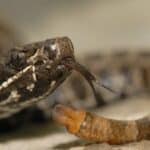
  • Juveniles typically show a bright yellow tail tip used for caudal luring of prey (a known behavior in A. contortrix); pattern contrast tends to be sharper in younger snakes.
  • Common human-encounter scenario linked to appearance/behavior: stepping near or on a well-camouflaged, motionless snake in leaf litter/wood piles/rock edges, leading to a defensive bite. High-level safety: watch footing and do not handle wild snakes.

Sexual Dimorphism

Sexes are similar in overall coloration/pattern, but differ in body proportions and scalation typical of many pit vipers.

  • Proportionally longer tail (post-vent length) with a noticeable taper; often a subtle hemipenal bulge near the tail base.
  • Typically more subcaudal scales than females (scalation dimorphism reported in taxonomic keys/field guides for A. contortrix).
  • On average, females tend to be slightly longer/heavier-bodied than males in many populations (reported in population studies of A. contortrix), while retaining the same hourglass banding and coppery head appearance.
  • Shorter tail relative to total length; fewer subcaudal scales than males (typical viperid dimorphism).

Did You Know?

Typical adult total length is ~53-91 cm; record length reported for A. contortrix is 134.6 cm (Gloyd & Conant, 1990; Ernst & Ernst, 2003).

Juveniles often have a bright yellow tail tip and use it as a lure to draw prey within striking range (caudal luring) (Ernst & Ernst, 2003).

Eastern copperheads are "sit-and-wait" ambush hunters and may remain motionless for hours, relying on camouflage rather than fleeing.

They are New World pit vipers (Viperidae) with infrared-sensitive facial pits that help detect warm-blooded prey in low light.

Litters are live-born (viviparous): commonly 3-10 young (often ~4-7), typically born in late summer to early fall (Ernst & Ernst, 2003).

Reported longevity is up to ~18 years in the wild and up to 29 years in captivity (Animal Diversity Web, Univ. of Michigan Museum of Zoology).

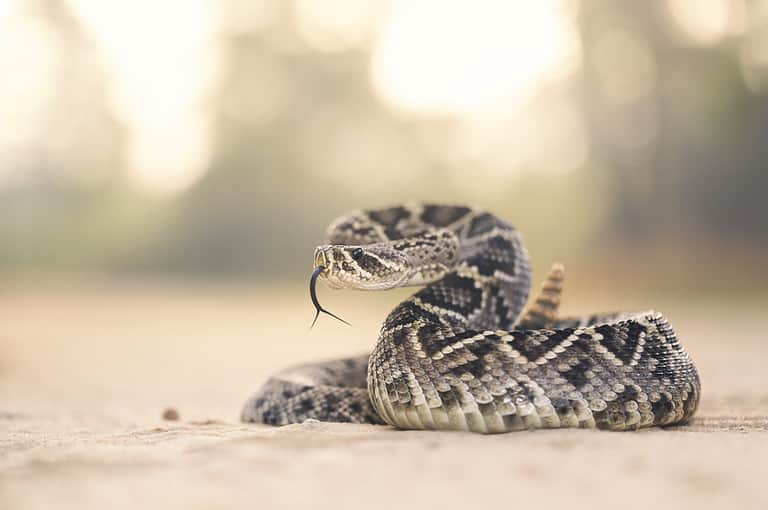
When alarmed, they may rapidly vibrate the tail against leaf litter, producing a "buzz" that can resemble a small rattlesnake's sound.

Unique Adaptations

  • Heat-sensing pit organs (pit viper trait): infrared detection complements vision and chemical sensing to locate prey and threats.
  • Cryptic patterning: classic dark 'hourglass' crossbands (narrow across the spine, wider on the sides) disrupt the body outline in leaf litter and dappled light.
  • Hinged solenoglyphous fangs: long, folding front fangs allow efficient venom delivery during very fast strikes (Viperidae hallmark).
  • Venom optimized for predation: primarily tissue-damaging/hemotoxic effects typical of many viperids, aiding prey immobilization and digestion (genus-level trait: Agkistrodon).
  • Robust cranial musculature and strike mechanics that support short-range ambush predation from tight coils.

Interesting Behaviors

  • Camouflage-first defense: often freezes instead of fleeing, which is why many bites occur when people don't see the snake and step or reach near it.
  • Ambush hunting: chooses travel corridors (log edges, leaf-litter margins, rock borders) and strikes quickly at close range.
  • Caudal luring (especially juveniles): wriggles the yellow tail tip like a grub/worm to attract frogs and lizards into range.
  • Thermal targeting: uses facial pit organs to aim strikes at warm areas on prey, improving accuracy at dusk/night.
  • Seasonal activity: most active in warmer months; in colder regions may overwinter in sheltered sites (rock crevices, root channels), sometimes near other snake species.
  • Threat display: body tightening/coiling and tail vibration; usually does not hold a prolonged elevated posture like many elapids.

Cultural Significance

In the eastern U.S., the Eastern Copperhead (Agkistrodon contortrix contortrix) is a well-known venomous snake used in safety messages. "Copperhead" was a Civil War name for Northern anti-war Democrats. Agkistrodon means "hook-tooth"; contortrix means "twister."

Myths & Legends

Appalachian and Ozark folk tradition long held that copperheads will "chase" people who enter their woods-told as cautionary stories to keep children and hikers wary in summer leaf litter.

In parts of the rural American South, copperheads were said to be able to "sting" with the tail, a fireside tale often linked to the tail-vibration behavior in dry leaves.

Some regional storytelling casts the copperhead as a deceptive 'leaf-snake'-so perfectly patterned that it can be mistaken for fallen foliage, a motif used in warnings about watching where you place hands and feet.

Civil War-era American political lore transformed "Copperhead" into a metaphorical serpent-an emblem in speeches, cartoons, and slogans implying hidden danger within the community.

Local hunting camp anecdotes sometimes describe copperheads as 'guardians' of rock piles, woodpiles, or old homesteads-places where rodents are common and where the snakes are frequently encountered.

Conservation Status

LC Least Concern

Widespread and abundant in the wild.

Population Stable

Protected Under

  • Not listed under the U.S. Endangered Species Act (ESA) at the species level; no federal ESA protections apply.
  • Regulatory status varies by U.S. state: often managed under state wildlife codes (e.g., as a nongame/venomous snake) with differing rules on take, killing, and collection; some jurisdictions restrict commercial collection or require permits.
  • HUBS (Agkistrodon group overview): Most Agkistrodon taxa are assessed as Least Concern, but localized vulnerability is common where persecution and habitat fragmentation are intense. Group-wide recurring threats include habitat loss/fragmentation (urbanization/agriculture), road mortality, and intentional killing due to venom risk; climate change and snake fungal disease are emerging concerns. Notable higher-risk taxa in the broader pitviper context tend to be island-restricted or narrowly distributed species/subspecies; conservation concern rises with small ranges, isolation, and heavy human pressure.

Life Cycle

Birth 5 hatchlings
Lifespan 8 years

Lifespan

In the Wild
4–18 years
In Captivity
10–29.5 years

Reproduction

Mating System Polygynandry
Social Structure Solitary
Breeding Pattern Transient
Fertilization Internal Fertilization
Birth Type Internal_fertilization

Behavior & Ecology

Social Hibernaculum aggregation Group: 1
Activity Diurnal, Crepuscular, Nocturnal
Diet Carnivore Small rodents (mice/voles) are the dominant adult prey category reported across much of the range (summarized in Gloyd & Conant 1990; Ernst & Ernst 2003).
Seasonal Hibernates

Temperament

Secretive and strongly crypsis-reliant; commonly remains motionless when approached, which increases accidental encounters.
Defensive rather than overtly aggressive; may coil, elevate head, and deliver warning behaviors before striking at close range.
Seasonally plastic activity: more diurnal/crepuscular in cooler spring/fall conditions and more crepuscular/nocturnal during hot summer periods (reported broadly for A. contortrix in field accounts: Gloyd & Conant, 1990; Ernst & Ernst, 2003).
Reproductive behavior includes male-male combat/ritualized contests (competitive interactions are context-specific rather than stable social dominance).

Communication

Hissing Audible exhalation used in close-range defensive contexts
Chemical communication via pheromones detected by tongue-flicking/Jacobson's organ: mate finding and reproductive condition signaling; males follow female scent trails during breeding seasons Gloyd & Conant, 1990; Ernst & Ernst, 2003
Tactile signaling during courtship (body alignment, rubbing/pressing) and during mating.
Visual/behavioral threat displays: tight coiling, head elevation/orientation toward threat, and body posturing to advertise readiness to strike.
Substrate-borne signaling and deterrence: rapid tail vibration against leaf litter A common pitviper defensive behavior) to create an audible rustling warning; more effective in dry litter than on bare ground (general behavior noted for A. contortrix in natural history summaries: Gloyd & Conant, 1990; Ernst & Ernst, 2003
Juvenile caudal luring: tail-tip twitching to attract prey Primarily an antipredator-independent foraging signal directed at prey rather than conspecifics, but a characteristic communication-like display in the species complex

Habitat

Biomes:
Temperate Forest Wetland Freshwater Temperate Grassland
Terrain:
Mountainous Hilly Plains Valley Coastal Riverine Rocky +1
Elevation: Up to 4921 ft 3 in

Ecological Role

Mesopredator in forest/woodland-edge and rocky-hillside systems; links lower trophic levels (arthropods, amphibians, small mammals) to higher predators.

Suppresses rodent populations locally (potentially reducing crop/seed loss and some rodent-borne disease risk) Provides prey for higher-level predators (e.g., raptors and larger snakes such as kingsnakes) Contributes to energy transfer from episodic arthropod pulses (e.g., cicada emergences) into vertebrate food webs, especially via juvenile diets (summarized in Ernst & Ernst 2003).

Diet Details

Main Prey:
Small mammals Shrews Small birds and nestlings Lizards Amphibians Large insects and other arthropods

Human Interaction

Domestication Status

Wild

Agkistrodon contortrix contortrix (Eastern Copperhead) is a wild, non-domesticated pit viper with no domestication history. Human contact is usually accidental, managed (relocation or killing), or limited captivity for education and research. Adults ~53–95 cm; ambush predator that often stays still and uses camouflage, causing accidental contact and defensive bites.

Danger Level

High
  • Medically significant envenomation: intense pain and swelling are common; local tissue effects can occur; systemic effects are less common but possible. Copperhead bites are rarely fatal with modern medical care, but can cause substantial morbidity and require hospital evaluation (Gloyd & Conant, 1990; Ernst & Ernst, 2003; regional clinical toxicology literature).
  • High encounter risk relative to more aggressive species because the snake often relies on camouflage and may not flee-bites frequently follow accidental stepping/handling while hiking, yard work, or moving debris/woodpiles (Ernst & Ernst, 2003).
  • Secondary risks: infection concerns from puncture wounds, allergic reactions/anaphylaxis to venom or treatment, and functional impairment during recovery.
  • Occupational/handling risk: greatly elevated for untrained keepers, relocators, and anyone attempting capture without proper tools and protocols.

As a Pet

Not Suitable as Pet

Legality: Eastern Copperhead (Agkistrodon contortrix contortrix): laws vary by state and local area; many places ban or require strict permits, secure cages, and bite or escape plans. Check rules—illegal keeping can lead to being seized and fined.

Care Level: Expert Only

Purchase Cost: $100 - $350
Lifetime Cost: $2,000 - $10,000

Economic Value

Uses:
Public health (envenomation treatment/antivenom demand) Scientific research (venom biology, hemostasis/toxinology) Education/ecotourism (zoos, nature centers, guided herping) Ecosystem services (predation on small mammals/rodent control)
Products:
  • venom samples for research (laboratory/toxinology use under permits)
  • clinical knowledge supporting antivenom development and medical protocols
  • educational programming/exhibits featuring native venomous snakes

Relationships

Predators 10

Eastern Kingsnake Lampropeltis getula
Scarlet Kingsnake
Scarlet Kingsnake Lampropeltis elapsoides
Eastern Ratsnake
Eastern Ratsnake Pantherophis alleghaniensis
Raccoon
Raccoon Procyon lotor
Virginia Opossum Didelphis virginiana
Striped Skunk Mephitis mephitis
Red Fox
Red Fox Vulpes vulpes
Red-tailed Hawk Buteo jamaicensis
Great Horned Owl Bubo virginianus
Wild Turkey
Wild Turkey Meleagris gallopavo

Ecological Equivalents 5

Animals that fill a similar ecological role in their ecosystem

Timber Rattlesnake
Timber Rattlesnake Crotalus horridus Co-occurs with the Eastern Copperhead (Agkistrodon contortrix contortrix) in eastern North American deciduous and mixed forests and on rocky slopes. Like the copperhead, this ambush hunter eats small mammals, uses camouflage, and is often found near trails.
Eastern Massasauga
Eastern Massasauga Sistrurus catenatus Pit-viper ambush hunter that eats small mammals and amphibians. More closely associated with wetlands and considered a niche analog in edge habitats where small mammal prey is common; Sistrurus and Agkistrodon are often compared.
Northern Watersnake Nerodia sipedon Often occurs in the same general landscapes (streams, riparian edges) and is frequently confused with pit vipers; both are secretive, defensive when handled, and feed on small vertebrates. Unlike Agkistrodon contortrix contortrix, Nerodia sipedon is nonvenomous and more strongly fish- and amphibian-focused.
Eastern Ratsnake Pantherophis alleghaniensis Occupies many of the same forests and edge habitats and preys heavily on small mammals; a functional analog as a medium-to-large, primarily terrestrial-to-scansorial predator in eastern woodlands, though it relies more on active foraging than ambush.
Lowland Copperhead Austrelaps superbus Not closely related (Elapidae vs Viperidae) but ecologically similar: a secretive, venomous snake in cool-temperate habitats that relies on camouflage and defensive behavior, shares the common name 'copperhead', and can cause accidental bites.

“The Copperhead is responsible for more snakebites than any other American snake.”

Agkistrodon contortrix is relatively mild-mannered, but it still bites more people than any other venomous snake in America. This snake is so well-camouflaged that it spotting it amid the leaf litter is no easy task. easy for a person in bare feet or flip-flops to step on it inadvertently. Who wouldn’t bite if they were stepped on? Read on for some facts about this beautiful reptile.

Five Amazing Copperhead Facts
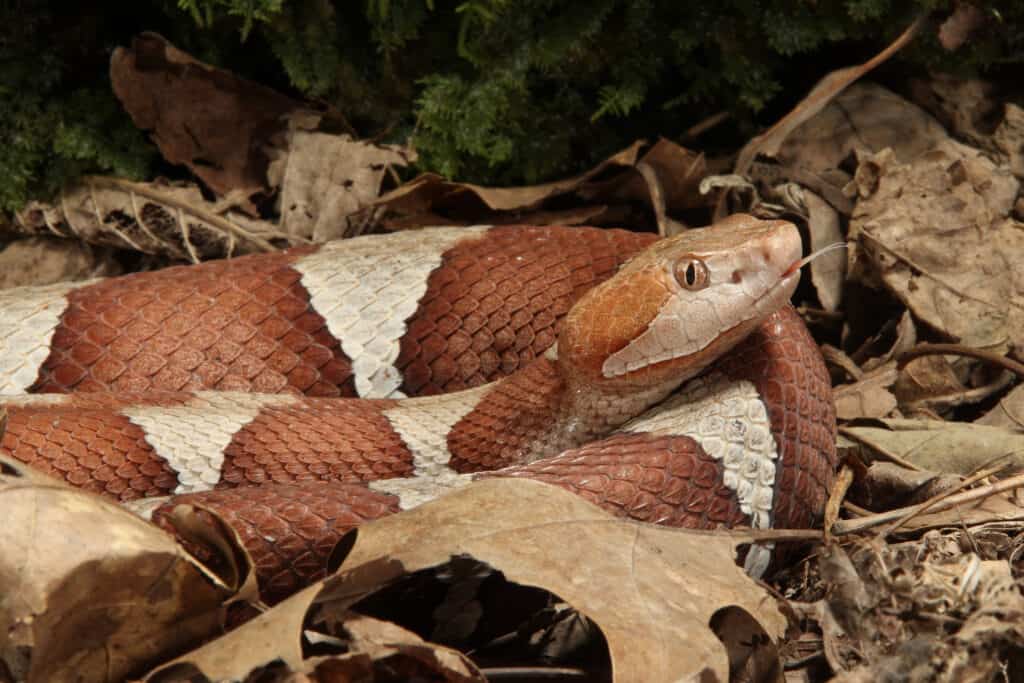
Broad Band Copperhead Snake

Copperhead snakes have been known to give birth without the help of a male. This is called parthenogenesis.

Here are five amazing facts about Agkistrodon contortrix.

  • It has been known to give birth without the help of a male. This is called parthenogenesis.
  • Young A. contortrix wiggle the tips of their tails to attract prey such as frogs or lizards. The tail mimics a worm.
  • “Copperhead” was the name given to northern Democrats who were against the American Civil War.
  • They hibernate and have been seen hibernating in locations with other snakes, such as rattlers and rat snakes.
  • Kingsnakes and opossums seem to be immune to the venom of the copperhead.

Different Types

  • Broad-banded copperhead (Agkistrodon laticinctus)
  • Northern copperhead (Agkistrodon contortrix)

Evolution and Origins
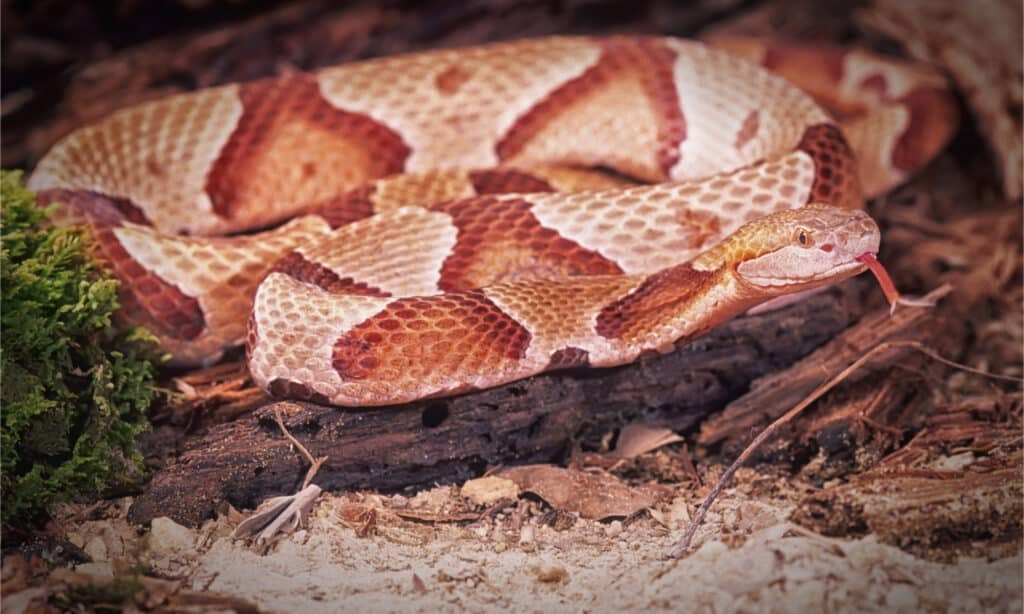
Even newly hatched copperheads are capable of injecting venom with fangs that are completely functional and just as lethal as the venom of an adult copperhead.

The snakes of North America and Australia separately developed comparable body shapes that aided them in moving and capturing prey more effectively over millions of years on opposite sides of the world.

The majority of biologists often presume that an organism group’s convergence in body form indicates that they must be biologically similar. Yet, our research reveals that despite many snakes having striking morphological similarities, there is essentially little commonality in their diets.

With that said, over the course of millions of years, the copperhead snake has developed, adjusting to environmental changes and evolving its poisonous bite for both defense and hunting. Before making the nearly 30 million-year migration to North America, the snake’s ancestors probably originated in Asia.

Where To Find the Snake
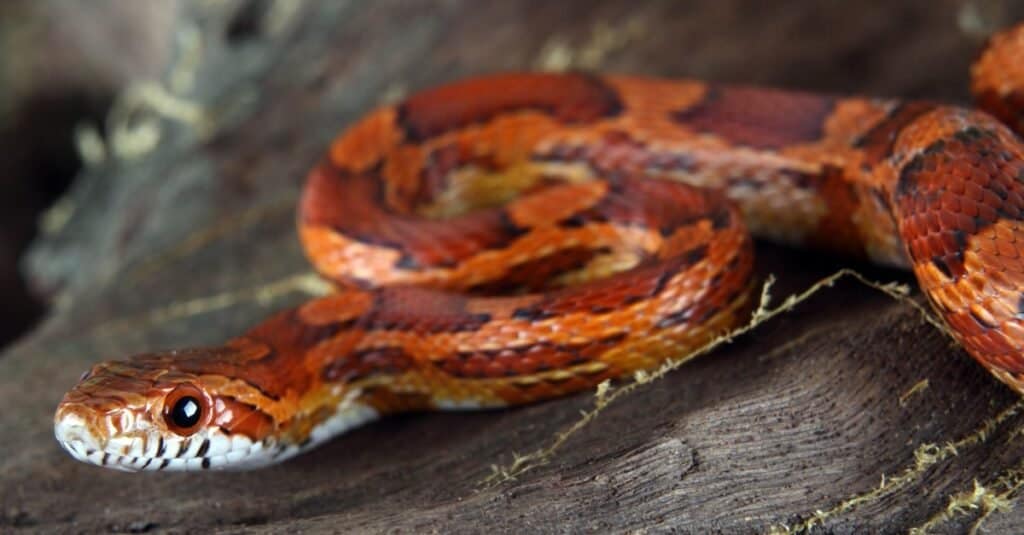
Snakes That Look Like Copperheads-Corn Snake

A beautiful corn snake in the garden. The name corn snake may have originated from the markings on this snake’s belly, which resemble maize, or Indian corn. They are often mistaken for copperhead snakes.

A. contortrix is native to the United States. It is found in southern Massachusetts, south to Georgia, west to Texas and northern Mexico, and as far north as Illinois and Ohio. Its wide geographic range means the snake to adapt to a variety of habitats such as open woods and edges of wetlands.

The copperhead also occurs in areas near rivers and rocky outcrops. Its innate adaptability allows it to live in neighborhoods and around homes, which causes unintended interactions.

When it’s time to brumate (reptile version of hibernation) the snake finds a safe place where it can hide for a couple of months until the weather warms. A hollow log, rock crevice, and the crawlspace under a home also work well!

Scientific Name
Snakes That Look Like Copperheads

Snakes That Look Like Copperheads

Agkistrodon contortrix can be interpreted as a “fishhook-toothed snake with twisted bands down its back.” Agkistrodon comes from the Greek ankistro, which means “hooked” and odon, which means “tooth.” Contortrix comes from the Latin contortus, which can mean “twisted,” “complex” or “intricate” and refers to the beautiful hourglass patches on the snake’s back that help in its identification.

Here are the currently accepted species and subspecies:

  • Broad-banded copperhead (Agkistrodon laticinctus) occurs north of San Antonio and into Kansas; its bands are wider across the back than other species.
  • Trans-Pecos copperhead (Agkistrodon laticinctus pictigaster) is found in western Texas and northern Mexico.
  • Southern copperhead (Agkistrodon contortrix contortrix) is found in eastern Texas and eastern Oklahoma and ranges north to Nebraska and east to Illinois, Ohio, Pennsylvania, New York, Connecticut, and Massachusetts.
  • Northern copperhead (Agkistrodon contortrix mokasen) is found in the southern states and as far north as Massachusetts. It’s also found in the Appalachian Mountains.
  • Osage copperhead (Agkistrodon contortrix phaeogaster), occurs in Missouri, Kansas, and Nebraska

The different copperheads are similar in looks and size but differ in location. Once you know what a copperhead looks like, it doesn’t matter which variety you see — you know it’s a copperhead.

The only southern state where copperheads are rare in Florida; there, you’ll only find a copperhead in the panhandle.

Population and Conservation Status 

A. contortrix is a common snake in its range, and its conservation status is least concern.

Appearance and Description 
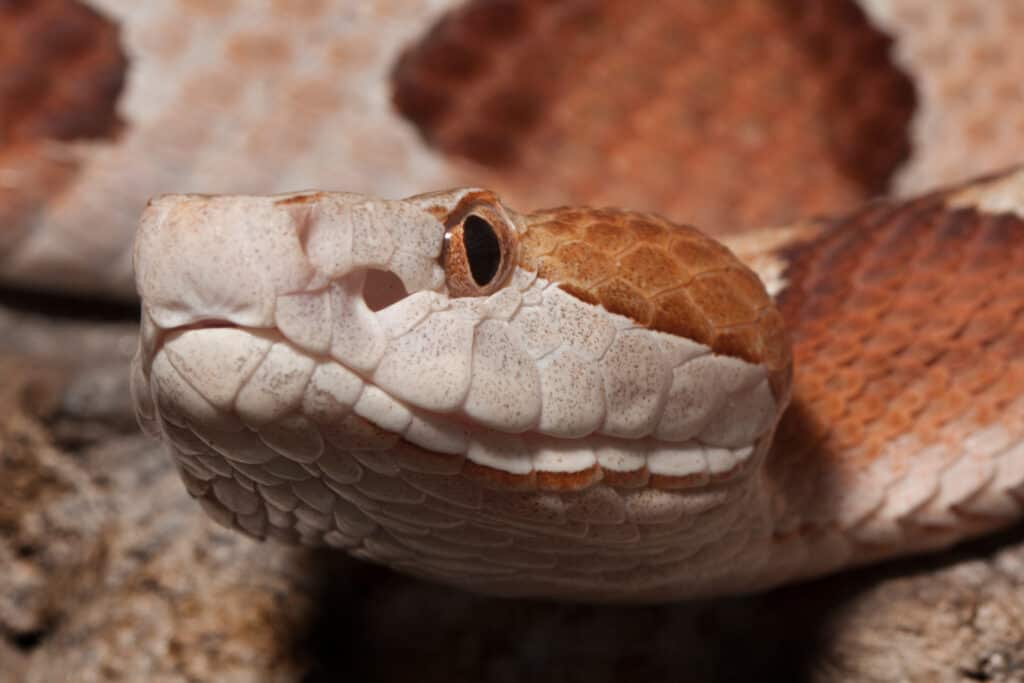
Venomous Copperhead Snake ( Agkistrodon contortrix)

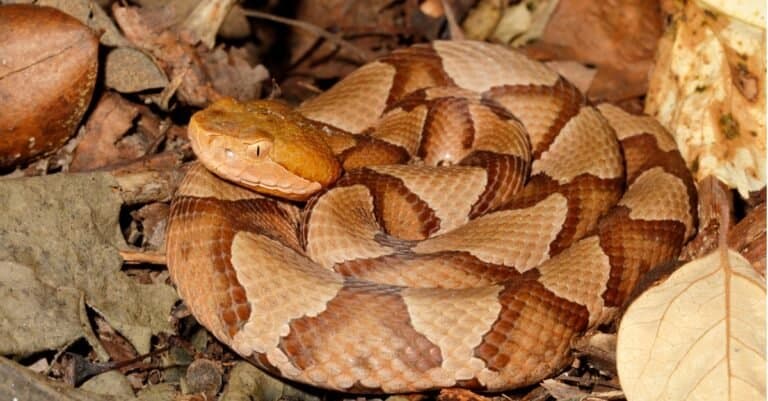
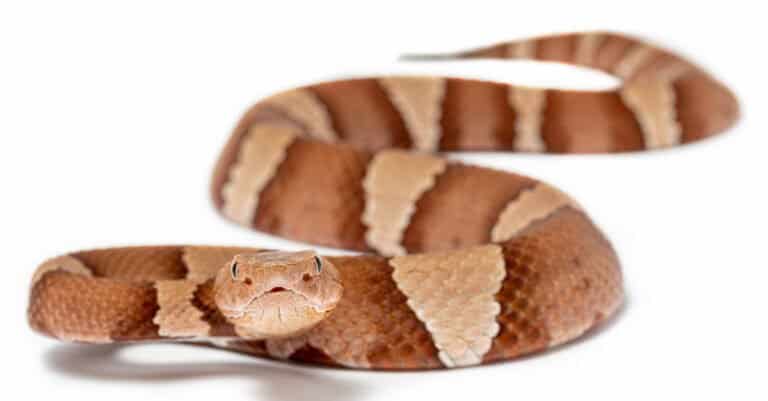
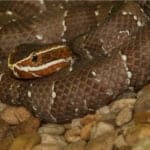
The color patterns on this snake make identification easy. Its ground color is pale brown to pinkish-brown, and it has darker, hourglass-shaped bands down its body. Though other snakes have similar colors, no other snake has a series of hourglass-shaped bands.

Its head, whose color gives the snake its common name, is broad and wedge-shaped, and its neck is slender; this is not a large snake, but it is thick-bodied. Its body ranges from 2 to usually less than 4 feet. The belly is pale and maybe mottled with gray, black, or brown.

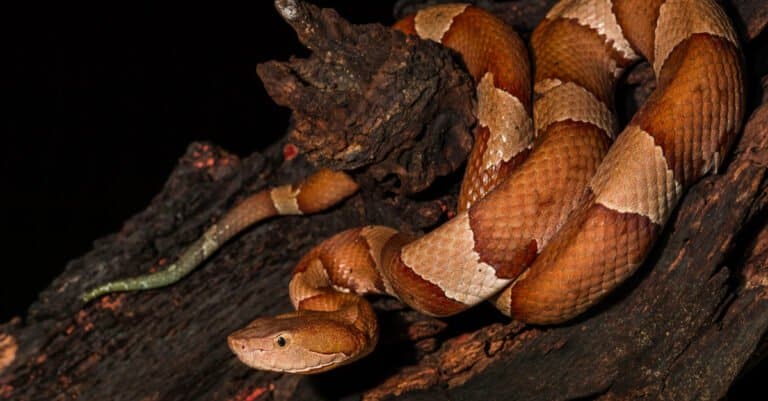
The reptile’s scales are keeled, and their eyes have vertical pupils that make them resemble cats’ eyes. The irises of the eyes can be rufous, tan, or orange. Young copperheads are grayer, but the tips of their tails are vivid yellow or greenish-yellow. This helps the little snake attract would-be prey who mistake its tail for a worm.

Pictures
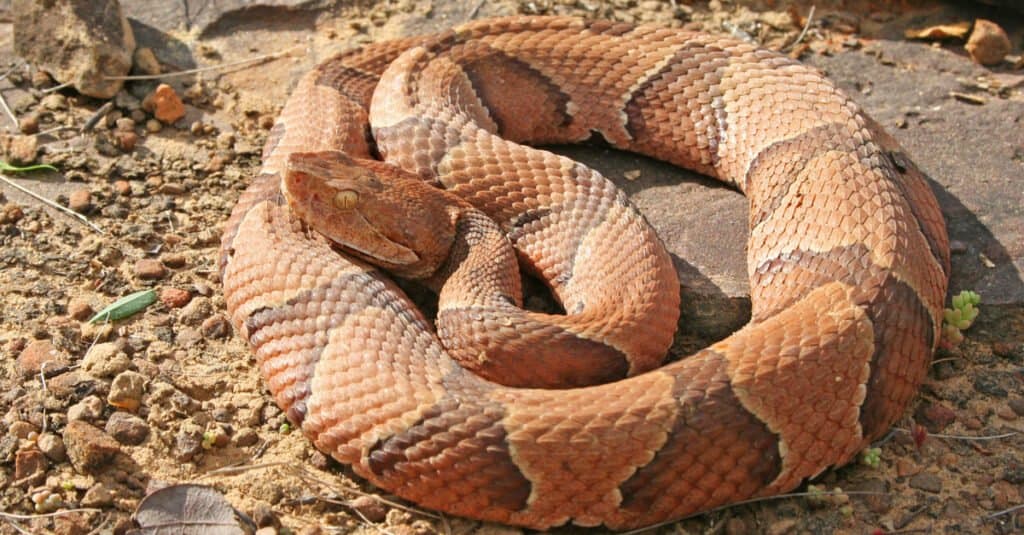
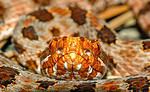
The Copperhead’s scales are keeled, and their eyes have vertical pupils that make them resemble cat’s eyes.

The Copperhead’s scales are keeled, and their eyes have vertical pupils that make them resemble a cat’s eyes.

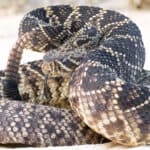
The body of the Copperhead ranges from 2 to usually less than 4 feet, but it is robust.

The body of the Copperhead ranges from 2 to usually less than 4 feet, but it is robust.

Venom: How Dangerous Are They?

Close-up of venomous Copperhead Snake. Its head, whose color gives the snake its common name, is broad and wedge-shaped.

Close-up of venomous Copperhead Snake. Its head, whose color gives the snake its common name, is broad and wedge-shaped.

Copperhead venom of both species is a hemotoxin, which means it destroys red blood cells. Yet copperheads are not the most dangerous of the pit vipers for at least two reasons. The first is they are not very aggressive, and the second reason is their venom is not very strong. Scientists believe it would take about 100 milligrams of venom to kill a person and few people have died after being bitten by A. contortrix.

A. contortrix is also known for delivering dry bites as a warning. These bites have little or no venom. If venom is injected, the symptoms are excruciating pain, terrible nausea, swelling of the area, and tingling. Muscle and bone can be destroyed if the snake bit the person on their hand or foot.

Behavior and Humans

Copperheads are generally not aggressive and can be described as shy.

These snakes are not aggressive and can be described as shy. During the spring and fall, they are active in the daytime, but when the weather gets hot, they become nocturnal. If there are warm days in the winter, they might leave their hibernacula to bask in the sun. They can do this on the ground or on a fallen long but have been known to climb as high as 16 feet into a tree to catch the warmth of the sun.

Copperheads freeze in place when they sense would-be predators approaching. Their incredible camouflage makes them nearly impossible to see. They’ll also vibrate their tail if the predator is getting too close. Some believe that noise is meant to resemble the rattling of a rattlesnake, but many snakes exhibit the same behavior — even snakes in Africa that will never see a rattlesnake.

These snakes usually lie in wait for prey to come within striking distance. They bite and envenomate their prey quickly. If it’s small, they’ll simply hold it in their mouth, but if it’s large, they’ll bite and release it, then follow it until it’s subdued.

Copperhead Reproduction and Babies

The breeding seasons for A. contortrix are February to May and then from August to October. Males look for mates by using their forked tongues to pick up the molecules of pheromones. Their tongues are longer than those of females and can be an aid in the identification of the sexes.

Males sometimes fight over females. After he’s conquered his rival, he has to court the female, who may not even be interested, and try to fight him herself. If she is interested, she’ll raise her tail. Females can mate with many males, and babies in one litter can have different fathers. The female may not become gravid right away but can store sperm until after hibernation. The older and larger in size she is, the larger her babies and litter.

Depending on a variety of genetic and environmental factors, this includes species and the presence of natural predators, snake litter sizes can range from 1 to 150.

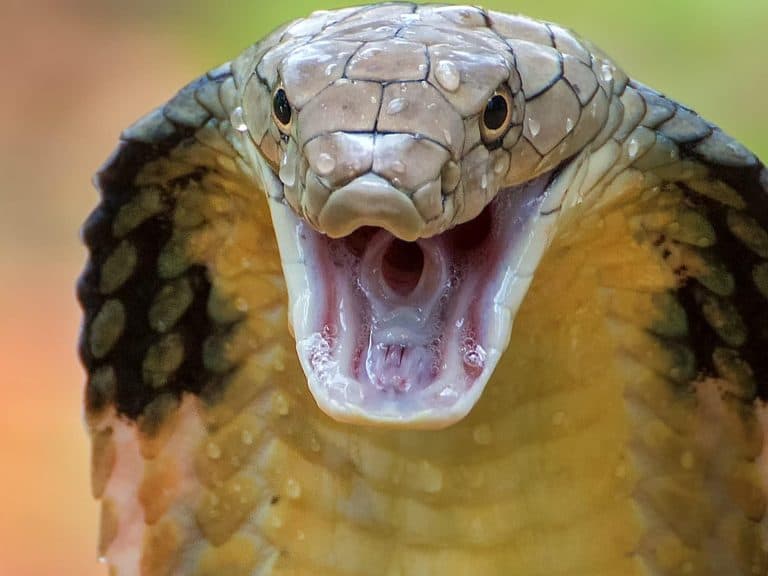
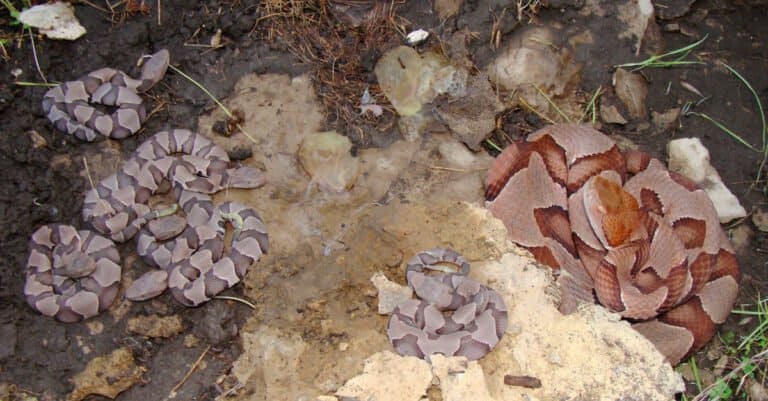
A. contortrix females breed every one to three years and can have as many as 21 babies at a time, though the average is about six. Gestation is 83 to 150 days. These snakes do not make nests. Indeed, the only snake in the world that makes a proper nest is the king cobra. Instead of a nest, the copperhead gives birth in a location called a parturition site or a rookery.

After the mother snake gives birth, the babies stay with her for a few days and then go off on their own. They are ready to breed themselves when they’re about 3.5 years old. Copperheads have a long lifespan and can live as long as 29 years.

Though it’s true that a copperhead is responsible for most snakebites in America, their bites are rarely fatal and are often dry. The snake is also helpful because it has vermin as part of its diet.

Similar Animals

View all 392 animals that start with C

Sources

  1. Snakes For Pets / Accessed February 11, 2022
  2. Wikipedia / Accessed February 11, 2022
  3. ITIS / Accessed February 11, 2022
  4. National Geographic / Accessed February 11, 2022
  5. IUCN Red List / Accessed February 11, 2022
  6. Live Science / Accessed February 11, 2022
  7. Smithsonian's National Zoo & Conservation Biology Institute / Accessed February 11, 2022
  8. Medium / Accessed February 11, 2022
Rebecca Bales

About the Author

Rebecca Bales

Rebecca is an experienced Professional Freelancer with nearly a decade of expertise in writing SEO Content, Digital Illustrations, and Graphic Design. When not engrossed in her creative endeavors, Rebecca dedicates her time to cycling and filming her nature adventures. When not focused on her passion for creating and crafting optimized materials, she harbors a deep fascination and love for cats, jumping spiders, and pet rats.
Connect:

Thank you for reading! Have some feedback for us?


Copperhead FAQs (Frequently Asked Questions)

They are venomous.