From the Great Smoky Mountains in East Tennessee and Rock City in Middle Tennessee to Reelfoot Lake in West Tennessee, there are plenty of places for folks to experience the great outdoors. Being outside brings people into contact with all sorts of animals in Tennessee, spiders included. While most of the spiders in Tennessee are small, there are a few that are rather large and deserve a bit of recognition. Continue reading to learn about the five biggest spiders in Tennessee.
5. Southern House Spider
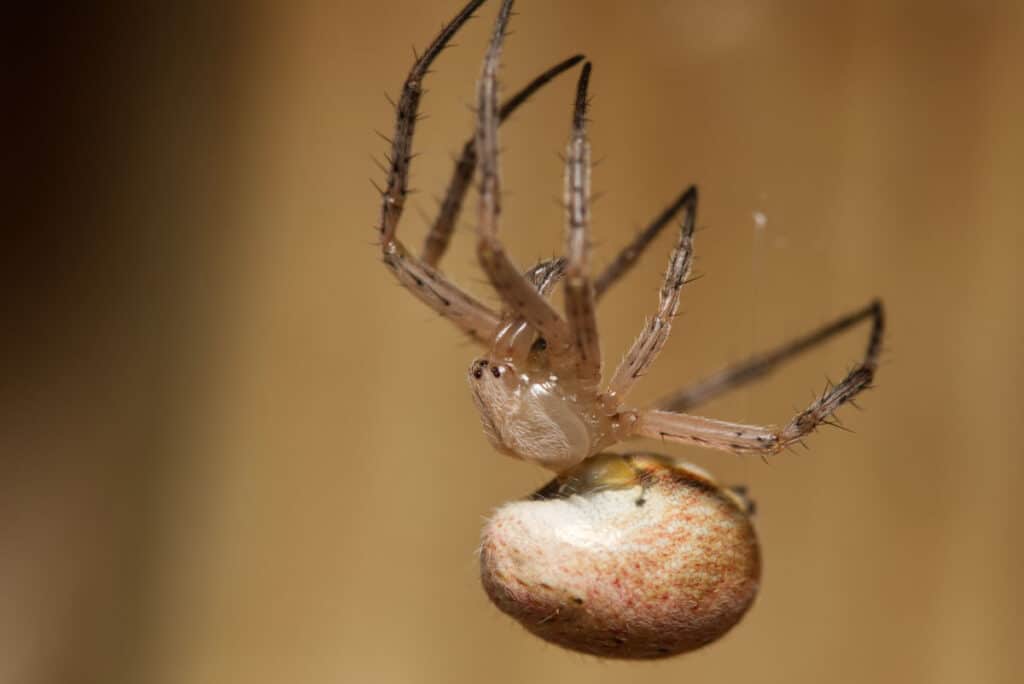
Southern house spiders often get mistaken for brown recluses.
©Kala Stuwe/Shutterstock.com
| Scientific Name | Size | Danger to Humans |
|---|---|---|
| Kukulcania hibernalis | 0.75-2 inches | Their bites can cause minor pain that diminishes over a day or two in most cases. |
The Southern house spider is often met with hostility by humans, as it tends to find its way into homes and bears a passing resemblance to the brown recluse spider.
Although Southern house spider bites can cause minor pain, it usually subsides quickly, lingering for a day or two at most.
Southern house spiders are brown and can be confused with brown recluses due to their similar coloration and body shape, but they do not have the distinctive violin-shaped mark found on brown recluses. These spiders often hide in cracks and crevices in buildings where they build webs to trap and kill their prey.
4. Long-bodied Cellar Spider
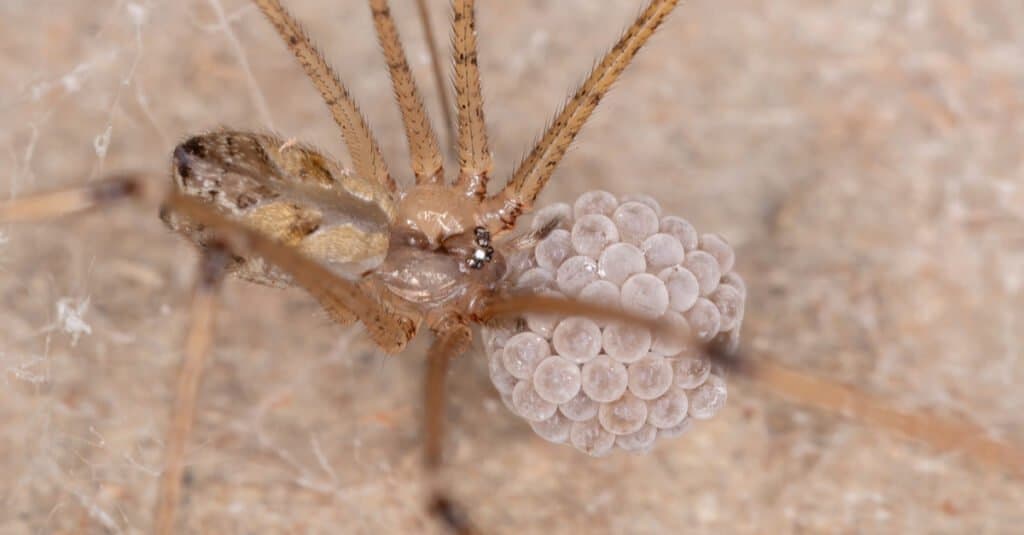
Cellar spiders have semi-translucent bodies.
©iStock.com/ViniSouza128
| Scientific Name | Size | Danger to Humans |
|---|---|---|
| Pholcus phalangioides | 1-2 inches | A bite may cause a mild, short-lived burning sensation. |
The long-bodied cellar spider has a peanut-shaped body and is usually a brownish-gray or light brown color, with a semi-translucent body. Combined with their long legs and the habit of vibrating their webs when threatened, this makes them appear rather unsettling.
Although they may look strange, the long-bodied cellar spider isn’t going to harm you. Their bites cause some mild pain and a burning sensation at most. There’s a common misconception that long-bodied cellar spiders are dangerous due to their long legs and the fact that they can subdue other spiders, but their venom is not harmful to humans.
Long-bodied cellar spiders dwell in basements, attics, and garages, out of the way of human foot traffic, where they can hunt in peace.
3. American Nursery Web Spider
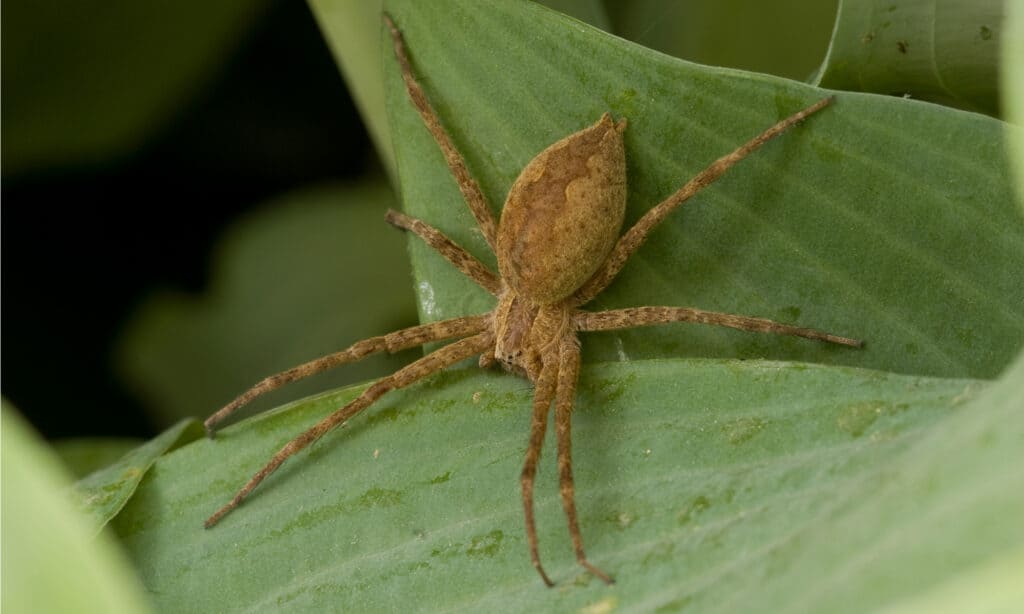
Nursery web spiders ambush and hunt their prey.
©SDeming/Shutterstock.com
| Scientific Name | Size | Danger to Humans |
|---|---|---|
| Pisaurina mira | 1-3 inches | Delivers a bite that is mostly harmless to humans, with pain and swelling common. |
The female American nursery web spider is known for the care she gives her hatchlings, building them a nursery web and watching over them as they grow.
These spiders are often found in vegetation near homes, such as trees, bushes, and tall grass. Unlike web-building spiders, they actively hunt and attack their prey instead of relying on webs to catch them.
American nursery web spiders are brown or reddish-brown, with a darker brown pattern running down their backs, usually bordered by light colors.
While female nursery web spiders can be cannibalistic and occasionally eat their mates, this is not common. Males often use strategies to reduce the risk, such as wrapping the female in silk or presenting a nuptial gift. The likelihood of cannibalism depends on factors like the female’s hunger and whether the male offers a suitable gift.
They do not bite humans often and don’t pose much of a threat if they do. Most people experience swelling and mild pain if they are bitten by this species, but that’s about it.
2. Carolina Wolf Spider
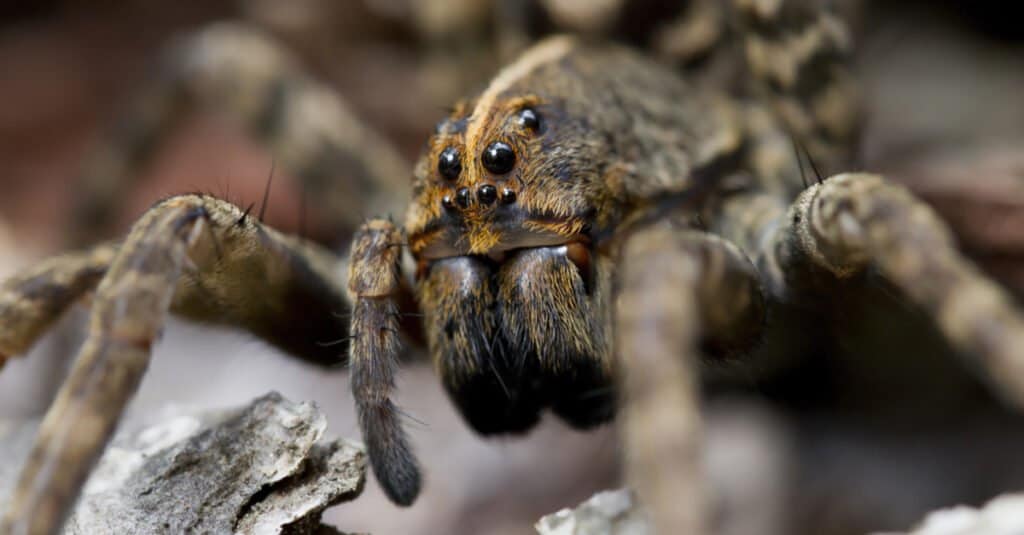
Carolina wolf spiders are large arachnids that deliver a painful bite.
©Will E. Davis/Shutterstock.com
| Scientific Name | Size | Danger to Humans |
|---|---|---|
| Hogna carolinensis | 2-4 inches | The bite from this spider causes local pain and swelling. |
The Carolina wolf spider is one of the biggest spiders in Tennessee, and it’s also the biggest type of wolf spider in the U.S. This monstrous spider’s legspan can measure up to 4 inches with a body that measures about an inch and a half.
These spiders are dark brown or black with mottled patterns on their abdomens. Their cephalothorax is often dark, with a light stripe running down the center starting behind the eyes and a lighter edge. Male Carolina wolf spiders may have orange on their abdomen, but that is not always the case.
Female Carolina wolf spiders carry their hatchlings on their backs, making them appear even larger and causing some people to mistake them for tarantulas. However, their bite is not considered dangerous. They are reluctant to bite, and a bite will cause moderate local pain and swelling. Be aware that people with allergies to spider venom can experience nausea, headaches, and other more severe symptoms that require medical aid.
1. Dark Fishing Spider
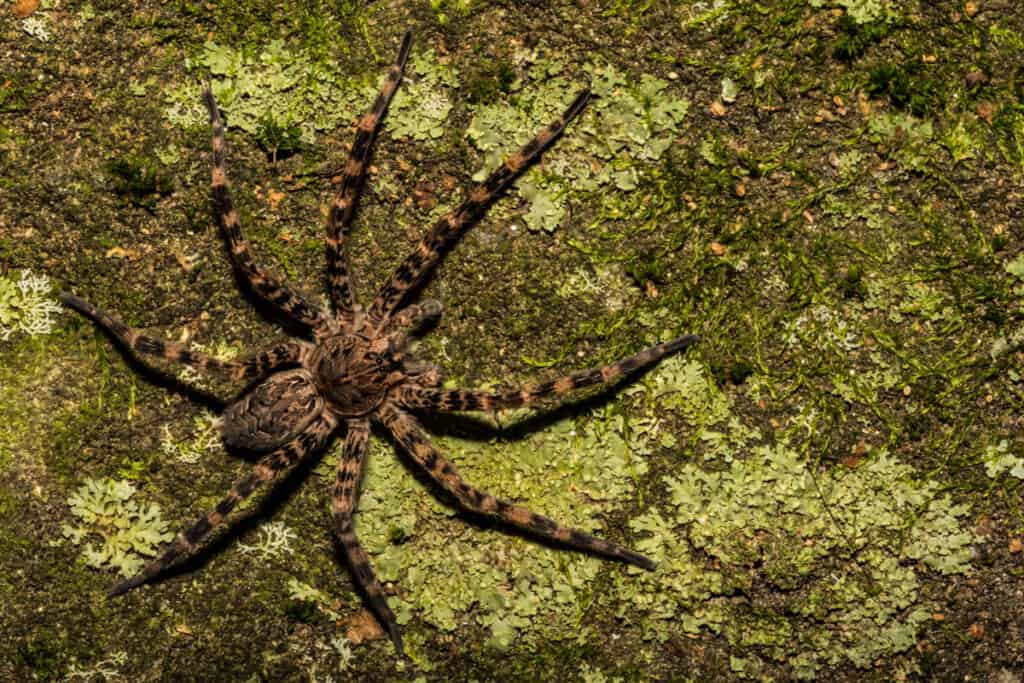
The dark fishing spider is unusual in that it is often found on trees.
©iStock.com/JasonOndreicka
| Scientific Name | Size | Danger to Humans |
|---|---|---|
| Dolomedes tenebrosus | 3.5-4.5 inches | Their bite will inflict pain and swelling similar to that of a bee sting. |
The dark fishing spider is the biggest spider in Tennessee, edging out the wolf spider by half an inch. Despite its name, this spider isn’t always found near water. The dark fishing spider is often found in wooded areas.
Dark fishing spiders have a mottled brown and black body with W-shaped dark patterns bordered by white on their dorsal abdomen. Their legs have black chevrons on the femurs, which transition into black and brown banding on the tibias.
The dark fishing spider possesses several adaptations that allow it to thrive near and on water. These include the ability to walk on the water’s surface, submerge themselves for extended periods, and capture prey both on and in the water.
Although these spiders are large, they rarely interact with humans and will flee at the sight of one. However, if you handle this spider, it may defensively react by delivering a bite that is about as painful as a bee sting.