
Quick Take
- One red and black spider on this list is so popular that people actively seek it out as a pet, and it might not be the one you'd expect. Meet the popular pet spider →
- Some of these spiders wear their red-and-black colors as a bluff, mimicking something far more dangerous than themselves. See the harmless mimic →
- One spider on this list hides in a silk tunnel and almost never comes out, with fangs that work in a direction few other spider's do. Discover the tunnel-dweller →
- Juvenile and adult versions of one species look so different that you'd never guess they belong to the same spider. See the dramatic color change →
There are many different types of spiders with red and black markings. The most infamous is the black widow, with its shiny black body and notable red hourglass marking. However, not all red and black spiders are dangerous. many are completely harmless and even beneficial. Let’s look at some of the most common red and black spiders in North America.
1. Southern Black Widow (Latrodectus mactans)
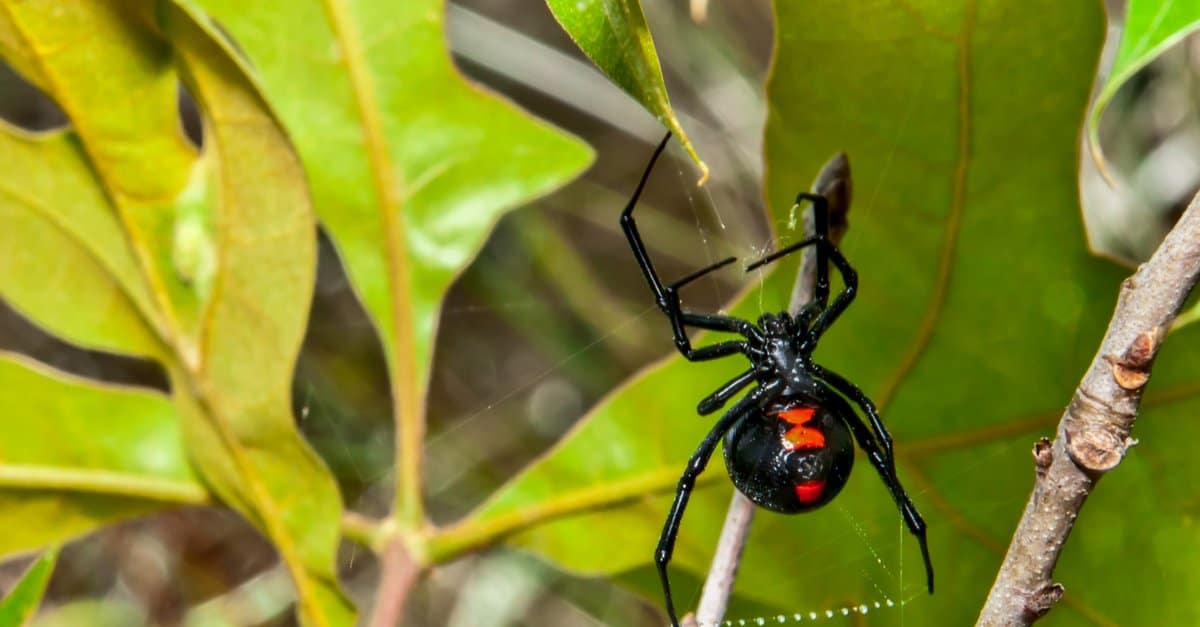
The female southern black widow spider can reach up to 0.50 inches long with a leg span of 1.5-2.0 inches. Males are about half this size. Female spiders have a shiny black body with a solid red hourglass shape on the underside of the abdomen. The top of the abdomen is generally a solid black color, but some spiders may have faint red spots and white or yellow markings. Only the female is capable of delivering a dangerous bite; however, these spiders are not aggressive and prefer to escape. They are often found around human structures across the Southeast, west into Texas, Oklahoma, and Kansas, and north along the East Coast as far as New York.
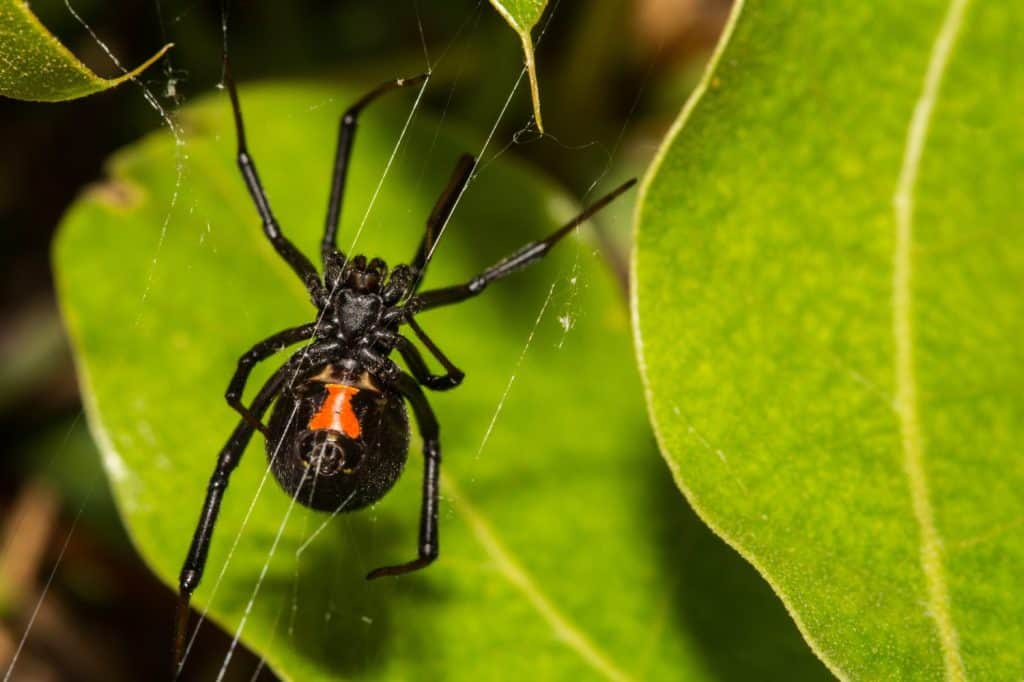
Female southern black widows have a connected red hourglass on their abdomens.
©Jay Ondreicka/Shutterstock.com
2. Northern Black Widow (Latrodectus variolus)
The northern black widow spider looks slightly different from its southern counterpart. Its identifiable features are a broken hourglass, which appear as two separate red spots or triangles on the underside of the abdomen, along with a row of red spots running down the middle of the back. Some northern black widows also have white stripes on the sides of their abdomens. Northern black widows are believed to be slightly smaller than southern black widows. The females are venomous, just like other black widows. Northern black widows tend to prefer forested habitats. Their range overlaps with the southern black widow across the East and Southeast U.S. However, the northern black widow can be found as far north as New England, and into southeastern Canada.
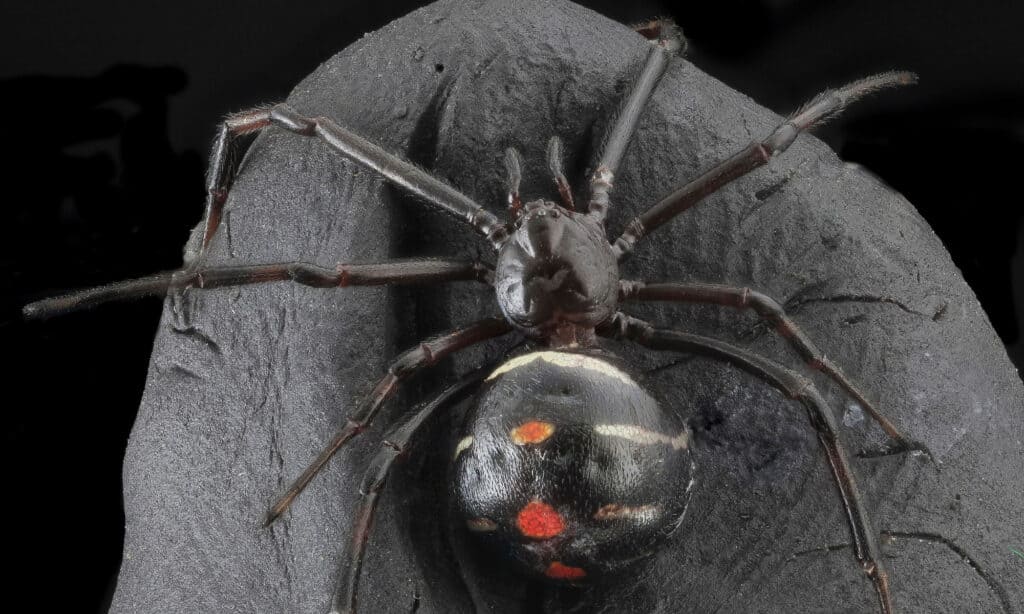
Northern black widows have a broken hourglass-shaped marking on their abdomens.
©Porco_Rosso/Shutterstock.com
3. Red Widow (Latrodectus bishopi)
Only the adult female red widows are red and black, while the males are much less eye-catching. Like their better-known cousins, red widows feature reddish dots on a black abdomen, though the hourglass shape is not as well defined. They have a reddish-orange body and long, pointed reddish-orange legs. They measure about 0.5 inches long, with a leg span of 1.5 inches or more. Red widows are venomous, but as they primarily live in the Central and South Florida sand pine scrub, they rarely encounter humans.
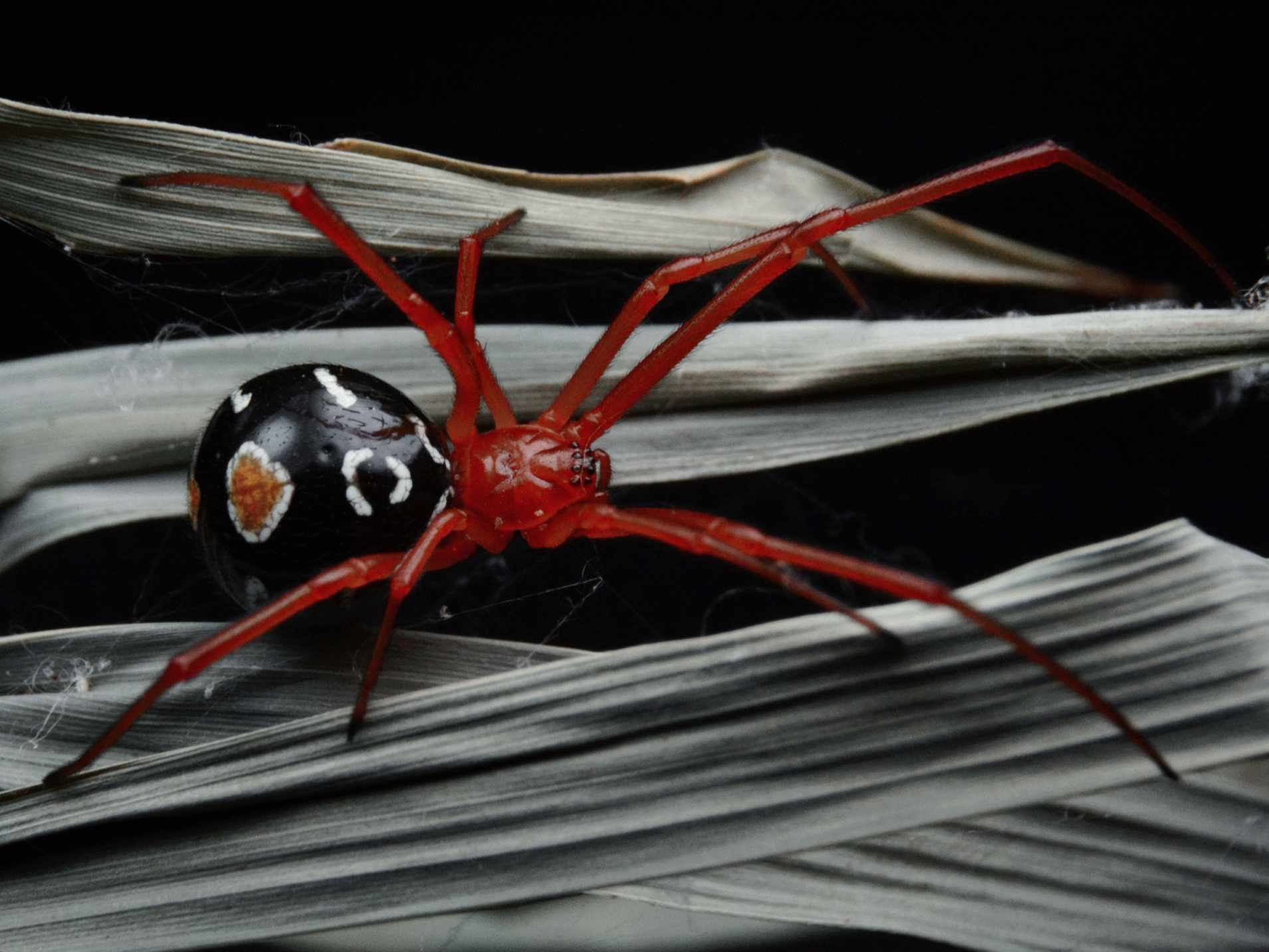
Red widow spiders have reddish-orange legs and bodies, with the exception of their black abdomen.
4. Emerton’s Bitubercled Cobweaver (Theridula emertoni)
Emerton’s bitubercled cobweaver is a tangle web spider. Both males and females measure roughly 0.20 inches in body length. Because they have an abdomen several times larger than their heads, they look more like bugs than spiders. Their abdomens are mostly a reddish-brown color with black markings on both the top left and top right sides. They also have a large cream-colored mark on the posterior of the abdomen. The legs are pale yellow, and the head is dark. Little is known about these spiders, but they favor forested habitats, and can be found in both the northeastern U.S. and Canada.
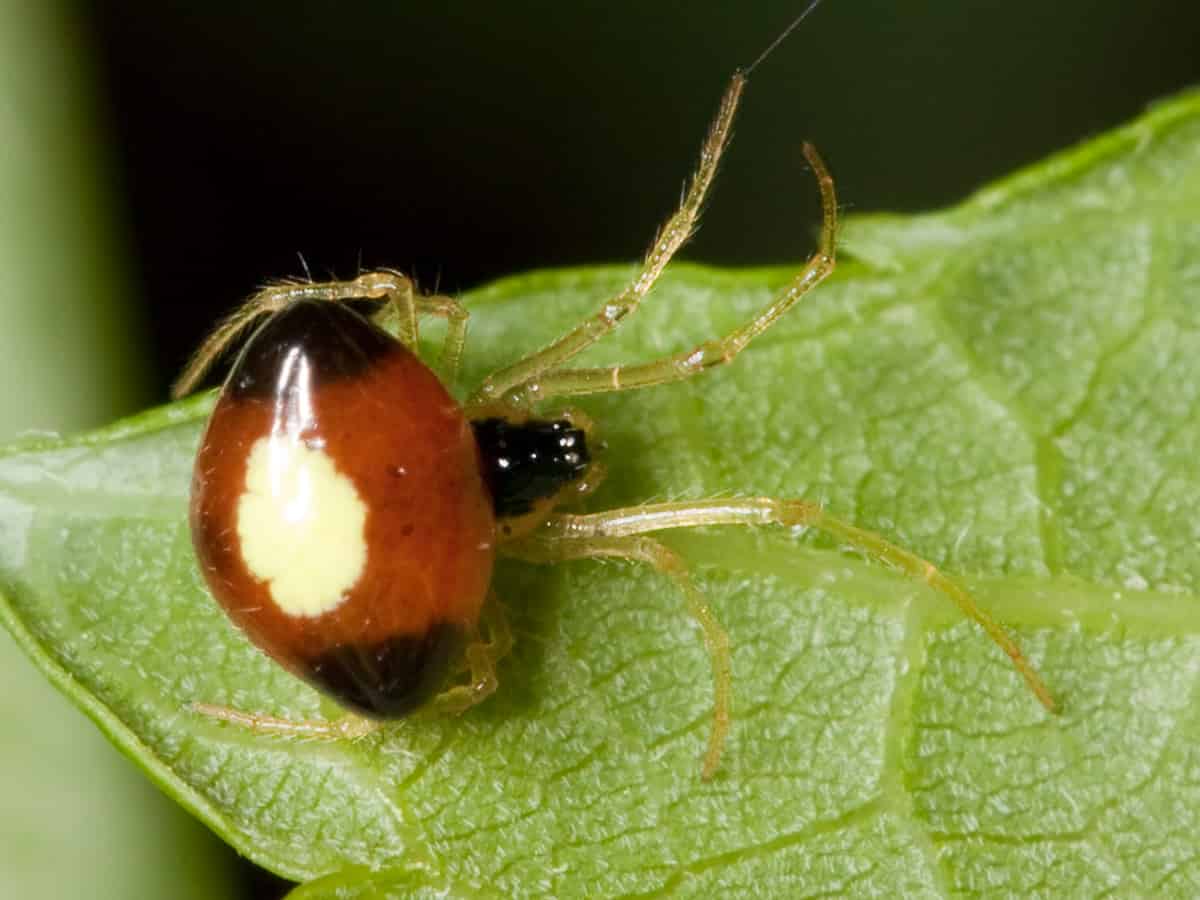
Emerton’s bitubercled cobweavers have an abdomen several times larger than their heads.
5. Red-Backed Jumping Spider (Phidippus johnsoni)
The red-backed jumping spider has a black cephalothorax and a bright red abdomen, with females displaying a black stripe down their middle. Tiny white and black hairs cover their legs. This species is one of the larger jumping spiders. They measure around 0.35 to 0.56 inches long, with males being smaller than females. Although their erratic jumping can be startling, they are completely harmless. Many people even keep them as pets due to their flashy coloration. These spiders can be found in dry habitats like coastal dunes and sage scrub in western North America, ranging from southwestern Canada down to northwestern Mexico.
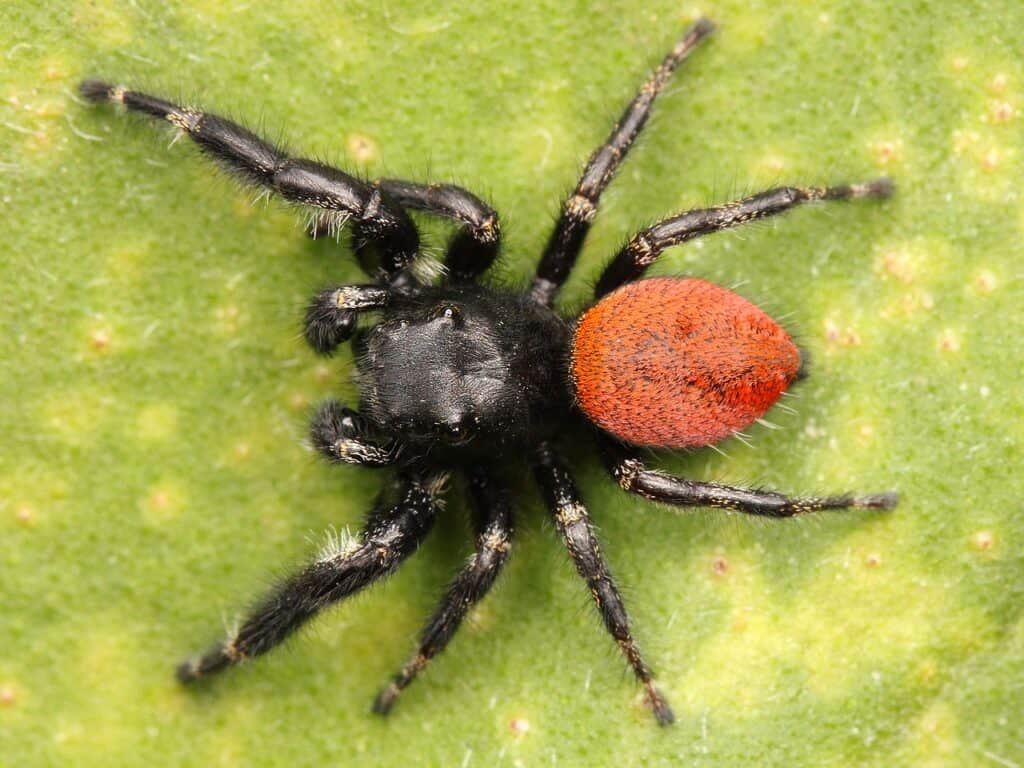
The red-backed jumping spider has a black cephalothorax and a bright red abdomen.
6. Apache Jumping Spider (Phidippus apacheanus)
The Apache jumping spider has a similar appearance to the red-backed jumping spider. However, their body is fuzzier and almost entirely red or orange on top, although females have a black stripe on the abdomen. These spiders also have fuzzy black legs. Adults generally reach up to 0.51 inches in length. Apache jumping spiders generally prefer dry fields, grasslands, and desert habitats in the southwestern U.S., Mexico, and Cuba.
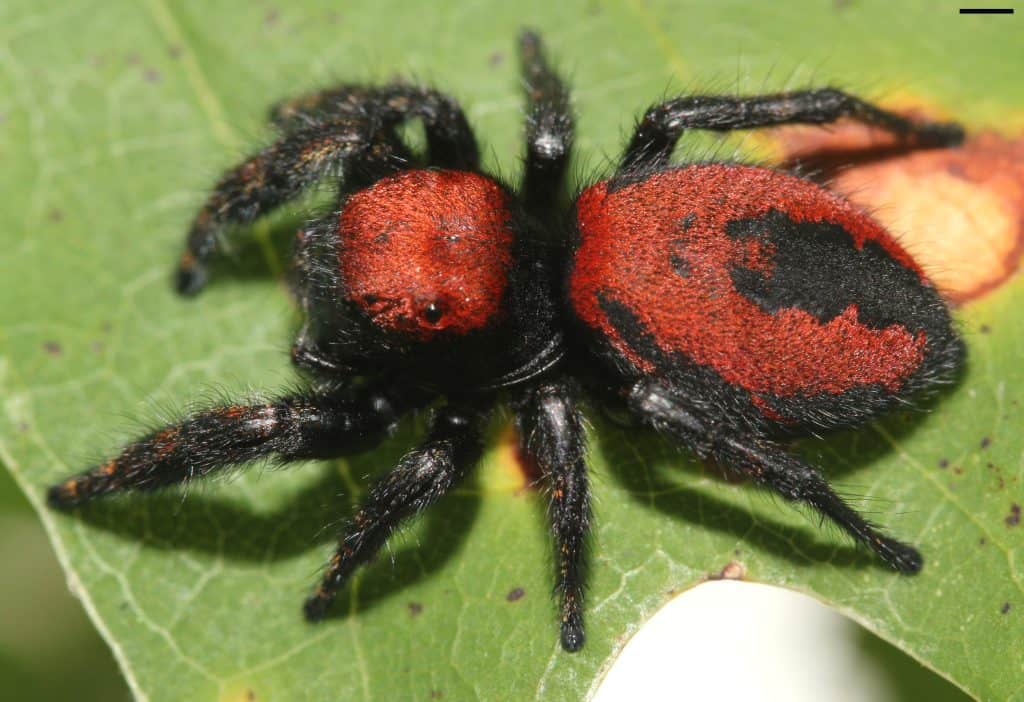
The red and black colors of the Apache jumping spider are believed to mimic wingless, stinging velvet ants.
7. Cardinal Jumper (Phidippus cardinalis)
The cardinal jumper is a vibrant red jumping spider with black legs, measuring around 0.39 inches long. Like the Apache jumping spider, their black and red pattern is sometimes mistaken for wingless wasps. However, they do not sting and are completely harmless to people. These spiders favor low vegetation in field and grassland habitats. They are found in the southern and eastern U.S. as far west as Colorado and New Mexico. They can also be found in Mexico.
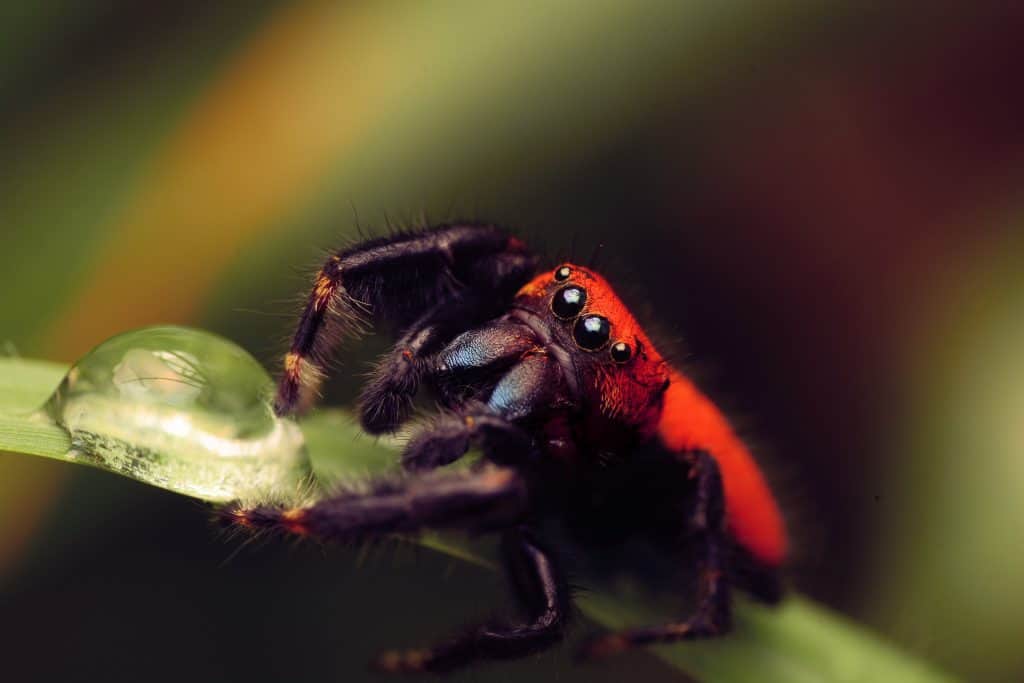
The cardinal jumper is found in the U.S. and Mexico.
8. Whitman’s Jumping Spider (Phidippus whitmani)
Whitman’s jumping spider has a bright red back and head, although its legs and underside are black. They have tiny white spines covering their legs, giving them a grey appearance. These spiders only measure up to 0.39 inches long. They can often be found in the leaf litter on forest floors from Newfoundland, Canada down to Florida and west to Texas.
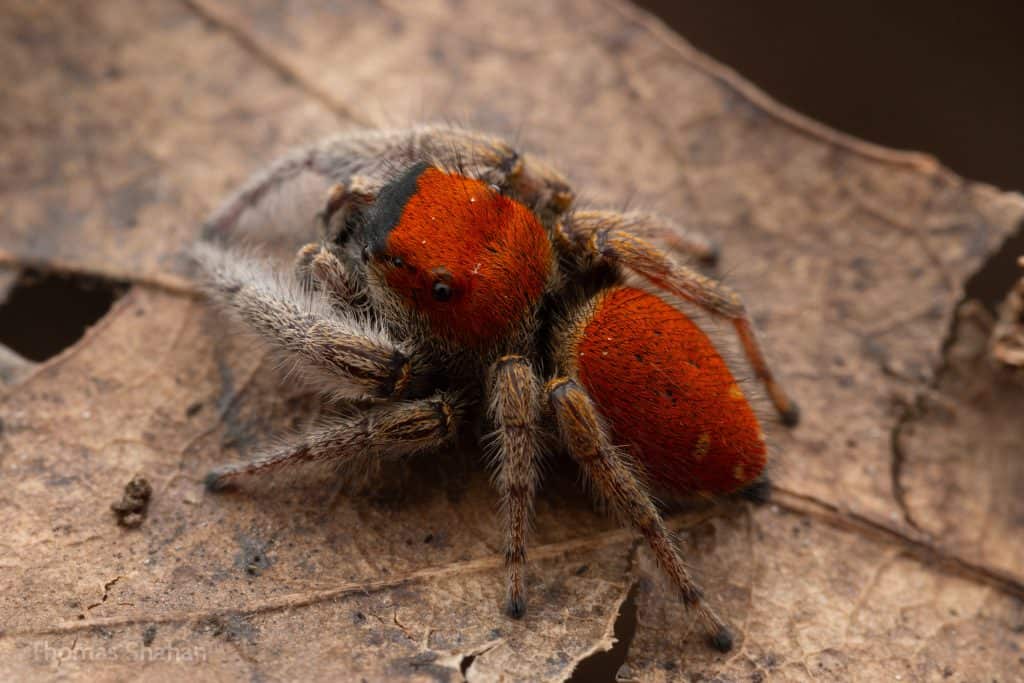
Whitman’s jumping spider has a wide range from Newfoundland down to Florida and west to Texas.
9. Bold Jumping Spider (Phidippus audax)
The bold jumping spider is mostly black with white spots and shiny, metallic green or blue chelicerae. However, juvenile bold jumping spiders have three vivid orange or red spots on their black abdomens that fade to white as they mature. Adults can measure up to 0.43 inches long. These spiders favor open areas such as grasslands, prairies, open fields, and gardens. They range from southeastern Canada west to British Columbia, through the eastern and central U.S. to Florida, west to the Gulf Coast, and south to northern Mexico.
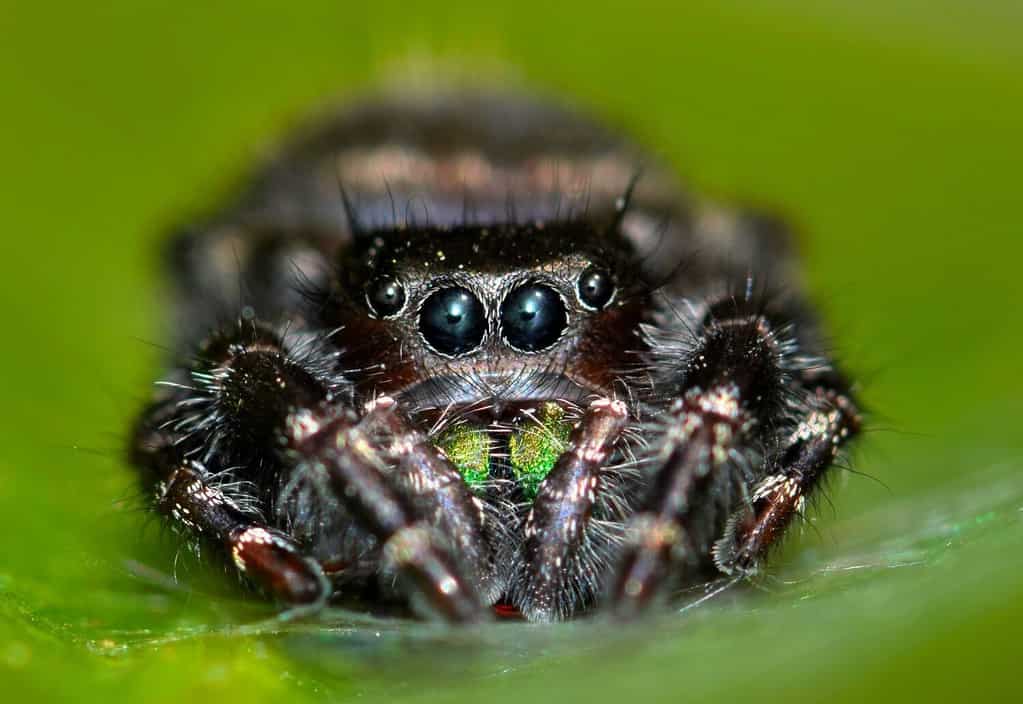
Juvenile bold jumpers have orange or red spots on their abdomens that fade to white as they age.
©Brett Hondow/Shutterstock.com
10. Spiny-Backed Orb Weaver (Gasteracantha cancriformis)
The spiny-backed orb weaver is known for its unusual appearance. This spider has a broad, white crab-like shell with black markings and six pointy, red spines. Their legs are black with red bands towards the bottom. Female spiders measure up to 0.35 inches wide and 0.51 inches long, while males only reach around 0.078-0.12 inches. They prefer woodland, shrubland, and garden habitats. In North America, they can be found in the southern U.S. and Mexico.
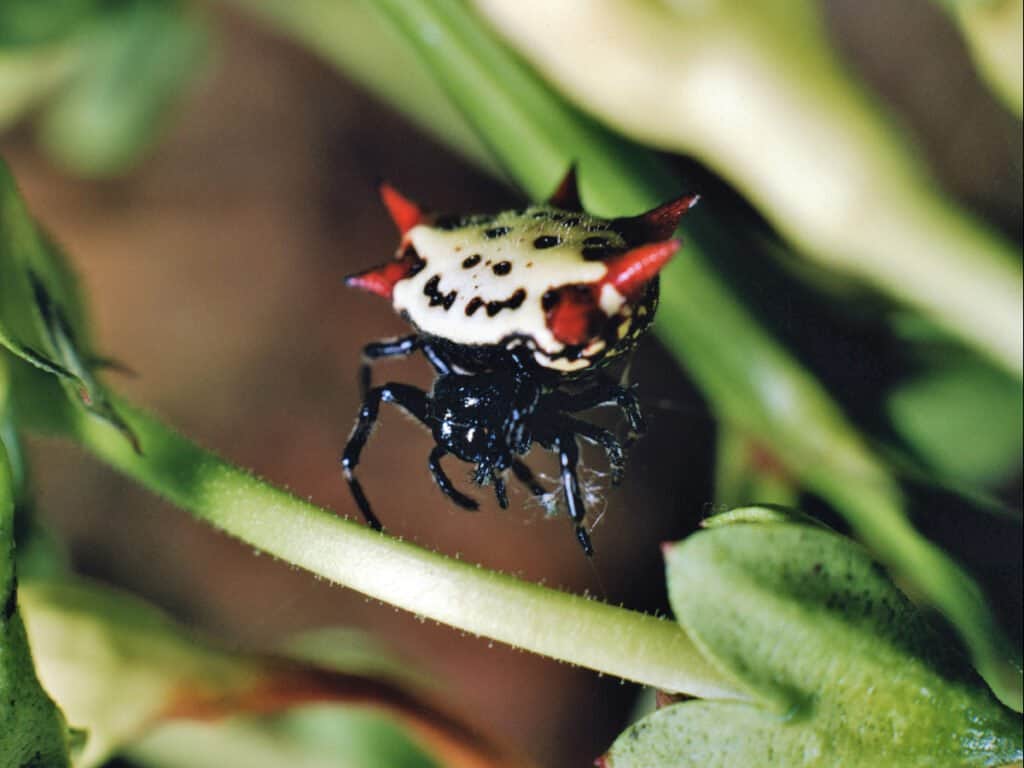
Crab spiders have a broad, white abdomen with red spines and black dots.
©iStock.com/Weber
11. Blacktailed Red Sheetweaver (Florinda coccinea)
This species of dwarf spider has tiny black legs and a reddish-brown body. They also have a black “tail” on their abdomens that sets them apart from other spiders. They are extremely small at only 0.16 inches, so a magnifying glass is needed to properly identify these spiders. The blacktailed red sheetweaver is most commonly found in the grasslands of the southeastern United States and Mexico.
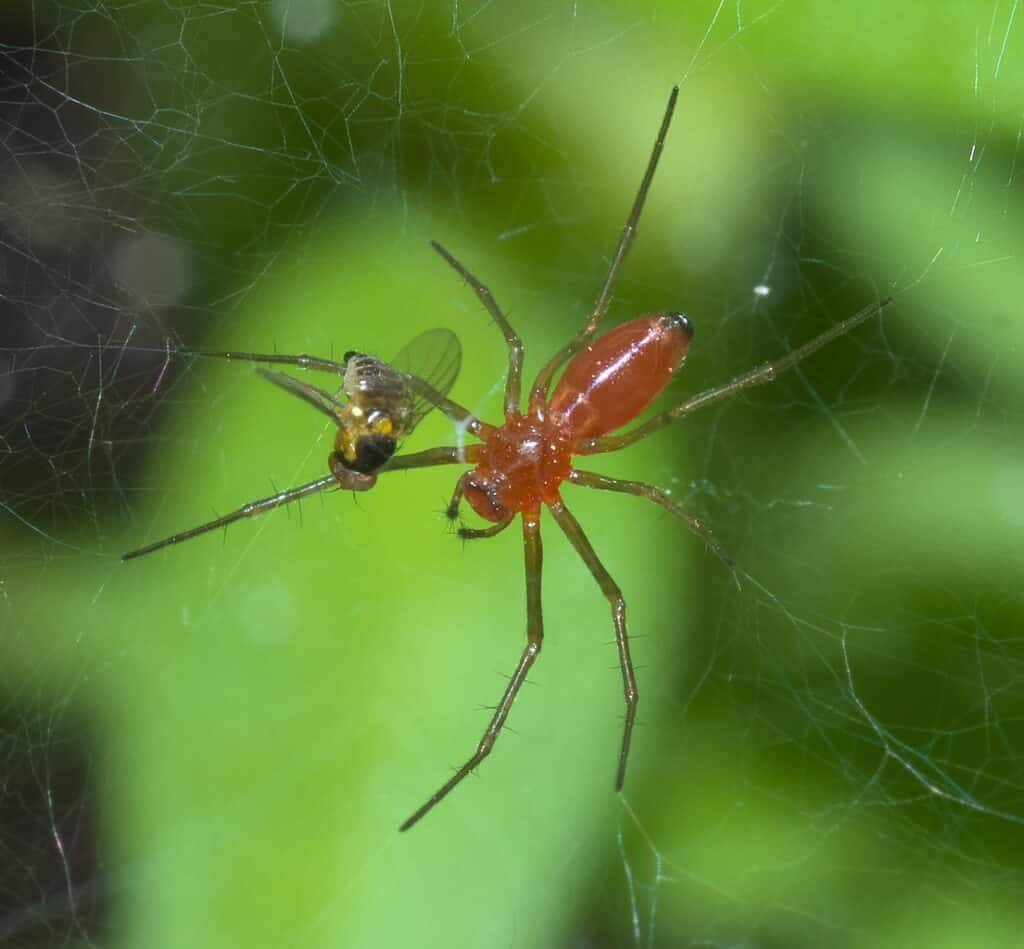
The blacktailed red sheetweaver has a red body with a black “tail.”
©Robert Webster / xpda.com / CC-BY-SA-4.0 – Original / License
12. Red-Legged Purseweb Spider (Sphodros rufipes)
Female red-legged pursewebs are large spiders at nearly an inch long, but males are much smaller at only about 0.59 inches. These spiders create tunnel-like webs that trap their insect prey. Spotting one is unlikely because they rarely venture out of these webbed enclosures. Red-legged purseweb spiders have reddish-orange translucent legs, but the rest of their body is black. These spiders also have exceptionally long fangs relative to their body size. Their fangs point downward so they can stab prey vertically rather than pinch like other spiders. Red-legged purseweb spiders are mainly found in temperate forests and undisturbed woodland areas with good leaf litter. They are prevalent across the southeastern and southern U.S., but have also been observed in the Midwest and some northeastern states.
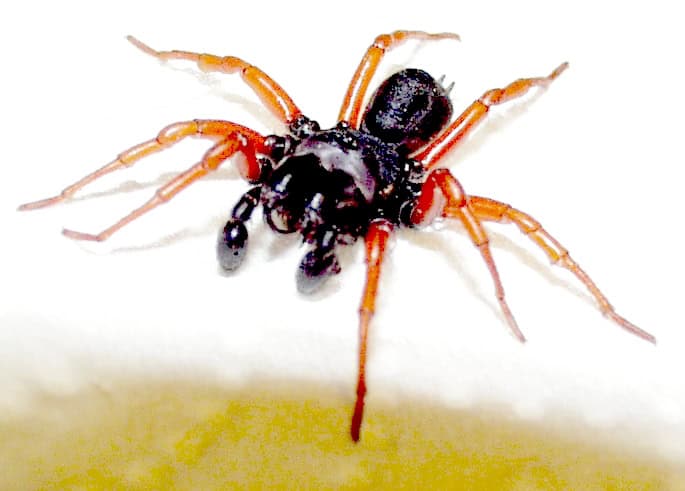
Red-legged purseweb spiders are mygalomorph spiders found in the southeastern and southern U.S.