
Quick Take
- The black widow you picture in your head probably looks nothing like the one actually lurking in Louisiana, and that mistaken image could cause you to walk right past it.
- One of these spiders has more toxic venom than a black widow, yet its bite is far less dangerous. The reason why changes how you should think about spider risk entirely.
- The spider most likely to be hiding in your patio furniture right now is not the one Louisianans traditionally worry about, and it arrived from another continent.
- One dangerous Louisiana spider can be identified by a feature no other spider has. Once you know it, you'll never misidentify it again.
If you’re in Louisiana and you’re getting ready to clean out the garage, repair the shed, or otherwise “invade” potential spider territory, you might want to know which are the most dangerous spiders in the state. Luckily, they’re all fairly easy to identify and not terribly aggressive or common. However, these arachnids can make you sick if they bite you. Learning how to identify them and knowing where they build their webs can help you avoid them.
Northern Black Widow (Latrodectus variolus)
For many, the name “black widow” induces fear and worry. With the toxic venom in their bite, it’s no wonder people are cautious. Take an in-depth look at how to identify the northern black widow, their habitats, and the symptoms of their bite.
Northern Black Widow Spider Identification
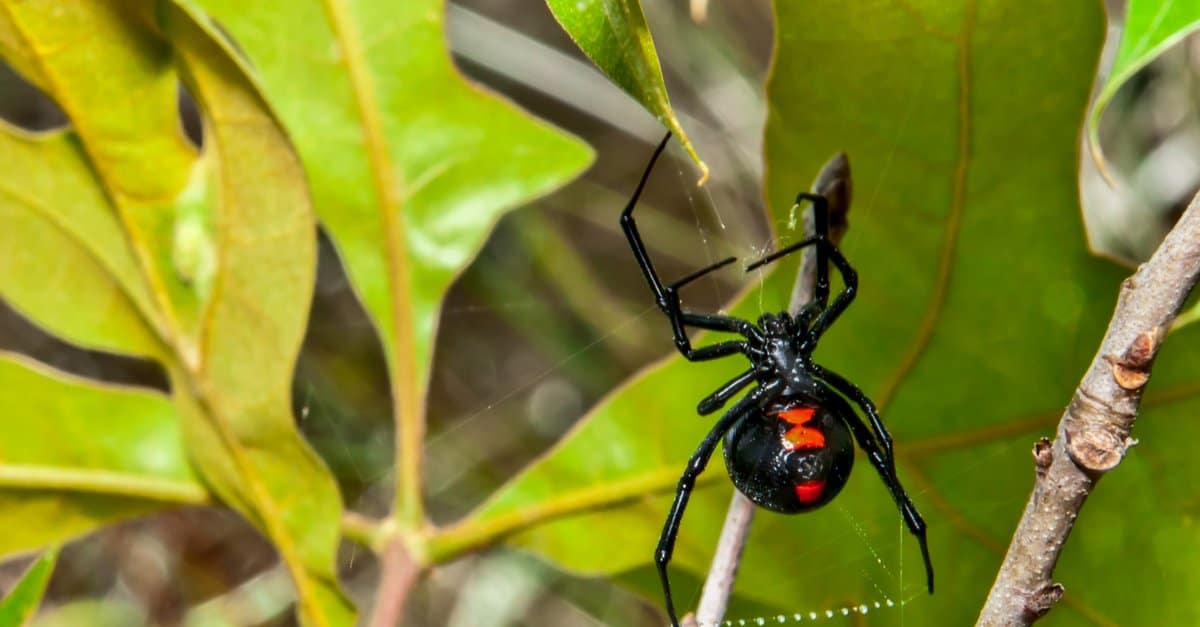
When most people think of black widows, they picture the black body and red hourglass. In the case of the northern black widow, though, they may be in for a surprise. Unlike other black widows, the northern species has a reddish-colored, separated hourglass shape on the underside of its abdomen. The upper part of their shiny, rounded abdomen may be solid black, but it could also have red or orange spots, sometimes with white or yellow lateral stripes. Males have longer abdomens and longer legs. They typically have grey to brown coloration with white and red patterned markings on the top of the abdomen.
Female spiders grow to about 0.4 to 0.5 inches in body length with a leg span of 1.5 to 2 inches. Male northern black widows are much smaller. They only measure 0.2 to 0.3 inches with a leg span of 0.5 inches to 1 inch. Only the females have fangs large enough to break the skin.
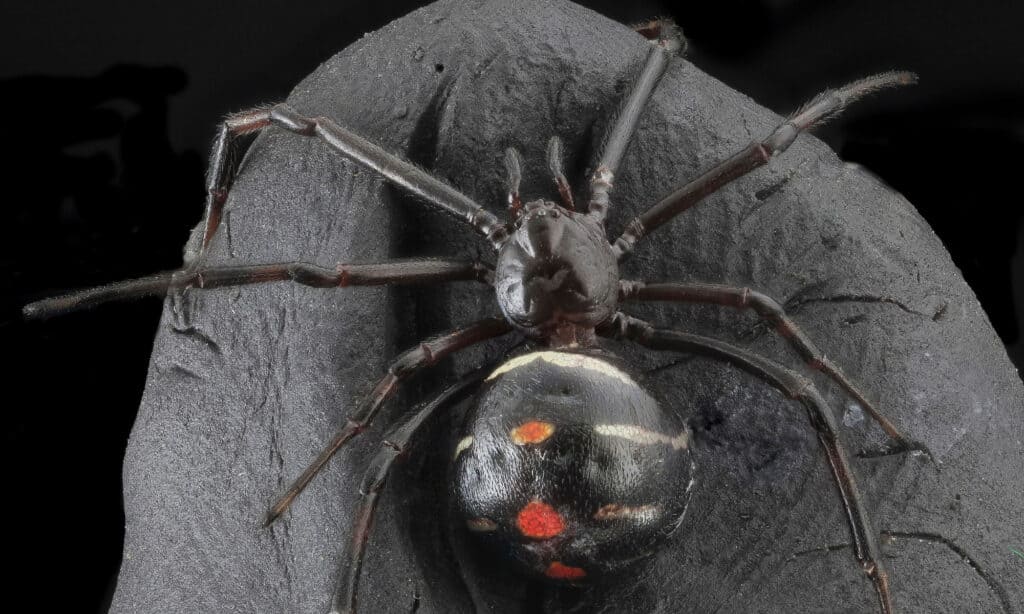
The northern black widow’s upper abdomen can have red or orange spots with white or yellow lateral stripes.
©Porco_Rosso/Shutterstock.com
Northern Black Widow Spider Habitats
Northern black widows prefer dark enclosed spaces where they can weave their irregularly-shaped three-dimensional webs. Black widows hang upside down in their webs and will bite defensively if disturbed. However, they typically prefer to flee. These spiders may be found inside human-built structures like houses and sheds, warehouses and garages, or around wood piles and fences. They can also be found inside old stumps, hollow logs, or rodent burrows. These spiders occur statewide, but they prefer rural and undisturbed areas.
Symptoms of Northern Black Widow Spider Bites
Most people bitten by northern black widow spiders experience mild to moderate symptoms that include:
- Moderate to severe pain
- Muscle rigidity
- Intense sweating
- Redness around the wound
More severe symptoms include:
- Muscle cramps or spasms beginning near the bite and spreading outward
- Seizures
- Chills and fever
- Nausea
- Vomiting
- Severe belly, back, or chest pain
- Severe high blood pressure
- Headaches
- Dizziness, stupor, or shock
Although the mortality rate is less than 1%, if you show signs of severe symptoms, seek medical assistance as soon as possible.
Southern Black Widow (Latrodectus mactans)
More people are familiar with the appearance of the southern black widow. Although the northern and southern are two different species, they have many similarities. Learn how to identify the southern black widow, their habitats, and the symptoms of their bite.
Southern Black Widow Spider Identification
Southern black widows have the red, orange, or yellowish-orange hourglass marking on the underside of their shiny, rounded black abdomens. The top may be unmarked or they can have additional red dots on the back of the abdomen above the spinnerets. Males have slimmer abdomens and longer legs. They are brown, grey, or a muted black with white stripes and yellow or orange dots.
Female southern black widows are roughly the same size as northern black widows. They measure about 0.4 to 0.5 inches in body length with a leg span of 1.5 to 2 inches. Male southern black widows are also about half the size of the female. They measure 0.2 to 0.3 inches with a leg span of 0.5 inches to 1 inch. The male’s fangs are too small to break human skin.
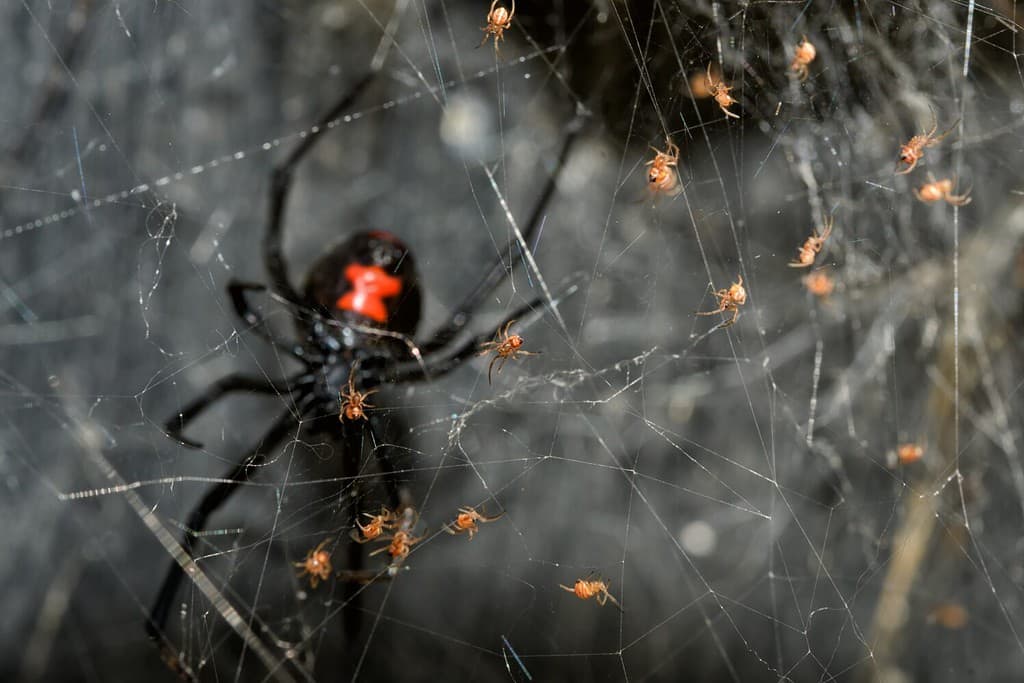
The southern black widow has a distinctive reddish-colored hourglass on the underside of the abdomen.
©Sari ONeal/Shutterstock.com
Southern Black Widow Spider Habitats
Southern black widows can be found throughout the state. However, just like northern black widows, southern black widows favor rural and undisturbed settings. Watch for them in dark, secluded places with corners, in woodpiles, under stones and logs, or inside other undisturbed cavities. Southern black widows spin irregularly-shaped webs, from which they hang upside down. These spiders prefer to escape rather than confront a threat, but they will bite defensively.
Symptoms of Southern Black Widow Spider Bites
The same symptoms appear in victims of southern black widow bites as in northern black widow bites. These include:
- Moderate to severe pain
- Muscle rigidity
- Intense sweating
- Redness
More severe symptoms include:
- Muscle cramps or spasms beginning near the bite and spreading outward
- Seizures
- Chills and fever
- Nausea
- Vomiting
- Severe belly, back, or chest pain
- Severe high blood pressure
- Headaches
- Dizziness, stupor, or shock
If you think you have been bitten by a southern black widow spider and you are experiencing severe symptoms, seek medical assistance.
Brown Widow (Latrodectus geometricus)
Lesser-known brown widows are not native to Louisiana. These spiders may be native to South Africa, though their true origins remain uncertain; they were first described from South America. They were first observed in Louisiana in the 2000s, and they are now the most common widow spiders in some urban centers.
Brown Widow Spider Identification
Female brown widow spiders are shades of beige, tan, and brown with a dark brown cephalothorax. Their legs may have tan, brown, or black segments. The underside of their rounded abdomens have orange or yellowish-orange markings that may look like an hourglass or may be irregularly shaped. The upper abdomen typically has wavy markings on the brown background and may include a row of bordered ovals near the center. Males are also variable shades of brown but typically lack bold patterning like the females. Males have longer, thinner legs and a slimmer abdomen.
The females measure 0.3 to 0.5 inches in length and have a leg span of 1.5 to 2 inches. Males are smaller, measuring only 0.1 to 0.2 inches in length. Their leg span can reach 0.5 inches to 1 inch. The males’ fangs are too small to break human skin.
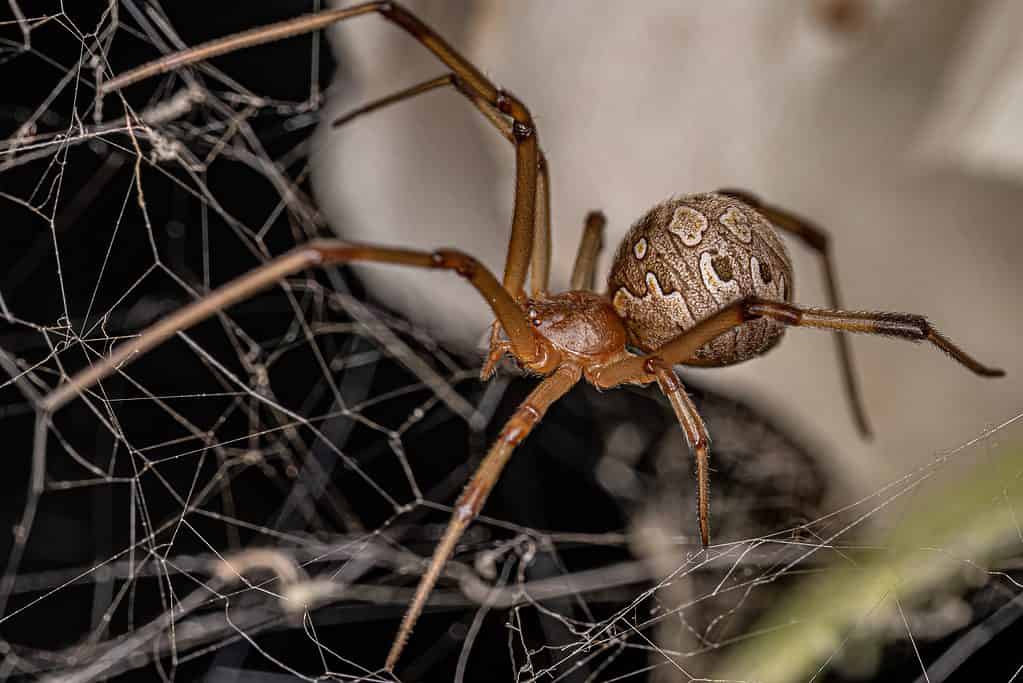
The brown widow spiders favors inhabiting populated areas.
©Vinicius R. Souza/Shutterstock.com
Brown Widow Spider Habitats
Brown widows are found throughout the state, but they can thrive in a wider variety of habitats than black widows. They also have a preference for living in populated areas. They frequently build webs in patio furniture, play sets, picnic tables, benches, and other places where people like to congregate outdoors. Their webs are irregularly shaped and the spiders hang upside down. Fortunately, bites are rare and typically occur due to trapping the spider close to the skin.
Symptoms of Brown Widow Spider Bites
While the black widow is far more infamous, brown widow venom is actually more toxic. However, brown widows inject less venom, resulting in milder symptoms. The two major symptoms of a brown widow bite include:
- Pain when the bite is delivered
- Redness at the bite site
More severe symptoms have been documented, so if you believe you have been bitten by a brown widow spider, seek the advice of your physician.
Brown Recluse (Loxosceles reclusa)
These “fiddle” spiders, or “violin” arachnids, known as brown recluses, deliver a painful bite containing two types of toxins. Most people who are bitten won’t have severe health consequences, but the elderly, children, and those with allergies will need medical care immediately.
Brown Recluse Spider Identification
Brown recluse spiders are, as you’d guess by the name, most commonly brown in color. They have darker brown violin-shaped patterns on their cephalothorax, with the neck of the violin pointing toward the abdomen. Brown recluse spiders only have six eyes, which also helps make them easy to identify. Other spiders have eight.
Females are 0.31 to 0.47 inches in length with a leg span of 1 to 1.5 inches. Males are slightly smaller and thinner than females, measuring 0.27 to 0.35 inches. However, they have proportionally longer legs.
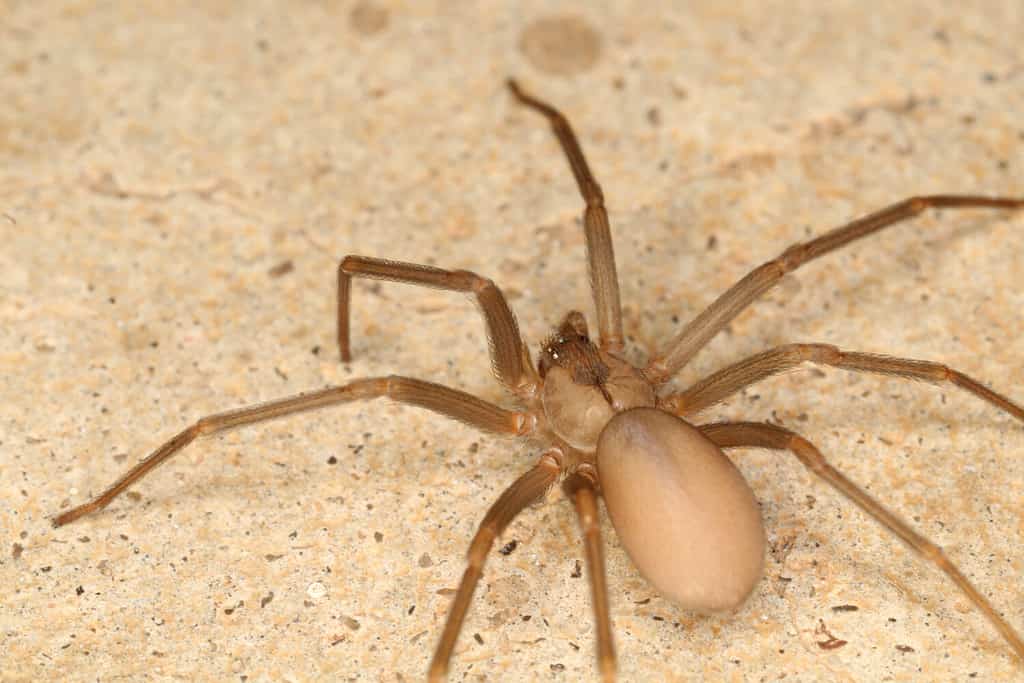
The brown recluse spider has a violin-shaped mark on its cephalothorax.
©Nick626/Shutterstock.com
Brown Recluse Spider Habitats
Brown recluses are common in the northern half of the state, but they are extremely rare in southern Louisiana. They favor warm, dark, dry, undisturbed areas, which has earned them their name. These spiders are solitary and prefer to flee to their retreats when threatened. Often, you’ll find them hunting for food in dark corners, or hanging in their messy webs in cellars, woodpiles, sheds, and the backs of closets.
Symptoms of Brown Recluse Spider Bites
Brown recluse venom is potent and necrotic and can also trigger serious systemic effects, making brown recluse bites some of the nastiest spider bites of all. However, as noted above, they tend to shy away from people and bites are rare. People are typically only bitten when the spider gets trapped against the skin.
If someone is bitten, though, the symptoms can be severe. You may experience any or all of the following.
- Red, irritated skin
- Swelling and blistering
- Soreness
- Necrotic decay of flesh
- Itching
- Moderate to severe pain
- Lethargy
- Flu-like symptoms, including body aches, chills, and fever
- Flat purple or red spots or rashes all over the body
Less than 1% of bites result in systemic issues, but it can take between 6 and 8 weeks to fully recover from severe bites. If you believe you have been bitten by a brown recluse, you should seek medical attention immediately.