
Quick Take
- Northern spotted owls have declined due to habitat loss, forest fragmentation, wildfires, and competition from expanding barred owl populations. Meet the invading species →
- A new study used acoustic recorders and machine learning to track northern spotted owls and barred owls across parts of the Pacific Northwest.
- Researchers found northern spotted owls are approaching functional extinction in Washington and along the Oregon Coast, while they are absent from the Washington Cascades north of Seattle. See what functional extinction means →
- Protecting old-growth forests, managing barred owl populations, and captive breeding could all play a role in helping northern spotted owls recover. Explore the removal plan →
The northern spotted owl has long been an iconic sight in the Pacific Northwest, but the joy of spotting these owls in this region may be coming to an end. Decades of decline through habitat loss and competition from other owls have pushed these birds to a critical point. As a result, a new study has now found that northern spotted owls are now functionally extinct in some parts of Washington and Oregon. Keep reading to discover what this means for them and if there’s anything that can be done to change it!
Why Are Northern Spotted Owls Disappearing?
Northern spotted owls are a subspecies of the spotted owl and can be distinguished by their dark brown plumage that is covered with white spots. They are medium-sized birds with a wingspan of around 40 to 43 inches. Northern spotted owls are native to the Pacific Northwest, where they can be found in old-growth forests.
Northern spotted owls have been classified as a threatened species since 1990 due to declining populations. There are a few reasons for this decline, but their greatest threat is habitat loss. Logging is the main factor, with large areas of the forests where they live completely removed. Also, although not as prevalent as logging, wildfires have also contributed to the loss of available habitat. Although some forests remain, many of them are now fragmented. Unfortunately, fragmentation is another issue for northern spotted owls. This is because populations are pushed into smaller areas and cut off from each other. This then affects their ability to reproduce effectively as they struggle to find mates, or populations can become inbred.
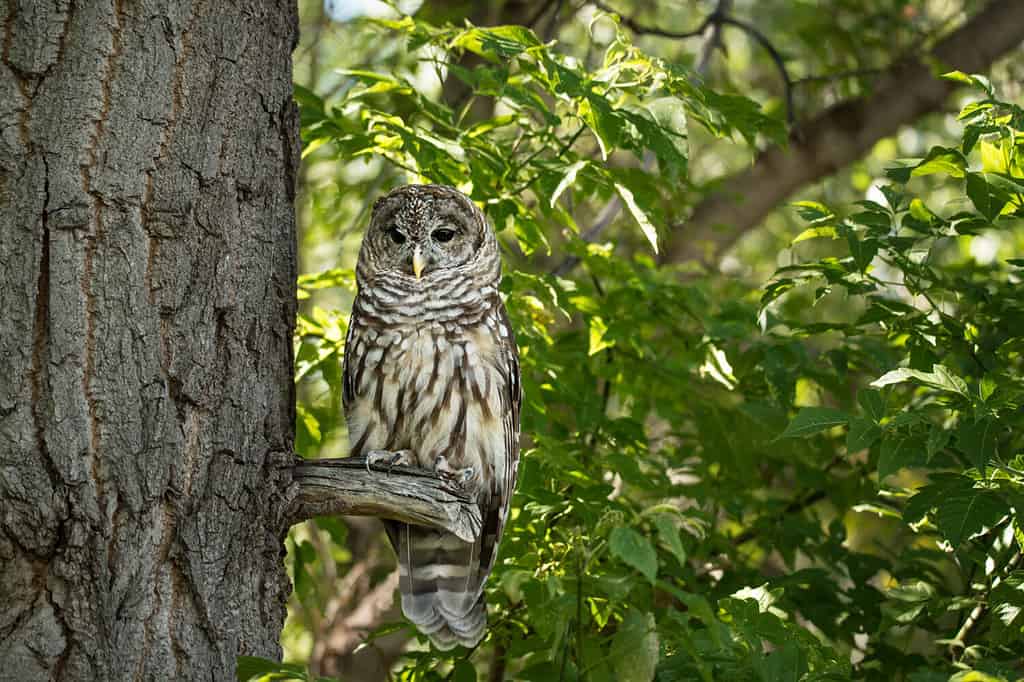
Northern spotted owl populations are becoming small and fragmented due to habitat loss.
©Georgia Evans/Shutterstock.com
Habitat loss isn’t the only threat that northern spotted owls face, as they also have additional pressure from barred owls. Barred owls are an invasive species in the Pacific Northwest, and they have spread into the northern spotted owl’s range. Barred owls are larger and more aggressive than northern spotted owls. This means that they outcompete them for both food and territory.
How Significant Is the Decline?
A recent study by the U.S. Forest Service and Oregon State’s Department of Fisheries, Wildlife, and Conservation Sciences looked at northern spotted owl populations across Washington, Oregon, and northwestern California. The study used acoustic recorders to record the vocalizations of birds across the three areas. Researchers then used machine learning to analyze the recordings and identify the calls of both northern spotted owls and barred owls.
The study recorded eight times as many barred owl calls compared to northern spotted owls. It also showed that northern spotted owls are more common in the southern part of the range. However, barred owls were heard more frequently in the northern part, especially around the Oregon and Washington coasts. These findings show that the decline is not happening equally across their entire range, with areas where barred owls are prevalent being areas where northern spotted owls are not as common.
The study has also shown that northern spotted owls have declined so much that they are now considered to be approaching functional extinction in both Washington and on the Oregon coast. They are also entirely absent from the Washington Cascades to the north of Seattle. Functionally extinct doesn’t mean that they have disappeared entirely from those regions. Instead, it means that their populations have become so small that there are no longer enough birds to make them viable. So, this means that there are not enough birds in the population for them to successfully reproduce and maintain itself.

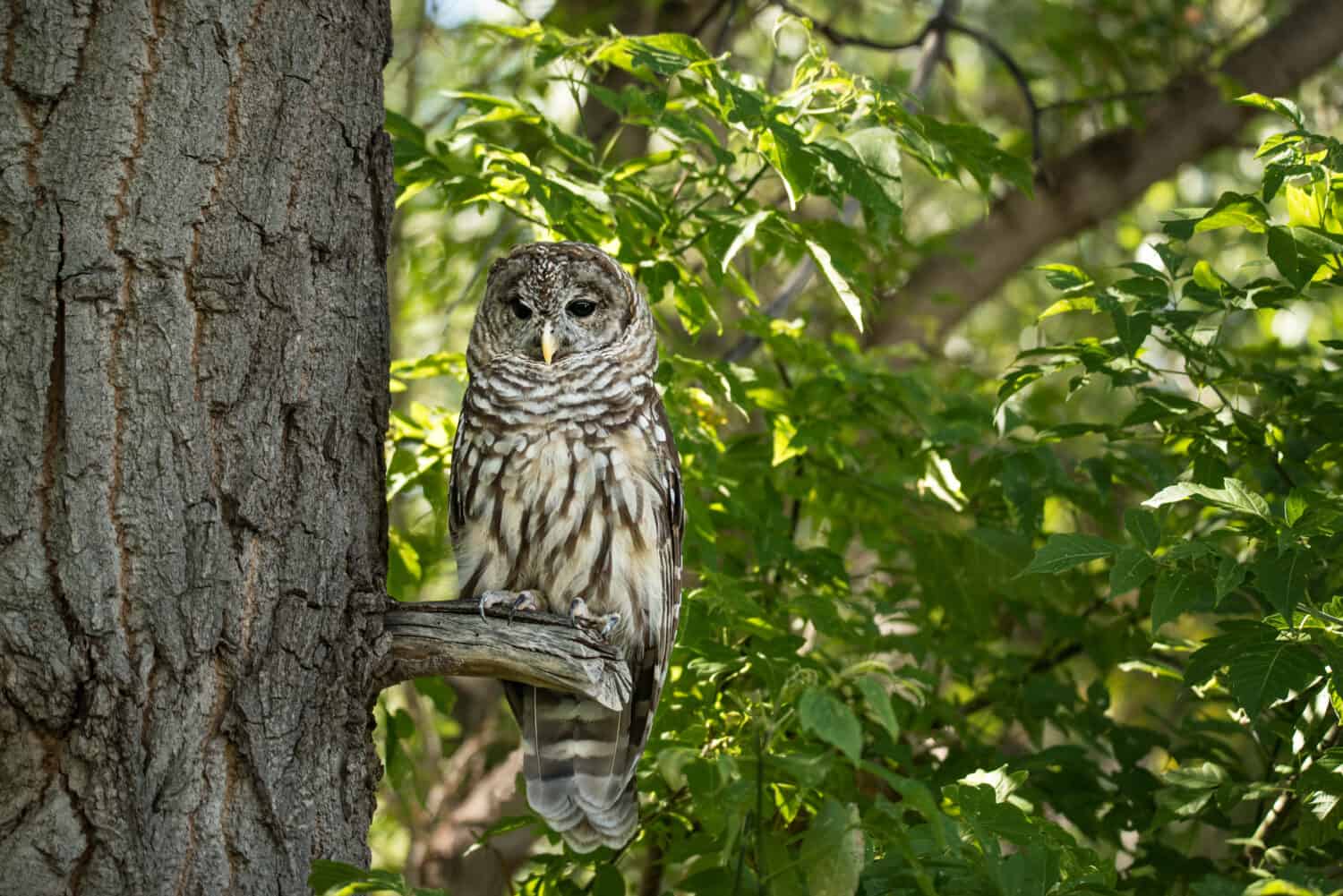
The larger barred owl is outcompeting northern spotted owls for food and territory.
©FSTOPdotCOM/Shutterstock.com
Can Northern Spotted Owls Still Be Saved?
Although it doesn’t look good for northern spotted owls, there is still a chance for them as they haven’t disappeared entirely from the Pacific northwest. Birds still exist in other parts of the range, meaning that there are populations that can be protected. These birds can then help restore the wider population if they have the right conditions.
Protecting the mature and old-growth forests that northern spotted owls live in remains an important part of the effort. It’s important that the remaining habitat is kept intact to provide the birds with somewhere to nest and find food. Preventing further fragmentation is also important to prevent populations from becoming even more isolated.
Managing barred owl populations is also another important step in the move to help northern spotted owls. The U.S. Fish and Wildlife Service already has a management plan in place to try and resolve the issue. The plan involves removing a proportion of the barred owls in the Pacific northwest to allow spotted owl populations to reach a stable level. Following an initial experiment, it was found that this had a positive effect on northern spotted owls, with populations stabilizing. In comparison, the decline continued in areas where barred owls were not removed. The final plan proposes that 15,000 barred owls will be removed and humanely killed every year for the next thirty years to give northern spotted owls a chance at recovery.
Another potential option is captive breeding of northern spotted owls, which has already been adopted in Canada. Bringing some birds into captivity for breeding could help boost the numbers in the long-term. However, it’s still vital that the forests are protected to prevent further losses and so there is sufficient habitat for any eventual releases.