
Quick Take
- Not all black spiders in Texas are created equal. Only one on this list is actually dangerous to you, and it's not the one most people fear most. See the only dangerous one →
- One Texas spider disguises itself as an ant, even mimicking fake antennae, to get close enough to kill its prey. Meet the ant impersonator →
- Texas has a spider that builds a hidden door in the ground and almost never shows itself above the surface. Discover the hidden-door spider →
- Black spiders in Texas are far rarer than most residents assume, a fact that might change how you react the next time you spot one.
As the United States‘ second-largest state, Texas has a wide variety of wildlife. It is home to various spider species, including tarantulas and jumping spiders. While there are many spiders in the state, black spiders are not as common as you may think. So, what are the black spiders in Texas? Read on to learn more about black spiders in Texas and how to identify them.
1. Black Widow
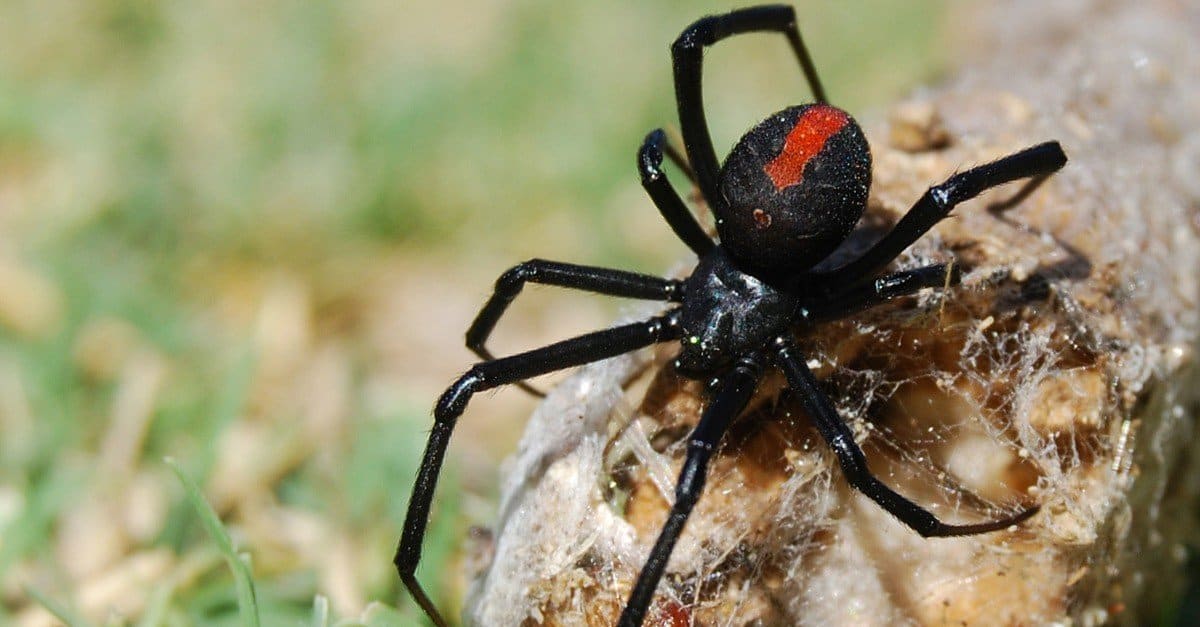
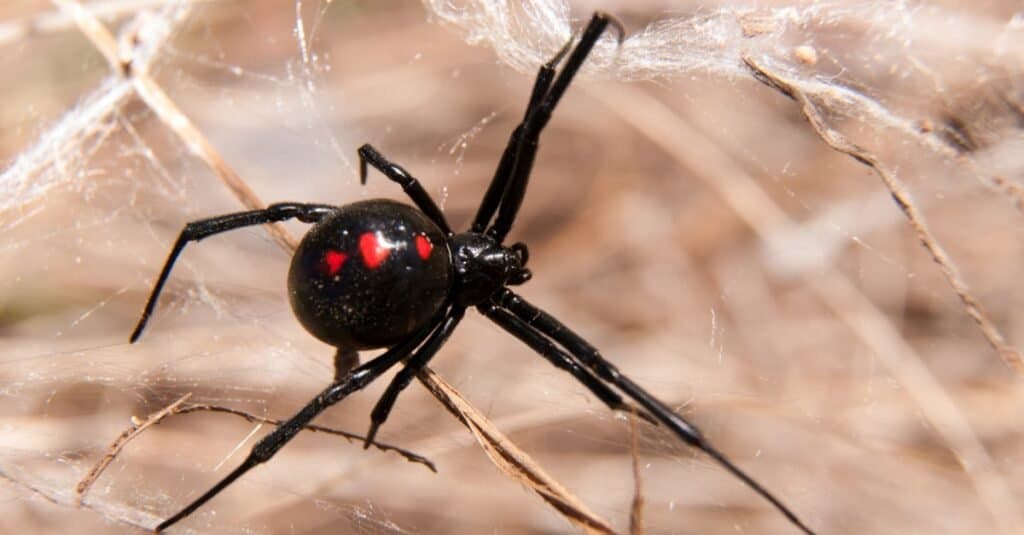
The black widow is perhaps the most well-known black spider in Texas, as they are also among the most venomous. However, only the females are dangerous to humans. Female black widows are glossy black with a distinctive red hourglass marking. They can reach 1.5 inches in length including legs. The most common black widows are the southern black widow (Latrodectus mactans), found primarily across the eastern and central parts of Texas, and the western black widow (Latrodectus hesperus) common in western and southwestern regions of Texas. Black widows are normally found outside in undisturbed areas.
Black widow spiders inhabit vegetation and animal burrows.
©Sari ONeal/Shutterstock.com
2. Bold Jumping Spider
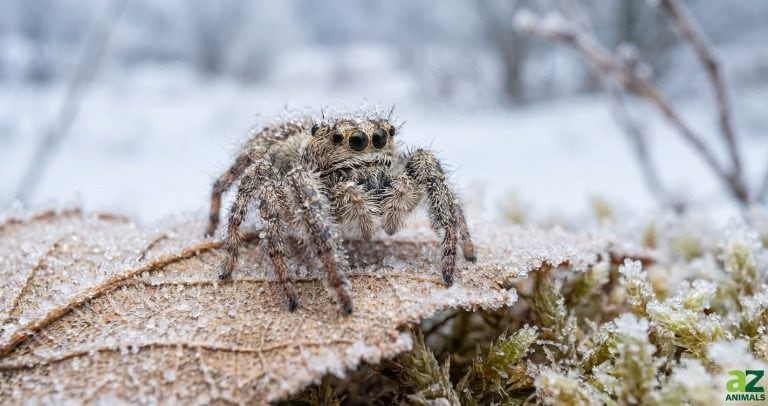
The bold jumping spider (Phidippus audax), or daring jumping spider, measures about 0.25–0.75 inches. It has a fuzzy black abdomen with a pattern of white spots, as well as black legs. Their front-facing eyes and green metallic mouthparts are their most recognizable features. In Texas, jumping spiders are among the most prevalent garden spiders. They are not dangerous to humans.
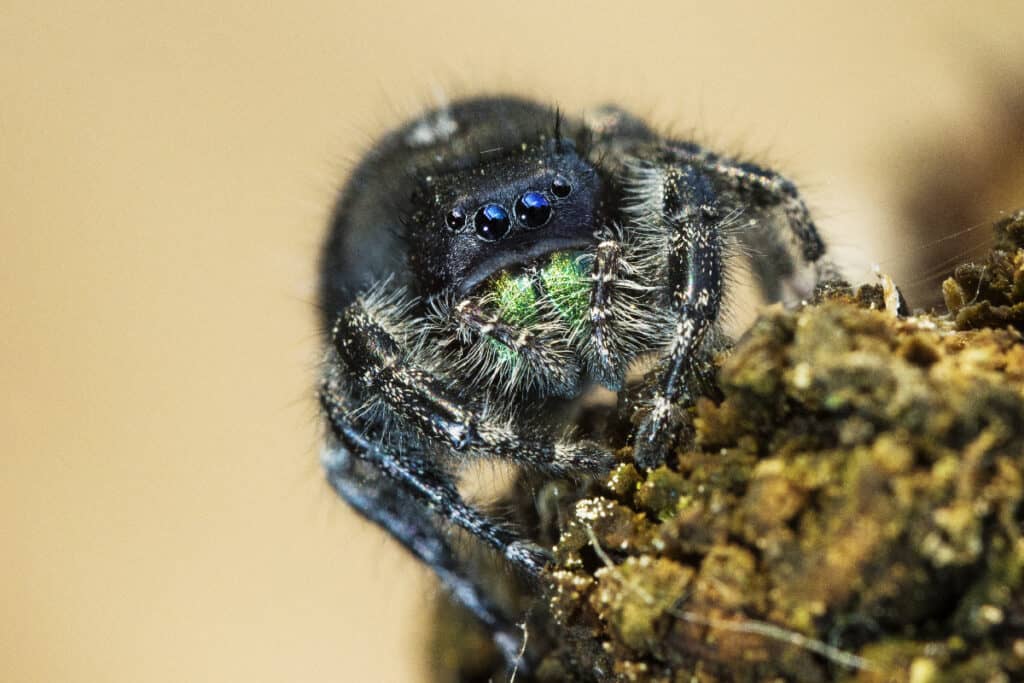
The daring jumping spider possesses excellent eyesight and leaping abilities that it uses to catch its prey.
©Mircea Costina/Shutterstock.com
3. Twin-Flagged Jumping Spider
The Anasaitis canosa is more frequently referred to as the twin-flagged jumping spider. These spiders have dark brown or black bodies with white, gold, or pink iridescent setae (hairs) and prominent white pennant-like markings on its pedipalps. These spiders measure 0.16–0.28 inches. Twin-flagged jumping spiders can be found in wooded areas and gardens across Texas. These jumping spiders are harmless to humans.
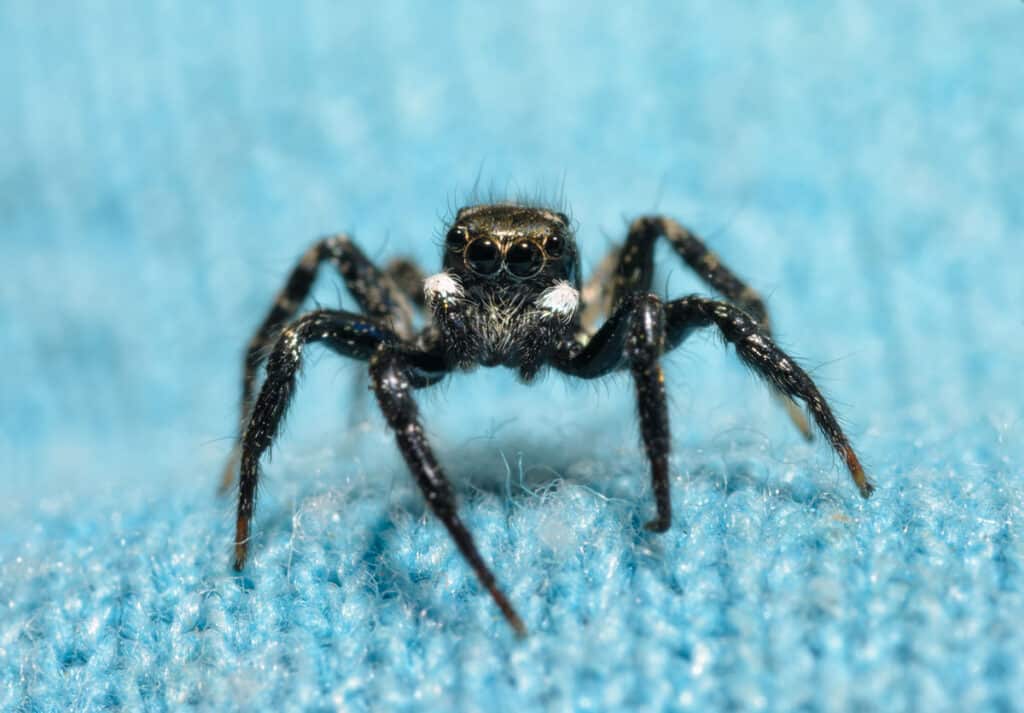
The twin-flagged jumping spider gets its name from the 2 pennant-shaped markings on its pedipalps.
©Sari ONeal/Shutterstock.com
4. Eastern Parson Spider
The eastern parson spider (Herpyllus ecclesiasticus) has black hairs on a dark brown exoskeleton and a white stripe on its abdomen that mimics an eighteenth-century necktie with ruffles. The ruffled necktie marking on its back makes the parson spider distinctive. It legs are a dark brown or blackish shade. Its body is 0.25-0.50 inches in length. With the legs included, it can measure up to 1 inch. This spider can be found in yards and gardens throughout the state. Its bite can be painful and cause mild localized reactions, but it is not generally dangerous to people.
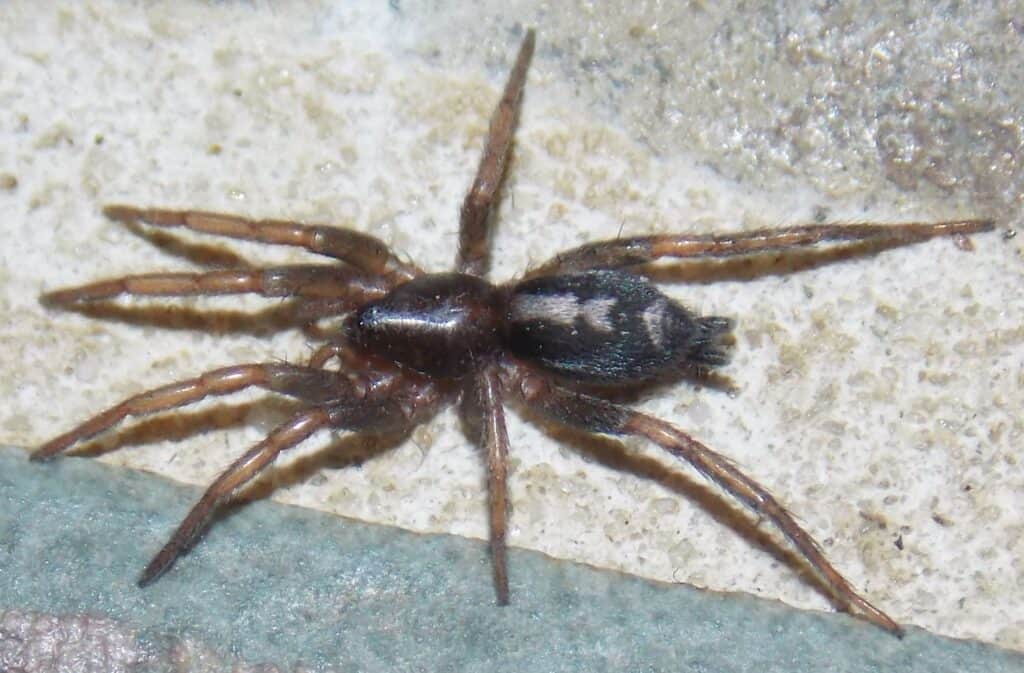
The eastern parson spider features a marking that looks like an 18th-century parson’s necktie.
©Fyn Kynd from Searsmont, Maine, United States / CC BY 2.0, via Wikimedia Commons – Original / License
5. Red-Spotted Ant Mimic Spiders
The red-spotted ant mimic spider (Castianeira descripta) gets its name from its resemblance with ants, which includes walking on six legs and using the front pair of legs as antennae. These are black spiders with a brilliant red mark on the abdomen and a pale line running down the middle of the carapace. It raises the front two legs as if they are antennae and walks on its remaining six legs. This cunning approach calms other ants and insects, making them believe that the spider is not a threat. They are more inclined to let the spider approach, which makes it easy for the spider to prey on them. These spiders can measure up to 0.6 inches. These spiders are not dangerous to humans.
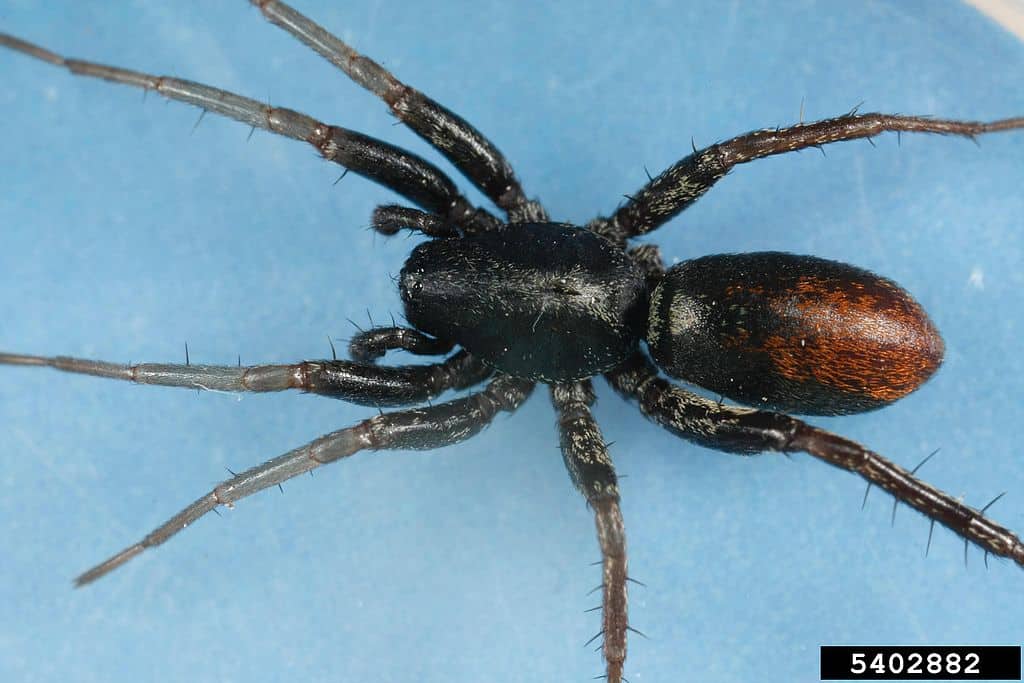
The red-spotted ant mimic spider acts like an ant in order to sneak up on its prey.
©Joseph Berger, Bugwood.org; University of Georgia / CC BY 3.0, via Wikimedia Commons – Original / License
6. Burrowing Wolf Spider
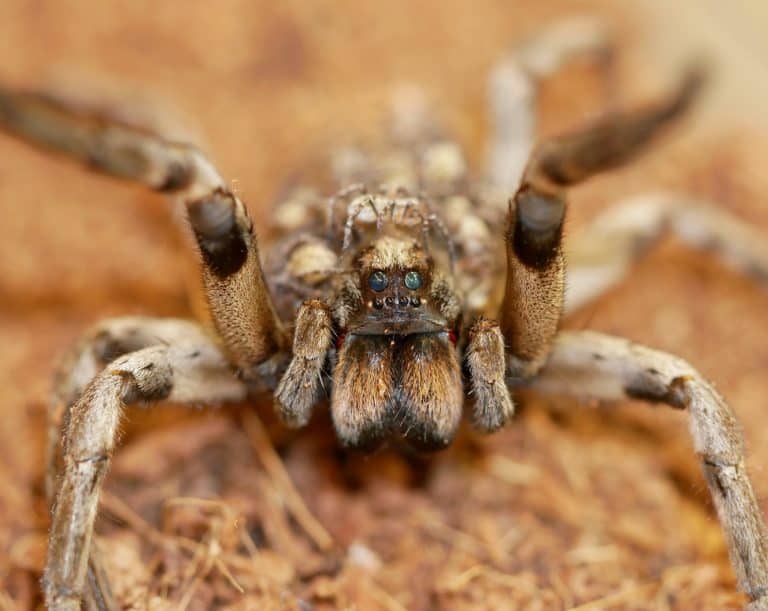
Several burrowing species can be found in Texas, including Geolycosa missouriensis (Missouri earth spider) and Geolycosa fatifera. These wolf spiders dig vertical tunnels in loose, sandy soil with their powerful jaws and short, strong legs. Their stout bodies frequently have black, gray, and brown patterns. They are roughly 0.6 to 0.8 inches in body length with a leg span of up to 1.5 inches. Wolf spiders are venomous, but their venom is not dangerous to humans.
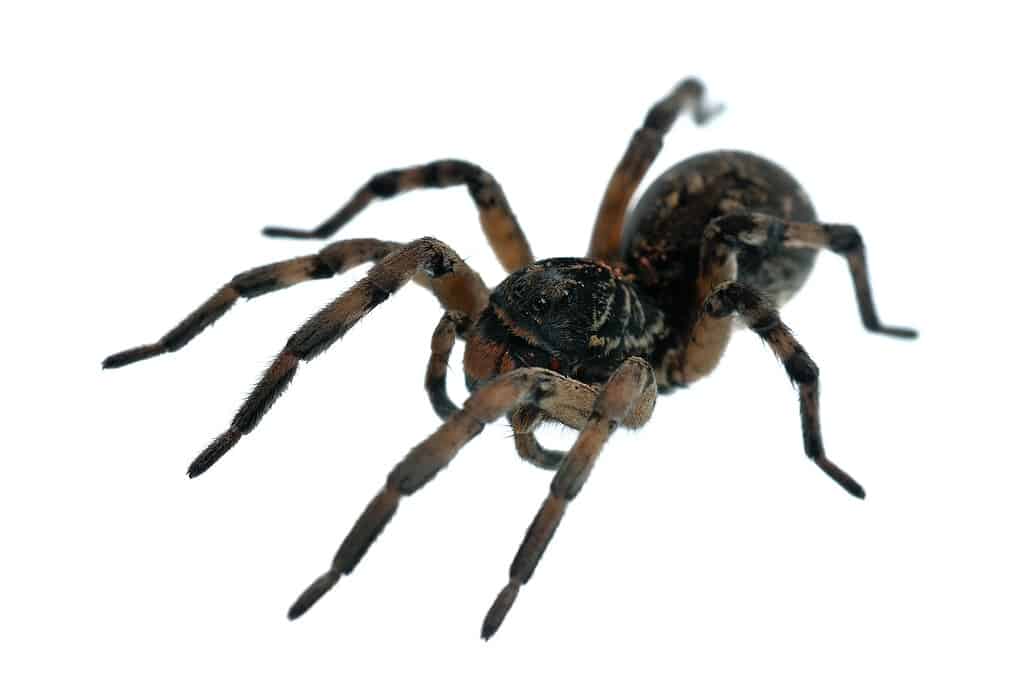
The large, fast-moving burrowing wolf spider digs vertical tunnels for a refuge.
©D. Kucharski K. Kucharska/Shutterstock.com
7. Trapdoor Spider
Although trapdoor spiders are not the largest spiders in Texas, these heavy-bodied spiders can reach respectable sizes of 1-1.5 inches in length with a leg span of up to 2 inches. One of the most common is the southwestern trapdoor spider (Eucteniza relata). They have smooth bodies ranging from black to dark brown. Trapdoor spiders are mygalomorph spiders, a suborder of spiders known for large, downward-striking fangs that they use to subdue prey. These spiders are rarely seen and retreat inside their burrows when they feel threatened. These spiders are most commonly seen in East Texas and the Central Texas Hill Country. They do have venom, but it is not typically harmful to humans.
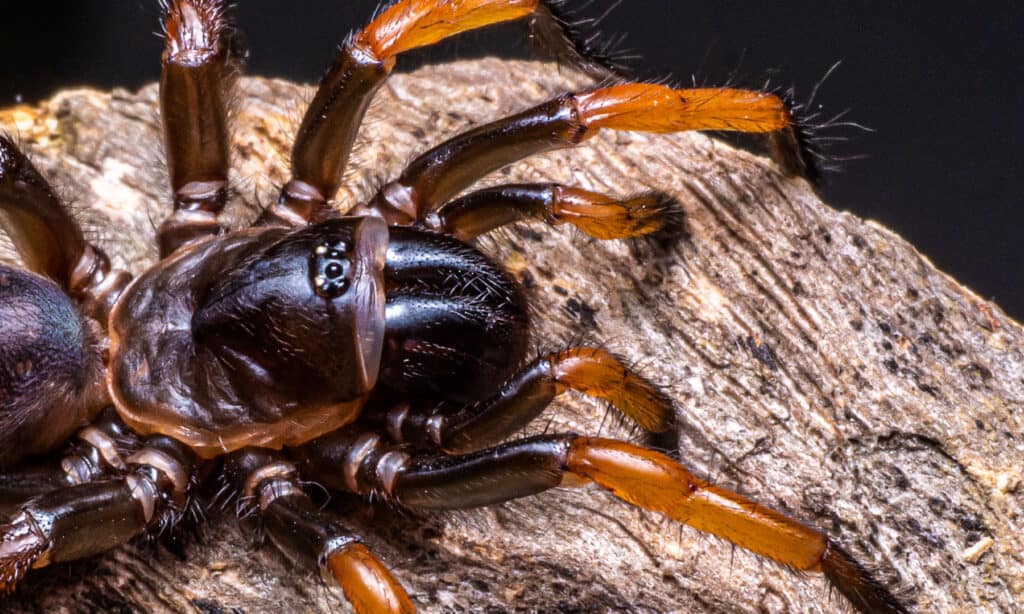
Trapdoor spiders have smooth bodies and colors ranging from black to dark brown.
©nokkaew/Shutterstock.com
8. Tigrosa Grandis Wolf Spider
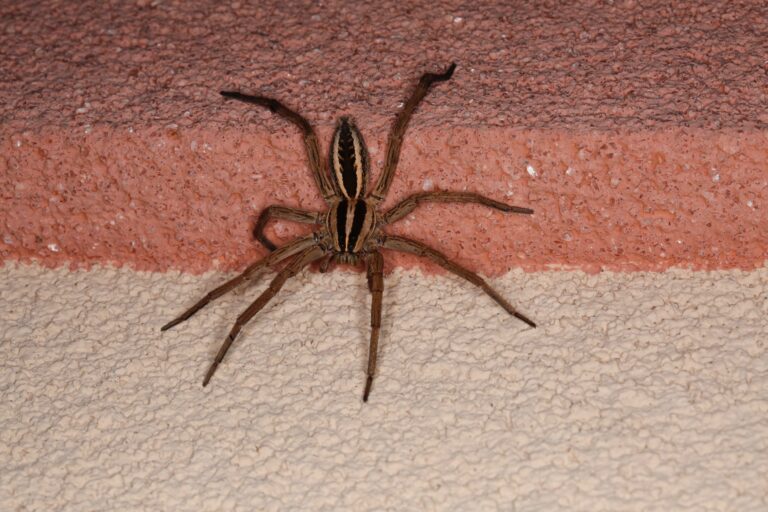
The wolf spider (Lycosidae) known as Tigrosa grandis is only found in the United States, where it may be found from Montana down to Texas. Tigrosa grandis is most frequently spotted outside in August. This spider can be black, dark brown, or greyish, with a light orange stripe running down the center of its dark cephalothorax. This spider measures up to 1.4 inches in body length with a leg span of 2 to 3 inches. As mentioned above, wolf spiders have venom, but it is not dangerous to people.
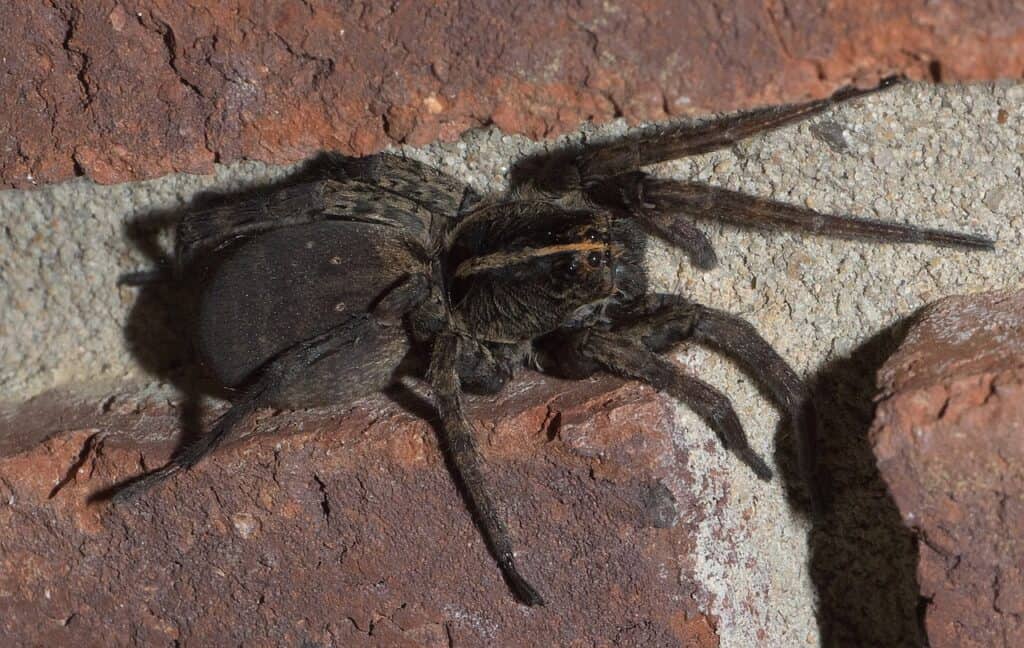
Tigrosa grandis can be found from Montana down to Texas.
9. Ribbon Jumping Spider
These small spiders measure 0.17–0.28 inches in length, with females being larger. Ribbon jumping spiders (Metacyrba taeniola) have a broad carapace that is nearly two-thirds of their body length. These spiders are often found near human structures, on tree bark, and in vegetation where they hunt smaller insects. Ribbon jumping spiders are widely distributed across the U.S. and down into Mexico. They are dark brown, charcoal grey, or black with subtle ribbon-like patterns. These spiders are harmless to humans.
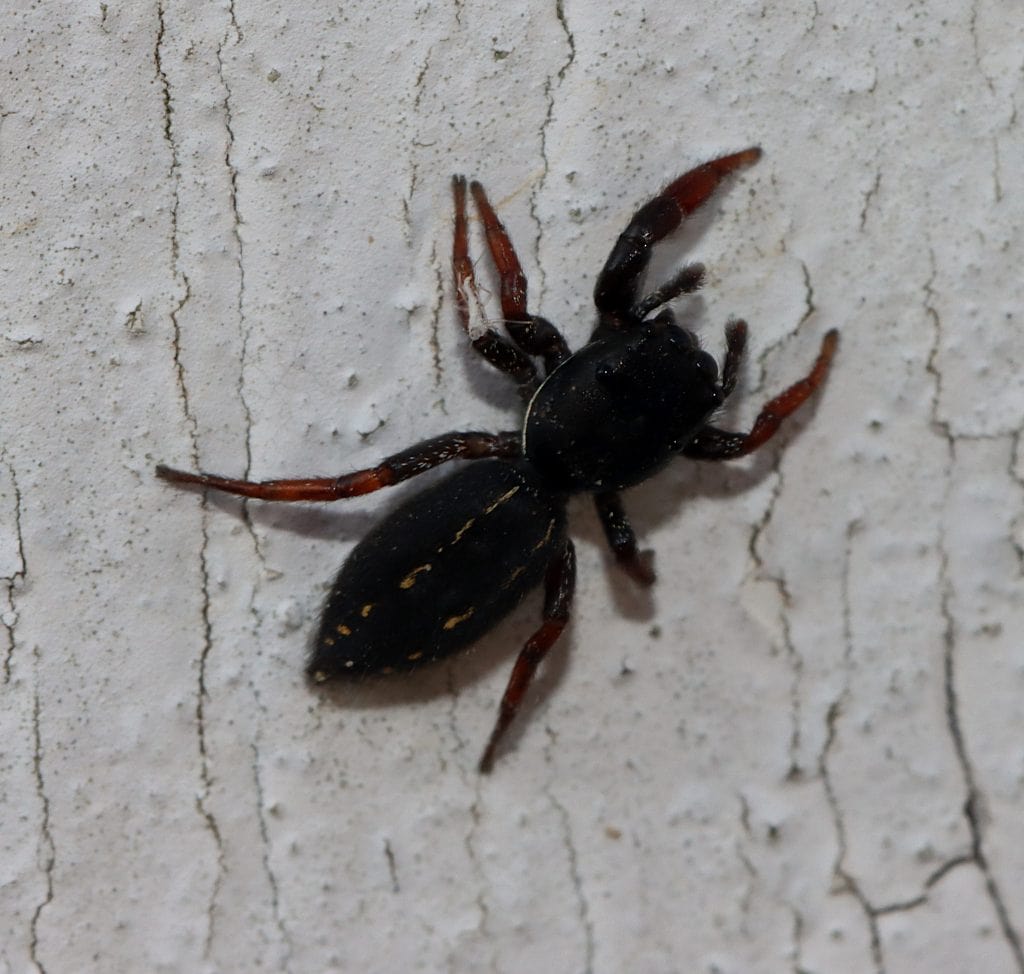
The tiny ribbon jumping spider is widely distributed across the U.S.