
Quick Take
- One spider on this list can reach the size of a human palm, and it might already be living near your home. See Michigan's palm-sized spider →
- Michigan has a spider that rivals the giant house spider in size, yet most people have never heard of it. Meet this lesser-known giant →
- Female wolf spiders behave in a way that almost no other spider species does, which might change how you think about them. Discover wolf spider maternal care →
- One spider on this list isn't even native to the U.S., which raises the question of how it ended up in Michigan homes. Learn about this non-native species →
Michigan is home to over 500 species of spiders. Of the spiders regularly found in Michigan, only the northern black widow has venom that is dangerous to humans. While brown recluses also have dangerous venom, they are rarely encountered in the state. Many people may find spiders frightening, but spiders are incredibly important to the environment and have no interest in hurting people. Most spiders in Michigan are small, not even reaching one inch in leg span. With so many spiders, it would be impossible to cover them all. However, we’ve rounded up ten of the largest spiders you can find in Michigan.
1. American Grass Spider
American grass spiders are a type of funnel weaver in the genus Agelenopsis. There are 14 species of grass spiders, five of which have been identified in Michigan. Grass spiders are sometimes misidentified as wolf spiders, but they are slightly smaller, measuring around 0.75 inches in length with a leg span of around 1.5 inches. That’s a little bit larger than a half-dollar coin. These spiders are shades of light to dark brown, with two dark, parallel bands running vertically down the cephalothorax and chevron markings on their abdomens.
Generally, all spiders are venomous. However, when people refer to venomous spiders, they mean spiders that have venom potent enough to harm a human. Grass spiders have venom that immobilizes their prey, but it’s harmless to humans. You’re probably more likely to notice a funnel weaver’s web than the spider itself. These spiders spend much of their time hiding in the entrance of their funnel-like webs, which they build in short grasses. When an insect walks by, they quickly strike, biting their victim and bringing it into their burrow to eat.
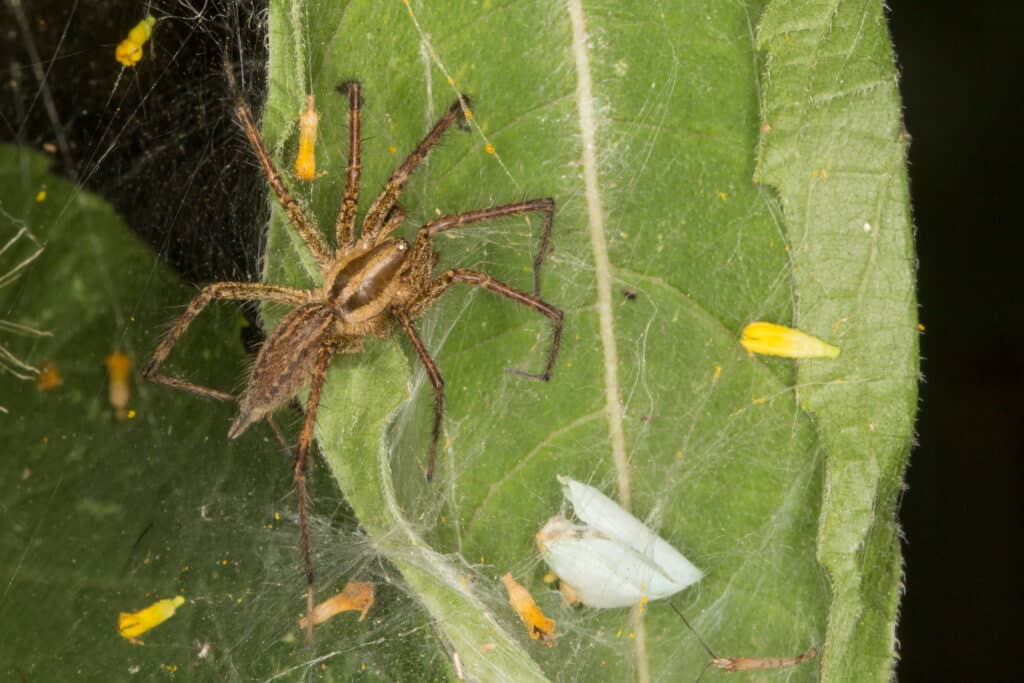
Grass spiders are a type of funnel weaver found throughout Michigan.
©Elliotte Rusty Harold/Shutterstock.com
2. Northern Black Widow Spider
The northern black widow spider (Latrodectus variolus) is one of two spiders that contain venom that is medically significant to humans. One of Michigan’s larger species, this spider has a leg span of up to 1.5 inches. That’s a little smaller than the diameter of a golf ball. The northern black widow is one of three black widow species found in the U.S. It is the only black widow to live in Michigan, where it most commonly appears in the western Lower Peninsula.
Unlike other black widows, northern black widows have a broken hourglass shape on the underside of their abdomens. They also have a row of red spots on their upper abdomens. Black widow spiders may have a fearsome reputation, but they are responsible for very few bites overall. These are timid spiders and are much more likely to flee from a human than attack.
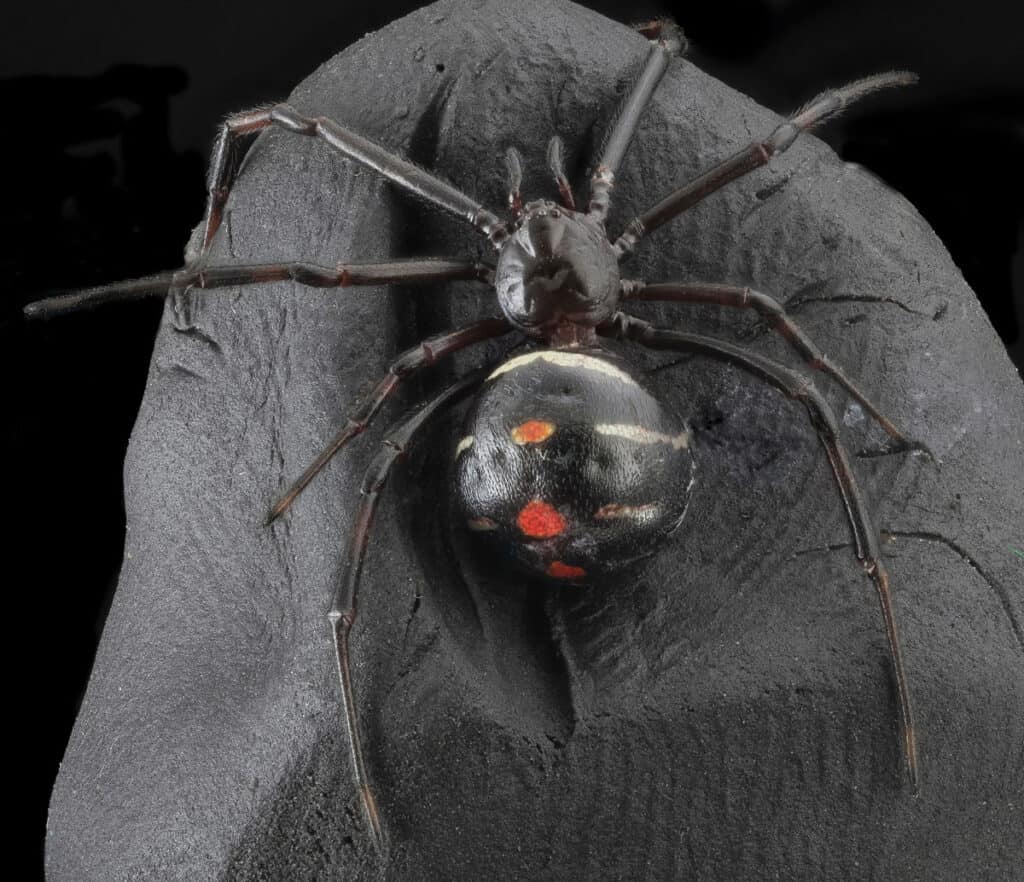
Northern black widows have a broken hourglass on their undersides and a row of red spots on the abdomen.
©Porco_Rosso/Shutterstock.com
3. Banded Garden Spider
The banded garden spider (Argiope trifasciata) is also sometimes known as the banded orb-weaving spider. It can be recognized by the silver, yellow, and black horizontal bands on its abdomen. It’s another one of Michigan’s larger spiders with a leg span of up to 1.5 inches. The banded garden spider is a type of orb weaver that is native across the country. It can be found statewide in Michigan.
Banded garden spiders are not dangerous to humans. Their bite is not medically significant, and according to the PennState Extension, they are only likely to bite if a human handles their egg sac. You may see a banded garden spider’s web before you see the spider. They weave intricate, spiral-shaped webs in open areas.
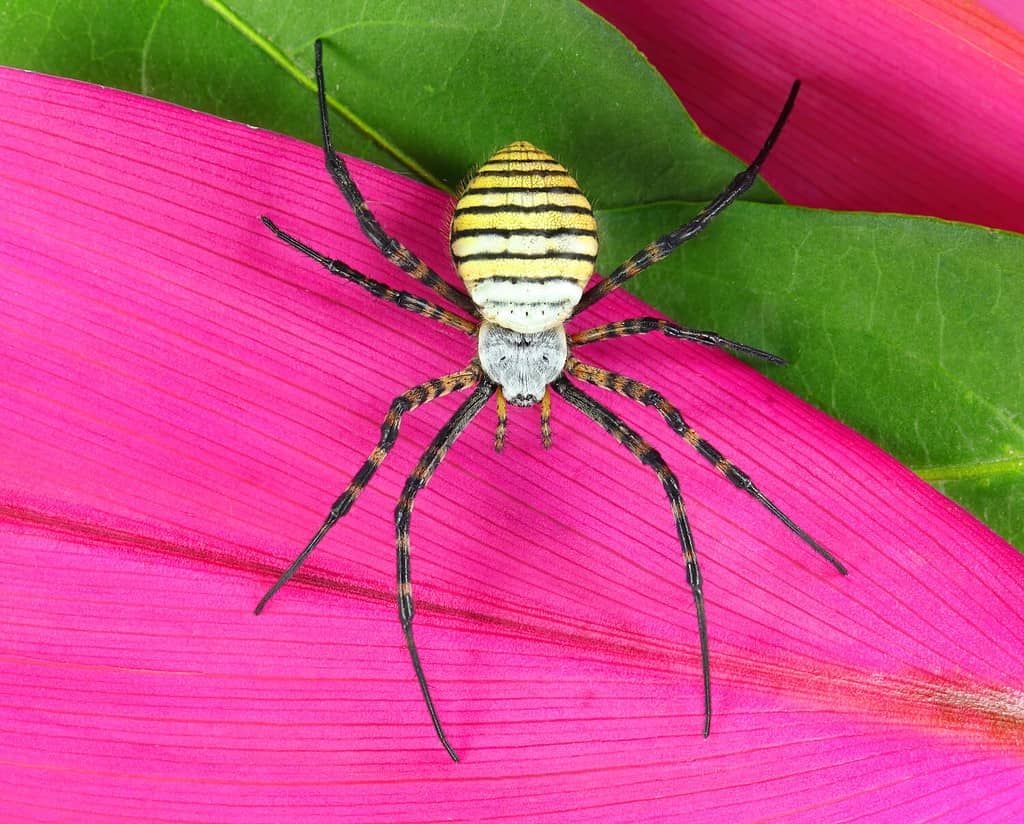
Banded garden spiders are recognized by their silver, yellow, and black horizontal bands.
©Protasov AN/Shutterstock.com
4. Long-Bodied Cellar Spider
The long-bodied cellar spider (Pholcus phalangioides) is sometimes also called a daddy longlegs spider. However, they are not like harvestmen, which are also called daddy longlegs. Cellar spiders are true spiders, unlike harvestmen. They have a legspan that can reach up to 2 inches, which is 5-6 times the length of its translucent, yellow-brown, peanut-shaped body.
Cellar spiders are common throughout the country and can be found living in urban areas all over Michigan. They are reclusive and shy, preferring dark, sheltered environments such as attics, basements, and the undersides of decks. Although their venom is potent to the insects they eat, they are not harmful to humans.
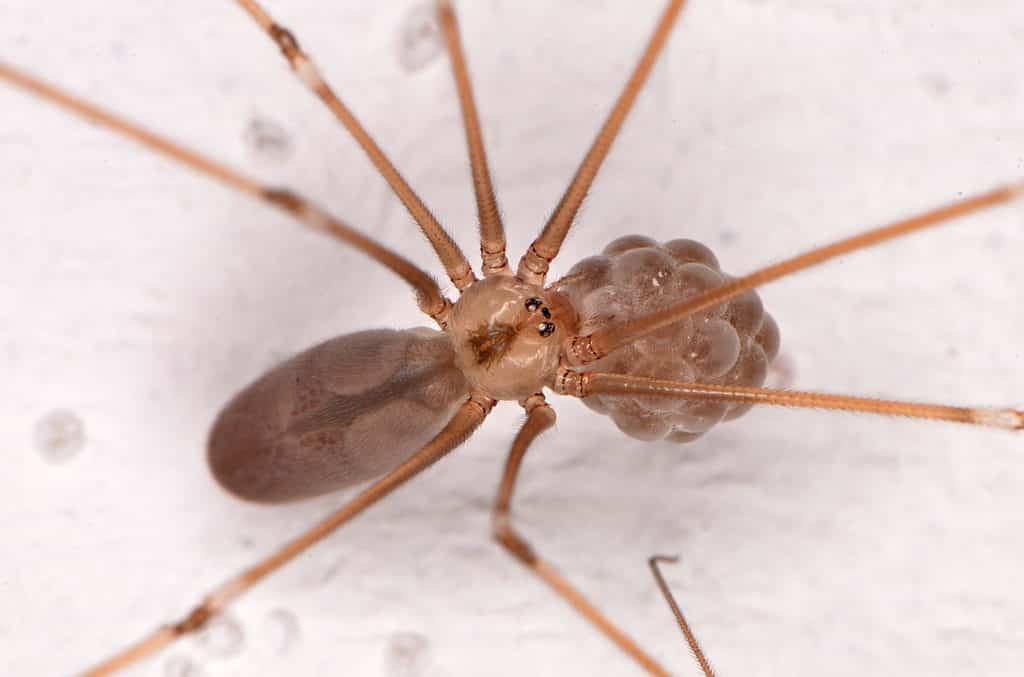
Long-bodied cellar spiders are sometimes called daddy longlegs.
©Marek Velechovsky/Shutterstock.com
5. Wolf Spider
There are well over 2,000 species of wolf spiders in the family Lycosidae. Over 50 different species live throughout Michigan. Depending on the species, wolf spiders are one of the largest spiders in Michigan. The largest wolf spider in North America, the Carolina wolf spider (Hogna carolinensis) reaches a legspan of 3-4 inches. These spiders are generally shades of brown, gray, or black with dark markings for camouflage. They get their name from their method of hunting. Instead of spinning webs and waiting for their prey to get caught, wolf spiders hunt their prey by ambushing it.
Wolf spiders aren’t likely to bite and will flee if possible. When threatened, they may bite, but their venom is not medically significant, although a bite would cause some pain and swelling. Female wolf spiders are excellent mothers. Unlike most spider species, they care for their young after they are born. The mother protects the egg sac and then carries the babies on her back for several weeks, until they are old enough to survive on their own.
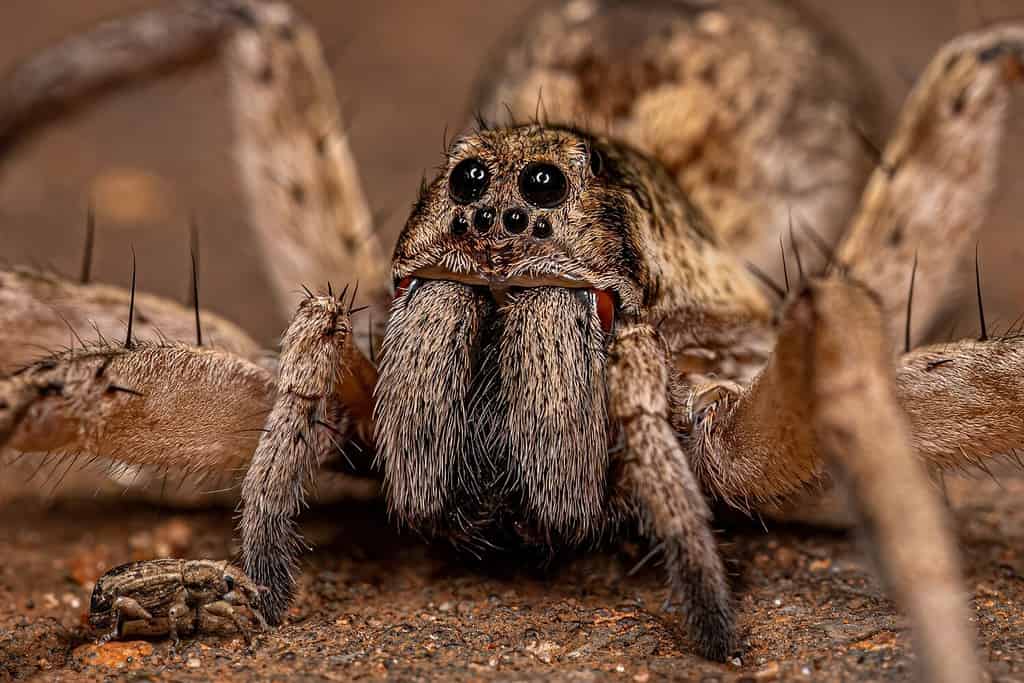
Wolf spiders do not wait for their prey to get caught in a web; they hunt by ambushing it
©Vinicius R. Souza/Shutterstock.com
6. Giant Lichen Orb Weavers
The giant lichen orb weaver (Araneus Bicentenarius) is a species of orb weaver that can be found mainly in the eastern half of the U.S. These orb weavers are called “giant” not just for their size, which is up to a 2-inch legspan, but also for the 8-foot webs that they weave. In Michigan, the giant lichen orb weaver can be found living throughout the state on trees that are covered in lichen, which is how it was named. Lichen is a composite organism made of algae and fungi that lives on trees. It may be grayish-green with thin, ruffled edges covering the bark. Lichen doesn’t harm the trees, but lives symbiotically on their surface.
The color and pattern of the giant lichen orb weavers match well with the lichen on trees. The spider camouflages itself to avoid predators and to catch food. It’s hard to spot a lichen orb weaver when it’s sitting quietly against the lichen of a tree. Like all orb weavers, they spin circular webs where they hide and wait for prey to get caught. Giant lichen orb weavers are not dangerous to humans, although they may bite if threatened or handled. Though they are venomous, the venom is only strong enough to subdue their prey, not to harm humans.
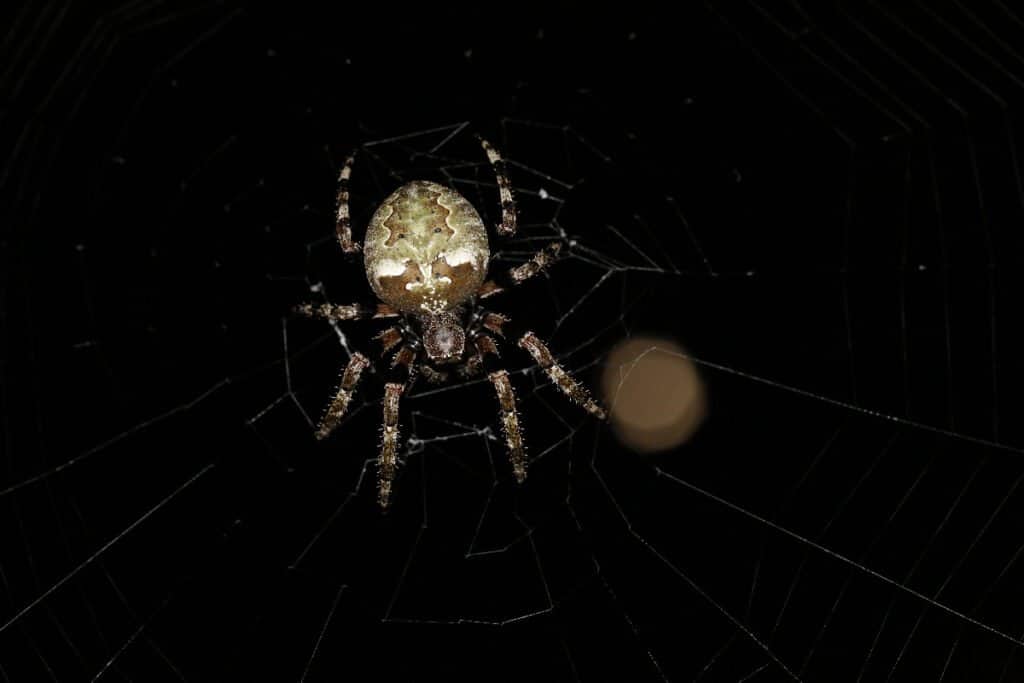
Giant lichen orb weavers camouflage themselves on lichen living on trees and spin 8-foot-wide webs.
©Cathleen Wake Gorbatenko/Shutterstock.com
7. Giant House Spider
Another of Michigan’s largest spiders is the giant house spider (Eratigena atrica). These funnel web spiders are not native to the U.S., but were brought over from Europe. Today, they are found in the Pacific Northwest and also in Great Lakes states, including Michigan and Wisconsin. They have long, hairy legs and mottled brown bodies. A female spider can have a body length of up to 0.70 inches and a leg span reaching up to 4 inches for large adults. They are often mistaken for hobo spiders, but hobo spiders are much smaller, with a legspan that is typically less than 2 inches.
Another way giant house spiders might surprise you is with their speed. They can dash across the floor at speeds of over 1.5 feet per second. As their name suggests, they often live in houses, including garages, basements, and attics. They are not aggressive and tend to run away from people. They won’t bite unless threatened or trapped. Bites are not known to be dangerous to humans.
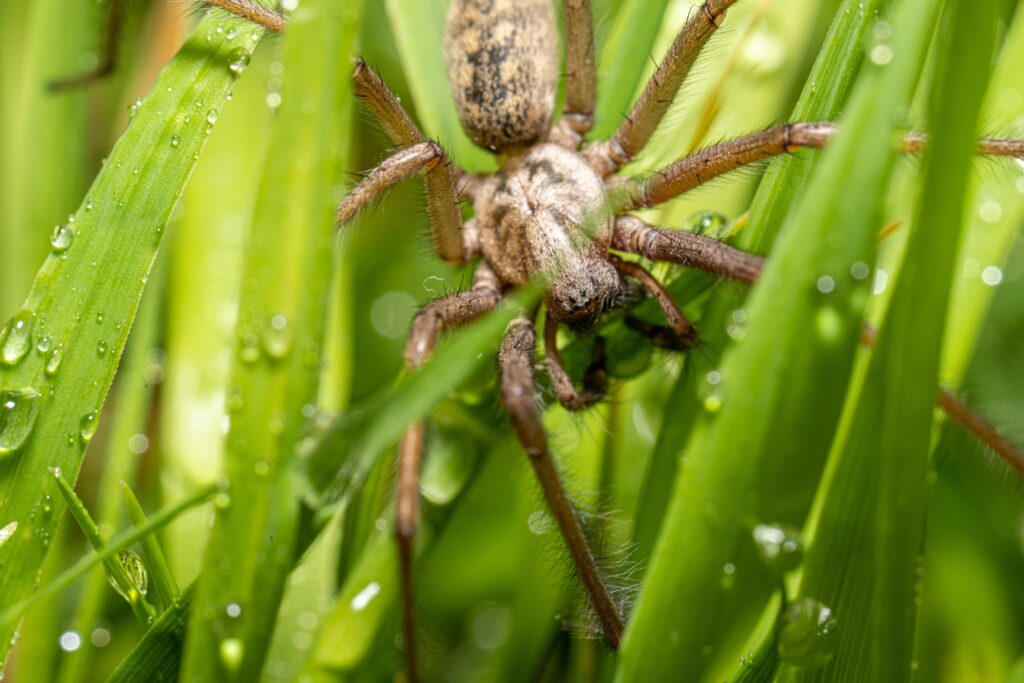
The giant house spider is not native to the U.S., originating in Europe.
©Trygve Finkelsen/Shutterstock.com
8. Yellow Garden Spider
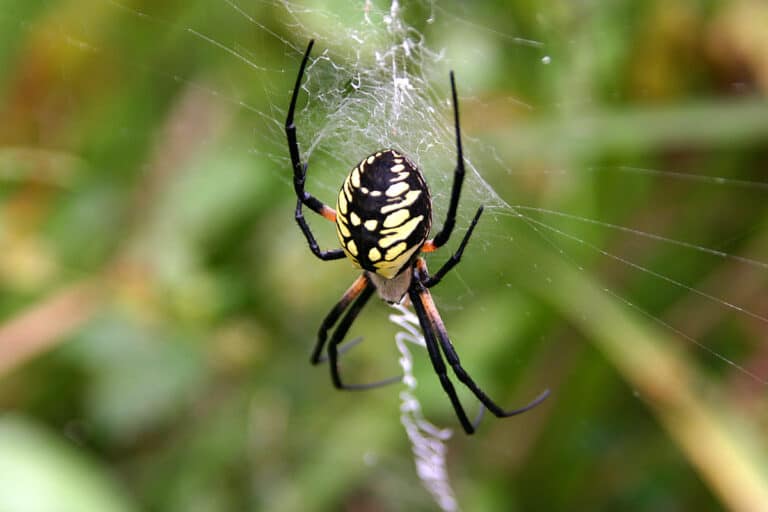
The yellow garden spider (Argiope aurantia) is also known as the black and yellow argiope spider or writing spider. They are orb weavers found throughout the U.S., including Michigan. These spiders can get pretty large for North American spiders. The females measure 0.75 to 1.1 inches in body length with a leg span of 2-3 inches, or about the same size as the diameter of a baseball. They are easy to spot with their bright yellow patterns against their black bodies.
You can recognize a yellow garden spider’s web by its vertical zig-zag pattern, which is where they get the name writing spider. You’re most likely to see them at the edge of where two habitats combine, such as the edge of a forest that opens into a grassy field. Their venom is not medically significant, but it will disable their prey, including dragonflies, moths, cicadas, and June beetles. These orb weavers are not likely to bite and will flee if possible from humans.
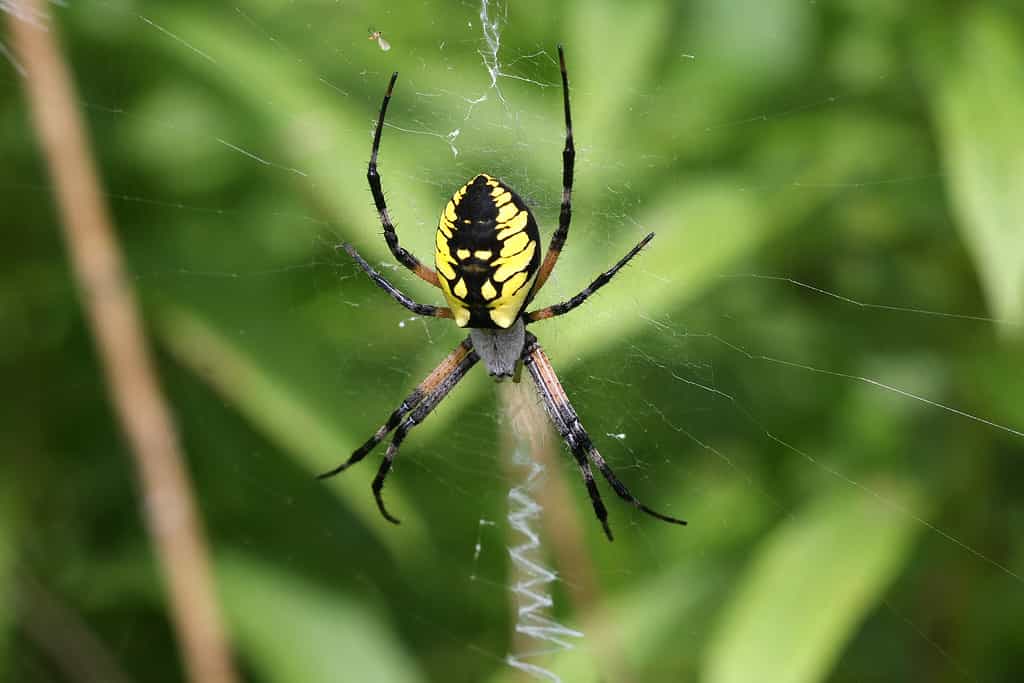
Yellow garden spiders weave spiral webs with a vertical zig-zag pattern down the middle.
©Ron Rowan Photography/Shutterstock.com
9. American Nursery Web Spider
Like wolf spider mothers, American nursery web spider mothers (Pisaurina mira) care for their young. They carry their egg sacs around until they hatch, and protect the new hatchlings in their web until they begin to disperse. These are some of the largest spiders you will find in Michigan, with bodies that measure roughly around 0.50 to 0.75 inches and leg spans that can reach over 3 inches.
Although they may resemble brown recluse spiders, American nursery web spiders don’t pose a threat to people. While they have enough venom to take down their prey, it’s not enough to harm a human. These spiders aren’t likely to bite unless trapped or protecting their egg sac or hatchlings. American nursery web spiders can be found across the eastern part of the country, including Michigan. They tend to live in grasslands and shrubs, but do sometimes make their way into people’s homes.
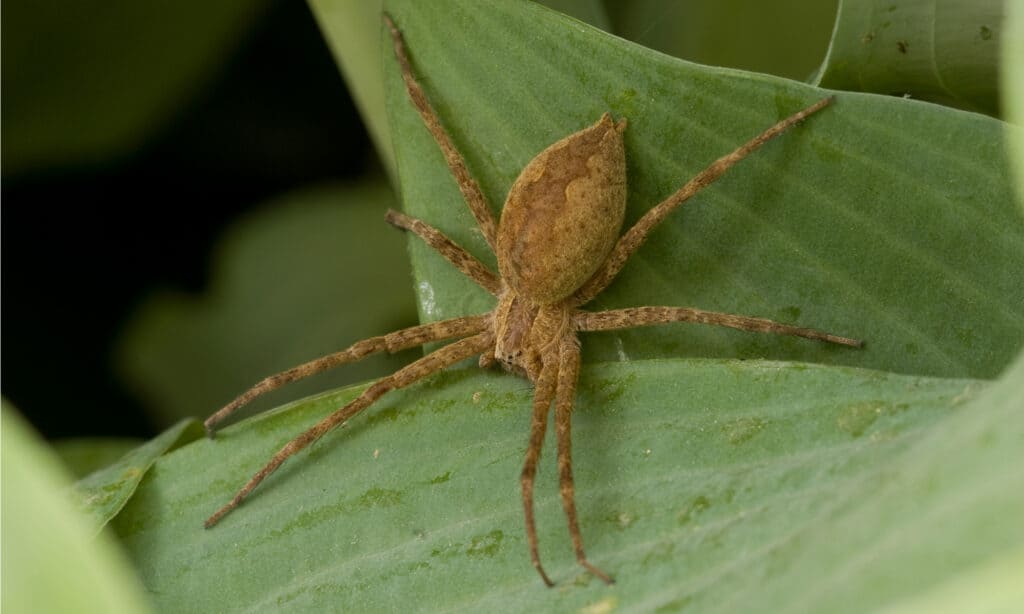
American nursery web spiders are named after the web they raise their young in.
©SDeming/Shutterstock.com
10. Dark Fishing Spider
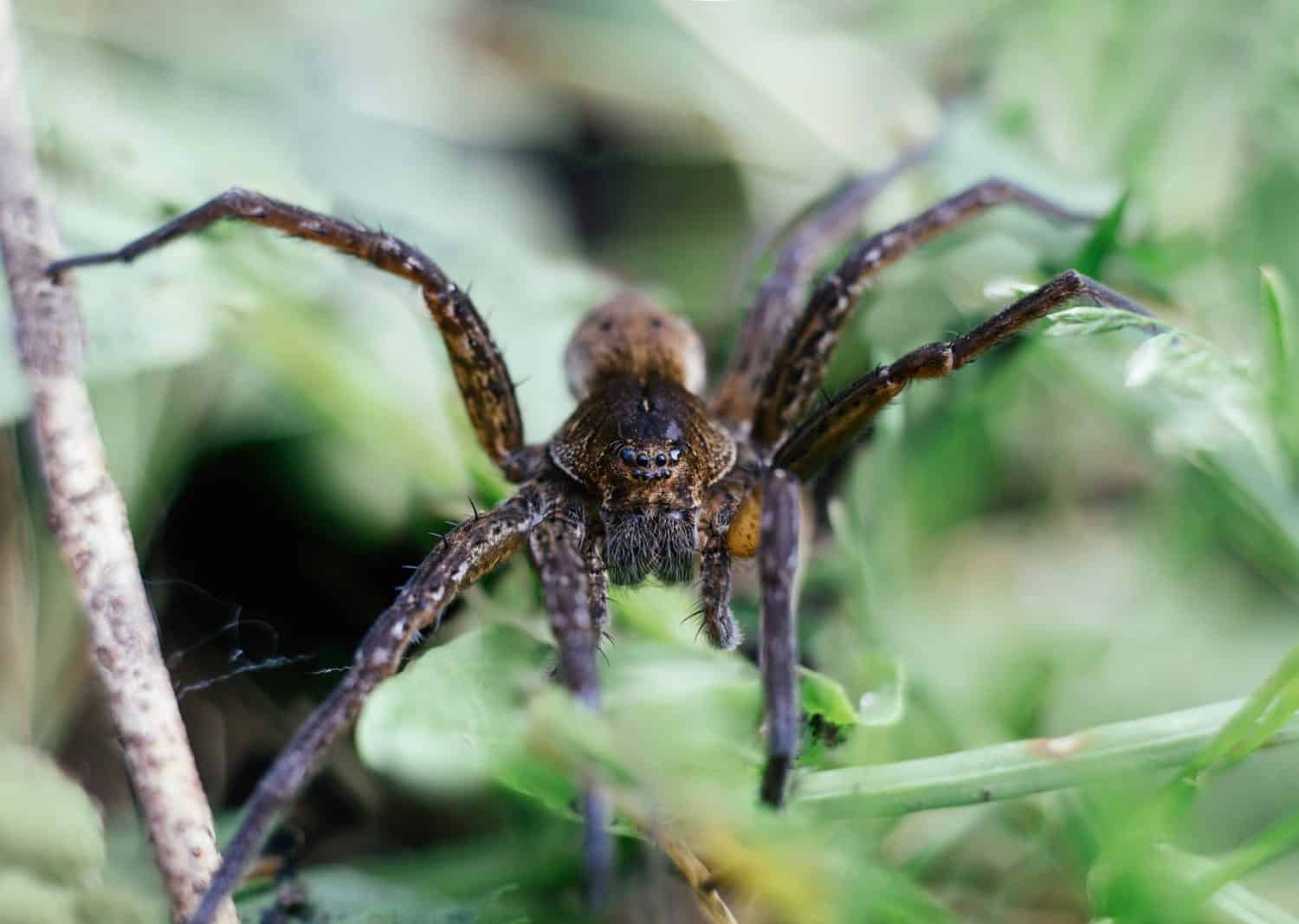
The dark fishing spider (Dolomedes tenebrosus) is one of the larger species of fishing spiders. Dark fishing spiders can be found across the eastern half of the U.S., including all over Michigan. A dark fishing spider has a body length of up to 1 inch and a legspan of 3-4 inches, which is about the size of a person’s palm. These spiders are a mottled brown and gray with dark markings on their abdomens and dark and light banding on their legs.
Fishing spiders live near bodies of water and prey on tadpoles, aquatic insects, and even small fish. Though they often live near the water, they can also be found in dry areas in forests and around rocks. Sometimes, in a hunt for food, they even make their way into people’s homes. Despite their size, they pose no threat to humans. They are more likely to flee than attack, and can even dive underwater to hide from predators. Bites are rare, but when they do happen, they have been compared to a bee sting.

With a legspan of 3-4 inches, dark fishing spiders are among the largest spiders in Michigan.
©Mary Swift/Shutterstock.com