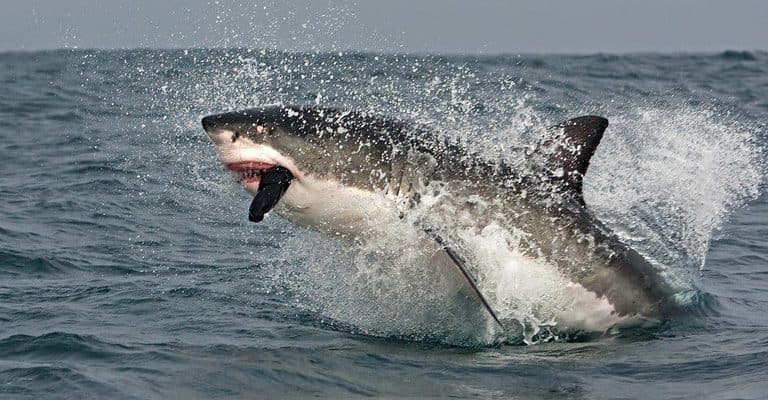

Tiger sharks are impressive animals. They are one of the largest and most aggressive shark species in the world. Tiger sharks, like great white sharks, are responsible for many shark attacks. However, did you know that tiger shark fishing is a popular sport? Tiger sharks put up a fight and are difficult to catch, which is why many anglers try to catch them in North Carolina. Can you guess just how big the largest tiger shark caught in the state was? Keep reading to discover the largest tiger shark ever caught in North Carolina.
How Big Is the Largest Tiger Shark Ever Caught in North Carolina?
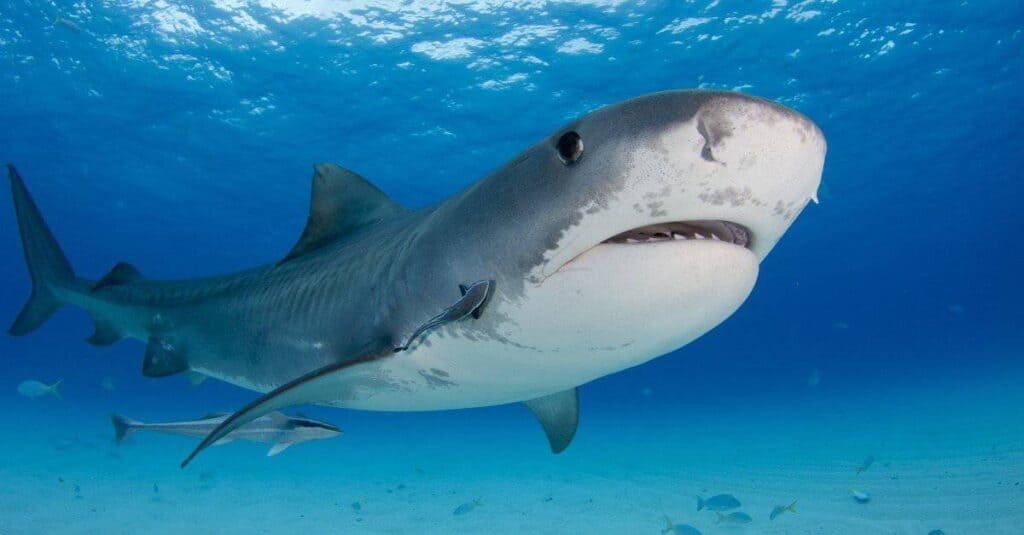
The largest tiger shark ever caught in North Carolina weighed 1,150 pounds.
©Matt9122/Shutterstock.com
In 1966, Walter Maxwell, a shark fishing legend, caught a 1,150-pound tiger shark at the Yaupon Beach Pier, which remains the North Carolina state record for the largest tiger shark. This catch came two years after Maxwell caught another record-breaking tiger shark in the Carolinas, which will be discussed later. While there are multiple shark records in North Carolina, none come close to the 1,150-pound beast that Walter Maxwell caught over fifty years ago. The closest second is a 768-pound mako shark caught by Russell J. Langford in 1983.
About Tiger Sharks
Tiger sharks (Galeocerdo cuvier) are a type of ground shark. They are members of the family Carcharhinidae. On the International Union for Conservation of Nature (IUCN) Red List of Threatened Species, they are listed as Near Threatened. Tiger sharks are among the largest shark species, regularly weighing more than half a ton. Learn more about these sharks in the following paragraphs.
Size and Appearance
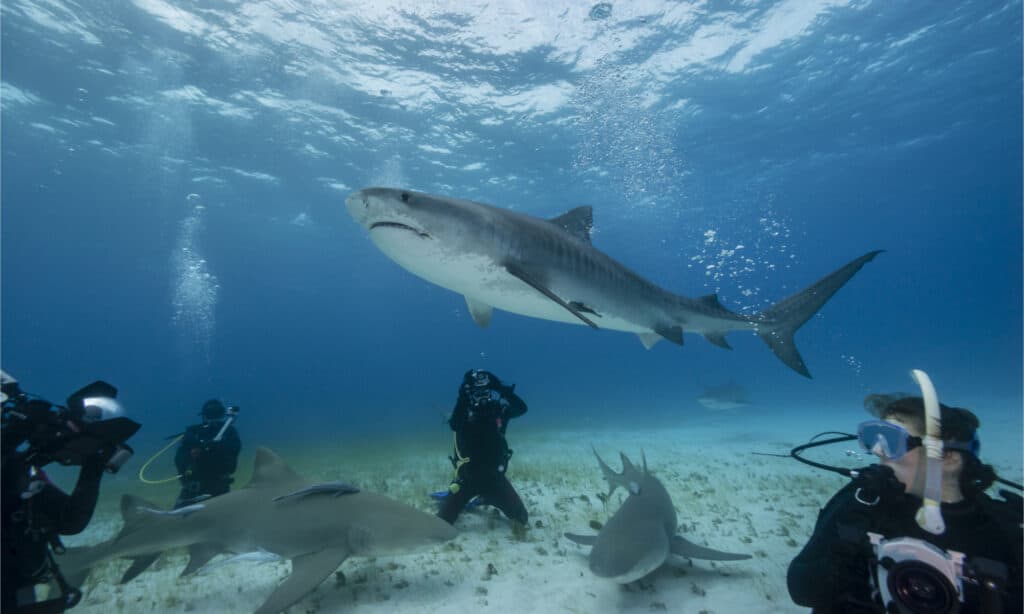
Tiger sharks are among the largest sharks in the ocean, reaching lengths of up to 18 feet.
©wildestanimal/Shutterstock.com
Tiger sharks have very sharp teeth with pronounced serrations and sideways-pointing tips. They also have long fins, particularly the pectoral fins, which are said to work like the flaps on airplanes to help them quickly move up and down in the water. Tiger sharks have blue-green skin with grey or white underbellies. They are best known for the tiger-like stripes on their sides. These stripes and spots are more vibrant in young tiger sharks and fade as they mature.
Apart from their tiger stripe-like markings, they are known for their massive size. Most tiger sharks measure between 10 and 14 feet, but they can reach up to 18 feet. On average, they weigh between 850 and 1,400 pounds. However, larger specimens have been reported. The world record tiger shark weighs over 300 pounds more than the upper end of the average range.
Distribution and Habitat
Tiger sharks live both in the open ocean and near the coasts in tropical and subtropical waters all over the world, except for the Mediterranean Sea. They are frequently found in harbors and estuaries, as well as in the shallow waters around islands. Tiger sharks are also migratory. They migrate from the tropics to more temperate waters in warmer weather and return to the tropics during the colder months.
Diet
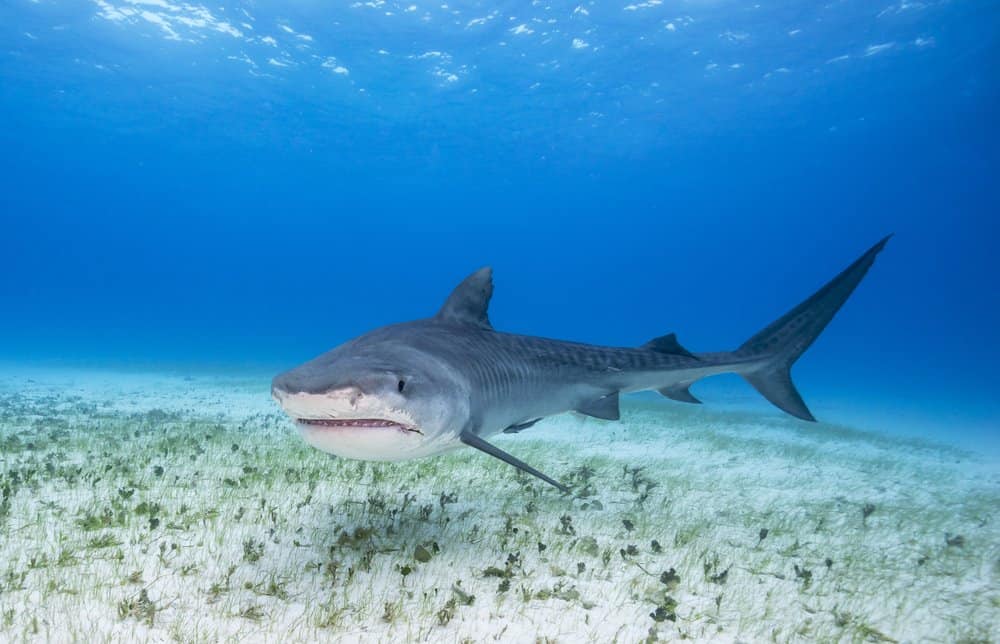
Tiger sharks are opportunistic and are said to eat almost anything.
©wildestanimal/Shutterstock.com
Tiger sharks are opportunistic feeders and will eat almost anything they encounter when hungry. During the day, they spend their days hunting in deep water, and at night, they come closer to shore. By the time tiger sharks reach about 7.5 feet in length, they can consume larger animals like other sharks, bottlenose dolphins, seals, and leatherback sea turtles. They also feed on squids, crustaceans, bony fish, sea birds, and carrion. Tiger sharks have been called the “garbage cans of the sea” because they sometimes consume trash, mistaking it for food.
Predators
Tiger sharks do not have many predators, as they are apex predators themselves. They are second only to great white sharks in terms of the danger they present to humans, based on the number of attacks they have been implicated in. However, humans are also a danger to tiger sharks. Humans and orca whales are the primary predators of tiger sharks. Orca whales have even been recorded holding tiger sharks down, causing them to drown.
The Largest Tiger Shark Ever Caught in the World

Tiger sharks are a popular big game fish worldwide.
©Thierry Eidenweil/Shutterstock.com
Technically, there are two world records for the largest tiger shark ever caught. The record-holding tiger shark weighed 1,785 pounds and 11 ounces. Kevin J. Clapson caught this massive shark in 2004 off the coast of Ulladulla, Australia. While he beat the previous record, it is technically a tie. For a new record to be considered, the catch must weigh at least 5% more than the previous record. However, Clapson’s tiger shark was only 5 pounds more than the previous record, but it needed to be 8 pounds and 14 ounces heavier. So, what was the previous record?
Walter Maxwell, the same angler who holds the North Carolina tiger shark record, caught a 1,780-pound monster on June 13, 1964, at Cherry Grove Pier in North Myrtle Beach, South Carolina. It took over five hours and a lot of patience, but he reeled in the jaw-dropping record, breaking the previous record by 300 pounds!