Quick Take
- Wild turkeys require high tree branches for their nocturnal rest.
- Turkeys tend to roost communally, which fosters communication.
- Turkeys have poor eyesight, so their night vision is not good enough for them to avoid predators.
- Poults must remain with their mother in the nest on the ground until they can fly and roost at 8 to 14 days old.
Wild turkeys (Meleagris gallopavo) are native to the Americas. There are five subspecies found across the U.S., except for Alaska. Turkeys favor grasslands and forests with nut- or berry-producing trees. These birds are diurnal and spend their days grazing and searching for food. Turkeys can often be found foraging along roadsides, in clearings, and at the edges of fields. But, how and where do they sleep at night? Read on to learn more about the surprising sleeping habits of turkeys.
All About Turkeys
Turkeys are very large, stout game birds. They have long, powerful legs, broad, fan-shaped tails, long necks, and small heads. Turkeys generally have dark plumage overall with a greenish-bronze iridescence. Their wings are also dark, with pale bars. Males, or toms, have unfeathered heads and necks, spurs on their legs, red wattles on their throats, and a long tuft of feathers on their breasts. The bare skin on their heads can be red, blue, or grey, depending on the season. Females, called hens, are smaller than males and are not as dark or colorful. They have blue-gray heads with feathered necks. Hens typically lack the tuft of feathers on the breast and do not have spurs.
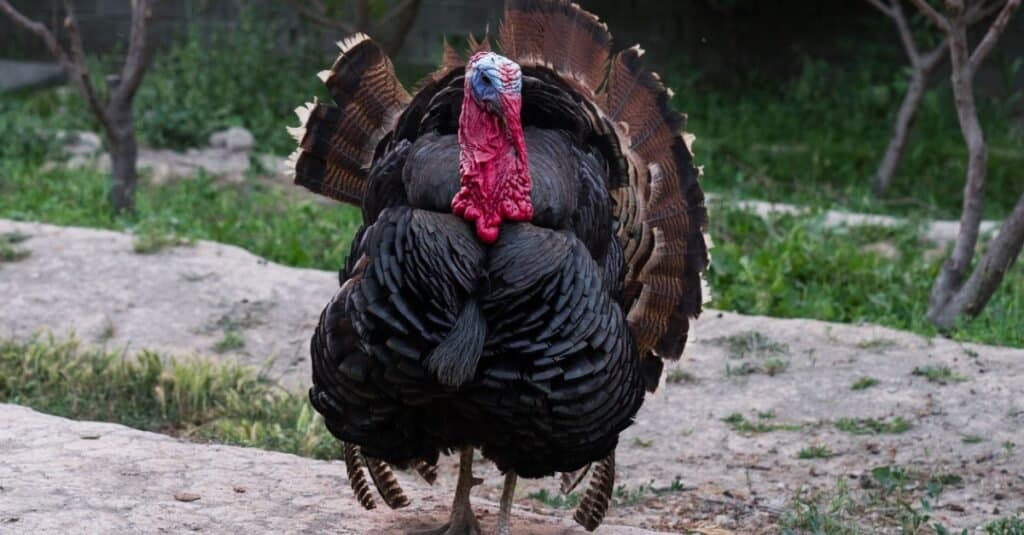
Wild turkeys typically weigh up to 25 pounds.
©iStock.com/DA69
Male wild turkeys are around 4 feet tall and generally weigh from 15 to 25 pounds. Females stand about 3 feet tall and weigh between 8 and 12 pounds. They are the largest members of the order Galliformes, which also includes chickens, pheasants, quail, peacocks, and many others. As noted above, turkeys favor open grasslands and forests, especially mixed pine and mature hardwood forests with clearings. Wild turkeys are omnivores, feeding on acorns, nuts, hard fruits, berries, corn, seeds, and small vertebrates such as insects and salamanders. Young turkeys, referred to as poults, tend to eat more insects. Turkeys can swim and fly, but they rarely fly farther than about 300 feet. However, they are very fast, capable of reaching speeds of up to 54mph.
Turkey Sleep Behavior
While turkeys have exceptional daytime vision, their night vision is not good enough for them to avoid predators in low light conditions. Therefore, when it gets dark, turkeys generally roost communally in trees, although some may roost alone. The turkeys fly up and perch high off the ground, where they are safe from predators, then fly back down in the early morning. The ideal turkey roosting tree is 40 to 50 feet tall with a wide diameter, horizontal limbs, and an open understory. This allows the turkeys to search the ground for predators before leaving their perches. Large trees also allow for communal roosting, which fosters communication among the birds.
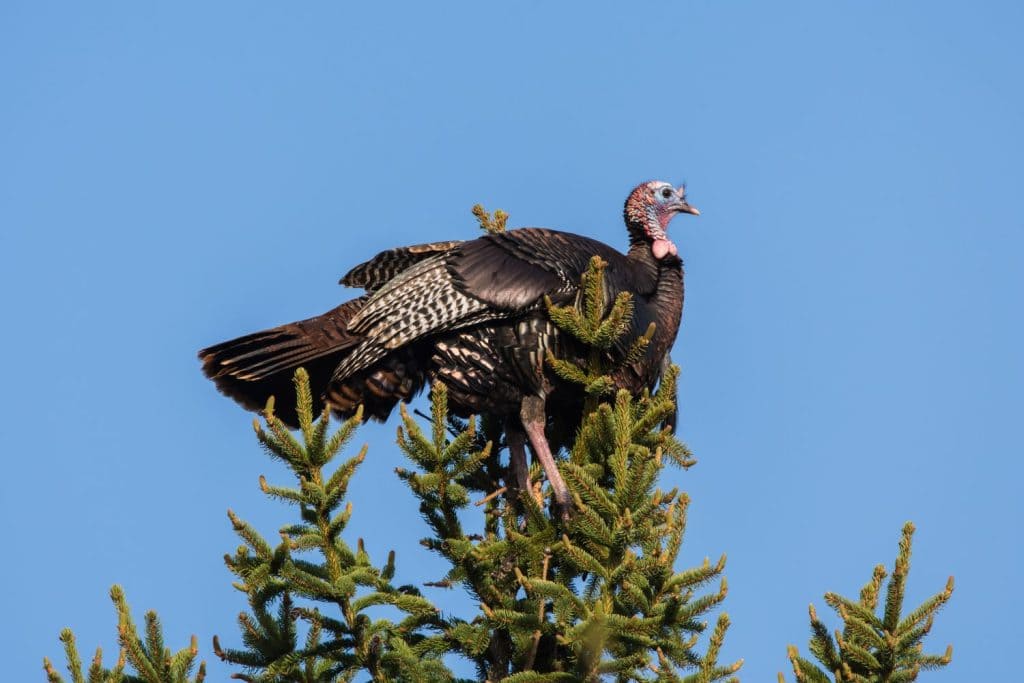
Turkeys roost high up in the trees to avoid predators.
©Paul Sparks/Shutterstock.com
During the winter, roosts are typically located closer to resources, including water, clearings, and shelter. Roost sites may also be closer to buildings, where turkeys can access supplemental food sources due to the proximity of humans and livestock. Researchers have found that turkeys in the northern parts of their range tend to select conifers during the winter because these trees help mitigate the effects of wind and, thus, heat loss. Communal roosting in winter may also aid in thermoregulation.
When resting on a perch or other elevated surface, turkeys remain still in either a sitting or standing position. The head is either hanging down in a forward-facing direction or tucked backwards into the feathers behind its wing or above the base of its wing. One or both eyes may be closed, or they may slowly open and close their eyes.
Where Do Young Turkeys Sleep?
The breeding season for wild turkeys begins in early spring. The toms start to gobble and display their feathers for the females. Hens build their nests in depressions on the ground. They use whatever materials are nearby to line the nest. Nests are typically located at the bases of trees or under thick vegetation in the cover of the forest but near a clearing.
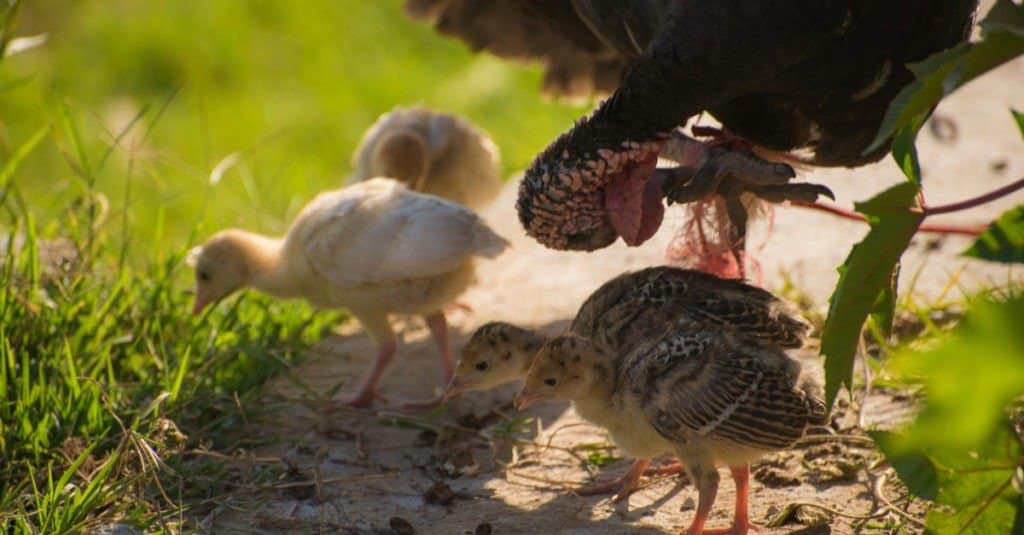
Poults sleep in nests with their mothers on the ground.
©Arturo Verea/Shutterstock.com
Hens generally lay between 8 and 14 eggs, at a rate of one egg per day. When all of the eggs have been laid, the mother will incubate them for about 25 to 31 days. The chicks are precocial and can walk and feed themselves within 24 hours of hatching. The young male poults stay with their mothers until fall, while the females remain until the following spring. Turkey chicks can fly short distances and start roosting in trees between 8 and 14 days old. Until then, they sleep in the nest with their mother.