Quick Take
- Turtle shell colors aren't random. They serve a hidden survival function that goes far deeper than simple camouflage. See how color aids survival →
- Some turtles sport pink, gold, and purple markings, and the biological reason behind these vivid colors might surprise you. Explore vivid shell colors →
- The underside of a turtle's shell tells a completely different color story than the top, and there is a clever reason why this is the case. Discover countershading explained →
- Which turtle carries a shell blazing with orange, pink, and purple concentric rings? The answer is wilder than you'd expect. Find the colorful species →
Beautiful, shelled reptiles roam the earth, hiding among twigs, tree roots, plants, and ocean waves. These animals are turtles. Depending on where in the world they live, their coloration varies from vivid green to startling white. Many turtles have colorful markings in red, pink, orange, or yellow, while others come in neutral shades. Read on to take a look at some of these incredible turtle colors.
Why Are Turtles Certain Colors?
Turtles, whether terrestrial, semi-aquatic, or fully aquatic, typically have coloration that helps them blend into their environment. This means that turtles living in the ocean have more aquatic colors, while land turtles have more earthy coloration. Spots, lines, and streaks on dark shells help disrupt a turtle’s outline and mimic the sunlight shining through the trees onto the forest floor. This allows the turtles to hide from predators among vegetation, mud, and leaf litter.
In most cases, the tops of turtle shells, known as the carapace, are darker than their undersides, the plastron. This is called countershading. For aquatic and semi-aquatic species, the lighter-colored plastron helps the turtles blend in with the sunlight filtering down into the water from above, while the darker carapace blends in with the river bottom or ocean floor below. Evolutionary traits like vivid, colorful markings can also serve as visual signals to help turtles of the same species recognize one another during the mating season.

The woodland box turtle’s colors help it blend in with the leaf litter on the forest floor.
Turtle Shells and Markings
Turtles of all types typically come in varying shades of green, gray, brown, or black as their dominant colors. However, they often have markings in a wide range of more vivid colors.
- Dark brown
- Black
- Reddish-brown
- Dark gray
- Mottled gray
- Gray
- Dark green
- Bright green
- Olive green
- Tan
- Red
- Yellow
- Orange
- Pink
- Purple
- Off-white/cream
- Gold
- White
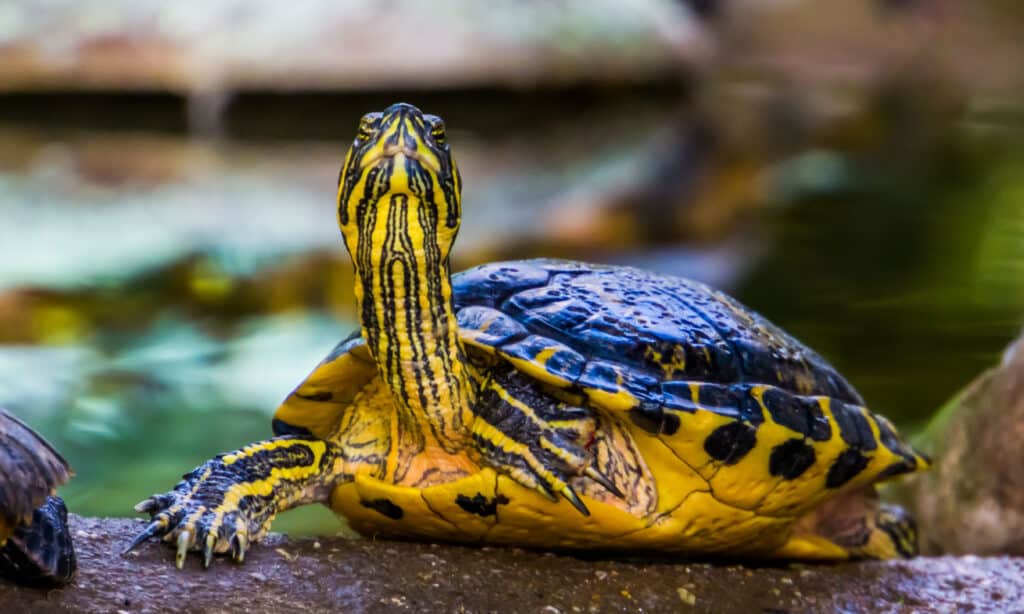
This bold yellow color can help turtles find others of their species.
©iStock.com/Charlotte Bleijenberg
Sea Turtle Colors
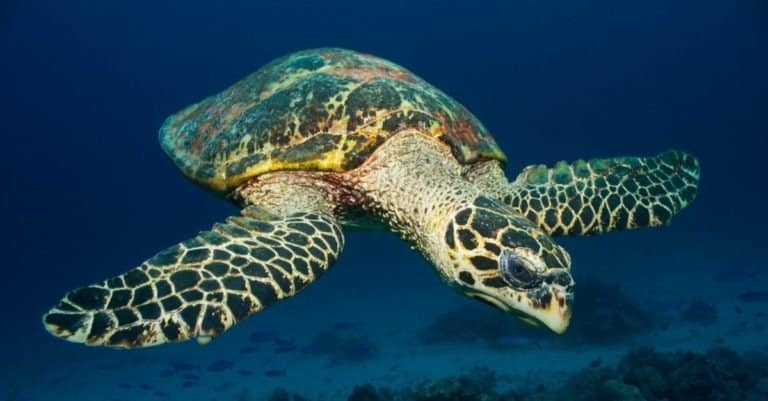
Depending on the species, sea turtles may be olive-green, grayish-green, greenish-brown, reddish-brown, yellow, or black. Some hawksbills have shells with yellow, orange, red, amber, brown, or black patterns of streaks and blotches. Leatherback turtles have dark carapaces with white, pink, and blue spots and white plastrons with dark spots. Most sea turtles have countershading, with a dark dorsal side and a light ventral side. As noted above, this countershading helps them hide in the ocean’s depths from predators.

Sea turtles, like this green sea turtle, have a dark carapace and light plastron for camouflage in the ocean.
©wrangel/iStock via Getty Images
Semi-Aquatic Turtle Colors
Semi-aquatic turtles live on land, basking in sunlight, and spend a great deal of time in the water, where they typically feed. The majority of semi-aquatic turtles come in brighter colors, often with red, orange, pink, bright green, or yellow markings across their bright to dark green or brown to black bodies. The markings can been seen on their faces, necks, upper and lower shells, legs, and feet. One of the most well-known semi-aquatic turtle species is the red-eared slider. These turtles have green to dark brown shells, often with yellow stripes or other markings. Their skin is green to brown with yellow stripes. They have a bright reddish orange patch behind each eye.
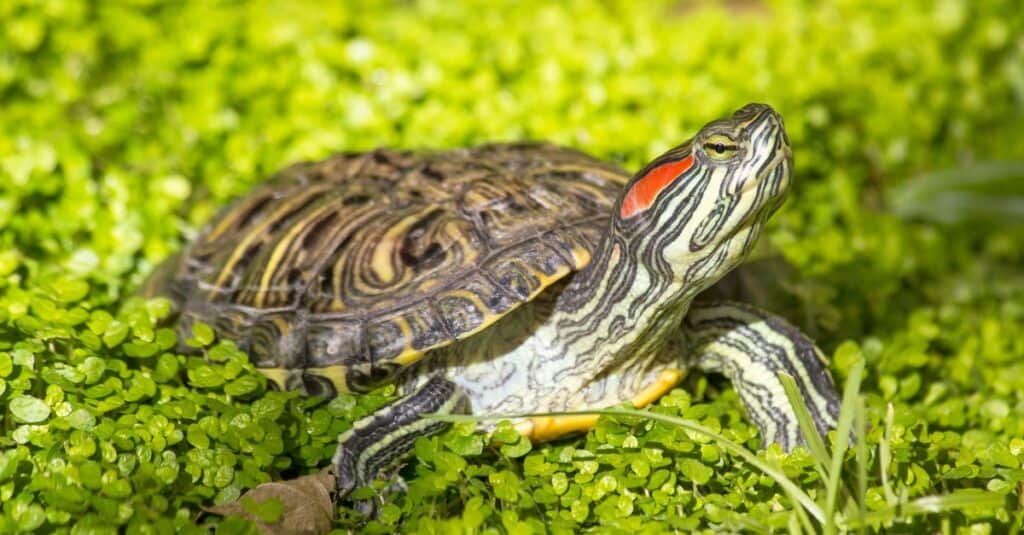
Red-eared sliders have bold red patches where “ears” should be.
©xbrchx/Shutterstock.com
Terrestrial Turtle Colors
Land turtles may come in a variety of colors. Most of these are tortoises or box turtles and their subspecies. These land animals generally come in shades of olive green, tan, brown, dark brown, and reddish browns. Their markings may be orange, yellow, olive-green, or darker brown than the rest of the shell. A great example of these colorful terrestrial turtles is the Florida box turtle. This animal has a dark brown to black shell with yellow to orange spots, stripes, streaks, or unusually shaped figures on their shells. Their heads are dark with yellow or orange stripes or markings. This kind of pattern is fairly common for a variety of land turtles.
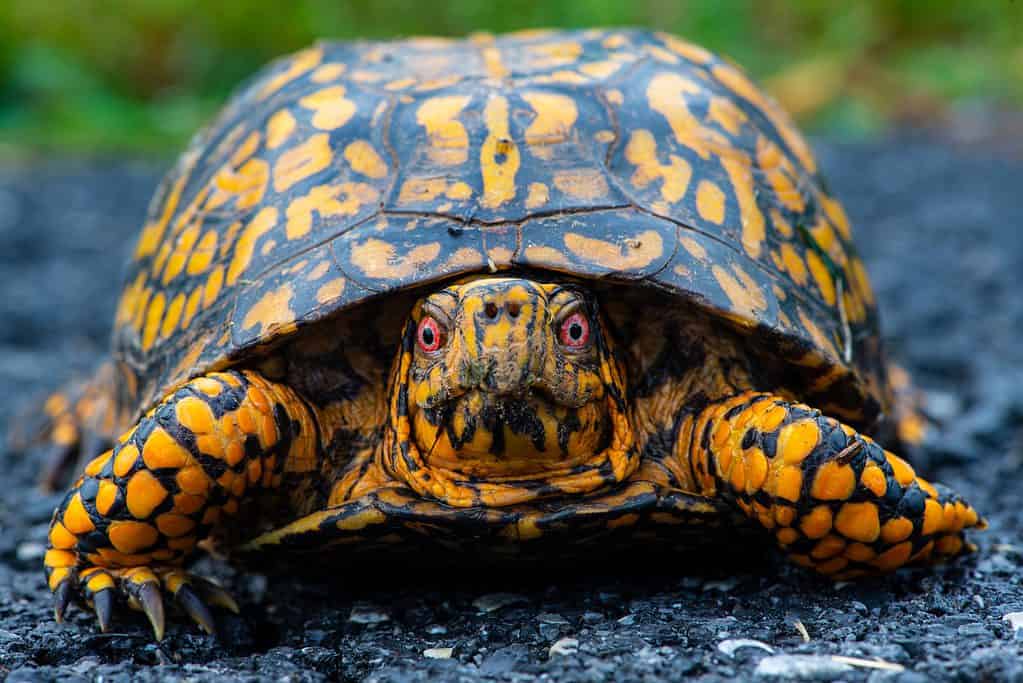
The box turtles of North America often have bold yellow markings.
©RenEgAdeRooStEr/Shutterstock.com
Turtles and Their Colors
Turtles are primarily shades of gray, brown, green, or dark yellow. However, many turtles have bright markings and patterns as part of their overall coloring. The chart below describes the coloration of some common turtle species.
| Turtle Name | Coloration |
|---|---|
| Common snapping turtle | dark brown or black with yellow or orange spots |
| Loggerhead turtle | reddish-brown with a yellow plastron |
| Eastern painted turtle | dark carapace, yellow plastron, and red and yellow stripes on the head, neck, and limbs |
| Blanding’s turtle | gray to black with bright yellow spots or streaks and a vivid yellow neck |
| African helmeted turtle | olive-green with a yellow plastron |
| Yellow-blotched map turtle | olive green to dark brown with yellow lines or patterns and bright yellow or cream stripes running down the head |
| Mekong snail-eating turtle | olive green to brown with yellow patterns, bright yellow or cream stripes running down the head |
| Green sea turtle | olive green to black with a yellowish-white underside |
| Eastern box turtle | dark brown or black with orange or yellow markings |
| Spotted turtle | black or bluish-black carapace covered in yellow, cream, or orange spots |
| Northern giant musk turtle | dark brown, black, gray, olive-brown, to a reddish or greenish shade with light and dark patterns |
| Red-footed tortoise | dark shells with gold, yellow, or tan patches in the middle of each scute |
| Indian star tortoise | golden to near black with light and dark star-shaped markings |
| Flowerback box turtle | olive-brown with orange, pink, purple, white, or cream concentric rings |
| Red-bellied short-neck turtle | olive, charcoal gray, brown carapace with a bright red, orange, pink, or yellow plastron |
| Hilarie’s toadhead turtle | gray to olive with a yellow border and a light plastron |
| Pink-bellied side-neck turtle | olive, grey, or brown carapace with pink, reddish pink, or salmon plastron |
| Pancake tortoise | brown shell with bright yellow markings |
| Ringed map turtle | olive to dark brown with dark-bordered yellow or orange rings |
| Spotted flapshell turtle | olive-green to gray-green carapace with dark yellow or black-bordered yellow spots |
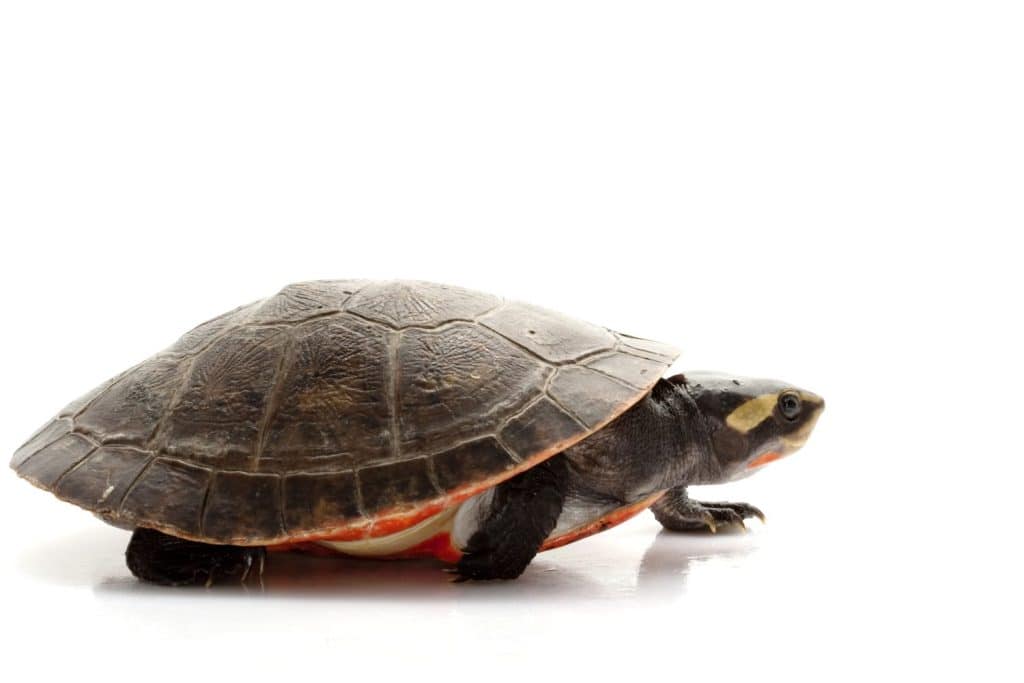
The pink-bellied side-neck turtle has a bright pink, reddish-orange, or salmon plastron.
©fivespots/Shutterstock.com