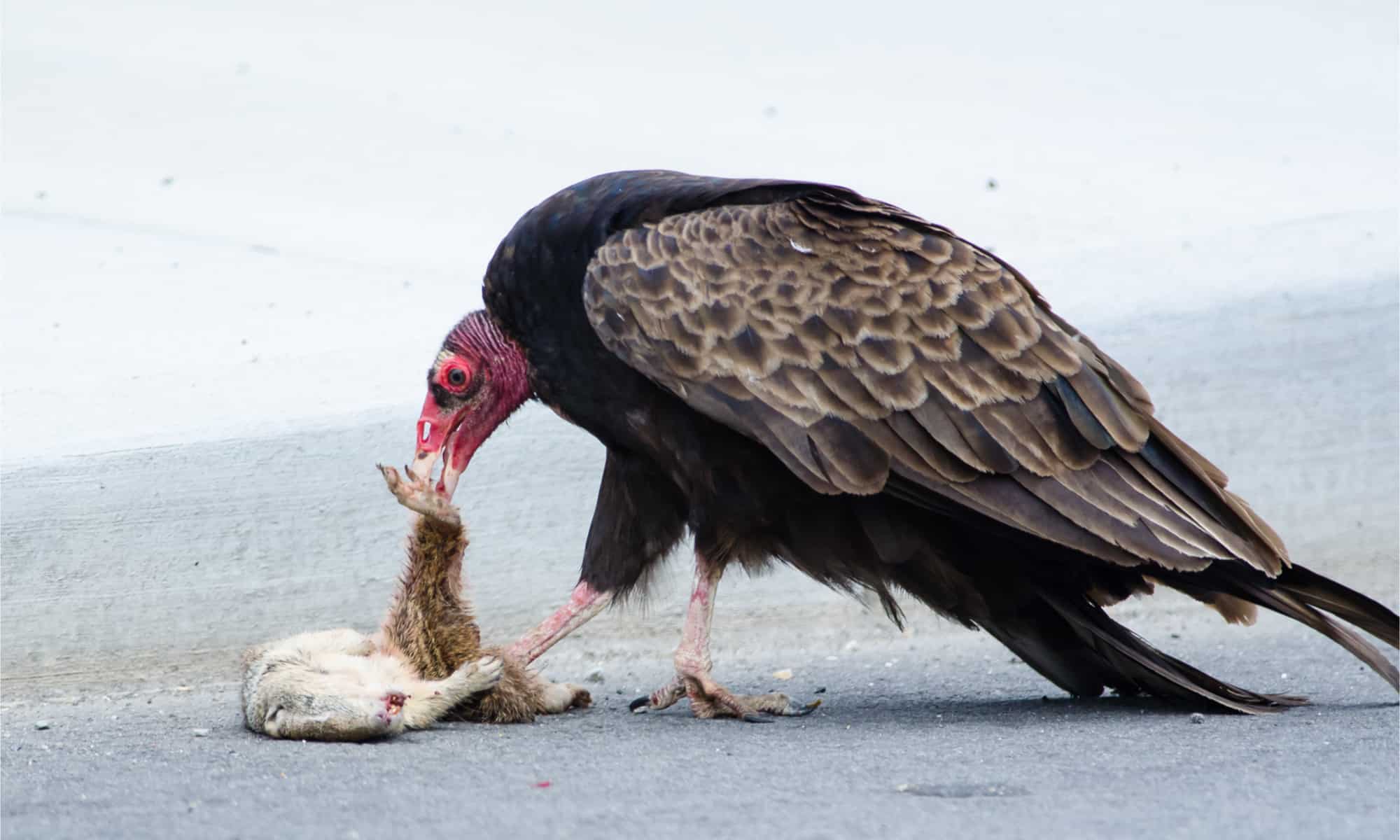

Turkey vultures are commonly found in North America and even in South America. These vultures, which resemble turkeys, are known for their long wingspans and lazy flying patterns. But what do they eat? Many people know vultures to be scavengers, but their diet does not only consist of opportunistic meals and leftovers. So let’s find out what turkey vultures eat.
Turkey Vultures: Diet
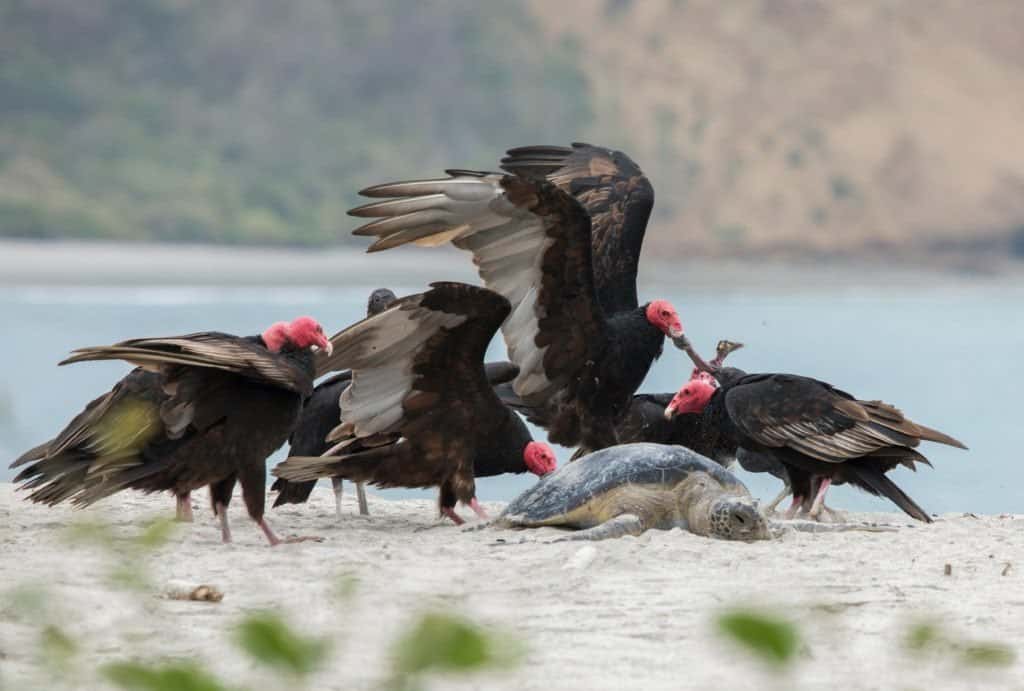
Turkey vultures eat carrion and dead or sick birds and animals.
©Ana Dracaena/Shutterstock.com
Turkey vultures primarily eat carrion, young or sick birds, and animals. However, they are technically omnivorous, which means they consume both plants and animals.
Carrion is the dead flesh of an animal, and this is turkey vultures’ first choice of food. They will eat a decaying carcass but prefer a fresh corpse. Turkey vultures have a strong sense of smell, which aids them when looking for food.
Turkey vultures will also eat dead birds, reptiles, amphibians, and invertebrates. Turkey vultures do not have a firm grip on their feet, meaning they consume most of the carrion where they find it. If these birds have no access to carrion, young or sick animals, they will eat other food like human waste, berries, fruits, and vegetables.
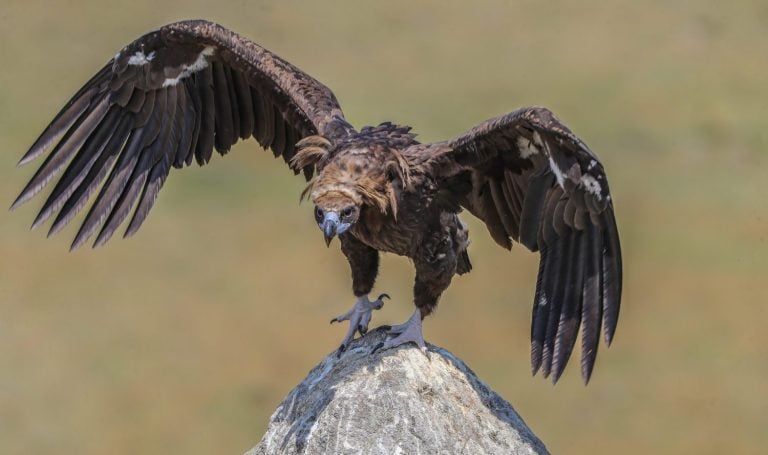
Turkey vultures are not the only animals that feed on carrion. They must compete with black vultures, lesser yellow-headed vultures, greater yellow-headed vultures, king vultures, and Andean condors. Also, black vultures are often their main competition, as they follow the turkey vulture and then fight it off once it finds carrion.
What Do Turkey Vultures Look Like?
Turkey vultures have red heads and necks, similar to turkeys, and that’s where they got their name. Although they resemble turkeys, they are smaller than turkeys and shaped differently. These vultures also have brown plumage across their body and have “fingertips” at the tips of their wings.
Their wings are often white or grey on the underside, which is a strong identifier. These vultures have tails that are longer than their legs and are either red or white-grey. Their legs may seem white because of urohidrosis. Urohidrosis is when animals, commonly birds, urinate on their legs to cool down. The dried uric acid causes a lighter color.
Turkey Vulture: Size
Adult turkey vultures grow roughly 32 inches long and weigh up to three pounds. They have a large wingspan that reaches almost six feet long. Turkey vultures reach maturity at around two years old. At this point in their lives, their heads will fully redden, and they will have reached their full weight and size. Male and female turkey vultures are often the same size and weight, unlike other vultures.
Location and Habitat
Turkey vultures are commonly found in many states across the United States. You might also be lucky enough to see them in Canada, and they migrate to Mexico, Columbia, and Ecuador during the winter. Turkey vultures are opportunistic in their diet and nesting habits. These vultures will nest in empty nests and on ledges.
Depending on their location, turkey vultures choose to migrate to different places, while some don’t migrate at all. For example, turkey vultures in the southern parts of the United States often do not migrate as these areas are warm all year round.
On the other hand, turkey vultures found in the northeast parts of the United States migrate to places like North Carolina, and vultures found in the western parts of the country migrate all the way down to Venezuela, Colombia, and Ecuador.
The Mating Habits of Turkey Vultures
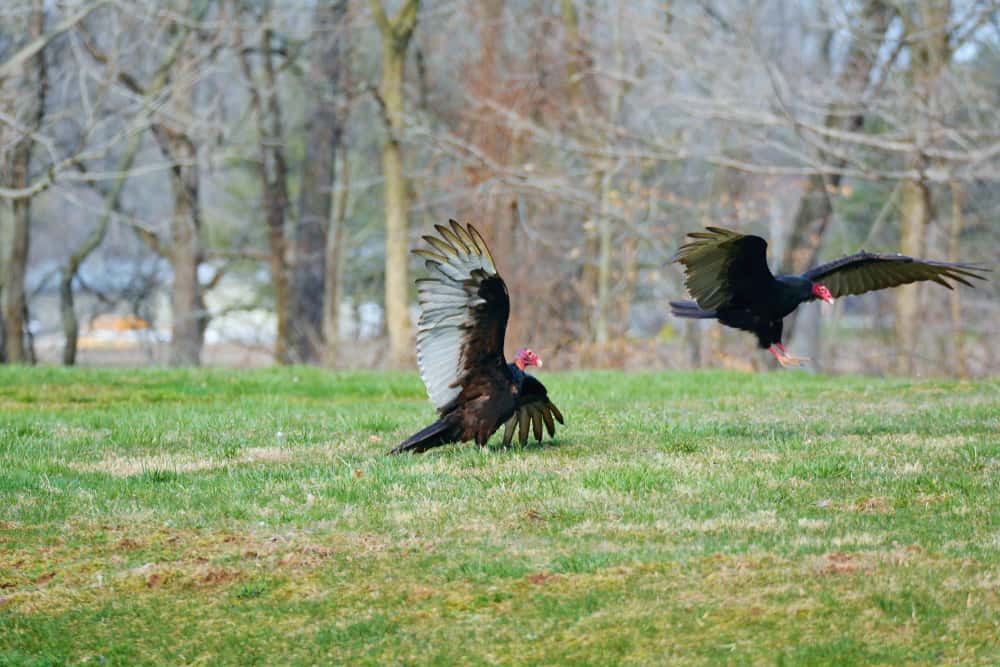
Turkey vultures participate in aerial courtship rituals to establish pair bonds.
©James W. Thompson/Shutterstock.com
Turkey vultures in North America often choose to breed in areas with as few humans as possible, like farmlands, rangelands, forests, and lower regions of mountains. These vultures do not build nests, which means they either find abandoned nests or lay their eggs on ledges, caves, hollow logs, or even on the ground.
Turkey vultures are monogamous animals, and pairs are known to remain together until death. These pairs are also known to reuse old nesting sites during every mating season. Turkey vultures practice aerial courtship, which means one of them follows the other and mimics the other’s flight path. Turkey vultures commonly lay two eggs, but sometimes they lay only one or up to three eggs. The incubation process is five weeks long, and both vultures share in raising their young.
Once the eggs hatch, both vultures brood the young and feed the young through regurgitation. The young will fledge at 60 to 80 days and stay with their parents for one to three weeks after their first flight. At roughly 12 weeks old, the young would have left their parents and nesting area.
Flying Habits
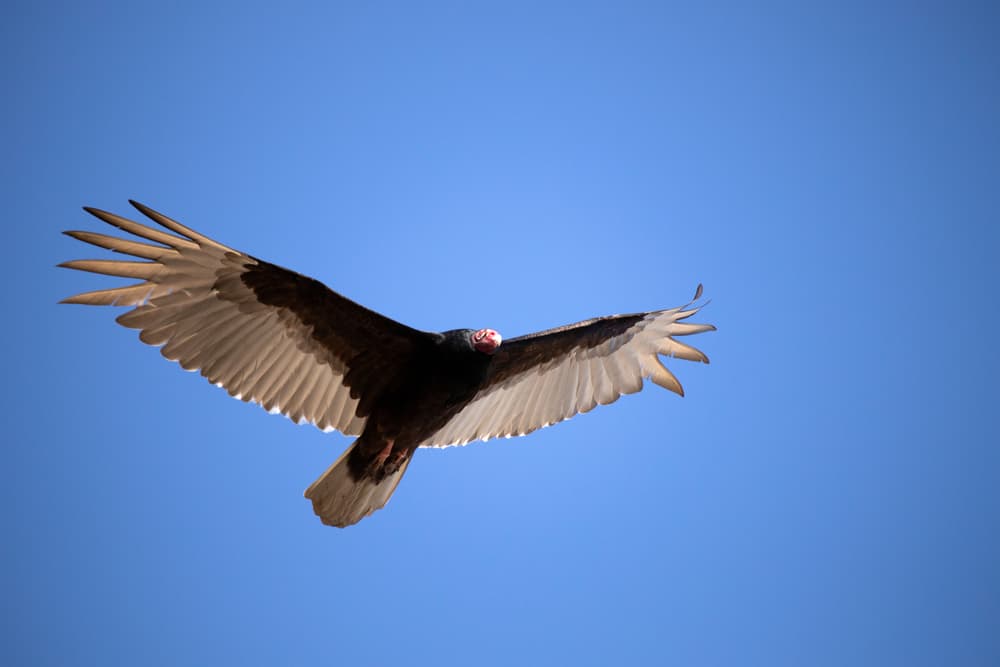
A circling Turkey Vulture looking for food.
©GarySang/Shutterstock.com
Like other vulture species, turkey vultures circle as they fly. However, to circle, vultures use the thermals to stay in the air and cover a large area without using much energy. Thermals, better known as thermal columns, are warm air streams rising into the sky. Their large wingspan uses these thermals to rise, taking up less energy.
Turkey vultures often circle because they are looking for food. Sometimes they will continue circling after they have found the food to ensure that there are no other predators around the prey or carrion. Although turkey vultures have an impressively long wingspan, they are not the best fliers, as they are adapted for soaring rather than flapping. As a result, turkey vultures often use small-scale turbulences to stay in the air.