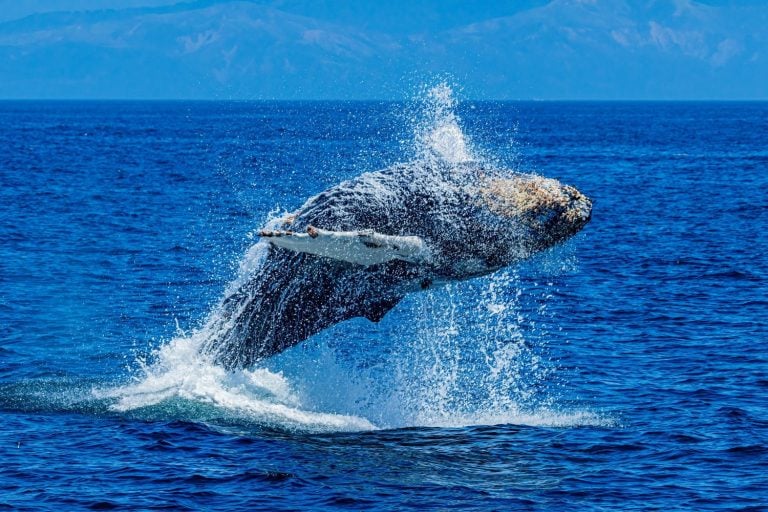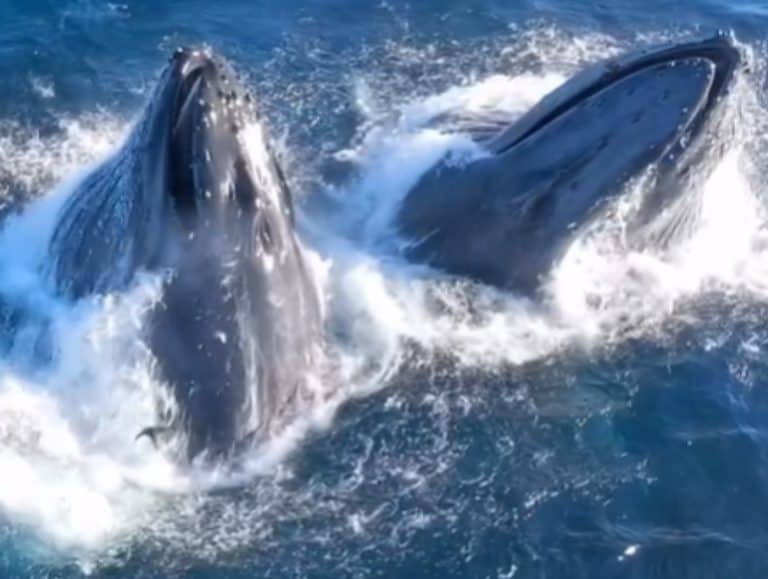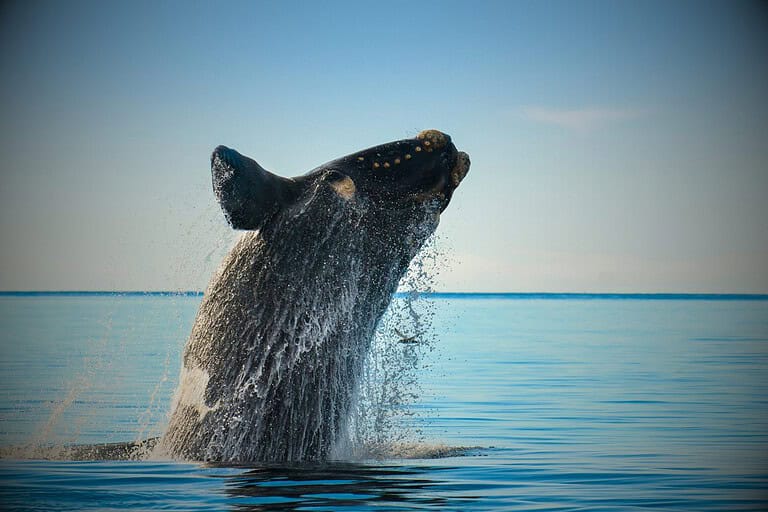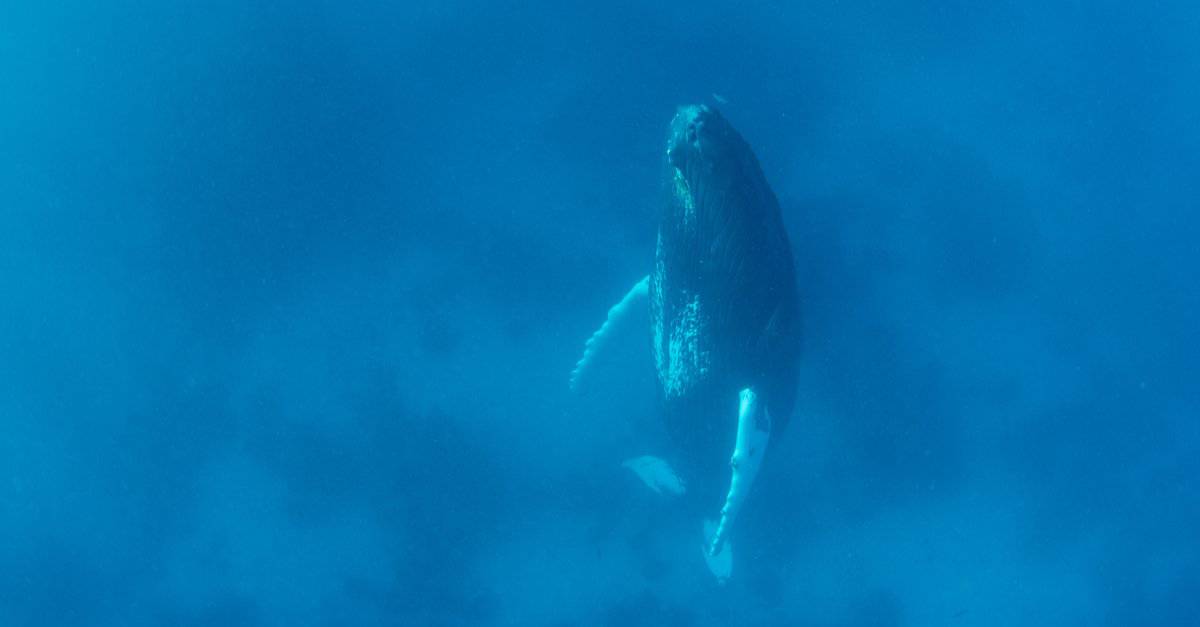

Whales are conscious breathers, meaning they must choose to inhale and exhale. Unlike humans, who breathe involuntarily, whales must think about each breath they take, even while sleeping. Unlike fish, which extract oxygen from water, whales have lungs and need to surface to breathe. To sleep without drowning, whales have evolved a unique sleep method that allows them to rest and relax while periodically surfacing for air. Dive in to discover more about how whales sleep underwater.
How Whales Sleep
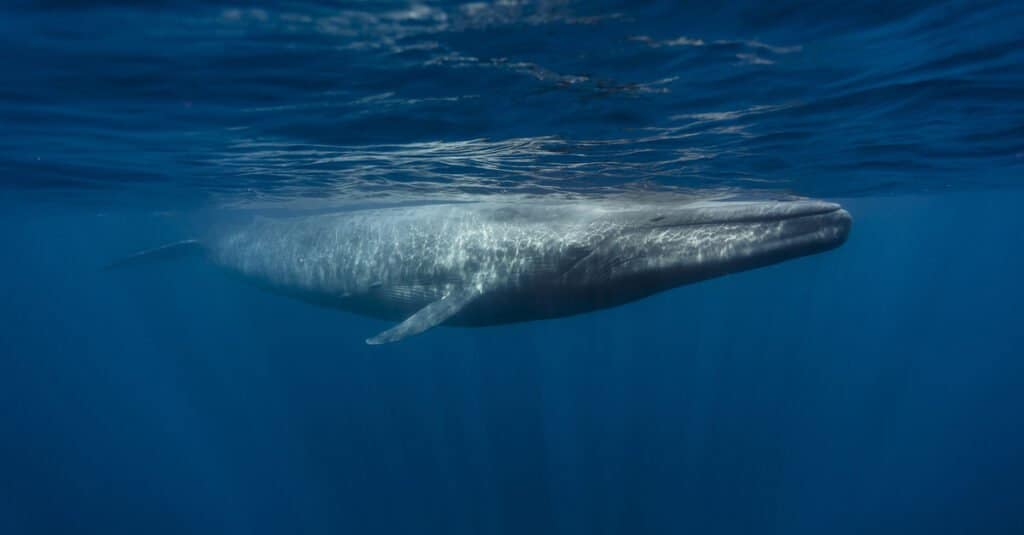
The blue whale, the largest animal in the world, can weigh up to 440,000 pounds.
©Andrew Sutton/Shutterstock.com
Among cetaceans, a group that includes dolphins and porpoises, whales are the behemoths. Whales are mammals that breathe air using lungs. Like other mammals, they must surface to breathe air through their blowholes, which are nostrils located on top of their heads. Whales are not fish and do not have gills for extracting oxygen from water.
Whales and other cetaceans cannot enter a deep, unconscious sleep like humans because they must consciously surface for air. They have adapted a unique way of sleeping known as unihemispheric slow-wave sleep, in which one half of their brain rests while the other remains alert. This adaptation allows them to rest while still breathing, which can be every 3 to 15 minutes, depending on whale species. While experiencing unihemispheric sleep, whales stay aware of their surroundings, breathe, and navigate. Other animals that use unihemispheric slow-wave sleep include manatees, Northern fur seals, sea lions, and many migratory bird species.
While many land mammals have developed adaptations that allow them to sleep standing up, these animals possess special anatomical features, such as a stay apparatus or specific joint-locking mechanisms, that enable them to rest while minimizing muscle effort and remaining upright. However, animals that can achieve light sleep while standing typically need to lie down for Rapid Eye Movement (REM) sleep, which is crucial for their physical and cognitive function.
How Do Whales’ Brains and Bodies Work While They’re Sleeping?
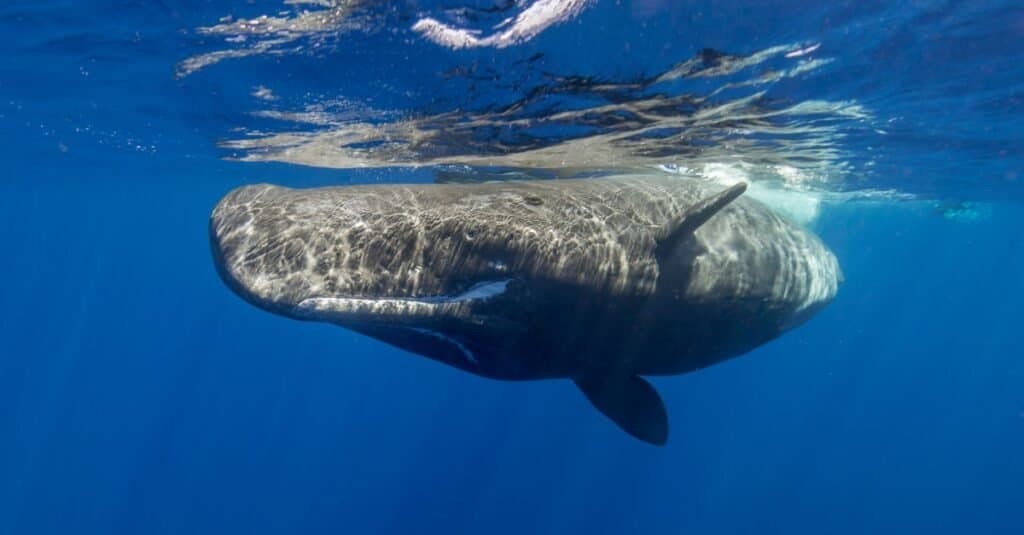
Sperm whales are the largest of all toothed whales and can grow to a maximum length of 52 feet and a weight of 90,000 pounds.
©wildestanimal/Shutterstock.com
One of the ways whales sleep is on or near the surface of the water. It’s a behavior called logging since they’re so still, they might be mistaken for a log.
The length of time they sleep varies according to species. Scientists have discovered that some nap in increments of 10-15 minutes (catnapping?). However, humpback whales have been found sleeping on the surface for up to ½ hour. Sperm whales are believed to sleep for only about 7% of their day. Their sleep is accrued in naps of 10-15 minutes, amounting to less than an hour and a half per day. Some dolphin species have been observed sleeping for several hours per day, but the exact duration varies by species and individual.
How Whale Calves Sleep
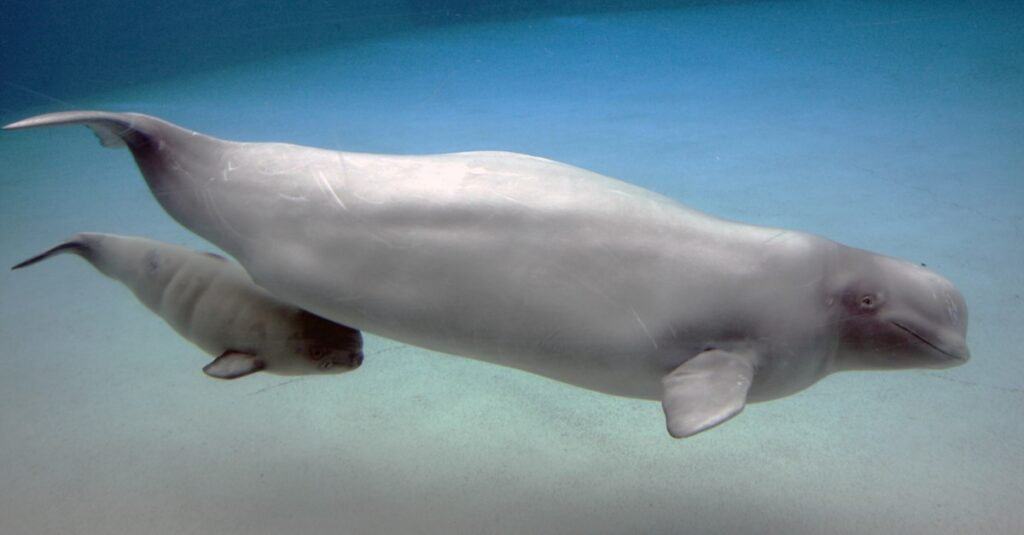
Beluga whale mother with a young calf. A beluga whale baby only starts to eat solid food at around 12 to 18 months old.
©Christopher Meder/Shutterstock.com
Did you know calves (baby whales) can actually sink if not for one thing: their mother! Whale moms don’t stop swimming for the first weeks of a calf’s life. If she does, her baby could sink since calves don’t have the blubber/fat needed to float.
While the mother swims, her calf rests, eats, and sleeps in her slipstream. It’s called echelon swimming. It’s kind of like driving behind a semi on the interstate. The aerodynamics are such that it sort of creates a suction that pulls you along.
The young one can’t swim long distances yet, so their mother stays with them, teaching and helping them build up their strength and fat reserves. If a calf is weak from swimming too much, it can endanger itself and the pod, since predators could be alerted.
Sperm Whale Sleeping Habits
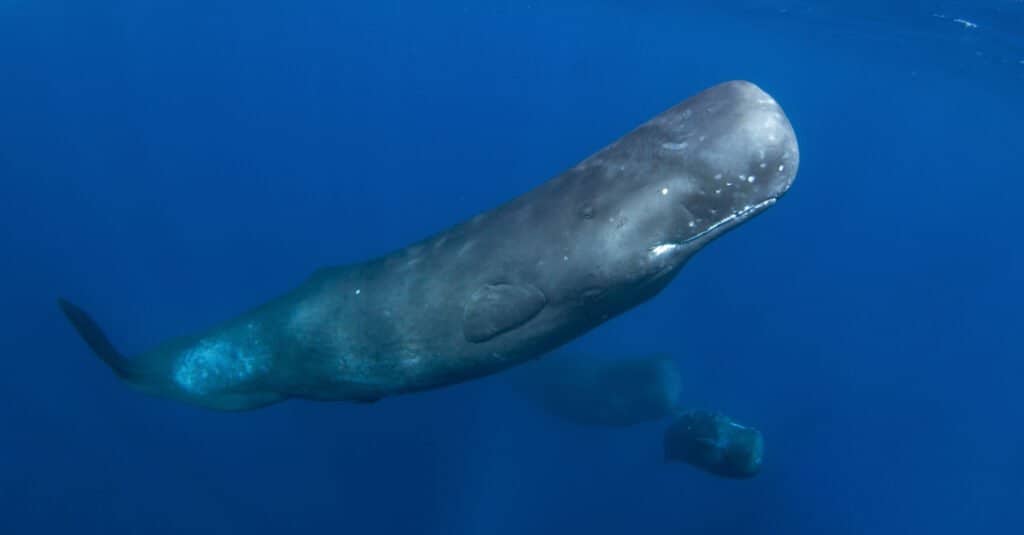
The sperm whale’s blowhole is on the left side of its head, which is unusual among cetaceans.
©Martin Prochazkacz/Shutterstock.com
There are stunningly remarkable photographs of whales sleeping. In 2017, photographer Franco Banfi snapped a picture of a pod of sleeping sperm whales when he was free diving (having no breathing apparatus). They were motionless, lying vertically with their heads pointed toward the surface. This unusual behavior might be hard to believe without photographic evidence.
Often referred to as drift diving or drifting, this unique sleeping behavior involves sperm whales positioning themselves vertically in the water, often near the surface, with their heads pointed upwards, and remaining relatively still for short periods.