
W
Species Profile

Worm Snake

Carphophis amoenus

The earthworm hunter underfoot
Mike Wilhelm/Shutterstock.com
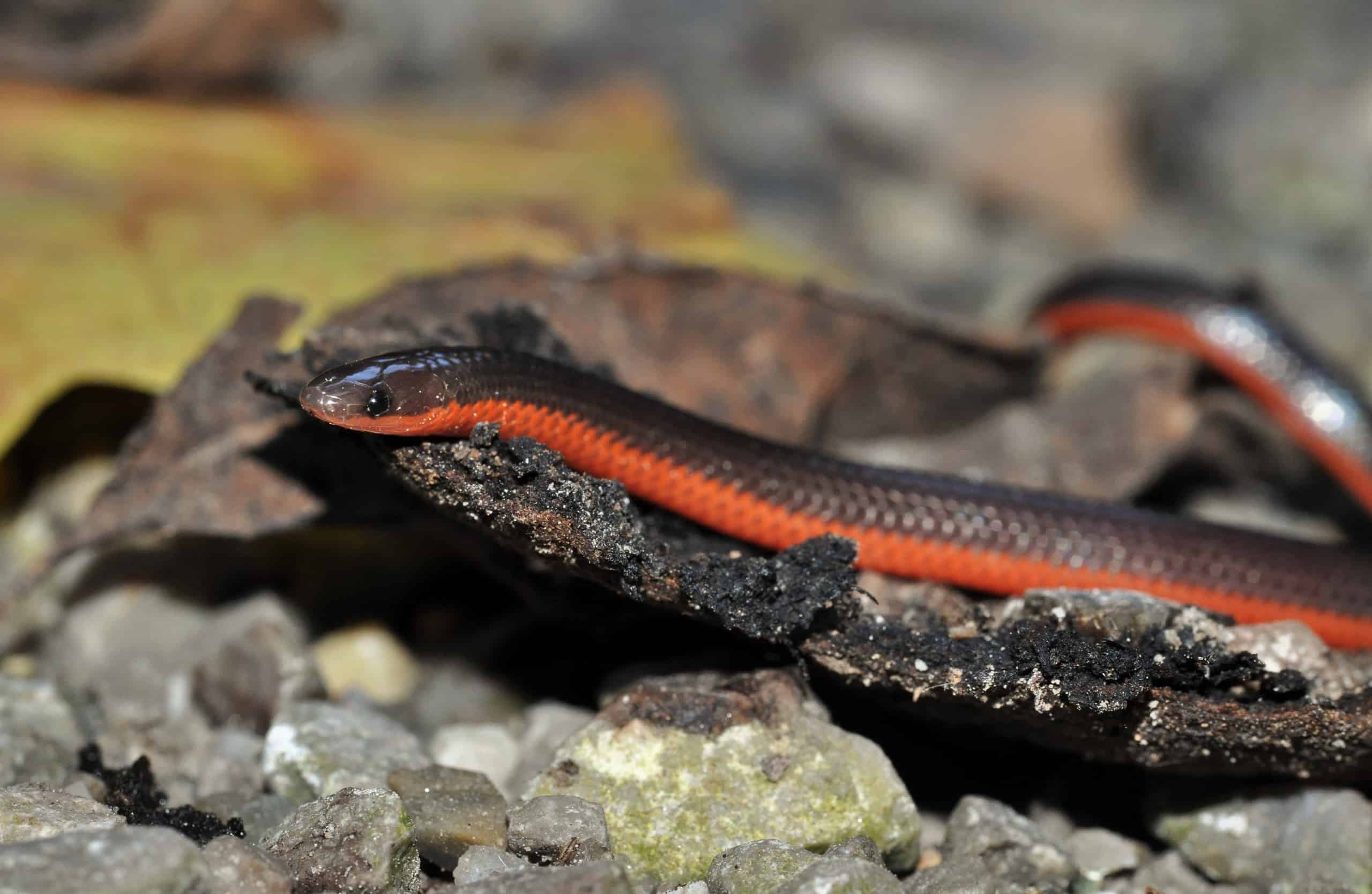
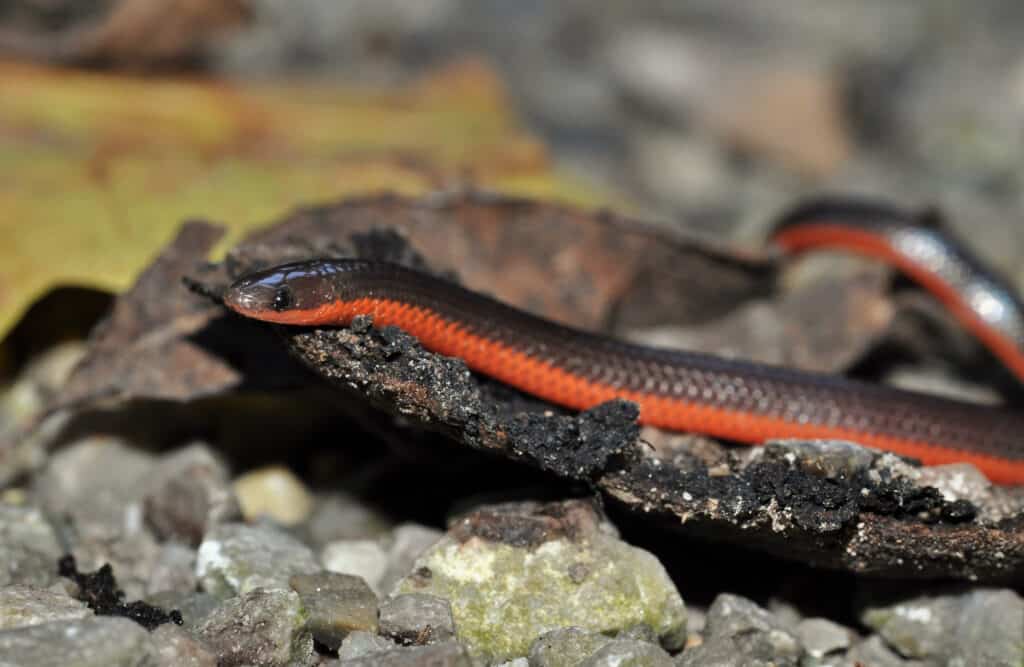
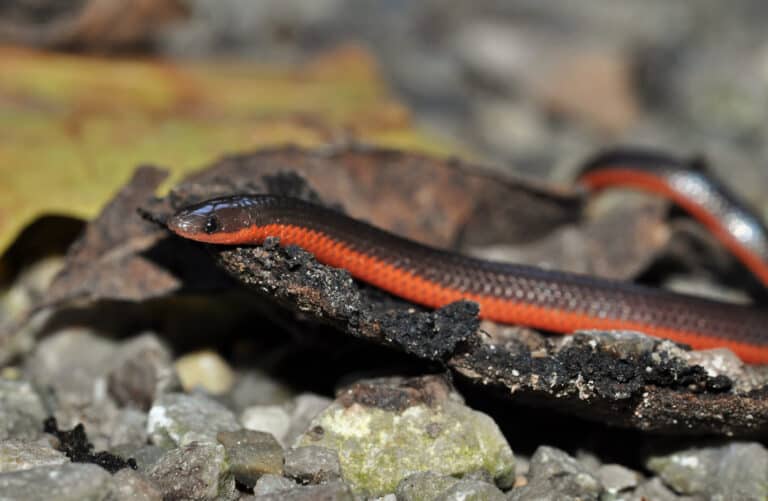
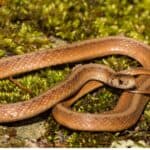
A tiny worm snake rests on a leaf

At a Glance

Wild Species
Also Known As Eastern wormsnake, American worm snake, Common worm snake, Wormsnake
Activity Nocturnal+
Lifespan 3 years
Weight 0.006 lbs
Status Least Concern
Did You Know?

Adults are typically 19-33 cm total length, with smooth, glossy scales that reduce drag in soil.

Scientific Classification

The Eastern Worm Snake is a small, secretive fossorial colubrid of eastern North America. It is smooth-scaled, earthworm-like, and typically found under logs, stones, or leaf litter. It primarily eats earthworms and other soft-bodied invertebrates and is harmless to humans.

Kingdom
Animalia
Phylum
Chordata
Class
Reptilia
Order
Squamata
Family
Colubridae
Genus
Carphophis
Species
amoenus

Distinguishing Features

  • Small, slender, smooth, glossy body
  • Burrowing lifestyle; rarely seen aboveground
  • Earthworm-like appearance and movement
  • Feeds heavily on earthworms

Physical Measurements

Length
9 in (7 in – 11 in)
Weight
0 lbs (0 lbs – 0 lbs)
Tail Length
1 in (1 in – 2 in)
Top Speed
1 mph
slithering

Appearance

Primary Colors
Secondary Colors
Skin Type Smooth scales
Distinctive Features
  • Adults usually 19-28 cm total length; maximum about 33 cm.
  • Smooth, glossy scales in 13 dorsal rows; earthworm-like cylindrical body.
  • Small but visible eyes; head only slightly distinct from the neck, unlike blind snakes with barely visible eyes.
  • Blunt snout with enlarged rostral scale used for burrowing.
  • Short tail ending in a small, pointed terminal spine.
  • Typically found under logs, stones, and leaf litter in moist woods.
  • Earthworm specialist; also eats soft-bodied larvae and slugs.
  • Often curls and uses tail spine defensively when exposed.

Sexual Dimorphism

Females average longer-bodied, while males have proportionally longer tails and more subcaudal scales. Differences are subtle in the field; both sexes share the same brown dorsum and pink ventrum.

  • Proportionally longer tail beyond vent; more subcaudal scales.
  • Often slightly slimmer body relative to total length.
  • Greater average total length and body girth.
  • Proportionally shorter tail; fewer subcaudal scales.

Did You Know?

Adults are typically 19-33 cm total length, with smooth, glossy scales that reduce drag in soil.

Midbody dorsal scale rows are 13, and the snake has enlarged belly scutes unlike true blind snakes.

It feeds mainly on earthworms, often swallowing them while anchoring the worm with body loops underground.

Clutches are small: about 2-8 elongated eggs laid in early summer, sometimes in communal nest sites.

The genus Carphophis has only two U.S. species: Eastern Worm Snake and Western Worm Snake (C. vermis).

When threatened, it may jab with its sharp tail tip and smear musk, while rarely attempting to bite.

Unique Adaptations

  • Smooth, polished-looking scales and a narrow head help it slip through soil and compact leaf litter.
  • A pointed, hardened tail tip helps brace in tunnels and may distract predators from the head.
  • Dark brown to black back with a pink to red belly provides camouflage above and below ground layers.
  • Small size and secretive habits reduce water loss and predation risk in shallow subterranean environments.
  • Enlarged ventral scutes provide traction for burrowing, unlike blind snakes that lack broad belly plates.

Interesting Behaviors

  • Spends most of its life underground or beneath logs, stones, and leaf litter in moist hardwood woods.
  • Often surfaces at night or after heavy rains, when earthworms are active near the soil surface.
  • Uses tight body coils to pin and control long earthworms while pulling them into a burrow.
  • Defensive displays include tail-jabbing and cloacal musk release; it typically stays quiet and non-aggressive.
  • Can share cover objects with salamanders and other moisture-loving forest fauna in the same microhabitats.

Cultural Significance

Often encountered by turning logs or gardening, it's a harmless "forest floor" snake that helps people notice soil health, leaf-litter habitats, and the ecological importance of earthworms and moisture-rich woodlands.

Myths & Legends

In parts of Appalachia, small burrowing snakes like wormsnakes are sometimes nicknamed "two-headed snakes," since the tail can resemble a second head.

Early American naturalist Thomas Say formally described the species in 1825, and its wormlike look helped popularize the plainspoken name "worm snake."

Some local folk talk treats wormsnakes as "earthworms turned to snakes" after rains, reflecting their sudden appearance on wet nights.

Conservation Status

LC Least Concern

Widespread and abundant in the wild.

Population Stable

Life Cycle

Birth 4 hatchlings
Lifespan 3 years

Lifespan

In the Wild
1–5 years
In Captivity
2–8 years

Reproduction

Mating System Polygynandry
Social Structure Solitary
Breeding Season April-May; sometimes in autumn
Breeding Pattern Seasonal
Fertilization Internal Fertilization
Birth Type Internal_fertilization

Secretive, solitary snake; breeding occurs mainly in spring (Apr-Jun). Males trail female pheromones and likely mate with multiple females; females may also mate multiply. Females lay 2-8 eggs in early summer; no parental care.

Behavior & Ecology

Social Aggregation Group: 1
Activity Nocturnal, Crepuscular
Diet Insectivore earthworms
Seasonal Hibernates

Temperament

Secretive
Docile
Shy

Communication

silent
pheromone trails
tongue-flick chemoreception
tactile courtship contact
cloacal musking

Habitat

Deciduous Forest Woodland Coniferous Forest Suburban Urban Agricultural/Farmland
Biomes:
Temperate Forest
Terrain:
Mountainous Hilly Plains Valley Coastal
Elevation: Up to 4921 ft 3 in

Ecological Role

Fossorial mesopredator regulating soil invertebrates

invertebrate population control supports soil food webs prey base for predators

Diet Details

Main Prey:
Earthworms Enchytraeid worms Beetle larvae Fly larvae Slugs

Human Interaction

Domestication Status

Wild

Wild fossorial snake (typical 18-28 cm total length; max 33.7 cm; Ernst & Ernst 2003), never domesticated. Across colubrids, interactions span pets, education, and nuisance removals; this species is mainly encountered under debris during yardwork and surveyed for research.

Danger Level

Low
  • Harmless bite (rare)
  • Defensive musking
  • Stress-related mortality if handled

As a Pet

Not Suitable as Pet

Legality: Often protected; possession/collection may require state permits.

Care Level: Expert Only

Purchase Cost: Up to $50
Lifetime Cost: $500 - $2,000

Economic Value

Uses:
Education Research Ecosystem

Relationships

Predators 7

Eastern Kingsnake Lampropeltis getula
Scarlet Kingsnake
Scarlet Kingsnake Lampropeltis elapsoides
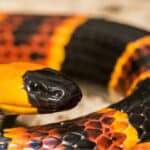
Eastern Coral Snake
Eastern Coral Snake Micrurus fulvius
Virginia Opossum Didelphis virginiana
Raccoon
Raccoon Procyon lotor
Short-tailed Shrew Blarina brevicauda
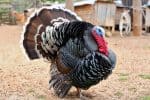
Wild Turkey
Wild Turkey Meleagris gallopavo

Related Species 6

Western Wormsnake Carphophis vermis Shared Genus
Smooth Earthsnake
Smooth Earthsnake Virginia valeriae Shared Family
Rough Earthsnake
Rough Earthsnake Virginia striatula Shared Family
Ring-necked Snake Diadophis punctatus Shared Family
DeKay's Brownsnake
DeKay's Brownsnake Storeria dekayi Shared Family
Red-bellied Snake Storeria occipitomaculata Shared Family

Ecological Equivalents 5

Animals that fill a similar ecological role in their ecosystem

Brahminy Blindsnake
Brahminy Blindsnake Indotyphlops braminus Tiny fossorial burrower; usually found under debris in moist soils
Carolina Blindsnake Indotyphlops carolinensis Native fossorial snake; similar subterranean habits and prey specialization
Smooth Earthsnake
Smooth Earthsnake Virginia valeriae Secretive, small-bodied cover-object user in moist forests and edges
Red-bellied Snake Storeria occipitomaculata Leaf-litter/under-log microhabitat overlap; similar size and crypsis
Ring-necked Snake Diadophis punctatus Often under logs/rocks; overlaps in moist woodland retreat sites
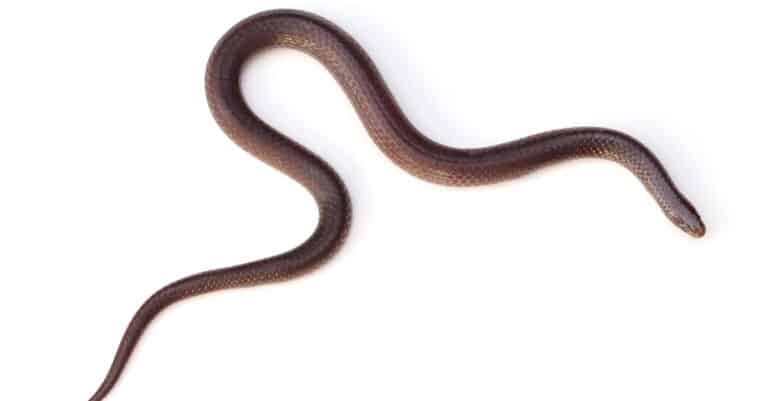
A Worm Snake is a small, burrowing snake with a slender, worm-like body and smooth scales.

Worm Snakes are small and shy.

If you turn over a flower pot in your garden and see a dark brown little snake of about 8 inches with a pink belly, it’s probably not the baby of a large snake such as a coachwhip but a fully grown worm snake.

These snakes get their name because they eat and look somewhat like earthworms, but if you look you’ll see it has a backbone, eyes, and a forked tongue.

Though they’re hard to find, there are places where there are more worm snakes than any other type of snake. Read on to learn more about these reptiles.

Five Amazing Facts
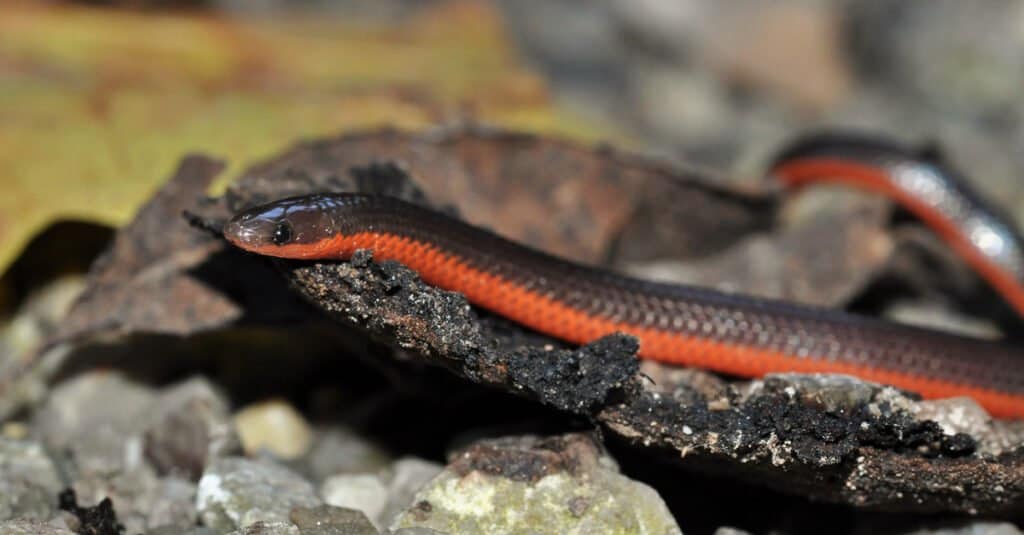
Snakes in Mississippi - Worm Snake

These snakes have several common names such as blind snakes, thunder snakes, milk snakes, eastern twig snakes, and cricket snakes.

Both species are only found in the United States.

  1. They’re also known as blind snakes, thunder snakes, milk snakes, eastern twig snakes, and cricket snakes.
  2. The tips of their tails are sharp, but they don’t sting.
  3. Worm snakes almost exclusively feed on the worms they’re sometimes mistaken for.
  4. They are also the favorite food of some other snakes.

Where To Find Worm Snakes
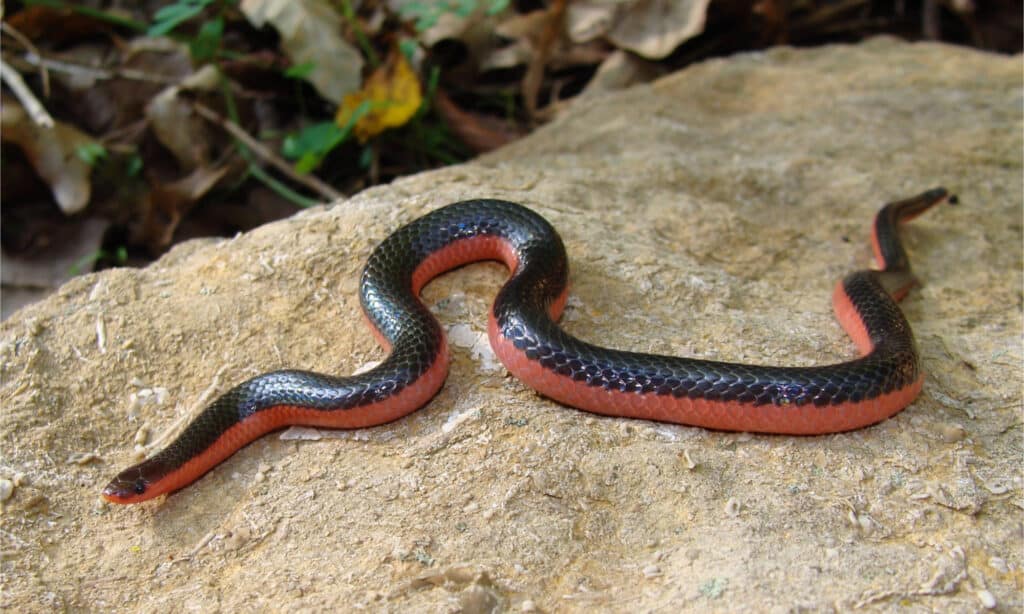
Worm snakes are frequently found in their native habitats, but their small size and preference for digging underground make them challenging to locate.

Worm snakes are common in the areas where they live, but they are hard to find because they’re so small and are fossorial, which means they like to burrow underground. The common worm snake and its subspecies are found in the eastern, midwestern, and southern states sans Florida while the western worm snake is found in the midwest and as far south as northern Louisiana in humid habitats.

Scientific Name

The worm snake’s scientific names are Carphophis amoenus for the common worm snake and Carphophis vermis for the western worm snake. Carphophis comes from the Greek words for “straw” or “drying out” which is karphe, and the Greek word for “serpent” which is óphis. Karphe may refer to the snake’s small size which makes them resemble a blade of straw or its tendency to dry out when its skin isn’t kept moist. Amoenus is Latin for “attractive” or “delightful,” and vermis is Latin for “worm.”

There are two subspecies of Carphophis amoenus. They are:

  1. Carphophis amoenus amoenus
  2. Carphophis amoenus helenae

C. vermis has no known subspecies.

Evolution and Origins

Worm snakes are not a rare species, as some people have been able to collect many of them in a small area within the states where they reside, and they are categorized as being of least concern in terms of conservation status.

In this species, females have longer bodies but shorter tails than males, and their small, conical heads are no wider than their necks, with reduced black eyes; their lifespan in the wild can reach up to 4 years.

Carphophis a. amoenus, commonly known as the eastern worm snake, gets its name due to its resemblance to an earthworm and is a small burrowing snake found in the southern regions and has recently started appearing in the southern parts of New England and adjacent areas of New York.

The Different Types

The common worm snake, Carphophis amoenus is found east of the Mississippi River in such states as North Carolina and as far north as the southwestern part of Massachusetts. They appear to be absent from Florida. Its subspecies, Carphophis amoenus amoenus is found from Alabama to southwestern Massachusetts, while C. a. helenae is found in the south and midwest.

Again, these snakes do not seem to be found as far south as Florida. The western worm snake, Carphophis vermis is found in the midwest to northern Louisiana, central Tennessee, northeast Texas, and eastern Oklahoma. All of these snakes are found in woods and wetland habitats and like to hide beneath fallen leaves, rotting logs, or rocks.

C. a. helenae rarely grows more than 9.8 inches, including its tail, and is dark brown dorsally and pink below. C. a. amoenus can grow a bit bigger and can be told from C. a. helenae because the prefrontal and internasal scales on C. a. helenae’s head are fused and those scales in C. a. amoenus are not.

The western worm snake differs from these subspecies in that it is black or even purple on top and pink or red below. It has also been seen to grow larger than the eastern worm snake and its subspecies, with the longest recorded specimen being around 15 inches long. All baby worm snakes are darker than adults when they hatch. They can live to be around four years old.

Appearance and Description
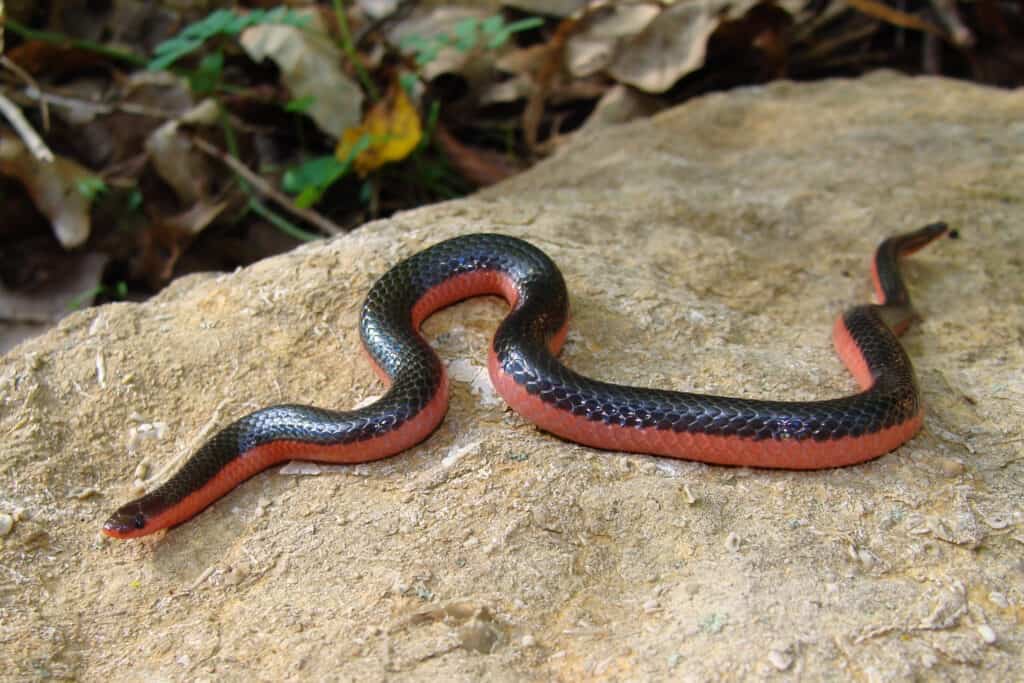
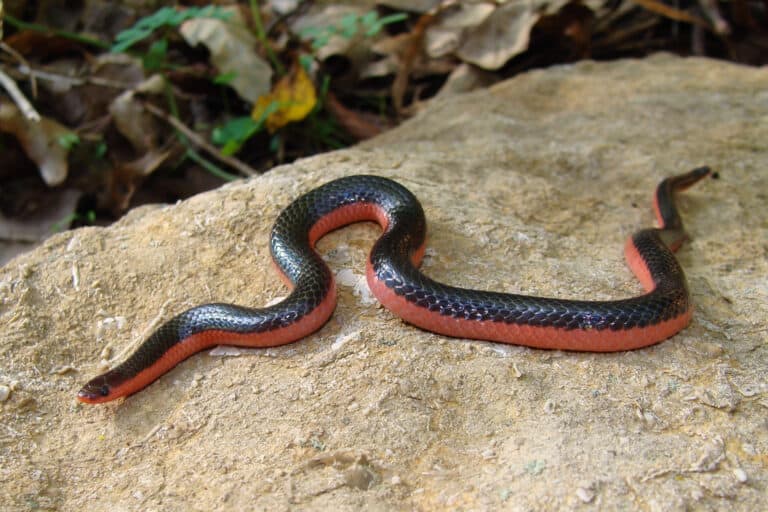
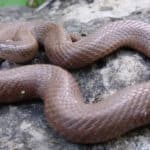
A Western Worm Snake rests on a flat rock

This species of snake typically measures less than 12 inches in length, lacks distinctive scale patterns, and tends to be dark on its upper surface while displaying a pink or orange color on its underside.

This snake rarely grows to more than a foot long. Its scales don’t have a pattern, but it is generally dark on top and has a pinkish or orange hue ventrally. These snakes have narrow, cone-shaped heads and, interestingly, short tail that ends in a little spike.

They have 13 rows of smooth scales on their body, which can separate them from genera such as Virginia or Tantilla. If the snake is flipped over, you’ll notice that they have a split anal plate as well.

Venom: How Dangerous Are They?

Worm snakes are nonvenomous and are not at all dangerous to human beings, though they’ll emit a bad-smelling liquid (called musk) if they are picked up.

The little spike at the end of the tail does not deliver a venomous sting either, though the snake will poke you with it to get out of your grasp. However, if they can get used to being handled they can make good pets.

Behavior and Humans
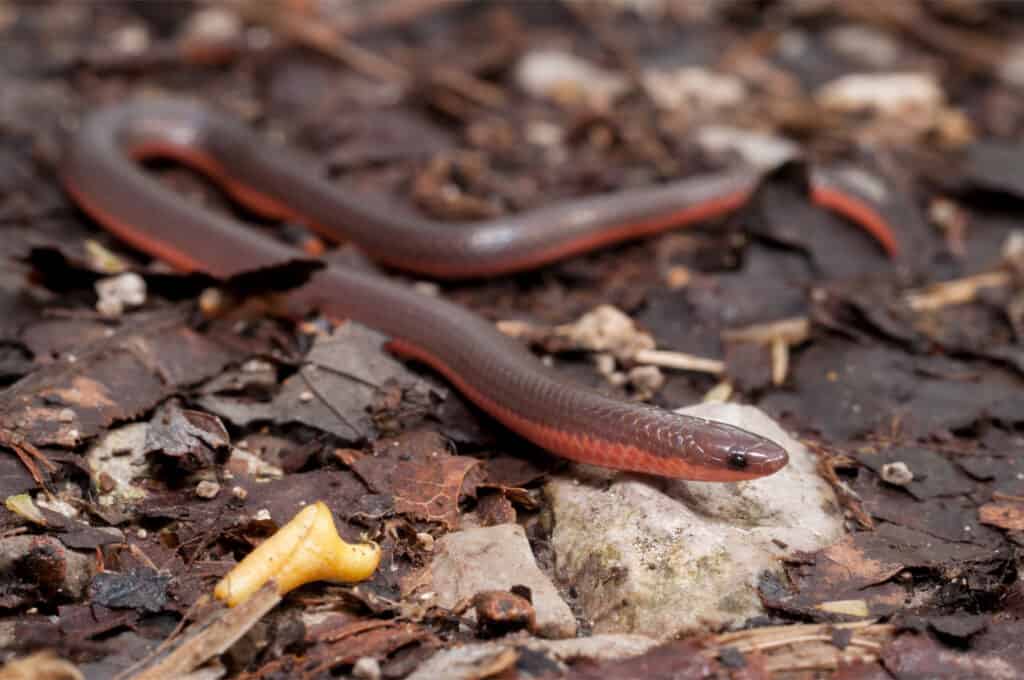
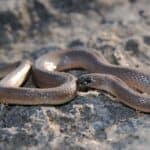
A Worm Snake rests its head on a rock

Worm snakes are frequently present in some areas, but locating them can be difficult since they typically conceal themselves beneath objects like leaf litter, rocks, and rotting wood.

Though often abundant in places, worm snakes are hard to find because they hide beneath leaf litter, garden pots, rocks, and rotting wood. They must stay in habitats with moist soil to keep from drying out, so they are especially hard to find during the heat of summer.

They may be more likely to be seen during the cooler months of early spring and fall in the late afternoon. Rainy days are also good times to look for these snakes. Worm snakes mostly eat earthworms, but they will also eat caterpillars, snails, slugs, and other soft-bodied invertebrates. In turn, they’re preyed upon by birds, opossums, and other snakes. Some end up as roadkill, or their numbers are reduced in some places by habitat destruction.

Though not much is known about their reproduction, worm snakes most likely mate in the spring. Since the female’s belly is translucent, you can actually see the eggs through her skin. She lays the eggs in the summer in abandoned burrows, in decaying wood, or under rocks.

The female may guard the eggs or at least stay near them for a while. There are usually two to eight eggs, and they hatch in late summer. Baby worm snakes are much darker than their parents and are about 3 to 4 inches long at birth.

View all 442 animals that start with W

Sources

  1. ITIS / Accessed April 19, 2022
  2. Wikipedia / Accessed April 19, 2022
  3. Savannah River Ecology Laboratory / Accessed April 19, 2022
  4. Virginia Herpetological Society / Accessed April 19, 2022
  5. Weebly / Accessed April 19, 2022
  6. Herps of NC / Accessed April 19, 2022
Rebecca Bales

About the Author

Rebecca Bales

Rebecca is an experienced Professional Freelancer with nearly a decade of expertise in writing SEO Content, Digital Illustrations, and Graphic Design. When not engrossed in her creative endeavors, Rebecca dedicates her time to cycling and filming her nature adventures. When not focused on her passion for creating and crafting optimized materials, she harbors a deep fascination and love for cats, jumping spiders, and pet rats.
Connect:

Thank you for reading! Have some feedback for us?


Worm Snake FAQs (Frequently Asked Questions)

Worm snakes are not venomous.