
Quick Take
- Males and females look nearly identical at first glance, but you can tell them apart from several features. Spot the key difference →
- A salamander's color pattern does more than just provide camouflage. It may also signal something about its health. Color as a health signal →
- Juveniles look quite different from adults, which matters a great deal for field identification. Juvenile vs. adult appearance →
- These salamanders surface for only a narrow window each year, and knowing the precise timing and location makes all the difference.
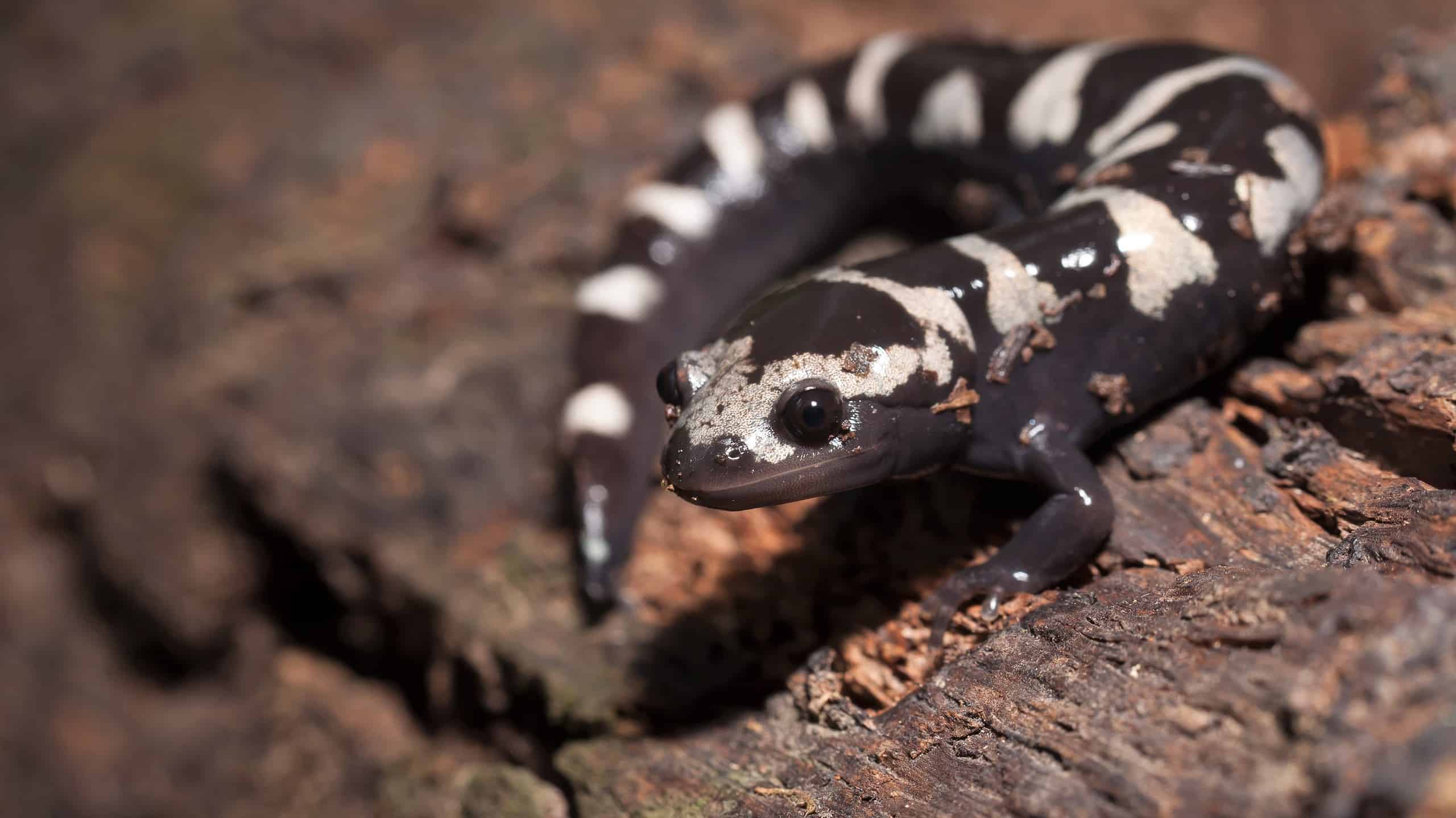
If you come across a marbled salamander (Ambystoma opacum), consider yourself lucky—they spend most of their time hidden from view. These stout salamanders, which grow up to about 4.75 inches long, typically hide under logs, rocks, or other debris in forests.
Because they’re nocturnal, marbled salamanders are most likely to leave their hiding places at night. They emerge for only a few weeks each year, during the breeding season. “They will normally be underground during the hot summer, unless a huge rain washes them out again,” explains Alonso Abugattas, the Natural Resources Manager for Arlington County Parks in Virginia and The Capital Naturalist, in an email interview. “On a rainy fall night, you might catch a glimpse of one migrating to its breeding habitat—typically dried-up ponds and ditches.”
Both males and females migrate to the breeding area, where males court females and deposit packages of sperm—called spermatophores—for the females to pick up. After fertilizing her eggs, a female lays 50–200 eggs in dry spots under leaves or moss, guarding them until winter rainfall submerges the eggs and triggers hatching. “They breed in the fall and winter, laying their eggs and often remaining with their eggs to protect them before any rains start filling up the vernal pools. This means that by the time the spotted salamanders and other vernal pool species arrive, they have already emerged,” says Abugattas.
Comparing Male and Female Marbled Salamanders
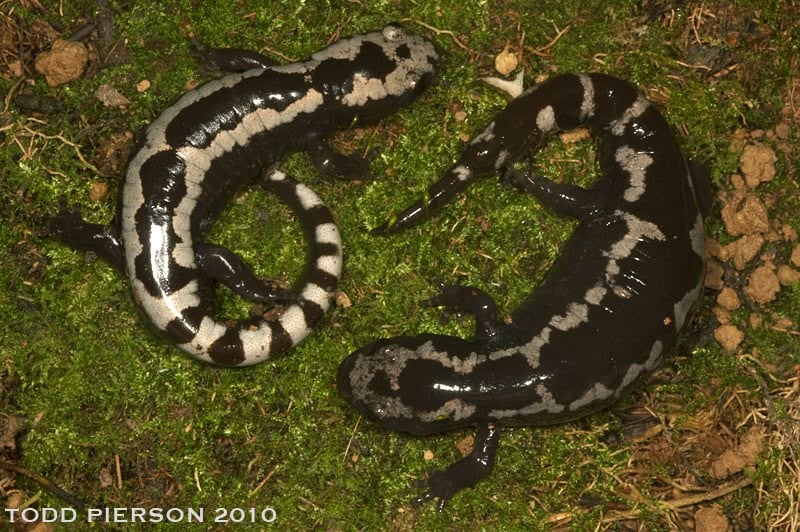
A brighter, smaller male is on the left, next to a duller, larger female.
Both male and female marbled salamanders have dark brown or black bodies marbled with whitish crossbands. Their undersides are all black. Like other salamanders in the family Ambystomatidae (the “mole” salamanders), they have large eyes and rubbery-looking skin.
If you find a marbled salamander sitting on a cluster of small, transparent eggs, it is a female guarding her clutch. Even before laying eggs, a female will appear noticeably plumper in her midsection compared to the slimmer males. Males, however, develop swollen glands around the reproductive opening beneath their tails during the breeding season. “The same rules of protecting vernal pools that apply to any salamanders will also apply to marbled salamanders,” says Abugattas, since they depend on these seasonal ponded waters for breeding.
Male and female marbled salamanders are more difficult to distinguish outside of the breeding season. Still, there are sexually dimorphic characteristics—traits that differ between the sexes—which are rare among salamanders. Female marbled salamanders are larger than males, and their marbling tends to be more gray or silvery. Male marbling is whiter and brighter, a feature they display to attract females during courtship.
On a rainy fall night, you might catch a glimpse of a marbled salamander migrating to its breeding habitat—typically dried-up ponds and ditches.
Alonso Abugattas, Natural Resources Manager for Arlington County Parks in Virginia and The Capital Naturalist
Coloration May Also Indicate Health
A 2007 study in the Canadian Journal of Zoology found that male marbled salamanders not only have whiter marbling but also a significantly greater surface area covered in white compared to females. In both sexes, a greater amount of whitish marbling was associated with better body condition, suggesting that coloration may indicate health. The study authors hypothesized that the conspicuous whiteness of the marbling on males might ‘increase a male’s chance of being noticed’ and thereby ‘increase his reproductive success.’
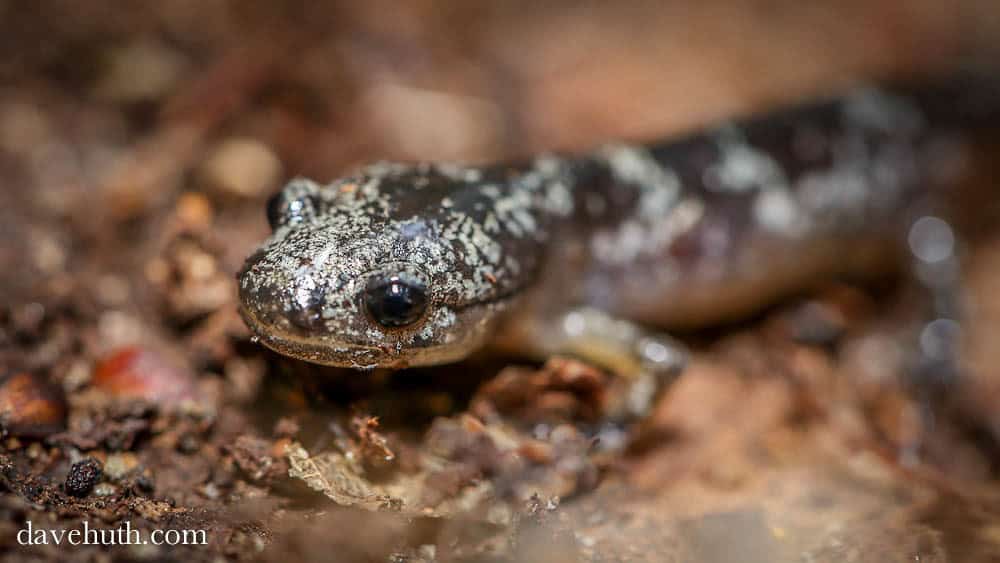
Immature marbled salamanders have a pattern of light speckles instead of marbling.
Juvenile marbled salamanders do not exhibit visible differences between males and females. They look quite distinct from adults, with grayish-blue spots on a purplish-black background. As they grow, the spots merge into the adult pattern of marbled bars of color, and their secondary sexual characteristics—which distinguish males from females—begin to appear.
Knowing how to recognize marbled salamanders by age and sex is useful to ecologists. Because marbled salamander habitats are often intersected by roads, many individuals are killed by vehicles each year during their fall migrations, which can impact local populations. They may also be negatively affected by contamination of their breeding ponds with insecticides and other pollutants carried by surface runoff.
By collecting data on marbled salamanders’ age and sex, ecologists can monitor the status of their populations.