
Quick Take
- The 116-pound sturgeon stunned researchers, though it barely registers compared to what has already been detected lurking in the same river. See the catch details →
- In 2018, National Geographic's sonar picked up something in the Hudson that left even veteran biologists unsure what they'd do if they ever caught it. Discover the sonar giant →
- Atlantic sturgeon numbers in the Hudson have collapsed to a fraction of what they once were, though the culprit is not what most people assume. Explore their endangered status →
- Catching these giants is actually illegal, yet researchers do it anyway. Their reason for doing so changes how you think about conservation. See why researchers catch them →
The Hudson River is home to a wealth of marine life thanks to the mingling of freshwater from the Adirondack Mountains and saltwater from the Atlantic Ocean. Because of this mix of waters, creatures of all sizes either live in the Hudson or visit it frequently.
However, one Hudson River fish recently caused a stir because of its enormous size. Although these prehistoric fish are known for their size, this particular Atlantic sturgeon still surprised everyone.
Massive Atlantic Sturgeon Was Caught on the Hudson River
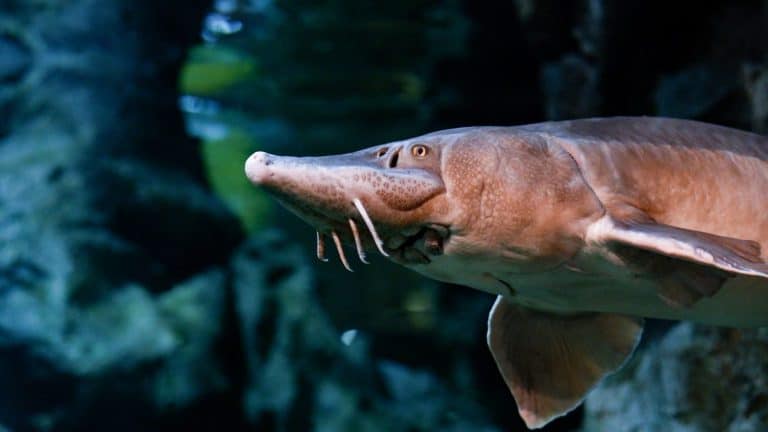
The Hudson River is no stranger to sturgeon. Two species of sturgeon live in the Hudson River: the shortnose sturgeon and the Atlantic sturgeon. It was the latter that gave researchers quite a thrill on June 22, 2026, when one of epic proportions was caught.
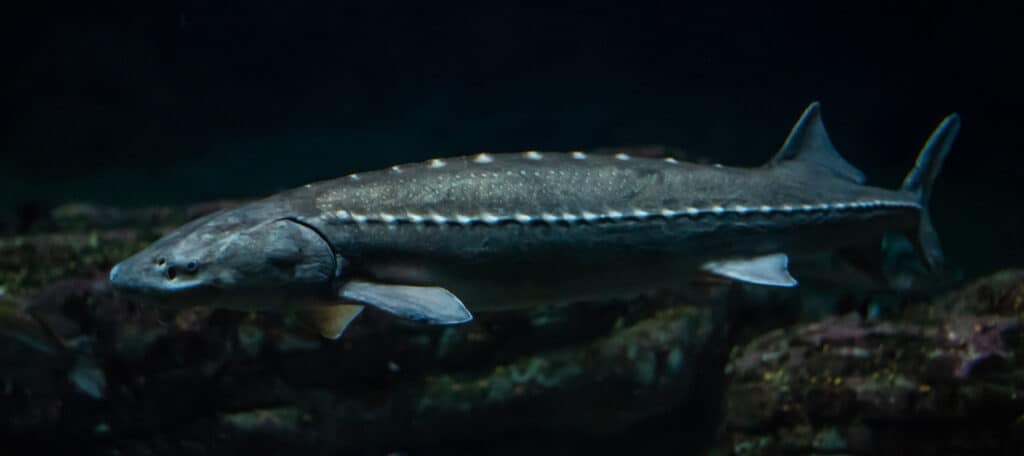
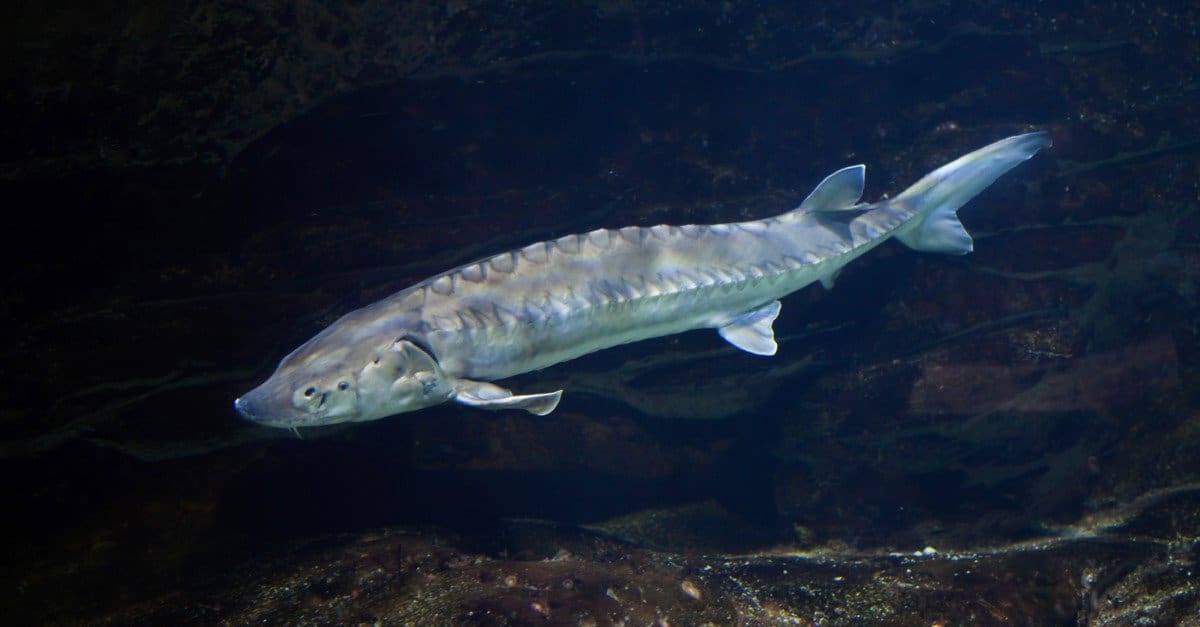
A 116-pound Atlantic sturgeon was recently caught in the Hudson River.
©David A. Litman/Shutterstock.com
On Monday, researchers with the New York State Department of Environmental Conservation caught an unexpectedly large Atlantic sturgeon. The sturgeon weighed 116.8 pounds and was 5′ 11″ long. While these sturgeon are the largest of the fish that live in the Hudson, the massive sturgeon came as a shock to researchers.
This particular sturgeon had never been caught and released by the researchers. Consequently, it was measured, tagged, and sent on its way.
The Atlantic Sturgeon Was Caught and Released
It is illegal to fish for Atlantic sturgeon due to their endangered species status. The only reason that researchers were catching the sturgeon was to gather information about the fish’s population before releasing them back to the Hudson.
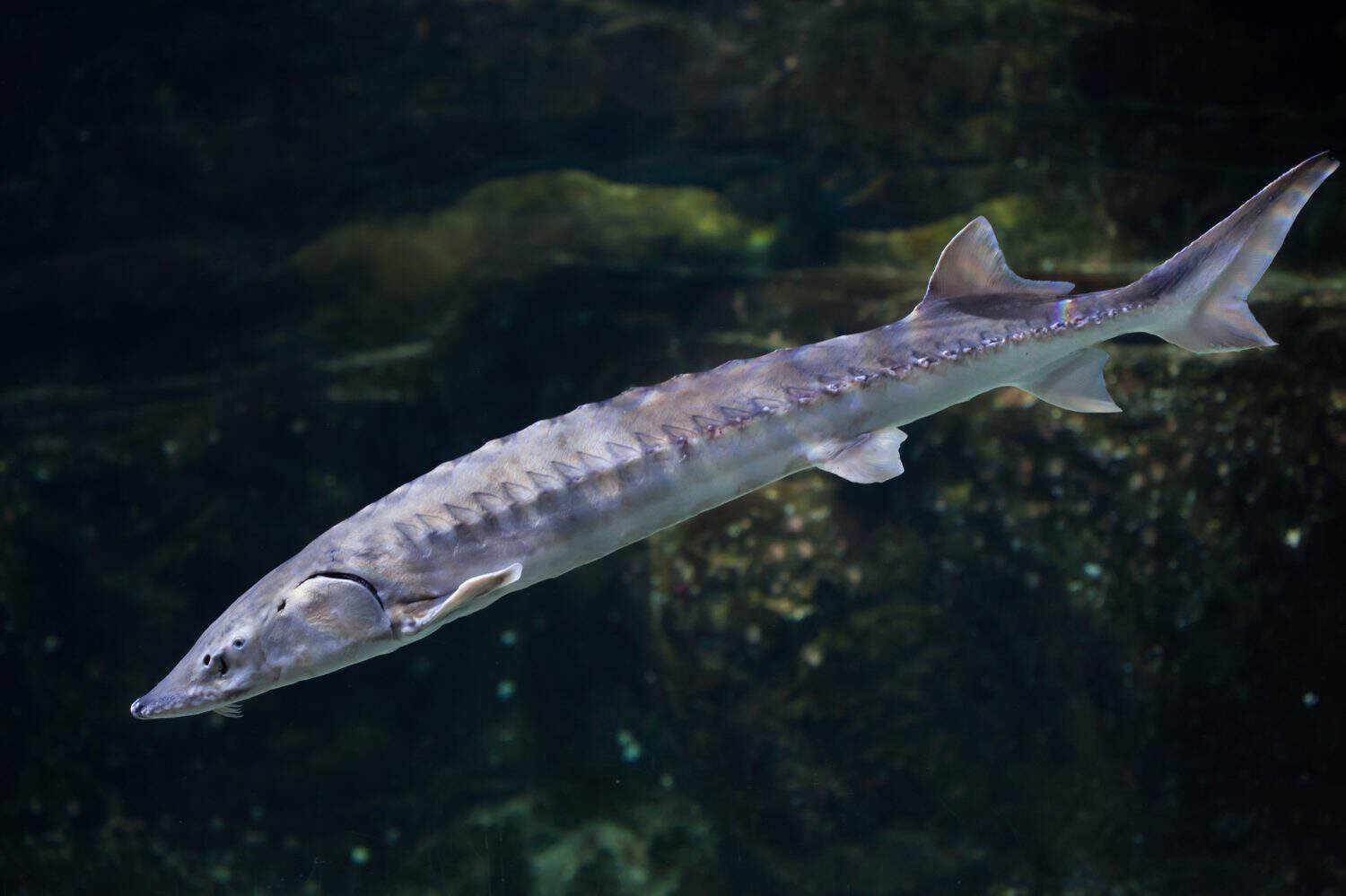
Atlantic sturgeon are caught and released as part of a research program to learn more about the species.
©Vladimir Wrangel/Shutterstock.com
When researchers catch sturgeon, they use gillnets. The fish are carefully removed from the nets and then moved to a tank on a boat where they are measured and weighed. A small amount of dorsal fin is collected for DNA examination, and the fish is scanned for a Passive Integrated Transponder (PIT) chip. If a PIT chip is not identified, the sturgeon is fitted with a chip the size of a grain of rice.
Once the chip is in place and researchers confirm it is working, the sturgeon is released back into the Hudson River to continue its journey to spawn.
Is This the Largest Atlantic Sturgeon Ever Caught on the Hudson River?
There is no denying that the Atlantic sturgeon caught on the Hudson River on June 22 was massive. However, compared to the whopper that was caught in 2024, this fish looked like a small fry.
In June 2024, the Hudson River Estuary Program fisheries staff caught an Atlantic sturgeon that was 220 pounds. The staff believes that the large size of the sturgeon is a sign that conservation efforts are working.
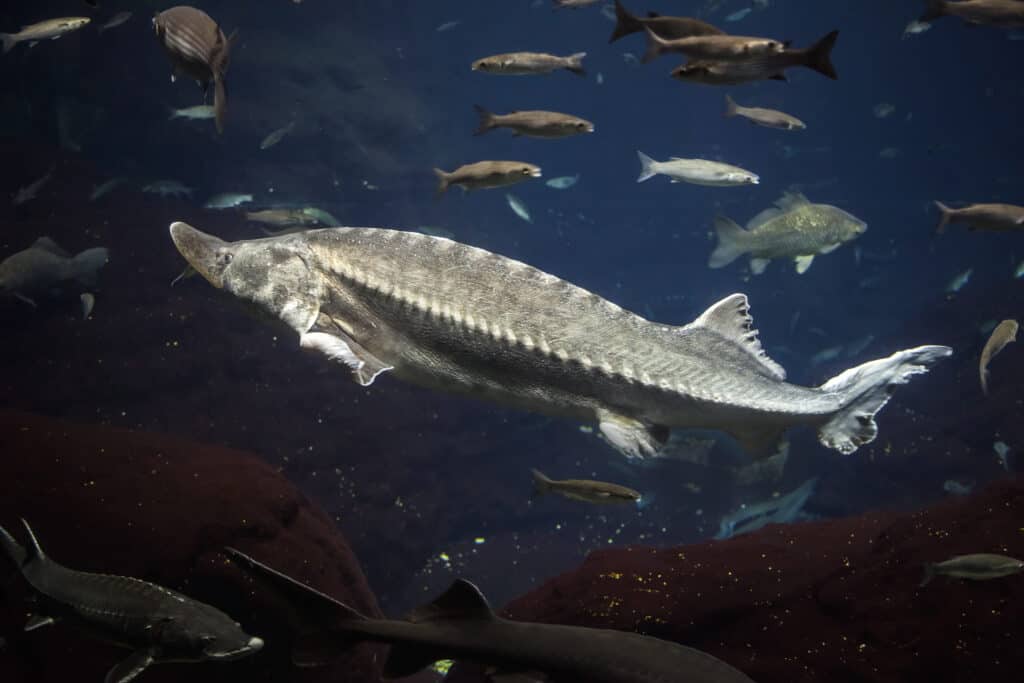
The largest Atlantic sturgeon ever recorded in the Hudson River is believed to have weighed 800 pounds.
©Evannovostro/Shutterstock.com
The 2024 Atlantic sturgeon was the largest ever caught on the Hudson. However, several years ago, National Geographic used advanced technology to monitor sturgeon. What they found, according to Amanda Higgs, a Fisheries Biologist with the Hudson River Estuary Programs, was a monster.
“In 2018,” Higgs explained to On The Water, “National Geographic used side-scan technology in the same area that we handled this 220-pound fish, and they discovered a sturgeon (near the bottom) that measured 14.1 feet long, which probably would have been about 800 pounds.”
Higgs continued, “We don’t catch them that big. I’m actually not sure what we would do with a fish that large, but there are fish of that size in the river today and, historically, they’ve grown to be that size.”
Why Atlantic Sturgeon Need to Be Monitored Today
Adult Atlantic sturgeon spend the majority of their time in the Atlantic Ocean. It is only when it is time to spawn that the fish make their way up the Hudson. After spawning, the adult sturgeon return to the ocean. Juvenile sturgeon will remain in the river for up to six years.
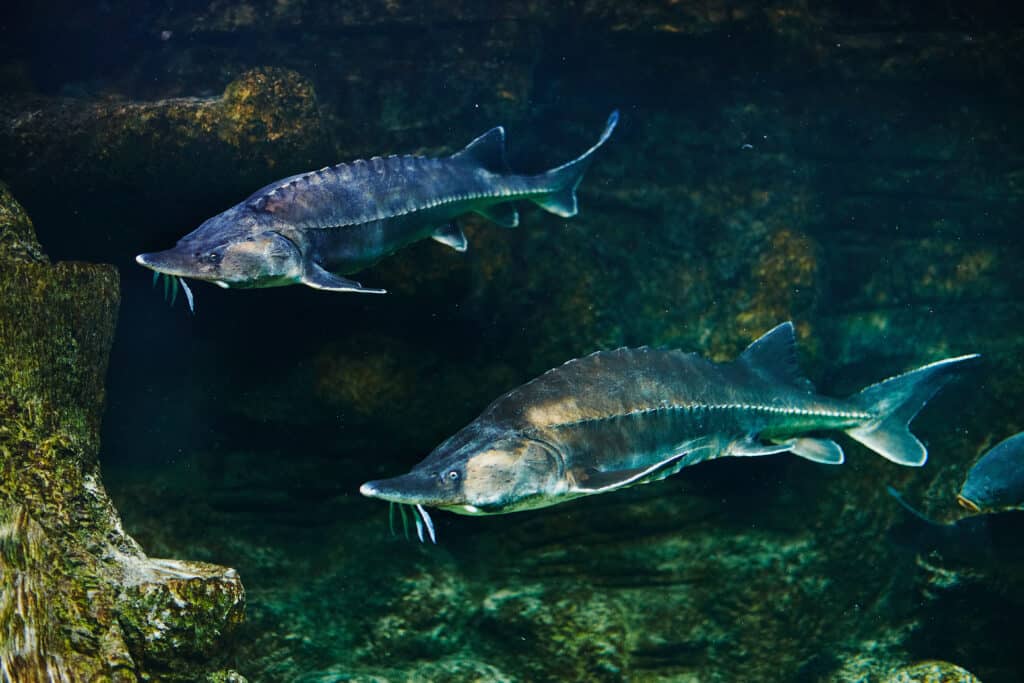
Atlantic sturgeon are being monitored in the Hudson River because they are an endangered species.
©AdaCo/Shutterstock.com
The current population of sturgeon that live in the Hudson River is between 1,000 and 1,500. Approximately 500 more Atlantic sturgeon will be present in the river during the spawning season. These numbers are far below their historical levels, including the approximate 9,500 that were in the river in 1995, due to overfishing and bycatch. Consequently, the Atlantic sturgeon in the Hudson are categorized as federally endangered under the Endangered Species Act.
Researchers monitor Atlantic sturgeon using PIT tags to better understand their behavior and population. Researchers can determine just how far the sturgeon swim, what regions of the river they use, and how many times they spawn. This information is helpful in determining the best conservation plans for the fish, which, if given a chance, can live a long, healthy 60 years in and around the Hudson River.