
At first glance, you might think wild bullfrogs are trained WWE professionals. The fighting, the drama, the expert skill — but these amphibians aren’t trained; they’re simply born with these moves. And watching them in action is free! BBC Earth shared a video of bullfrogs boxing on their YouTube channel, and you won’t be able to look away. The video begins in slow motion, as one frog flies through the air with its mouth open to attack its fellow frog. They tussle in the water, using their wide mouths and sharp front teeth to attack.
Why Do Bullfrogs Fight?

Bullfrogs are very territorial and will fight for their chance to mate.
©Mircea Costina/Shutterstock.com
“The males occupy the center of the pond and fight to hold their place there,” the narrator explains in the clip. They must fight their way to the center, where the strongest bullfrogs gather, in order to meet and mate with females. It’s not easy, though. The frogs have to dodge hits as they make their way through the gauntlet of competitors to come out on top. The camera follows one frog as it leaps over others, jumping through the muddy water. Imagine having to swim, leap, and then fight — these are some tough bullfrogs! Instead of following the same path as the males, the female bullfrog swims underwater to reach the center.
What Is the Ideal Outcome?
The prize for this battle? Mating with a female!
“If a male is to mate, he must stay in the center. And he won’t be able to do that without a fight,” the narrator continues, showing the bullfrog slowly turning around to face off against another standing right behind him. Fighting for a female’s affection is so Middle Ages of them!
“These battles are no-holds-barred and can even be fatal,” the narrator says, as one frog flips the other over its back to fend him off. They keep fighting and lunging at each other with full force until one frog accepts defeat and leaves… or is killed.
Of course, the prize is worth it for true love — or, rather, the chance to reproduce.
“I am sitting here laughing at frogs’ [bodies slamming] each other,” one person commented on the video. “It looks so intense from this angle, but if you are standing at the edge of the field, it would just look hilarious.”
Another noted, “This made me think about how absolutely terrifying these things would be if they were like human size.” Someone else said, “Swamp WWE…😄 Nature is truly fascinating.” Yes, it is!
All About Bullfrogs
©Dwayne Towles/Shutterstock.com
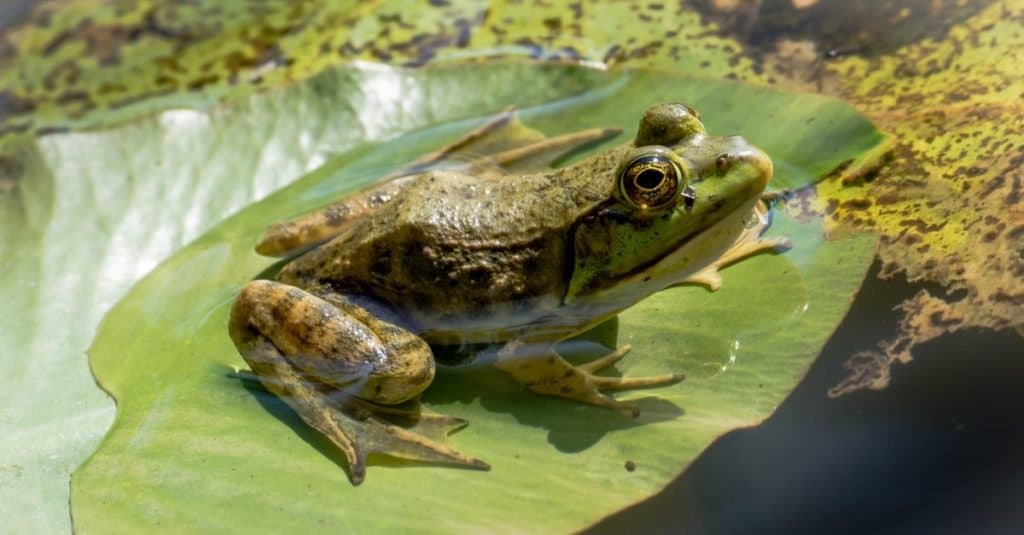
Bullfrogs (Lithobates catesbeianus) are known for their powerful legs, broad shoulders, and cow-like calls. They are native to lakes, ponds, rivers, and streams in eastern North America, but have been introduced and become invasive in various regions of Central and South America, Europe, and Asia.
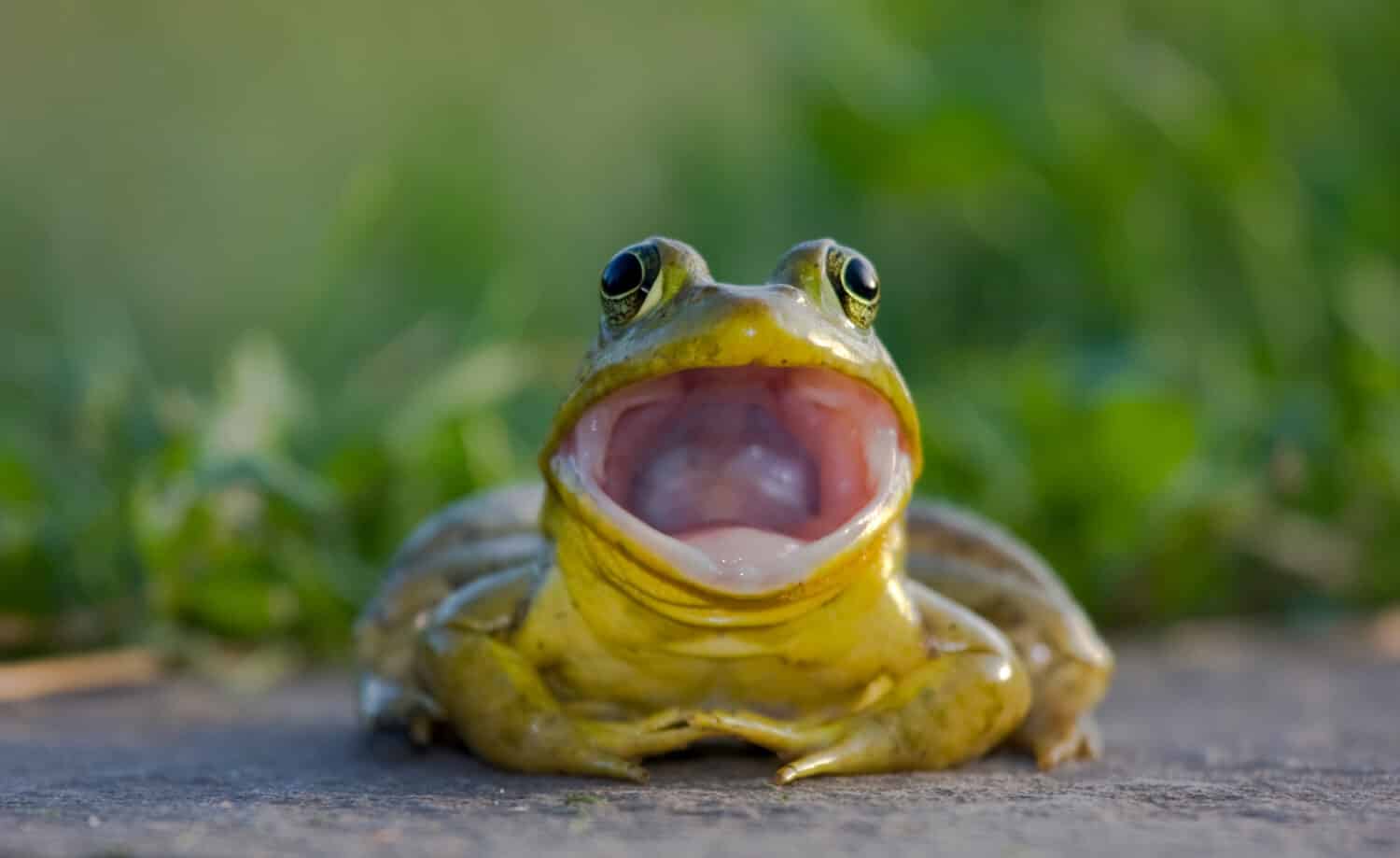
Bullfrogs can jump anywhere from 3 to 6 feet, a skill that helps them both in battles and when catching prey. They wait quietly for insects, snails, water beetles, or small fish, then quickly leap with their mouths open wide to catch their meal.
When a male opens its mouth to call out, it’s doing so to attract a female. Researchers at Brown University stated that female bullfrogs will travel a significant distance to respond to a male’s call. Andrea Simmons, Brown University professor of psychology and neuroscience, said in a 2000 study, “A male must keep track of females and other males in the area, but it also doesn’t need to put itself at any further risk from competitors or predators.”
“A bullfrog doesn’t need to waste energy calling to another male if it already knows it is present, especially if the territorial boundaries are obeyed,” Simmons continued. “So a male bullfrog will call just enough to get a female to cross the pond and to remind the other males where it is, so it doesn’t lose its territory.”
Reproduction Facts

Tadpoles will hatch from their eggs in about 4 or 5 days.
©iStock.com/Suwatwongkham
The aggressive amphibians aren’t afraid to fight for their territory. However, when this happens, their mating call turns into an aggression call, which could deter mating opportunities.
“When bullfrogs fight, their advertisement calls change to aggression calls,” Brown University neuroscience investigator and co-author of the study, Seth Horowitz, said. “Females will hear this and will no longer be attracted to mating with the males. The males take their competition for females very seriously.”
Sometimes, a male will hide to avoid attracting attention from the calling male, then swoop in to intercept the female. “This lets males have the chance to breed without challenging other males or announcing their location to predators,” Horowitz said, explaining that this is called “satelliting.”
After mating, the male will establish a territory and find a safe place for the female to lay her eggs. A female can lay up to 20,000 eggs at a time! Males will help guard the eggs for a few days until they hatch into tadpoles. They will continue to swim in the water until they grow legs, which usually happens at about 14 months. The usual lifespan of bullfrogs is about 8 to 10 years.