
Quick Take
- The Portuguese man-of-war isn’t a jellyfish but a floating colony of genetically identical organisms that work together as one animal.
- Its gas-filled float acts like a sail, allowing wind and currents to carry it across warm and temperate oceans worldwide.
- Its long tentacles deliver a powerful sting that’s rarely deadly but extremely painful, even after the animal washes ashore.
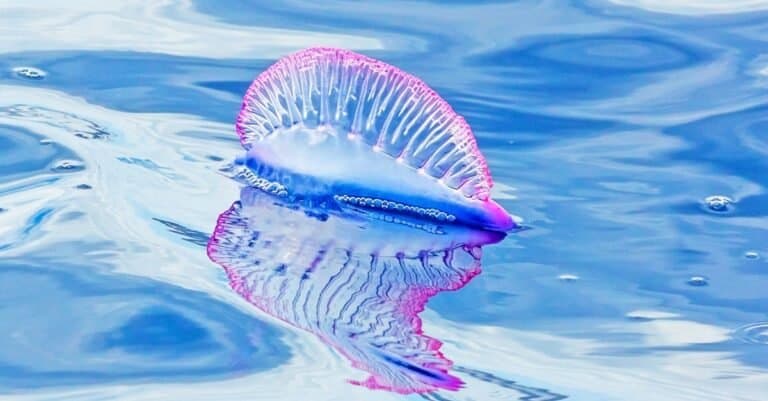
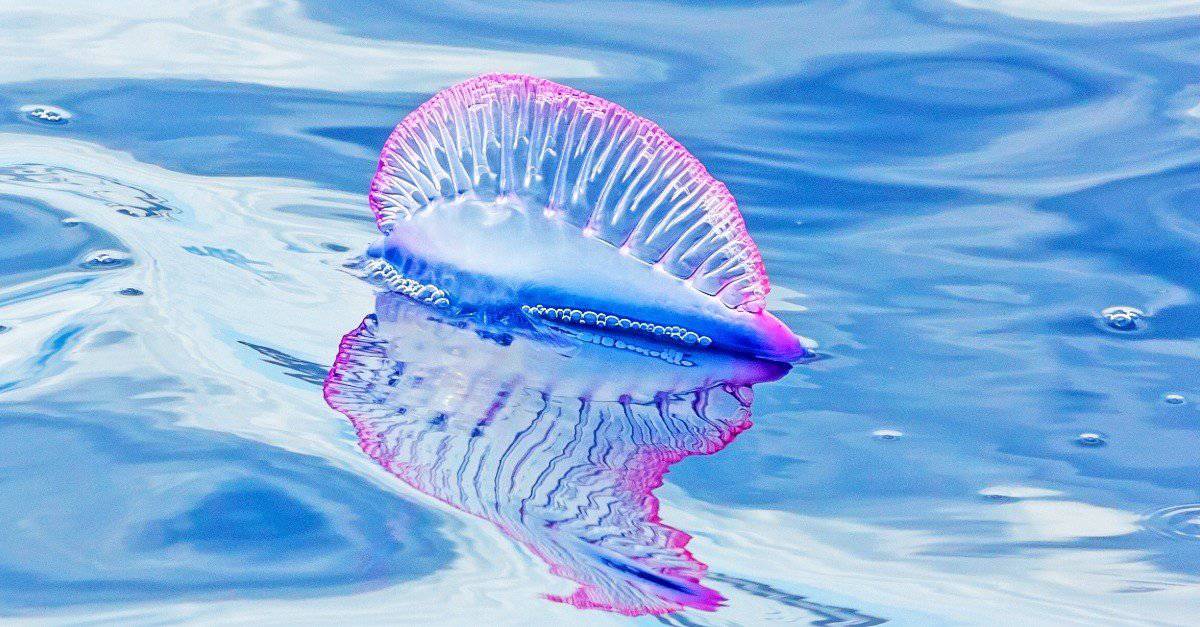
It looks like a child lost their floaty toy, right? But whatever you do, don’t try to pick it up. That ain’t no floaty toy. That translucent, bubble-like object bobbing along the surface, its colors catching the light like stained glass—that’s a Portuguese man-of-war. It’s beautiful to look at, but not so much to touch. It’s one of the ocean’s most effective and notorious stingers.
But the Portuguese man-of-war is a lot more than just a venom-filled blob you really don’t want to step on if you encounter one washed up on the beach. It’s a pretty fascinating creature—or group of creatures, as it turns out. Let’s break down what this animal really is, why it inflates like a living balloon, and what to do if you ever cross paths with one.
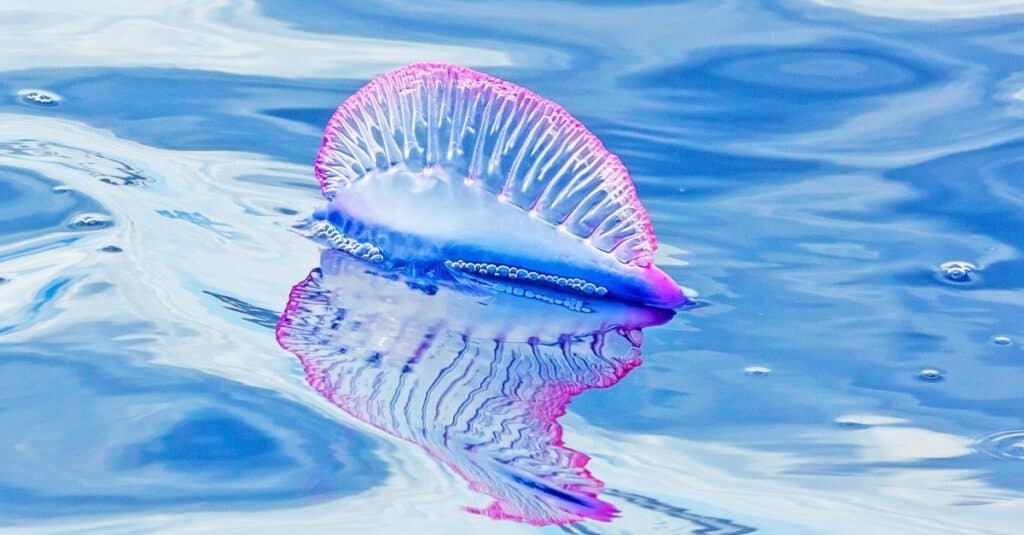
Despite looking like a single animal, a Portuguese man-of-war is actually a floating colony made up of specialized, genetically identical zooids.
©iStock.com/aldorado10
What Exactly Is a Portuguese Man-of-War?
A more appropriate question might be what are a Portuguese man-of-war, since it’s actually not one single organism. The Portuguese man-of-war is something called a siphonophore, a colonial organism made up of many individual animals called zooids. All the zooids are genetically identical, but they differentiate into specialized units, each handling a specific task like buoyancy, feeding, or defense. None of them could survive alone, but together they function as a single creature.
The species most people encounter is Physalia physalis. It belongs to the same broader group as jellyfish, corals, and sea anemones, but that’s where the similarities mostly end. A man-of-war doesn’t pulse through the water or swim with intention like those other species; it drifts, fully at the mercy of wind and surface currents. That drifting lifestyle is the key.
Where Are Portuguese Man-of-War Found?
Portuguese man-of-war are found in warm and temperate oceans around the world. They’re especially common in the Atlantic, Pacific, and Indian Oceans, including the Gulf of Mexico and the Caribbean Sea.
Along the United States, they’re most often reported along the Atlantic coast and the Gulf Coast, particularly in Florida. That said, they don’t stay neatly within tropical zones. Strong winds and currents can push them much farther north or south. Beachgoers in places like North Carolina, the Mid-Atlantic, and even as far north as New England occasionally encounter them during certain weather patterns.
They spend their entire lives at the surface of the ocean. You’re not going to find one swimming up from below or lurking underwater. Wherever you are, if you see a man-of-war, it arrived there by drifting.
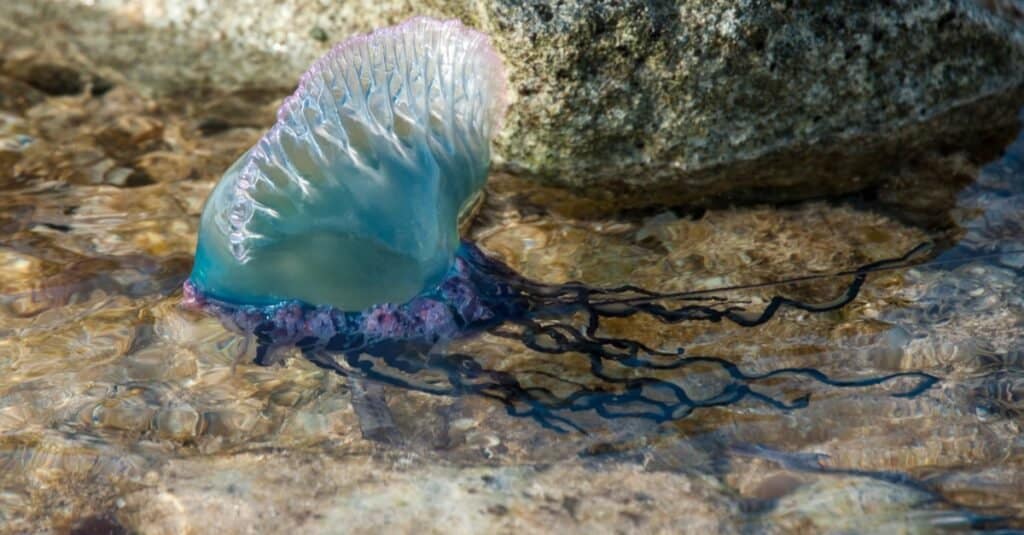
Portuguese man-of-war drift across warm and temperate oceans worldwide, often washing ashore after strong winds or storms.
©NFKenyon/Shutterstock.com
The Inflated Float
The thing that obviously stands out the most about a Portuguese man-of-war is its float. The members of the colony produce a mixture of gases that fill this bulbous structure, reaching up to about a foot long and rising several inches above the surface. This float isn’t just for buoyancy. It also acts as a sail.
By inflating this chamber, the man-of-war stays on the surface and catches the wind. Some individuals have sails that angle slightly to the left, others to the right. This helps reduce the chance that entire populations will wash ashore at once, since they’ll drift in slightly different directions under the same wind conditions.
The float’s firmness can change. It can partially deflate when conditions are rough, allowing the colony to ride lower in the water. This helps prevent damage from strong waves and may reduce the chance of being blown too far out of its comfort zone. Once conditions calm, the float reinflates.
Those Infamous Tentacles
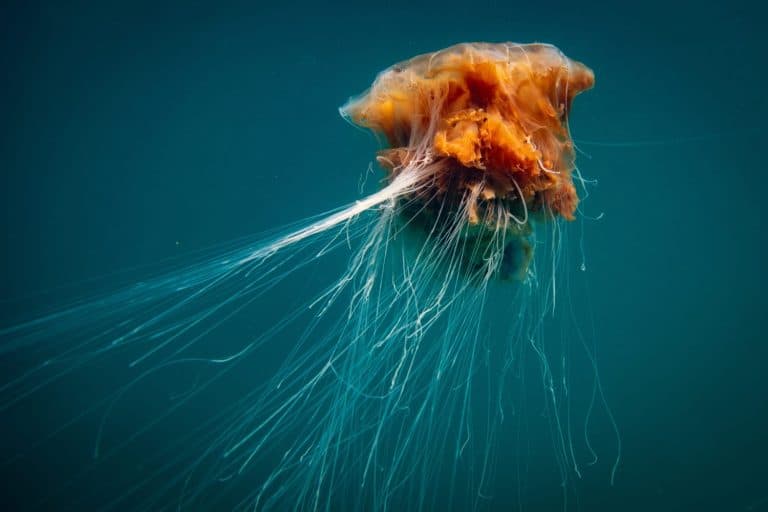
While the float is what catches the eye, what’s happening below the surface is just as astonishing—and far more dangerous. Its tentacles can trail a shocking distance, often between 30 and 50 feet, and in rare cases even longer! That bubble you see floating on the surface is only a small fraction of the animal.
These tentacles are covered with specialized stinging cells called nematocysts. Each nematocyst contains a tiny, harpoon-like structure loaded with venom that fires in a fraction of a second when triggered by touch.
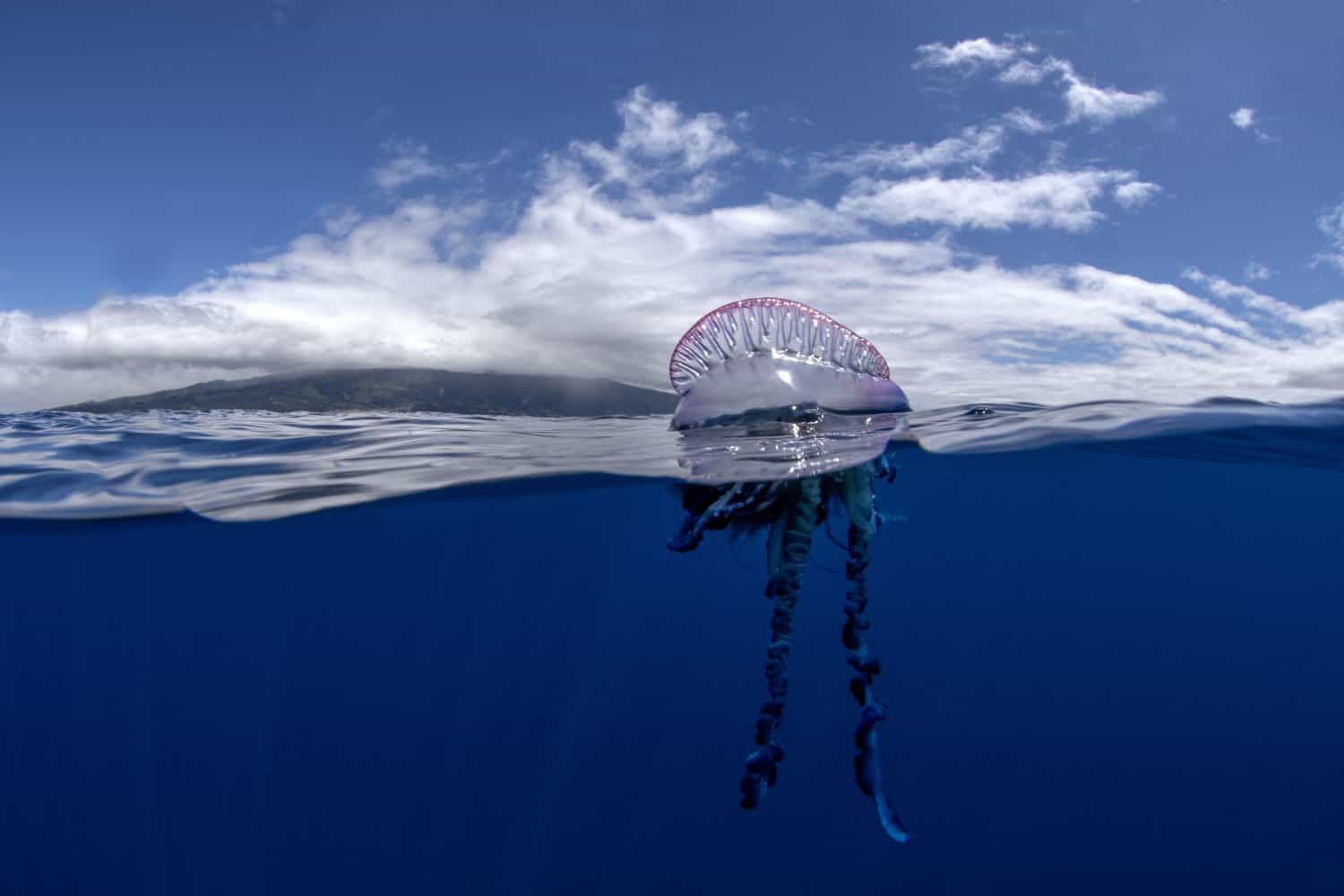
Trailing up to 50 feet below the surface, a Portuguese man-of-war’s tentacles deliver venom powerful enough to paralyze small fish.
©Martin Prochazkacz/Shutterstock.com
The tentacles are primarily used to catch prey, not to defend against humans. Small fish and plankton drift into them and are immediately stung and paralyzed. The tentacles then contract, drawing the prey up to the feeding zooids. Even detached tentacles can still sting. That’s an important detail for beachgoers. A washed-up man-of-war that looks dried out or harmless can still deliver a sting hours or even days later. And you definitely don’t want to be stung by a man-of-war.
The sting is typically described as intensely painful. Many people compare it to a burning or electric shock sensation that can leave long, red welts on the skin. The pain can last for hours, and the marks may linger for days or weeks. For most healthy adults, the sting isn’t deadly. However, it can cause more serious reactions in some people, especially children, the elderly, or anyone with allergies or underlying health conditions. Symptoms can include difficulty breathing, chest pain, nausea, muscle cramps, and, in very rare cases, heart complications.
Where Humans Are Most Likely to Encounter One
Most human encounters happen in shallow coastal waters or on beaches. Because man-of-war drift at the surface, they’re easily pushed toward shore by onshore winds. You’re most likely to run into one while swimming, wading, or walking along the shoreline after a storm or strong wind event. They often wash up in groups, and beach closures sometimes follow when large numbers appear.
Surfers and paddleboarders are also at risk, since they spend extended time on the water’s surface where tentacles may be trailing invisibly below. If you do see one, the simplest advice is also the best: don’t touch it. Give it plenty of space. Remember that its tentacles extend far beyond the float you can see. You may think you’re a safe distance away, but the tentacles can extend much farther than you expect.
If you spot one on the beach, avoid stepping near it and warn others, especially children. If local authorities or lifeguards are present, inform them. Beaches with frequent sightings often have established protocols for safely removing them.
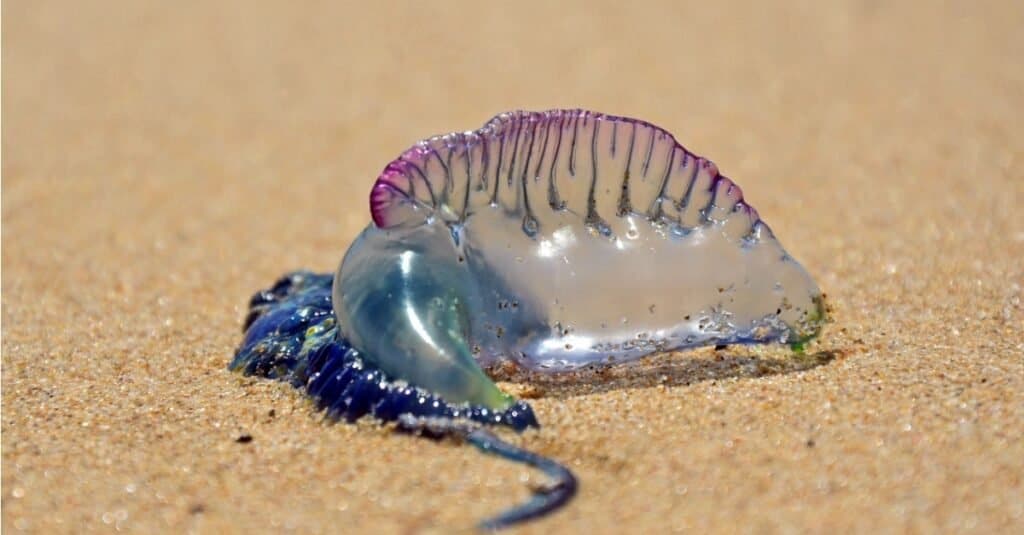
Most human encounters happen near shore, where wind and waves push Portuguese man-of-war into swimming and wading areas.
©KarenHBlack/Shutterstock.com
What to Do If You’re Stung
Despite best efforts, stings do happen. Knowing what to do can make a big difference.
- First, get out of the water calmly to avoid further contact.
- Don’t rub the area, as that can trigger more nematocysts to fire.
- Rinse the affected area with vinegar if it’s available. Vinegar helps deactivate unfired stinging cells in many cases. If vinegar isn’t available, seawater is a better option than fresh water. Fresh water can cause more nematocysts to discharge. You may have also heard the rumor that urine will soothe a sting. This is a myth. Do not do this—it will likely cause additional stinging cells to fire.
- Carefully remove any visible tentacle fragments using a stick, tweezers, or gloved hand. Never use bare fingers.
- After that, soak the area in hot water—as hot as can be tolerated without burning—for about 20 minutes to help relieve pain. Heat has been shown to break down venom proteins.
- Seek medical attention if symptoms are severe, if pain doesn’t improve, or if the sting involves the face, eyes, or large areas of the body.
Look But Don’t Touch
The ocean is full of oddities, at least by human standards, and the Portuguese man-of-war is certainly one. It looks so delicate, almost toy-like, but it’s actually a finely tuned drifting predator—or rather, a group of predators working together. Knowing what it is and how it operates doesn’t make it any less painful to encounter, but it does make you appreciate it more. And regardless, it’s certainly a cool thing to look at. It’s a living validation of the old phrase: look but don’t touch.