
Quick Take
- As frogs evolved, they developed a retractor globis muscle behind their eyes.
- Because there is no bony structure between the eye and the esophagus (food pipe), this muscle can pull the eyes into their sockets.
- Frogs retract their eyes to push the food towards the esophagus.
- Either one or both eyes can be retracted.
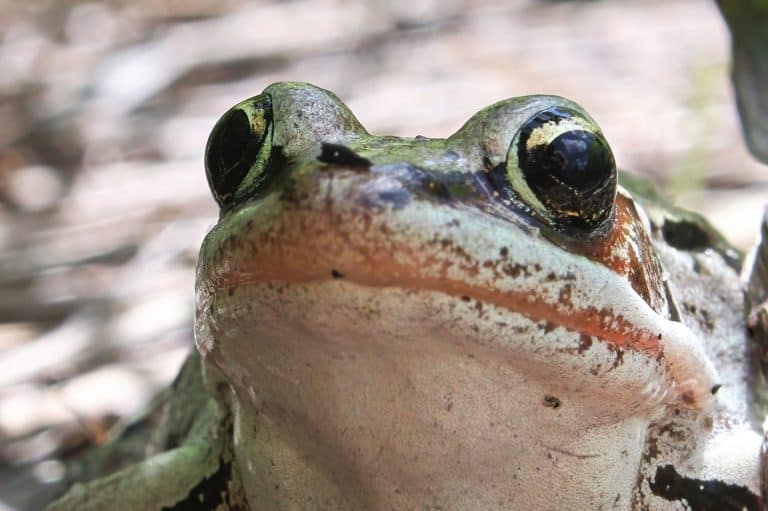
Frog eyes are distinctive, unique, and fascinating. They are huge, globular, and positioned atop their heads. We know that their eyesight is good, and thanks to their eye placement, frogs have excellent peripheral vision. But this is just part of the story. Scientists are discovering that frogs can even use their eyes for swallowing! This is what research is revealing about the eye-powered eating of the Northern leopard frog.
Northern Leopard Frog Diet and Behavior
Northern leopard frogs (Lithobates pipiens) are found in marshlands, brushlands, and forests throughout much of North America. They prefer to live in areas with permanent, slow-moving water, but can also be found in agricultural areas and on golf courses. When not breeding, they are often found far from water.
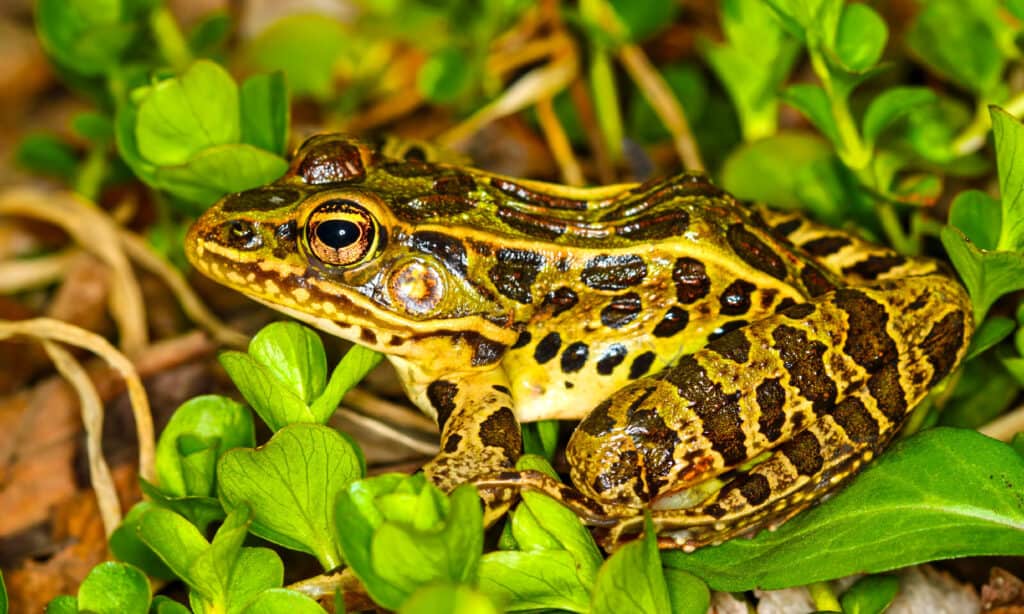
Leopard frogs are carnivores.
©Jason Patrick Ross/Shutterstock.com
They forage during the day and are carnivores. Therefore, they need to be able to swallow spiders, insects, insect larvae, snails, slugs, and earthworms. Larger adult frogs can even swallow smaller frogs. To do this, their eyes come in useful!
Frog Eye Evolution
The animals that we now call amphibians probably evolved during the late Devonian period, approximately 375 million years ago. Vertebrates came out of the water and breathed air, but still relied on their aquatic home for reproduction. Their eyes also changed in many ways.
Frogs lost their range of color vision but gained an enhanced ability to detect movement. More interestingly, they developed a retractor globis muscle behind their eyes. Because there is no bony structure between the eye and the esophagus (food pipe), this muscle can pull the eyes into their sockets.
Eye-Powered Eating Technique
It’s no secret that many frogs and toads close and retract their eyes repeatedly during swallowing (deglutition). Scientists speculated that they did this to help push the food back toward their esophagus, but it had never been proved. So, researchers conducted a study to establish just how useful eye retraction is in swallowing in the Northern leopard frog.
Simple observations of frogs eating crickets showed that there is significant variability in eye retraction. Frogs can retract either one or both eyes, and this can occur simultaneously with swallowing or as a separate movement. When retracted, the eyes are drawn deep into the oropharynx (the area behind the mouth) and actually make contact with the food item. This contact pushes the food towards the esophagus and may also help to fix the tongue’s position. Studies of the electrical signals in the retractor bulbi muscle confirm that it contracts during eye retraction. If the retractor bulbi muscles are prevented from working, frogs can still swallow, but require more swallows to move the food down their esophagus. So, scientists concluded that eye retraction enhances swallowing in frogs, but it is not essential for it.