
Quick Take
- Fulmars are one of the most successful seabirds in the Northern and Southern hemispheres.
- This bird uses projectile vomit rather than flight to defend its vulnerable offspring.
- This vomit consists of stomach oil, which penetrates the waterproofing in feathers, causing predator birds to drown.
In the animal kingdom, there are several types of responses to danger and trauma. While humans are most familiar with the fight-flight-freeze-fawn dynamic of survival responses, one creature ups the stakes more than all of the rest. Meet the fulmar, a type of tube-nosed seabird that lives in northern regions of the globe. If sufficiently threatened, a fulmar chick will projectile vomit a string of bright, orange stomach oil to prevent further hostility.
While other birds prefer to hide or fly off when faced with a threat, fulmars vomit instead. It’s a bold strategy, but one that pays off thanks to the destructive power of said vomit. Composed of wax-rich stomach oil, this spray can destroy the waterproofing on the feathers of birds of prey and even put their flying abilities out of commission. Let’s learn more about fulmars and how they use chemical warfare to outgun even the most intimidating predators.
Fulmar Facts
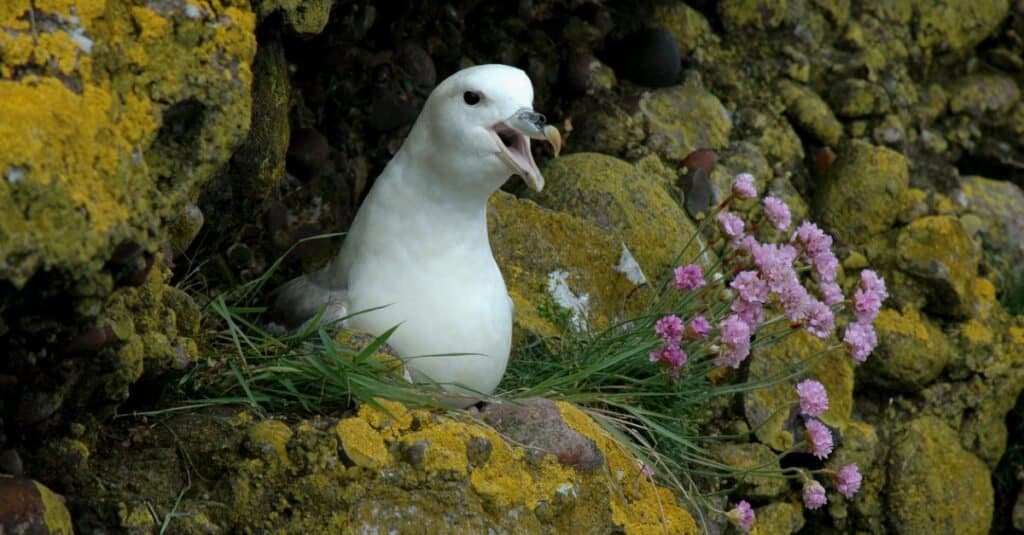
Fulmars spend most of their lives at sea and typically return to land primarily during the breeding season.
©iStock.com/Michel VIARD
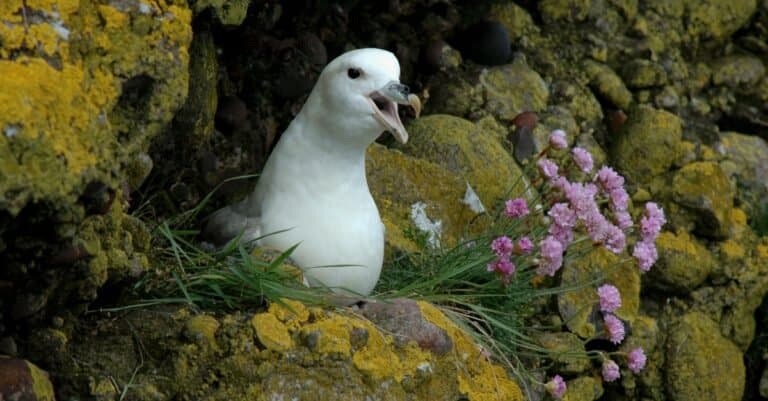
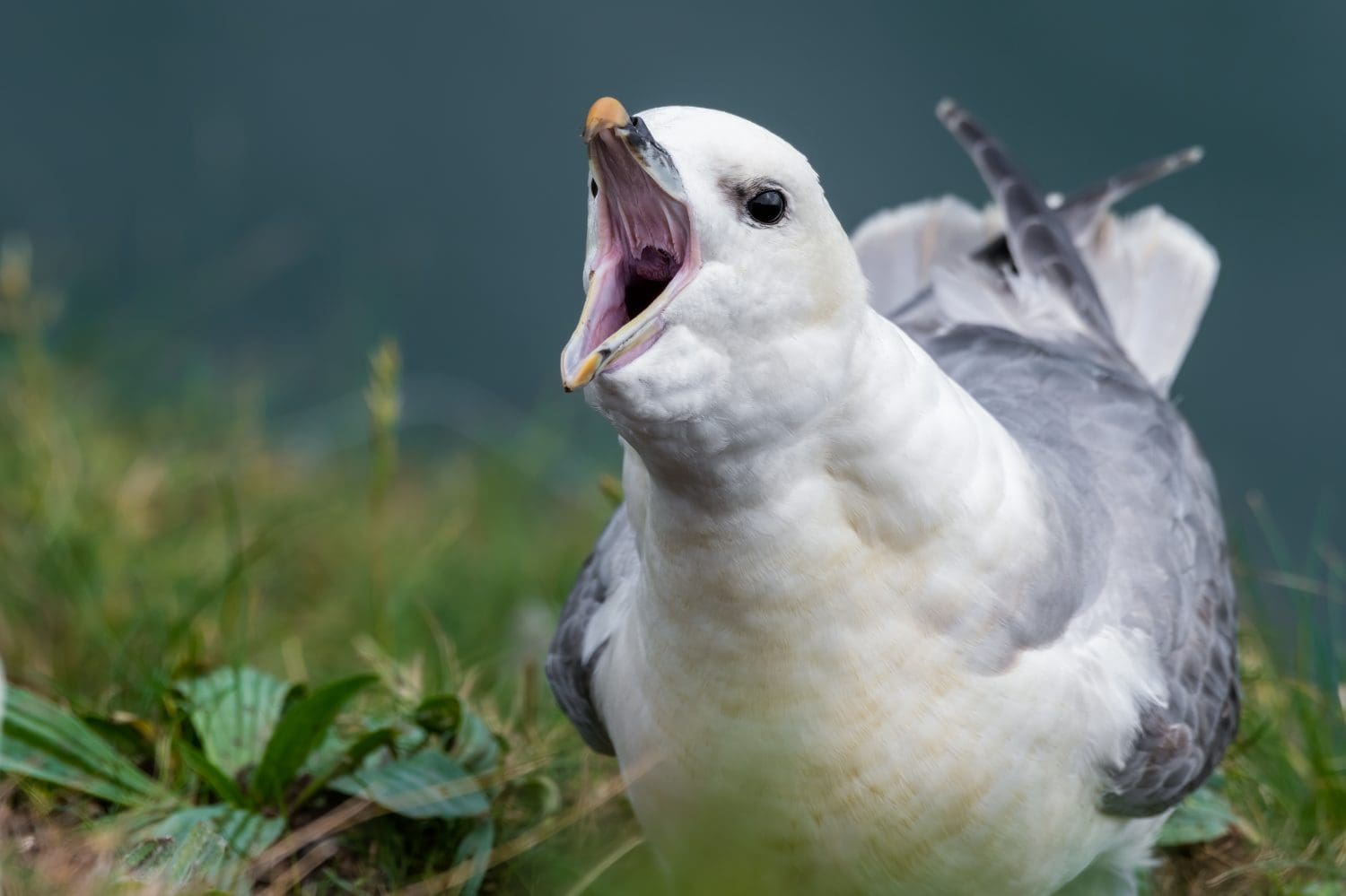
If you travel north enough on the globe, you will eventually run into the fulmar (Fulmarus glacialis), a type of tube-nosed seabird in the family Procellariidae. At first glance, many people mistake them for seagulls due to their white heads and yellowish beaks. Fulmars, however, are more closely related to albatrosses. Upon closer inspection, the differences between fulmars and gulls become evident; the former feature distinct tubular openings atop their bills. These nostrils help fulmars excrete built-up salt and sniff out food across great distances.
Technically, there are two types of fulmars: Northern Fulmars and Southern Fulmars, both of which live in the planet’s extreme zones. Northern Fulmars live in the waters around northern Europe, while Southern Fulmars live in the seas and islands around Antarctica, including the South Sandwich Islands and South Orkney Islands. The two extant species of the genus, both Northern and Southern fulmars, are closely related.
True pelagic birds, fulmars spend most of their lives at sea, where they eat a diet of fish, plankton, squid, and offal. This means that fishermen often see fulmars hanging around fishing vessels, picking up scraps with remarkable efficiency. These birds are characterized by features built for endurance, including thick necks and narrow wings. Fulmars spend most of the year at sea but return to land for the breeding season, often arriving at their nesting sites well before egg-laying and remaining there for an extended period. There, the colonies become noisy and competitive, which likely contributed to the evolution of this seabird’s most infamous trait: toxic vomit.
Agent Orange
Fulmars don’t seem to have much in the way of defense until they start vomiting. That’s because a fulmar’s stomach oil is so adhesive that it can literally destroy the plumage of avian predators and even lead to their death. Fulmars eat so many oil-rich creatures—from squid to krill—that they have to do something with all the sludge. Instead of just digesting these lipids, the fulmar’s stomach concentrates these oils in a specialized chamber called the proventriculus.
This thick, oily, orange stomach oil is a remarkably complex mixture of digested remains. Typically, this stomach oil consists of dietary remains in the form of wax esters, triglycerols, and diacyl glycerol ethers. When combined, these different lipids create a kind of biological napalm that serves two purposes. While it serves as a noxious weapon, it also helps sustain fulmar chicks during long trips across the open ocean.
While adult fulmars can fly away when faced with a particularly dangerous threat or predator, fulmar chicks don’t have many options. They are sitting ducks in the face of a hungry predator, so they must rely entirely on this stomach oil projection. Luckily, fulmar chicks can vomit up this chemical weapon and shoot it up to two meters away with impressive accuracy.
Stuck in Oil
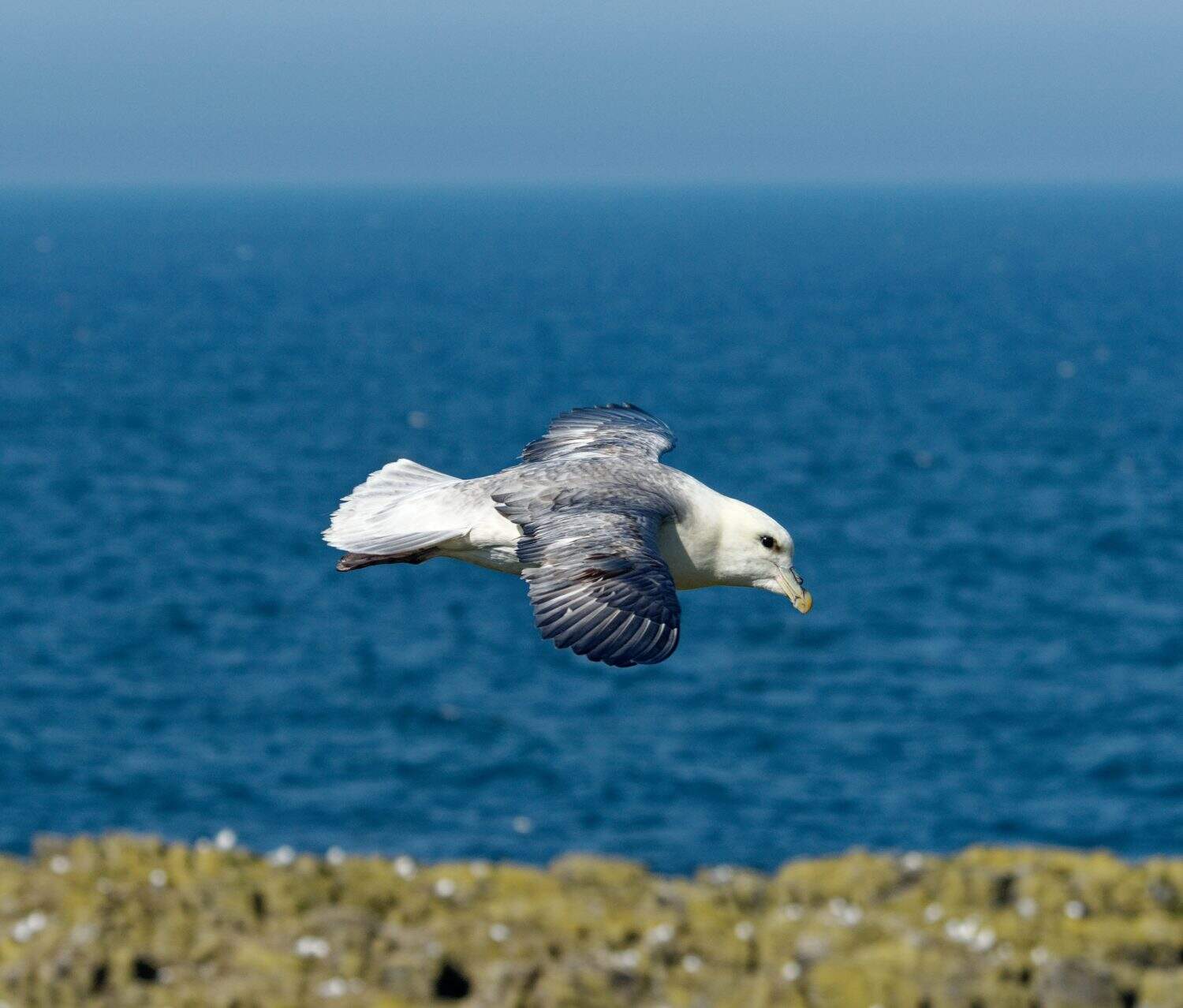
Even much larger birds are helpless when soaked in a fulmar’s sticky stomach oil.
©Colin Seddon/Shutterstock.com
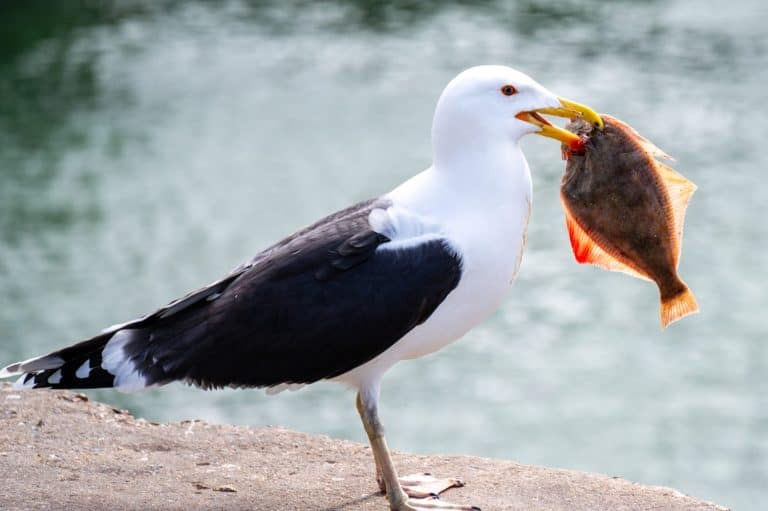
If a person were to be “puked” on by a fulmar, it would likely be no more than a filthy annoyance. If one of the fulmar’s predators were struck with this stomach oil spray, however, it could very well be a death sentence. While fulmar stomach oil lacks any venom or poison in the traditional sense, it can do serious damage to the structural integrity of feathers. This is bad news for avian predators like white-tailed eagles or Great Black-backed gulls.
Most seabirds have feathers with microscopic structures that make them waterproof. Often, these feathers consist of interlocking barbs that trap a layer of air against the skin. This provides buoyancy, insulation, and waterproofing. If these wings are hit with fulmar stomach oil, its high wax ester content pierces the interlocking barb structure of the feathers. Enough oil and the feathers lose their grip completely. Once the oil penetrates the previously waterproof feathers, a bird can quickly become waterlogged.
That exposure can cause even the toughest birds of prey to become dangerously cold. Even in relatively mild climates, the cold ocean water can cause hypothermia for birds with exposed skin. If a bird’s feathers are soaked in fulmar stomach oil, it struggles to stay afloat. Without the ability to stay afloat, many birds covered in this oil eventually sink and drown. Lab experiments have shown that fulmar stomach oil can severely compromise the waterproofing of feathers in other birds, which may lead to hypothermia and death, especially in cold conditions.
Self-Immunity
Considering that they are also seabirds, you might think that a fulmar’s stomach oil could do just as much damage to their own wings. However, fulmar wings have a slightly different structure from those of other seabirds. This structure allows them to clean off their oil more effectively than other birds. This simple yet effective (and stinky) defense mechanism has allowed the Northern Fulmar to become one of the most successful seabirds in the Northern Hemisphere.