
Did you know that the U.S. has a concerning bullfrog problem? You might be wondering what these seemingly innocent creatures have done to trigger such concern in the country. However, they’re actually quite an intrusive species. Despite being native to America, they’re also now considered invasive.
Native to the Eastern U.S. in particular, bullfrogs have found their way to the West. In fact, humans introduced them to the West in the early 1900s. Specifically, they’ve become common in states like California, Oregon, and Colorado, according to Vox. Since then, they’ve become a major threat to many animals in the area.
How Did Bullfrogs Become Invasive in the U.S.?
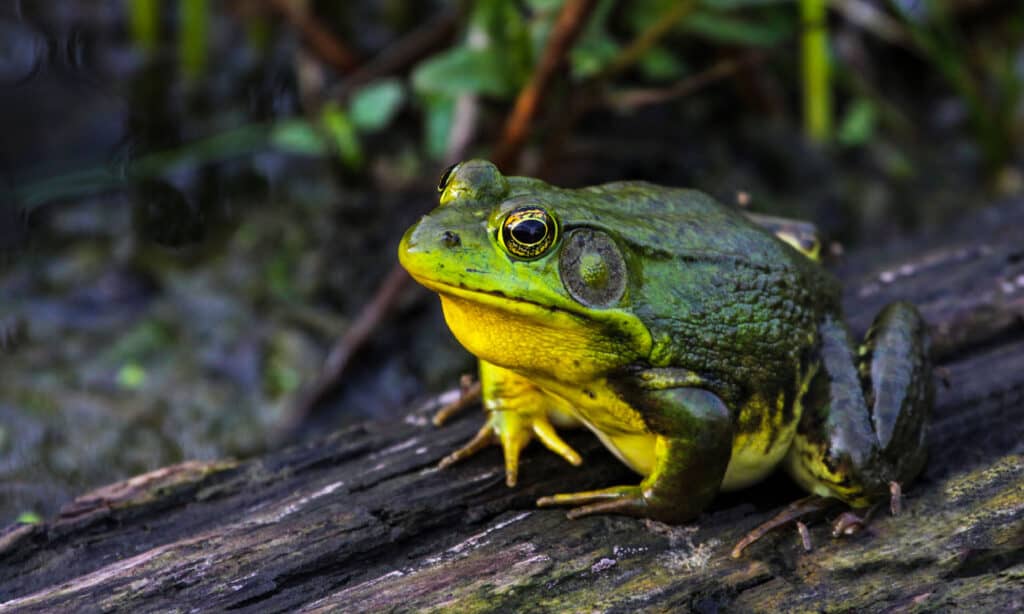
Unfortunately, American bullfrogs harm native populations in the western portions of the U.S.
©iStock.com/187715314
It’s strange to consider how a native animal could become invasive in its home country. However, such is the case with bullfrogs. “American bullfrogs are native to the eastern United States, as far west as the Great Plains, but they have been introduced outside of their native range in the western U.S. and in over 40 other countries,” says Dr. Allison Sacerdote-Velat, PhD, Curator of Biology and Herpetology/VP of Conservation Research at Peggy Notebaert Nature Museum. “Many of the introductions outside of their native range were carried out between 1900 and the 1940s in order to farm American bullfrogs as a food source with aquaculture approaches.”
However, due to their massive size and strong bodies, they’re also predators of many native species within certain regions. Bullfrogs ambush their prey, which includes other amphibians and reptiles. “American bullfrogs are the largest of the North American frogs, and tend to have greater survival rates than smaller species,” says Sacerdote-Velat. “Because of their large, powerful hind limbs, they are able to disperse up to 1 kilometer (.62 miles) from a location and colonize new bodies of water.”
As the American bullfrog disperses to new areas, pathogens may move with them into new places.
Dr. Allison Sacerdote-Velat, PhD, Curator of Biology and Herpetology/VP of Conservation Research at Peggy Notebaert Nature Museum
These animals are extremely adaptable and are even able to survive in anthropogenic aquatic habitats, according to Sacerdote-Velat. While other smaller species might require fishless wetlands for safe breeding grounds, bullfrogs do not have such requirements.
Additionally, in non-native habitats, they’ve been able to reproduce at smaller body sizes. Naturally, this increases their reproductive output throughout their lifespans, adding to their invasiveness in these regions. “Because an individual female bullfrog can produce between 1,000-20,000 eggs at once, their numbers can rapidly increase,” Sacerdote-Velat says.
Risk of Bullfrogs in the US
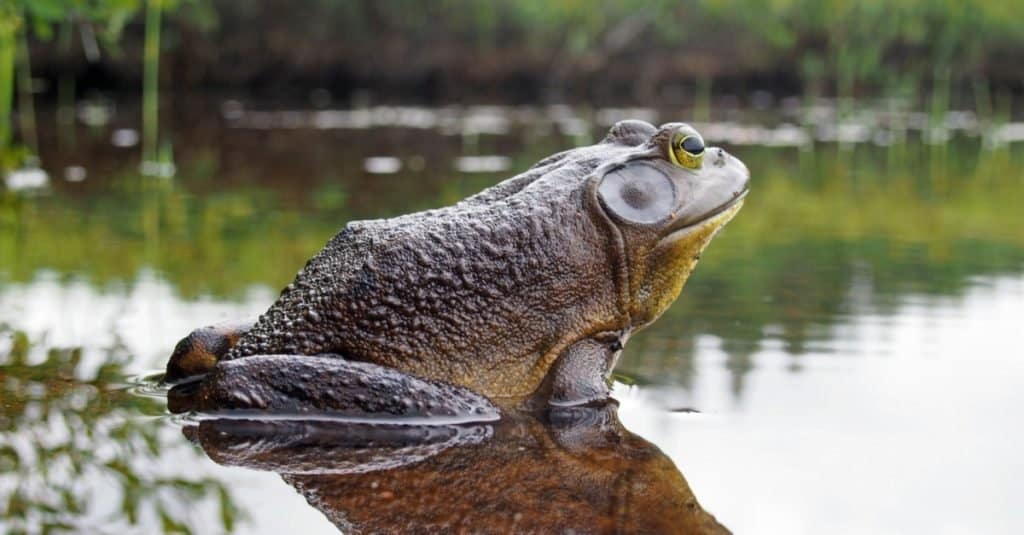
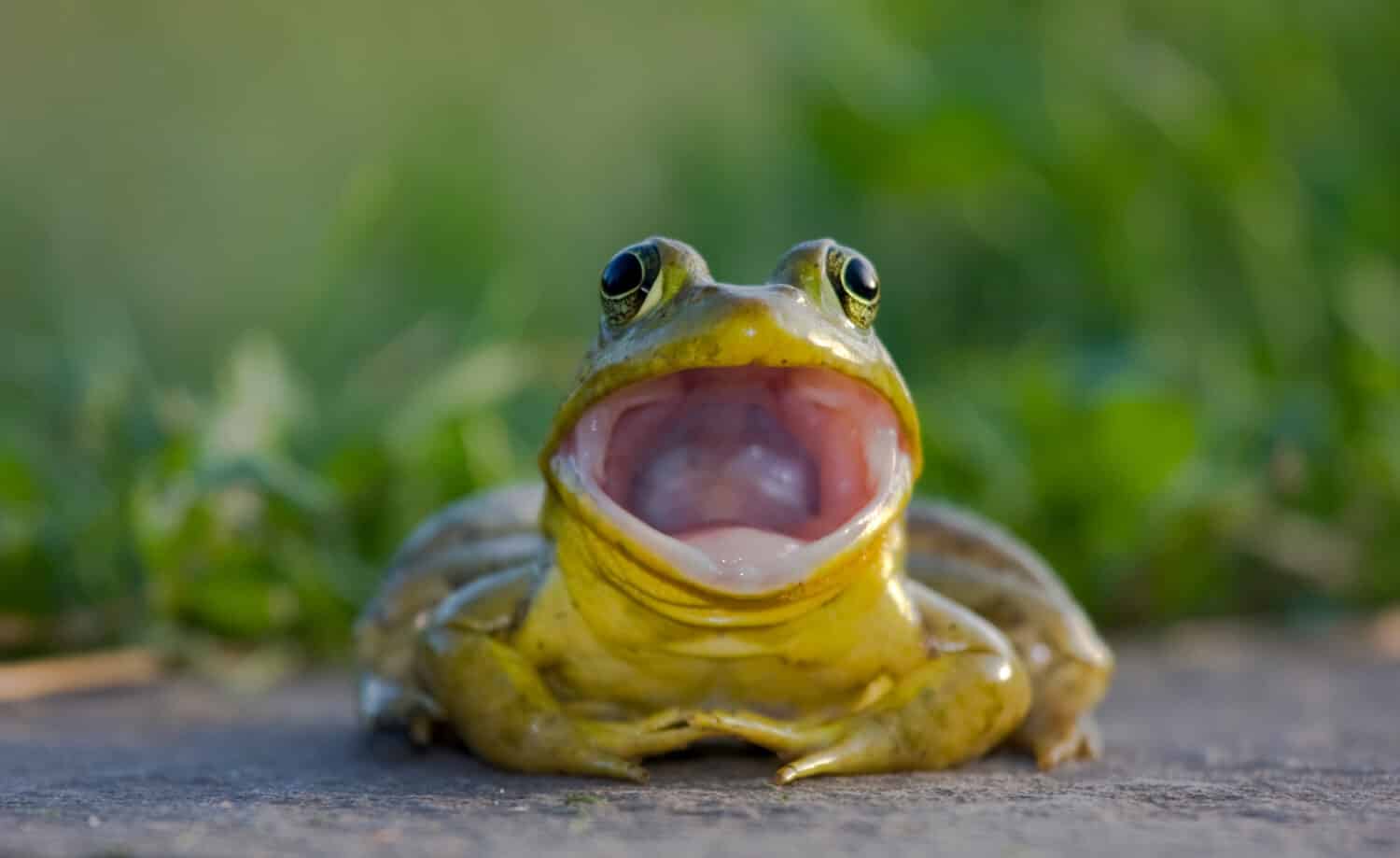
The American bullfrog has a bellowing call.
©Christian Ouellet/Shutterstock.com
It’s quite clear how bullfrogs have become invasive in the U.S. However, why, exactly, do they present such a dangerous threat?
“American bullfrogs are larger than other native species,” Sacerdote-Velat explains. “They can eat many other smaller native species, and can outcompete other native frog species, contributing to declines in many endemic frogs within the introduced range of American bullfrogs.”
Additionally, Sacerdote-Velat continues, bullfrog tadpoles feed on the same food sources (think: algae and larvae) as other species. Naturally, this impacts aquatic ecosystems.
When they reach adulthood, however, this becomes even more complex. “Adult American bullfrogs will feed on both vertebrate and invertebrate prey and can compete with native birds, reptiles, fish, and other amphibians for food,” Sacerdote-Velat explains.
They also feed on native species like other amphibians and reptiles.
Another reason bullfrogs are considered invasive is their ability to spread dangerous pathogens. “American bullfrogs are known reservoir species for pathogens such as Chytrid fungus and Ranavirus,” Sacerdote-Velat says. “As the American bullfrog disperses to new areas, pathogens may move with them into new places. Because American bullfrog populations can have high densities of individuals, the risk of disease transmission may increase.”
How Do Bullfrogs Disrupt the Ecosystem?
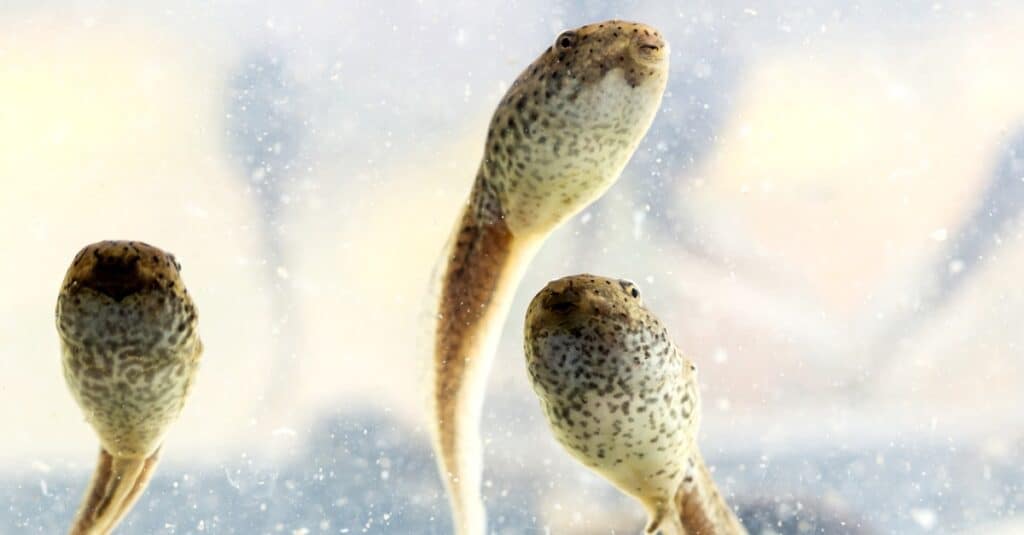
Baby bullfrogs eat insects and algae.
©iStock.com/Suwatwongkham
As mentioned above, bullfrogs directly and negatively impact many ecosystems. Not only do they consume the same food sources as native species within the area, but they are also predators of said species.
“When a new species is introduced to an ecosystem, there are direct and indirect effects on the other species occupying that ecosystem,” says Sacerdote-Velat. “Invasive wildlife can directly predate native species, outcompete native species, and change characteristics of the habitat, such as [the] presence of algae, or the availability of oviposition sites.”
This raises the question: Would American bullfrogs be considered invasive if they had not been introduced to the Western U.S.?
Simply put, no. They wouldn’t be. To be deemed “invasive,” the species must cause harm to a region in which they are not native.
“Generally, the introduction of American bullfrogs outside of their native range can contribute to declines in populations of native frogs and other aquatic organisms, and to decreased species diversity within an invaded wetland ecosystem,” Sacerdote-Velat concludes.