In 2024, the Centers for Disease Control and Prevention (CDC) shared data that suggests approximately 70 million people in the United States are living with a disability. Of these, only a small amount (approximately 1%) have service dogs. Service animals are trained to support the needs of those with disabilities. Working with a service animal has also been shown to have serious benefits for dog handlers. These range from improved mental and emotional well-being to more community connection or physical activity. It’s not an exaggeration to say that service dogs are incredible workers for the people they’re paired with.
But, in recent years, the rates of false service dogs have skyrocketed. A 2019 survey performed by Canine Companions for Independence and the Assistance Dogs International North America Regional Chapter Board found that 92.6% of service dog handlers have encountered a “questionable” service dog, 78% have been lunged at or vocalized at by an out-of-control dog while with their service animal, and nearly 66% felt that false service animals harmed their credibility and had a negative impact on quality-of-life. It’s true: fake service animals can shift public opinion and potentially reduce the rights of those who rely on their service dogs. To avoid the potential consequences, know what to look out for when trying to differentiate between a real service animal and a fake service animal.
What is a Service Animal?
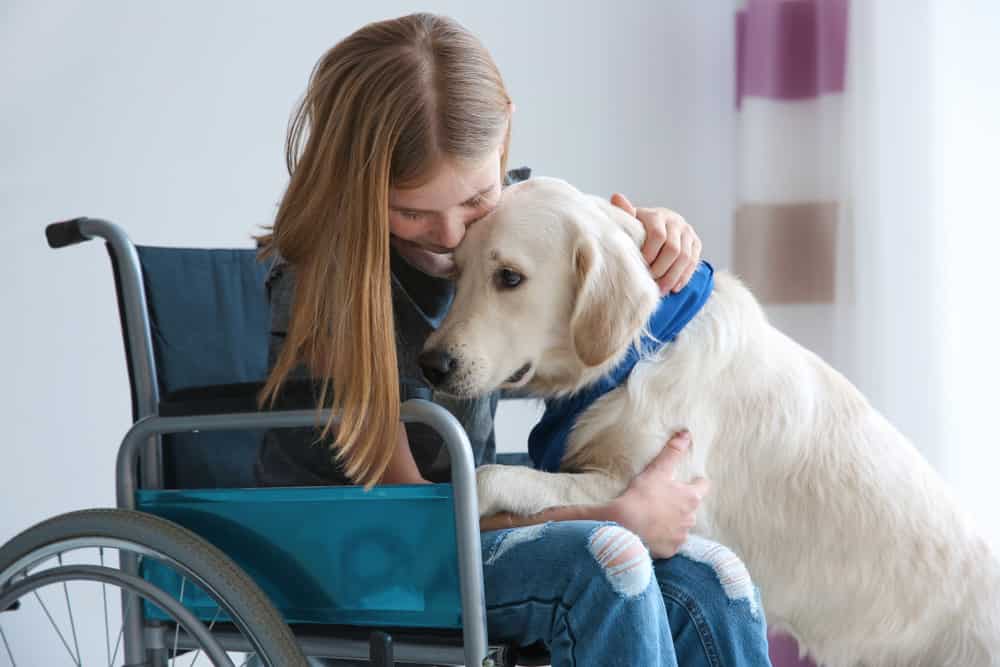
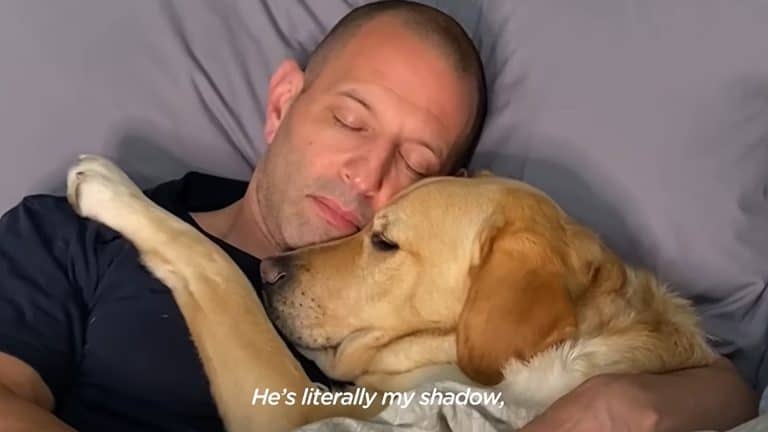
Service dogs provide assistance to individuals with disabilities, and are specifically trained to meet the needs of their person.
According to the Americans with Disabilities Act (ADA), service animals are dogs of any breed or size that perform a task related to someone’s disability.
“Service dogs provide a valuable addition to the tools of a veteran or other individuals living with a disability,” says Pat Hairston, who founded Four Paws NC with her husband Rick Hairston in 2019. “The skill-trained dog can help the person to regain independence lost due to their disability.” Rick has been working in the service dog industry for nearly three decades, serving five years on the Board of Directors for Assistance Dogs International, the internationally recognized governing body that establishes industry standards and practices.
Four Paws NC was founded in 2019 to provide service dog training for veterans and individuals with disabilities.
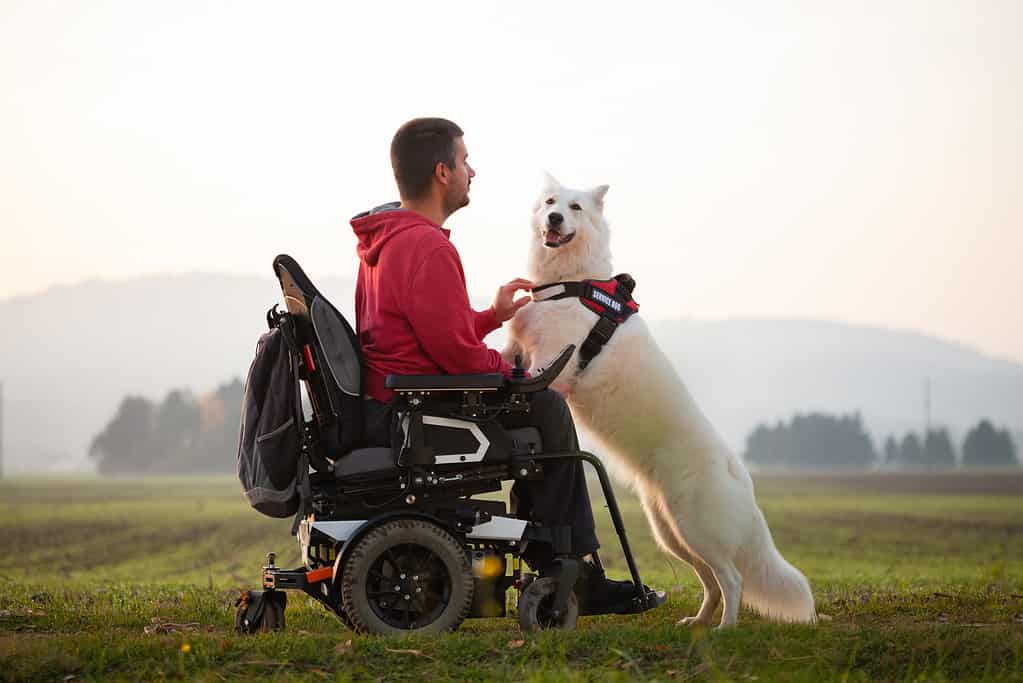
Retrieving an item or items for someone in a wheelchair
Alerting when someone is about to have a panic attack or seizure
Providing deep pressure therapy for individuals with PTSD by placing their body on the person to ground them
The tasks performed vary from person to person based on their needs.
“Instead of having to rely on another person to pick up a dropped item, the service dog can do that,” Hairston explains. “In exchange for a cane, a service dog can be trained in a harness to assist the person with mobility. Daily living becomes more bearable with the service dog by their side.”
While service animals help their owner with valuable support, there are things that service dogs are not known to do. For example, a pet dog may provide simple comfort and companionship. But someone could not use a dog solely for companionship while still considering it a service animal.
Most Popular Service Dog Breeds
The ADA doesn’t bar any dog breed from becoming a service dog. But several breeds have the right temperament, personality, and motivation to excel in their roles. The most common service dog breeds include:
Service animals are allowed access to public places where animals aren’t typically permitted.
“A service dog has legal rights under the Americans with Disabilities Act to go with their person wherever they go with very few exceptions, including restaurants, hotels, businesses, and public transportation,” Hairston says. “No additional fees can be charged by businesses because a service dog is with the person. Service dogs are a medical necessity like a wheelchair, walker, cane, or crutch.”
Emotional support animals (ESAs) do not have the same legal rights. “Some exceptions are given to housing under the Fair Housing Act for a person to have an ESA,” Hairston says. “But otherwise, an ESA has no legal access to go with a person.”
According to the ADA, business owners are allowed to ask two questions to people who bring their animals into their place of business:
Is this dog required because of a disability?
What specific tasks or work does the dog perform?
However, it’s important to note that staff cannot require documentation about the service animal or the disability, or require the dog to do this task. With just questions, many people balk at the idea of having to ask someone whether their pet is a service animal out of fear of sounding rude. While businesses must allow in service dogs, businesses can also remove the dog and handler if the dog behaves inappropriately and/or is not under the control of the handler.
How to Spot a Fake vs. Legitimate Service Animal
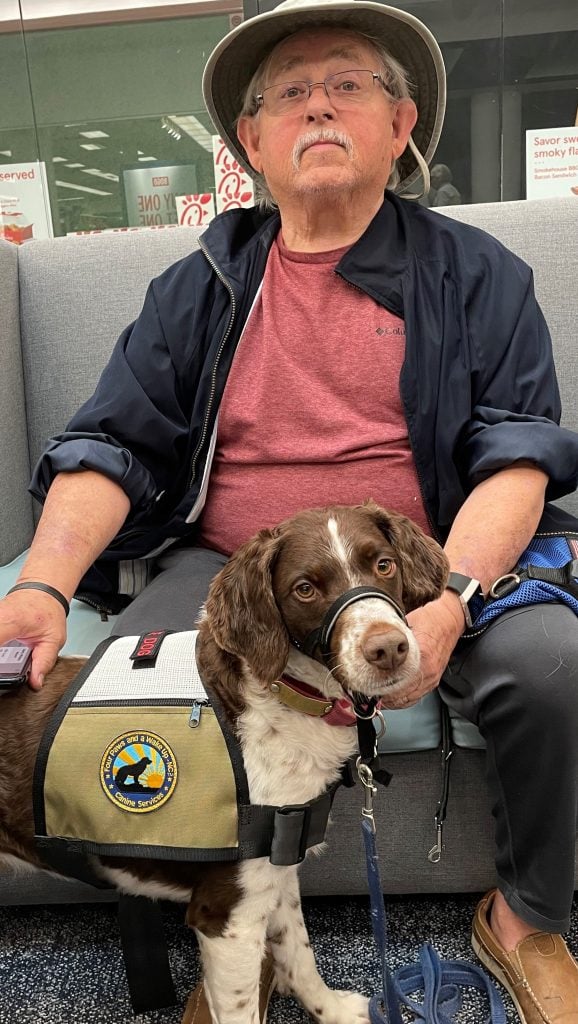
No matter where they are, service dogs should always be tuned into their handlers.
If you see people with their dogs out in public, you might be wondering how to tell a legitimate service animal from a fake service animal. While even service dogs can have bad days, there are certain tells to look for that show what legitimate service dogs look like.
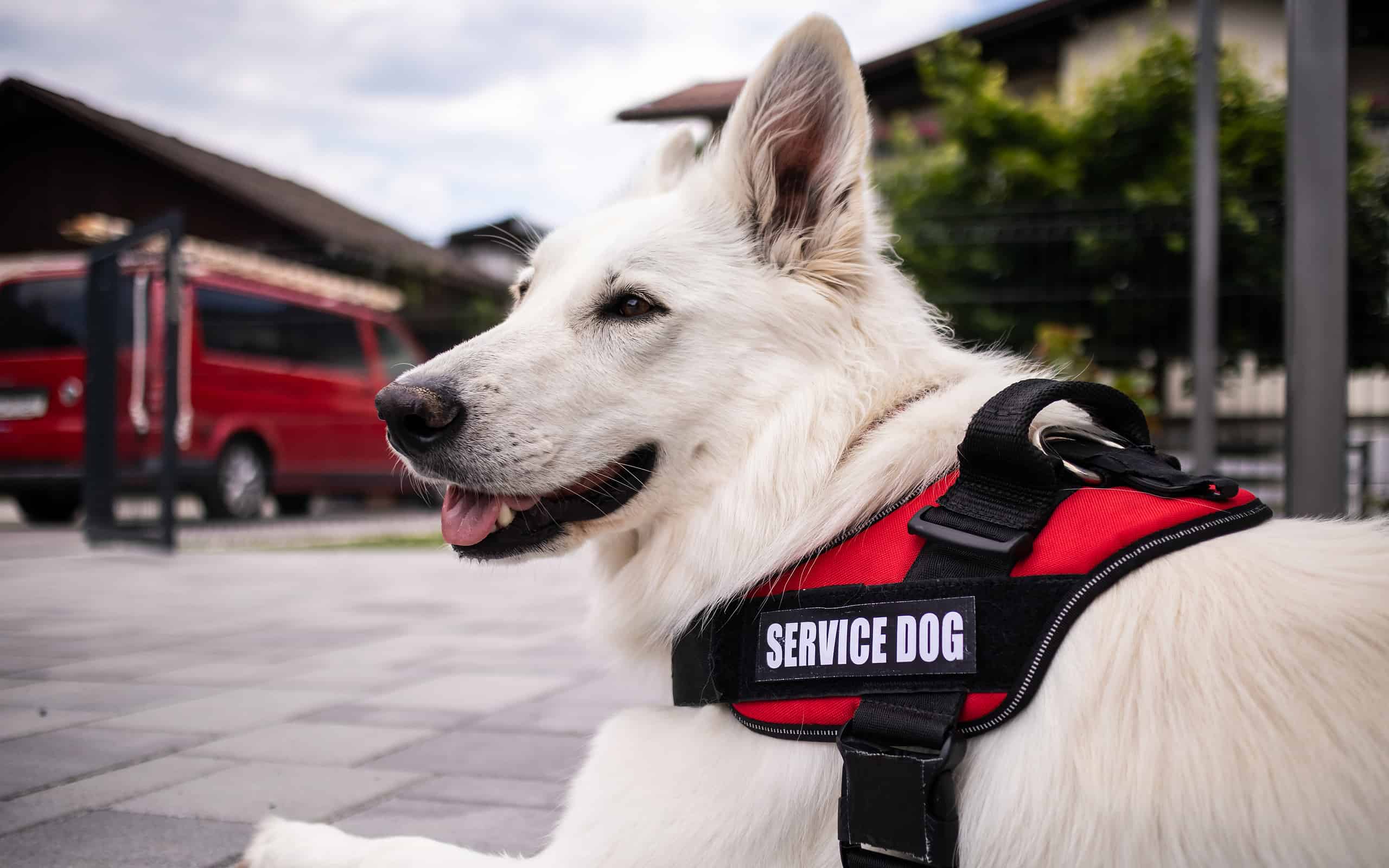
Not All Service Dogs Wear Vests
Some individuals do have their dogs wear service vests. But did you know that these vests are not required? It’s often a misconception that someone can call their dog a service animal after buying a vest online.
Unfortunately, this has led to an uptick in people falsely claiming their dog is a service animal so that they can bring their pet everywhere. Many of them buy vests online for a false veil of authenticity.
“The availability of service dogs’ vests certainly has made it easier for people to misrepresent their dogs. Another issue is the site that claims to register a service dog and provide identification,” Hairston says. “Again, falsely claiming a dog is a service dog. This harms people with a legitimate need for a service dog because the laws may change, and service dogs will not be allowed access at all.”
Service Dogs Are Well-Trained
Training a service dog is not cheap. Estimates vary in exactly how much the training costs, but most people will spend anywhere from $10,000 to $50,000, depending on the specific condition and tasks. The process may take several years. Many individuals make false equivalencies between service dogs and ESAs. But ESAs are not trained or required to have any training, as their main purpose is to provide comfort to their owners.
Service Dogs Are Well-Behaved
Thanks in part to their specialized training, service dogs remain calm and focused in public. Service dogs remain focused on their owners, even in high-stress situations or in areas with large crowds. A genuine service dog should not be seeking out attention from others or pulling on its leash. In fact, a service dog is typically so well controlled that a service animal should not even react if food is dropped on the ground in front of them.
“A typical service dog should ignore distractions and other animals. In a crowded environment, it will remain focused on their person and remain by their side. It will remain quiet and not bark. Service dogs must have excellent obedience and social skills. It must be accepting of a wide variety of experiences, situations, sounds, and scents. Service dogs must be taught to navigate the community, seen and not heard, responding to their person and focusing on their person to accomplish the job,” Hairston says.
Service dogs, like those trained by Four Paws NC, know to stay close to their handlers.
Therefore, a purported service animal behaving poorly in public could be a giveaway that the dog is not trained to be a true service dog. Hairston notes that behavior to look out for includes dogs that are:
Aggressively approaching other dogs, animals, or humans
Barking excessively or repeatedly
Wandering away from their handler or pulling on the leash
Jumping on furniture or chairs
Inappropriately urinating or defecating
A typical service dog should ignore distractions and other animals. In a crowded environment, it will remain focused on their person and remain by their side.
Pat Hairston, cofounder of Four Paws NC
Service Dogs Remain On-Leash
Because service dogs are doing work, they are usually leashed and ready to step in if their handler needs help. If a dog is being carried or rolled around in a stroller, it is likely not a service animal.
Handler Reactions
Finally, the last way to differentiate between real and fake service animals is by looking at the handler. Legitimate handlers understand their rights, keep their service dog close, and make sure the dog is focused on the task at hand. People with fake service animals may carry false certification paperwork or let their dog behave poorly, sometimes without correcting them.
False service animals harm the reputation of real service dog teams. People with disabilities may face even more scrutiny or discrimination than they already do. But by knowing the signs, you can help advocate for those who need these animals.
Jessica Lynn is a writer at A-Z-Animals.com, where her primary focus is sharks, reptiles, and insects. Jessica has been writing for over 10 years and holds a Bachelor's degree in English from Virginia Commonwealth University, which she earned in 2014.
A resident of North Carolina, Jessica enjoys beachcombing for unique shark teeth, spending time on the water with her kayak, or relaxing at home with her cat.
Thank you for reading! Have some feedback for us?
Contact the AZ Animals editorial team
Thank you for your feedback!
We appreciate your help in improving our content.
Our editorial team will review your suggestions and make any necessary updates.
There was an error submitting your feedback. Please try again.