
Quick Take
- One expert argues cats are actually easier to train than dogs, though this is only true if you avoid the mistake most owners make without realizing it. See why cats surprise →
- A cat's intelligence has surprisingly little to do with how well it trains. The real factor is something most owners overlook entirely. Explore cat intelligence →
- There's a specific training window that makes cats absorb new behaviors faster, and most people would be surprised by how short it actually is. Find the ideal session length →
Have you heard about the Virginia Tech students training cats to fistbump? While many believe cats are sassy, solitary creatures, they’re actually highly adaptable and relatively easy to train. That is, if you have the patience and the correct approach.
Interested in teaching your feline friend a few tricks? In this article, we speak with cat behavior consultants about the best ways to train a cat—and some information on the adored pet.
Are Cats Smart?
The answer to this question depends on your definition of “smart.”
“In comparisons using human standards of intelligence, dogs tend to do better than cats. However, that doesn’t mean cats are dumb,” says Joey Lusvardi, an IAABC Certified Cat Behavior Consultant and Accredited Professional Cat Trainer through the Pet Professional Guild’s Pet Accreditation Board. “They’re good at being cats and what they have needed to do to survive as a species.”
Additionally, a cat’s intelligence greatly depends on the individual feline, meaning one of your pet cats might be smarter than another.

Every cat has its own personality and intelligence levels.
©Natalia de la Rubia/Shutterstock.com
“Cats are all individuals, so like humans, there are really smart cats and other cats who maybe struggle with putting things together,” says Heather Alvey. I am a certified cat behavior consultant and the owner of Felidae Behavior Consulting.
However, a cat’s intelligence doesn’t necessarily impact its ability to learn new tricks or have successful training sessions.
“I had a cat who was more handsome than he was intelligent, but he was great at training because he was very food-motivated and really wanted to figure out what I was asking so he could get that reward!” Alvey says.
How Trainable Are Cats?
According to both Lusvardi and Alvey, cats are extremely trainable creatures.
“All it takes is figuring out what the cat finds motivating enough to work for,” Alvey says. “My clients are often amazed at how much their cats can learn in just a few minutes.”
In fact, Lusvardi even considers cats to be easier to train than dogs in many ways. Of course, it might take time to learn how to train cats versus dogs (more on that later), but felines are adaptable and pick up on behaviors quickly.
“People accidentally train their cats to do a lot of annoying behaviors all the time without even trying,” Lusvardi says.
What Can You Train Your Cat to Do?
Though they’re highly trainable, cats aren’t always going to deliver in the way we want them to. For example, according to Lusvardi, cats wouldn’t make good service animals as dogs do.
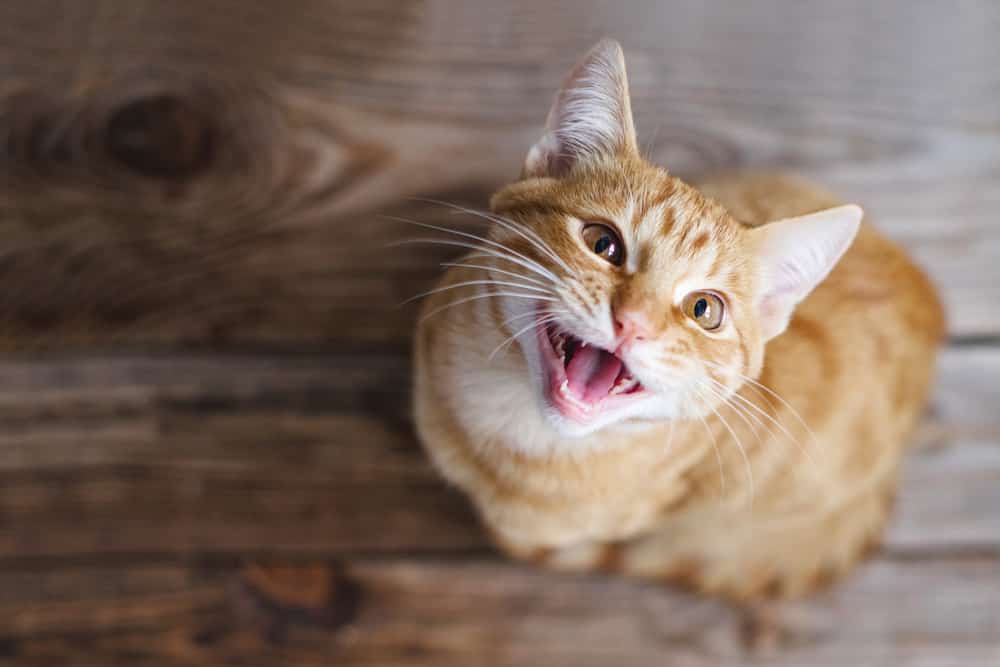
You can train your cat to speak, or “meow.”
©savitskaya iryna/Shutterstock.com
“They’d likely end up too distracted in public settings, but you can easily train your cat to do a lot of cool tricks or get them to understand basic cues,” he says. “It’s very doable to train your cat to voluntarily offer a paw for a nail trim or even take medications willingly. I trained my cats to press a button on my Nintendo Switch and beat a Zelda game for me. If you have enough time, you can train cats to do really complicated behaviors as long as they are physically capable of doing so.”
As Alvey puts it, “When it comes to training, you are only limited by your creativity!”
People accidentally train their cats to do a lot of annoying behaviors all the time without even trying.
Joey Lusvardi, cat behavior consultant
How to Train Your Cat
Now that you know cats are trainable, it’s time to see this fact in action. Here are some expert tips for training your cat.
Train in Short Bursts
Cats learn best in short training sessions rather than long, exhaustive ones.
“When training your cat, you shouldn’t work for more than five minutes at a time,” Alvey says. “That doesn’t sound like a lot of time, but it is amazing how much they can learn in those few minutes!”
Thankfully, it doesn’t take long for cats to pick up on cues.
“For simpler behaviors like sitting, you may be able to teach the cat to do the behavior in a single session,” says Lusvardi. “Other behaviors may take multiple sessions.”
Use Positive Reinforcement
Like dogs, cats also respond to positive reinforcement, like treats or toys.
“Cats (and other animals for that matter) do much better when they are first learning a new behavior with a high rate of reinforcement. In other words, you want them to succeed so they can get treats,” says Lusvardi. “Treats aren’t a bad thing if you don’t overdo it. If your cat doesn’t like particular treats or prefers something else instead of a treat, train them using that!”
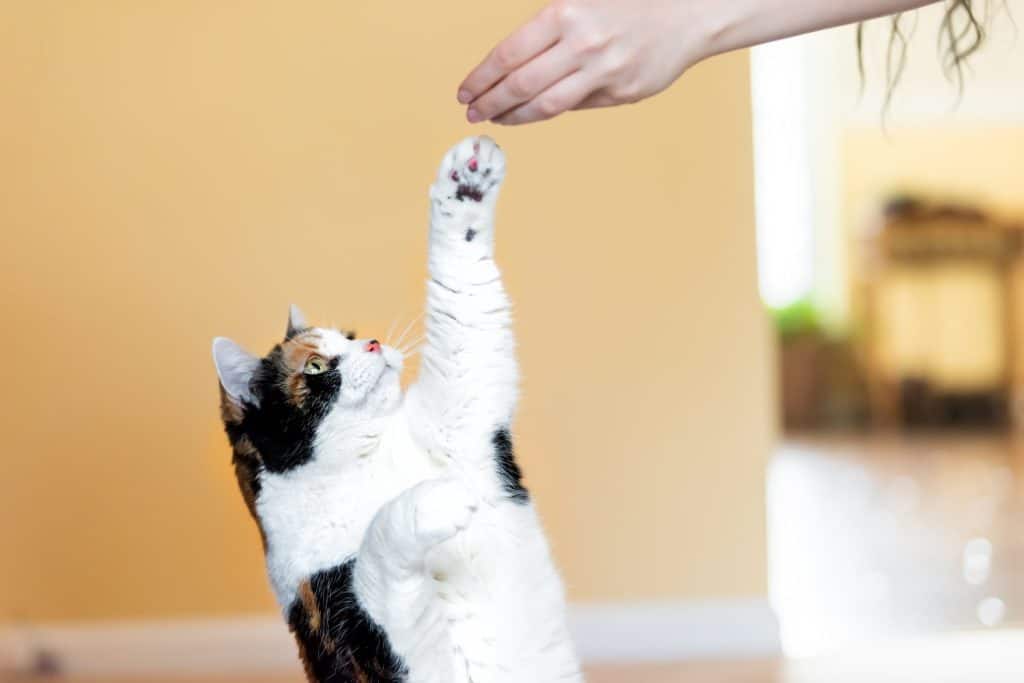
Cat treats act as a positive reinforcement for many felines.
©Andriy Blokhin/Shutterstock.com
Thankfully, you can experiment with other forms of positive reinforcement. As mentioned earlier, each cat is different and might crave different rewards.
“Before you start training your cat, you need to know what they’re willing to work for,” Alvey says. “If my clients aren’t sure what their cats like, I suggest running a treat trial where they offer a little bit of a few different treats at the same time and see what the cat chooses first. If the cat doesn’t get excited by food, maybe there is something else they love, something like brushing, or a favorite toy could be used.”
Be Specific
The more specific you get with your cues and tricks, the more quickly and easily your cat will pick up on it.
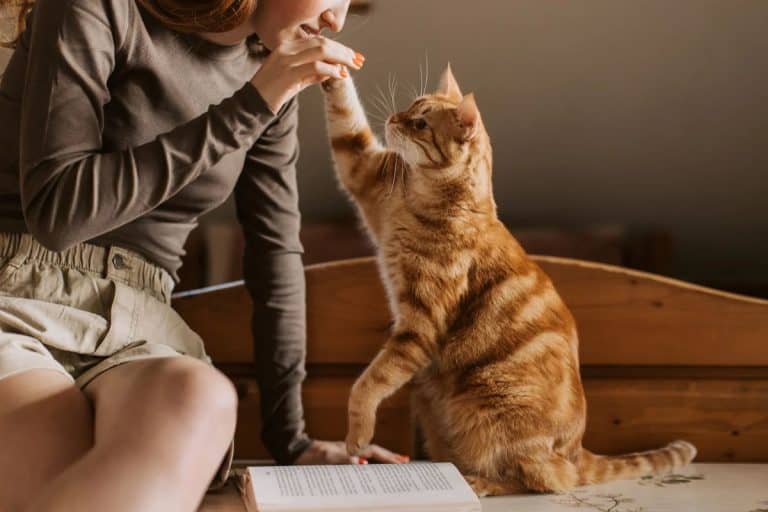
“Make sure your cat understands the behavior you want them to do: the more specific you are, the better,” says Lusvardi. “If they aren’t succeeding, make the training a bit easier for them or adjust what you’re asking them to do. For example, if you’re training your cat to high five you, present your hand on the ground instead of holding it up to start until your cat is reliably putting their paw in your hand. You can then work your way toward your final target behavior.”