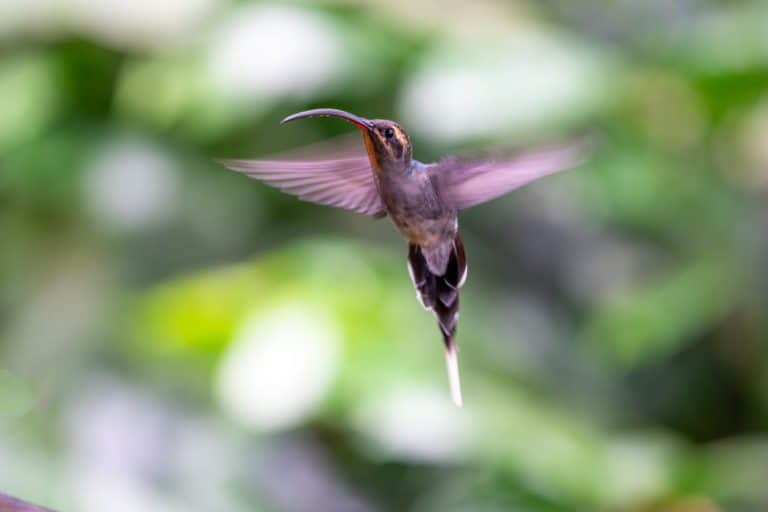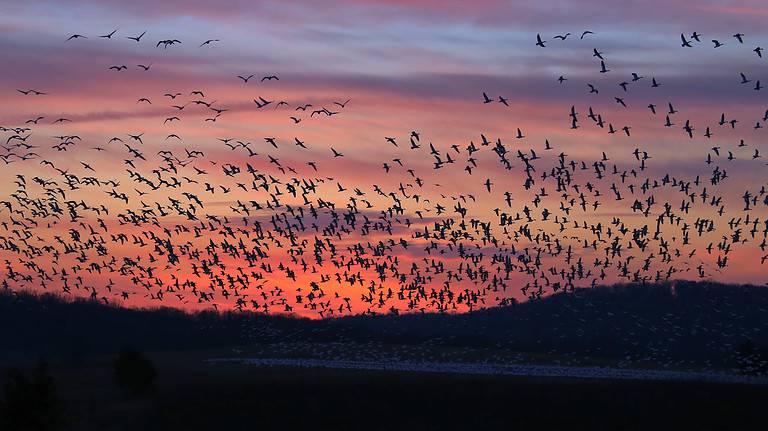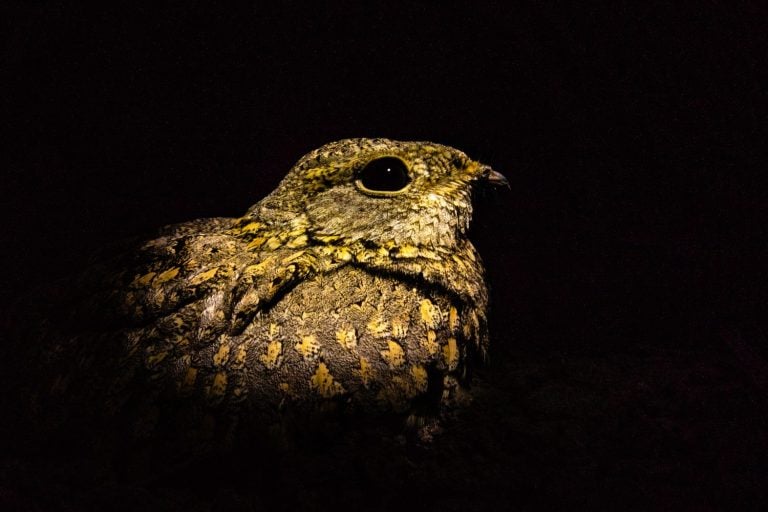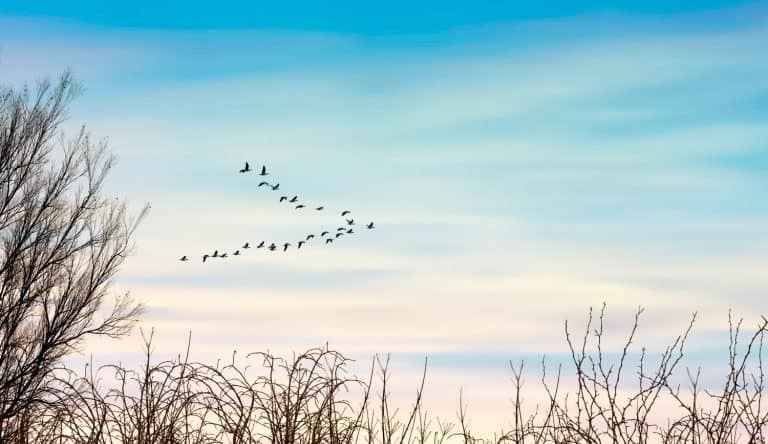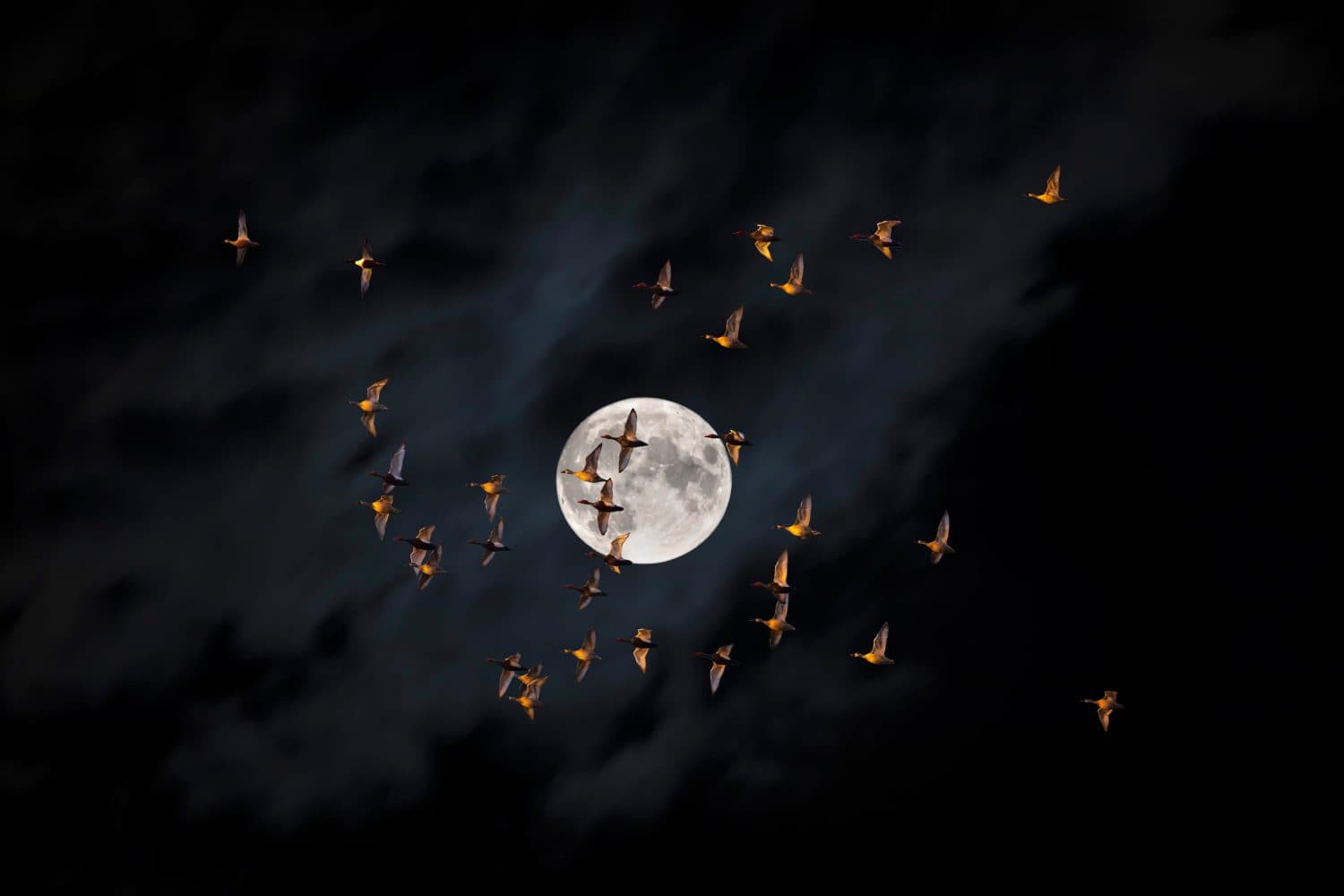

The millions of birds—encompassing almost 500 species—that migrate across North America every year undertake challenging journeys. They must cover hundreds to thousands of miles, find food and resting spots along the way, and recognize landmarks for orientation along their routes. Eighty percent of North American migratory birds travel at night, relying on the moon and stars for navigation—just as humans did before the invention of navigational tools like GPS. Now, with the night sky altered by the myriad human light sources, it’s losing its reliability for bird orientation. “Migration is very energetically expensive,” explains Audubon Coastal Biologist Lindsay Addison, “and anything that makes it less efficient or wastes birds’ energy can cause harm.”
What Is Light Pollution?

This image of Saudi Arabia and its surroundings shows the magnitude of night-time light pollution.
©Anton Balazh/Shutterstock.com
In the past, we could see a sky full of stars at night. Now, most people—especially those living in cities—see only a faint handful, because ‘skyglow’ (light scattered into the atmosphere) from artificial lights obscures our view of the stars. A citizen science study published in Science reports that from 2011-2022, the average night sky brightened by about 10% per year, which equates to a doubling of brightness every seven years. At that rate, “a child born in a place where 250 stars are visible will only be able to see 100 stars there on their 18th birthday,” writes James Asworth in a UK Natural History Museum article.
As early as the 1970s, scientists sounded the alarm that man-made light pollution was causing skyglow, as astronomers noted the increasing difficulty of finding a truly dark sky. The brighter Earth’s lights are at night, the more they hide the contrast between bright stars and space. Now, fifty years later, light pollution continues to increase, with recent studies showing a rise of about 2% per year in radiance and extent. In the Science article, the study authors noted that images taken from the International Space Station of Earth at night show the urban lights snaking across the planet. Skyglow is estimated to affect about 23% of the world’s land area.
Because wildlife evolved with natural cycles of daylight and darkness, the ever-increasing brightness of the night is disrupting long-established physiological adaptations and behavioral patterns.
Migration is very energetically expensive, and anything that makes it less efficient or wastes birds’ energy can cause harm.
Audubon Coastal Biologist Lindsay Addison
The Impacts on Birds
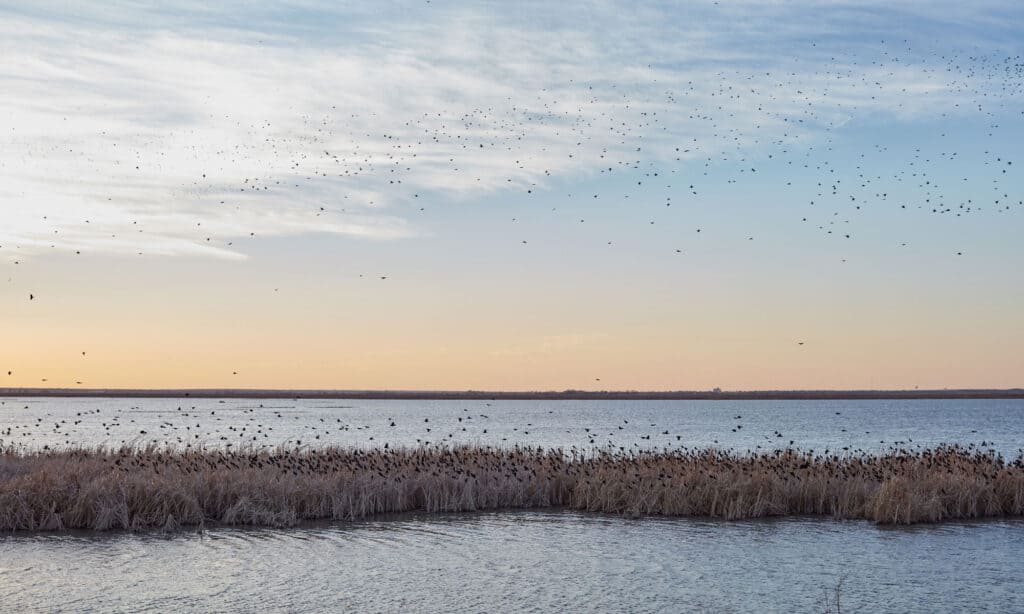
Cheyenne Bottoms, Kansas, is a key stopover for many migratory birds, including these blackbirds.
©iStock.com/Colby Lysne
During their exhausting journeys, birds make terrestrial stops to restore their energy through feeding and rest. Flocks of migratory birds use the same stopover areas across seasons and even decades.
In a recent study published in Nature Communications, researchers analyzed more than 10 million remote sensing observations of migratory birds and mapped their stopover behaviors. Skyglow was identified as a highly influential factor in predicting bird migration stopovers. For reasons not yet fully understood, birds that migrate at night are attracted to artificial lights, which may lure them into cities where they circle in confusion. “More directly, bird fatalities happen when birds either collide with buildings or waste energy flying around bright lights and become exhausted,” says Addison.
According to the study, migratory birds are also drawn to areas with higher forest cover, likely because of the shelter it provides. As net forest loss continues and urbanization increases, birds may expend more energy looking for rest stops and risk collapsing from exhaustion. A recent study published in Nature Communications found that city lights can draw birds away from high-quality forested stopover areas they need to refuel.
Ultimately, therefore, skyglow reduces birds’ abilities to find food, take shelter, and avoid predators along their historic migratory routes.
Why Should We Care?

Artificial lights also mess with our own natural cycles of sleep and wakefulness.
©iStock.com/Prostock-Studio
A secondary effect of birds experiencing increased stress in urban environments is disease transmission. Research conducted by the University of South Florida showed that house sparrows exposed to artificial light at night stayed infectious with West Nile Virus for twice as long, potentially increasing the risk of transmission to mosquitoes and therefore to humans.
Even aside from the impacts on migratory birds, we should be concerned about the direct effects of artificial lighting on humans. Like birds, we evolved with circadian rhythms of waking and sleeping that were timed with the natural dawns and dusks. Now, there’s evidence that our exposure to artificial lighting at night reduces our sleep quantity and quality, interfering with the production of the hormone melatonin. Because melatonin, produced by our pineal gland, regulates sleep, its suppression leads to poorer sleep.
In an online interview by DarkSky International, physiology researcher Cat Kennedy, who studies the cognitive and neurological effects of nighttime lights, says, “Melatonin is critically important, and that’s the biggest issue we’re seeing now with exposure to so much artificial light at night, as well as spending too much time in dim light during the day.”
What Are Cities Doing About Light Pollution?
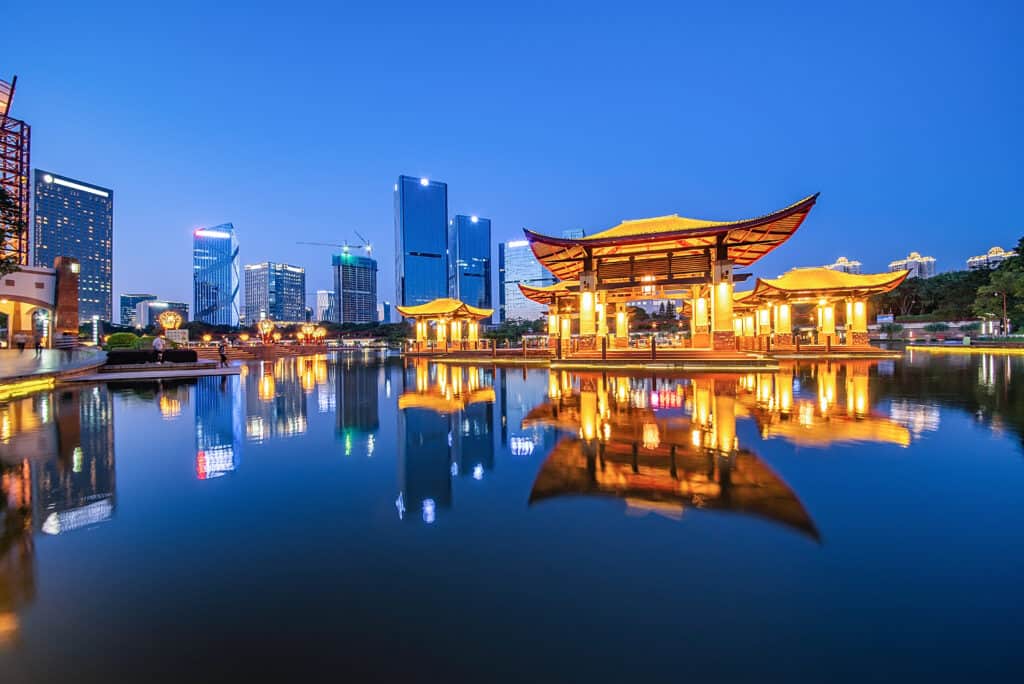
Even at night, the Central Business District of Foshan City, China, is blindingly bright.
©Lili.Q/Shutterstock.com
Many cities have implemented initiatives to reduce light pollution for birds and other wild animals. In Oregon, Portland’s Lights Out initiative encourages the owners of buildings and homes to turn off any unneeded overnight lighting at key times of year. On their website, they cite the top priority as “turning off exterior, ornamental, and rooftop architectural lighting.” That could be walkway lights around your home, decorative lights on a porch, or lit-up inflatables in a yard.
For buildings, the responsibility for reducing light pollution often falls on the building owners. For example, commercial buildings can turn off some or all of their neon signs at night, especially during late-night and early morning hours when fewer people are likely to see them. Buildings can schedule maintenance and cleaning during daytime hours to avoid having to keep the lights on at night.
What Can Individuals Do?

Other than essential lights, such as beacons for ship navigation, a dark nighttime is best for everyone.
©Angelito de Jesus/Shutterstock.com
We can all turn off any lights at night that we no longer need. For example, porch lighting may be useful for an outdoor dinner gathering, but it serves little purpose after you have gone to sleep. Indoor lights shining through windows can also disorient birds, so turn them off in rooms you’re not using.
If you prefer to keep your home well-lit, consider using blackout shades to reduce the amount of light that escapes through your windows. For outdoor lights, keep them close to the ground and use shielding to prevent the light from scattering upward. Consider using red or amber (longer wavelength) lights that are not as disorienting to birds. If you’re using LEDs, choose warm ones under a 3,000 Kelvin rating. On DarkSky, you can see which lighting products are approved for reducing light pollution.
However, even downward-facing “bird-friendly” lighting can still disrupt migrations. A recent study published in Integrative & Comparative Biology found that even low-rise, downward-facing artificial lights can affect the flight behavior of night-migrating land birds. Therefore, the best solution for migrating birds and other nocturnal wildlife is to turn off artificial lights at night. “Turning off lights—especially during the spring and fall—helps mitigate these threats,” says Addison.
In the unfortunate event that a bird does get trapped in an area because of disorientation from artificial lights, like on a porch, turn the lights off until it finds its way out. Pay special attention to reducing your light pollution during spring and fall migration seasons, when birds are most likely to be traveling to the critical destinations they rely on.
And, if you long to see the brilliance of stars against a dark sky, perhaps with some migratory birds silhouetted against the Moon, check out these Dark Sky Places during migration season.